Showing posts with label Mallard. Show all posts

Friday, December 17, 2021

Odds and Ends

      Winter has been a strange affair so far, with snow and relatively cold temperatures one day, followed by above freezing conditions day after day thereafter, with precipitation in the form of rain. The regular species  have been active at the feeders, including a very welcome Red-bellied Woodpecker (Melanerpes carolinus). 


     More often than not a male has graced us with his presence, so we were especially happy to see this female.

Saturday, November 27, 2021

Hillside Park with Waterloo Region Nature

     There are few things I enjoy more in life than leading a bird walk, and when I can do it under the auspices of my favourite naturalists club the pleasure is magnified.
     A group of enthusiastic participants took part in my two latest outings to Hillside Park in Waterloo. In the first contingent the youngest participant was seventeen months old and the oldest a mature eighty-three years. Birding does have its allure!

24 November 2021

Leader: David M. Gascoigne

Members: Miriam Bauman, Lynn Conway, Pauline Copleston, Lisa Den Besten, Beth Hobson, Jen Leat, Graham Macdonald, Marg Macdonald, Karl Malhotra, Geoff Moore, Heather Polan (with Lily), Pauline Richards, Rog Suffling, Kathy Waybrant, Andrew Wesolowski. 

Jen, Kathy, Karl, Lisa, Geoff, Beth, Pauline C, Marg, Rog. Graham, Pauline R, Lynn, Andrew, David

Wednesday, September 01, 2021

Lily, Birds, Frogs and Bugs

20 August 2021 
Waterloo Park, Waterloo, ON

     It was a warm morning even by eight o'clock and we decided to take Lily to Waterloo Park where she could enjoy the splash pad.
     The entire park is being renovated and improved and from what we see has the potential to be terrific. There is a remnant of an old small "zoo", with very few animals remaining, almost in the nature of a petting zoo. It was a first for Lily, but she took to it like a duck to a June bug.


     She was really delighted!


     After a session with the animals and a little walkabout, we headed to the splash pad. 


     Lily, who is now walking as you see, loved it!


     When it was time to go she didn't even put up a fuss.


     But the morning wasn't over. We all went to Vincenzo's, our favourite deli, where we sat at a table in the shade and had gelato. 
     Not a bad way to end off a morning if you ask me! And did you ever see a more beautiful couple than these two? I don't think I did.

22 August 2021
Columbia Lake, Waterloo, ON

     The weather has been too hot of late to do a whole lot of walking, but I made a visit to Columbia Lake. I barely saw or heard a songbird, so I suspect they were staying deep in the foliage away from the oppressive heat and humidity.
     A Great Egret (Ardea alba) no doubt remained somewhat cool by striding through the water whenever it felt the urge to do so.


     Can you identify the two species of gull?


     At the right in the picture above is a Caspian Tern (Hydroprogne caspia), seen in a little better detail below.


     It was impossible to get close enough to the birds for better shots.
     New England Aster (Symphyotrichum novae-angliae) is blooming prolifically across the region. 


      An Eastern Tailed Blue (Cupido comyntas) was very cooperative.


     A Northern Leopard Frog (Lithobates pipiens), a very handsome amphibian, was content to remain motionless in the grass.


24 August 2021
West Perth Wetlands, Mitchell, ON


It was the day for our Tuesday group to get together, but only Franc and Carol were able to make the trip to Mitchell to join Miriam and me.
     The early morning was pleasant, but the forecast was for a hot, sticky day, and by the time we left it was getting that way.
     Here you see quite easily the size differential between Killdeer ( Charadrius vociferus) and Least Sandpiper (Calidris minutilla).


     Let us never become blasĂ© about American Goldfinches (Spinus tristis). Common they may be, but they are also uncommonly beautiful.


     Guelder-rose (Viburnum opulus) makes a fine splash of colour on the landscape too.


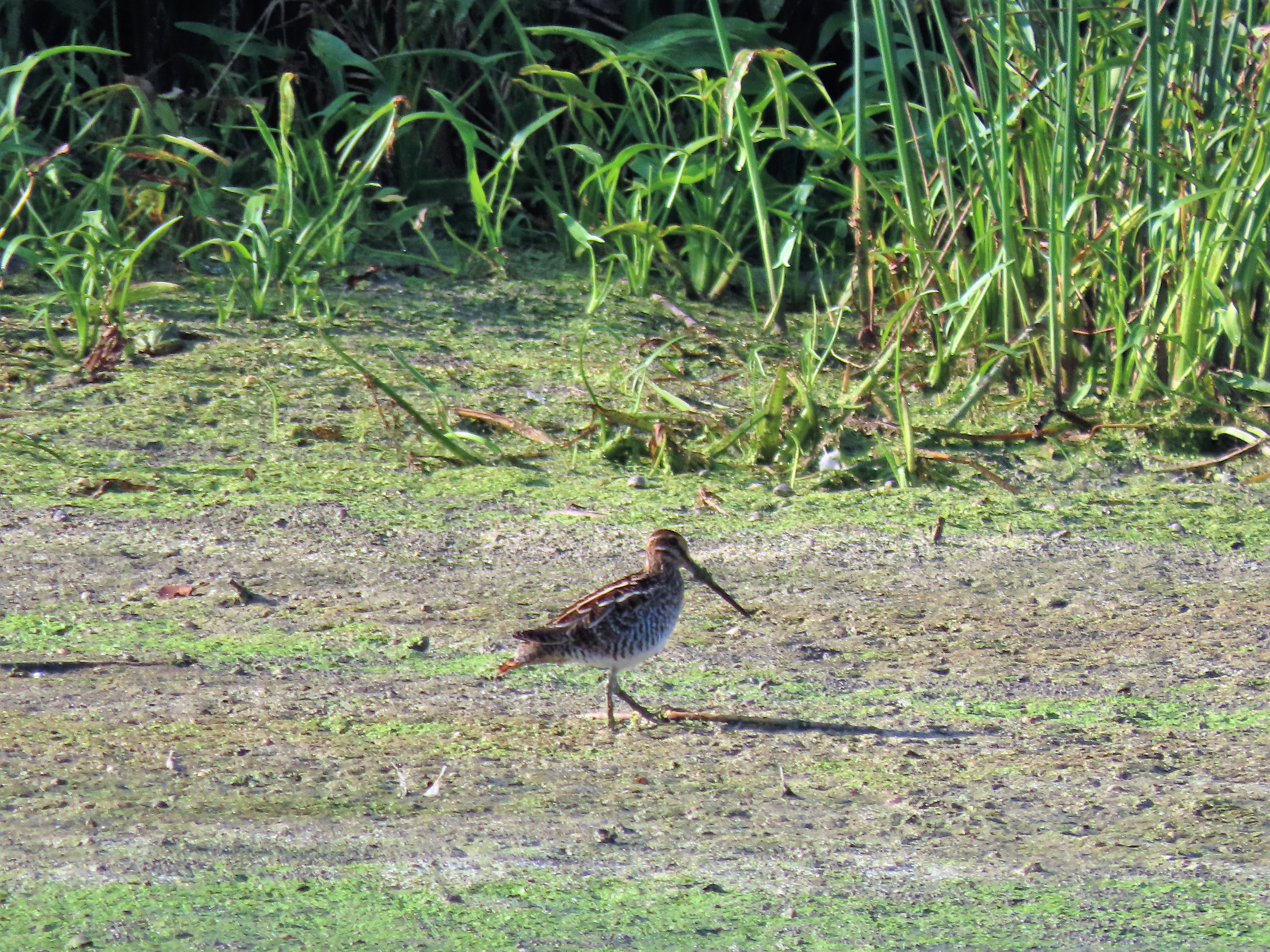
     A lone Wilsons Snipe (Gallinago delicata) was feeding frantically.


     Many of the trees and bushes have berries by now, and where there are berries, there are Cedar Waxwings (Bombycilla cedrorum).


     Greater Yellowlegs (Tringa melanoleuca) is always substantially outnumbered  by Lesser Yellowlegs (Tringa flavipes), but we did spot a few.


     Perhaps in the picture below of a Lesser Yellowlegs you can pick out some of the differences, other than size, between a Greater and Lesser Yellowlegs.


     There were several Green-winged Teal (Anas carolinensis) amongst the Mallards (Anas platyrynchos), all quite far out unfortunately, but this individual obligingly flashed its speculum for us.


     It was not hard to find a Monarch (Danaus plaxippus).


     This wetland is a place where we always expect to see substantial numbers of Wood Ducks (Aix sponsa), but we saw few on this occasion.


     No doubt many are concealed in the reeds, concerned for their safety pending the regrowth of their flight feathers.
     Several different species of dragons and damsels were present, but few condescended to perch for us.  Eastern Forktails (Ischnura verticalis) were a pleasing exception.


     There were hundreds of Mallards on the various ponds, many of them males resembling females. They have undergone complete moult, including all their flight feathers, and will rarely stray from the safety of the water during this period when escape from danger by flight is not an option. 


     Various species of Milkweed (Asclepias) are developing their signature seed pods.


     Soon the pods will burst open and seeds will be scattered by the wind.
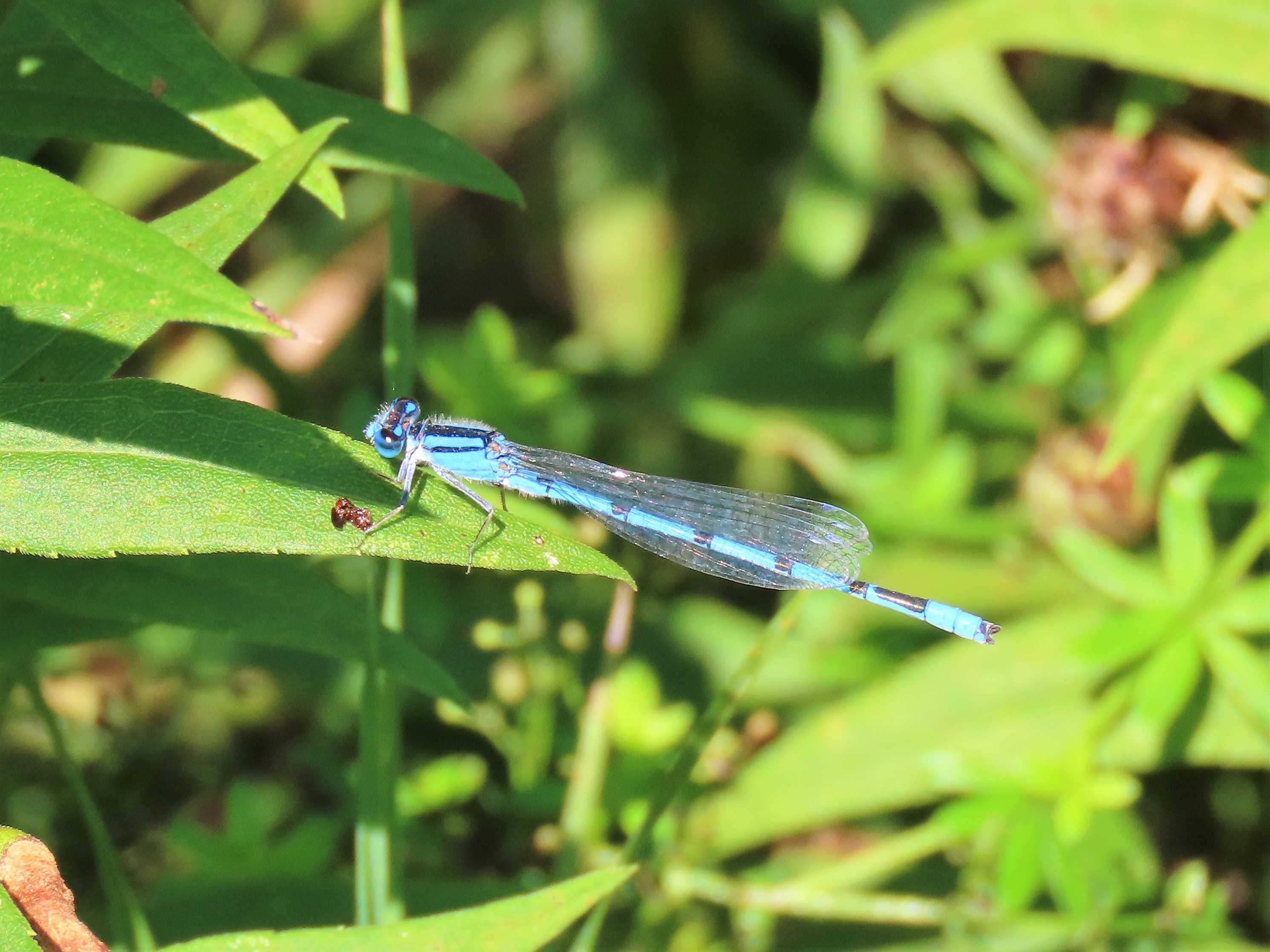
     Familiar Bluets (Enallagma civile) were as familiar as their name implies.


     Black-legged Meadow Katydids (Orchelimum nigripes) for the most part kept well ahead of us, but Miriam did manage this photograph.


     It is a striking insect as you may see.
     Yellow Garden Spider (Argiope aurantia) is a large and dramatic arachnid.


27 August 2021
Columbia Lake, Waterloo, ON

     It was a brutally hot day, but we thought it might be a little cooler near the water.
     From an avian perspective there was little to be seen that was different from my visit a few days earlier.

Lesser Yellowlegs
Least Sandpiper

Great Egret

Lesser Yellowlegs and Least Sandpipers

       It was exciting to discover the caterpillar of Bedstraw Hawk-moth (Hyles gallii), a formidable larva if ever I saw one!


27 August 2021
At home, Waterloo, ON

      We were sitting in the family room when Miriam spotted a "blotch" on the patio door. It turned out to be a Green Cloverworm Moth (Hypena scabra).


     A great way to end the day!

Friday, May 07, 2021

Still Close to Home


      The restrictions on movement imposed by the Provincial Government in response to COVID are in effect until 20 May, so at least for a while we will not be wandering far afield.

28 April 2021
Benjamin Park Trail, Waterloo, ON

     How fortunate we are to have this trail so close to our house. From our front door to the start of the trail is less than five minutes walk.
     Virginia Spring Beauty (Claytonia verginica) comes in both white and pink forms - absolutely stunning either way.


     I think you could set out in a dour mood and be instantly transformed as soon as you came across these very aptly named spring beauties.
     Black-and White Warbler (Mniotilta varia) is generally one of the earliest neotropical warblers to arrive back in southern Ontario and this year was no exception.


    It is a very appealing little bird and in many respects emulates our resident nuthatches as it clambers up and down trunks and branches, sometimes upside down, searching for spider eggs, insect larvae and other tasty treats.


     This individual entertained us for a few minutes before moving off to another section of the woods.


     Daffodils (family Amaryllidaceae) are common in woodlands, along highway verges and in meadows, and I am never quite sure how they got there and which species I am dealing with. They are incredibly attractive, and I am going with Wild Daffodil (Narcissus pseudonarcissus). 


     If any of my botanical friends care to offer further elucidation or correction, feel free to do so.
     Once again, I must own up to a little confusion. I am pretty sure that the blossom shown below is some kind of cherry (Genus Prunus) - but that is where my "educated" guess ends.


     I have no doubt that there are people reading this blog with far greater botanical knowledge than I, and help is eagerly sought and appreciated.
     Field Forget-me-not (Myosotis scorpioides) is familiar to all, and about this one I have no doubt.


01 May 2021
Benjamin Park Trail, Waterloo, ON

     White Trillium (Trillium grandiflorum) is beginning to bloom throughout the region and woodlands are carpeted with Ontario's Provincial Flower.


     Black-capped Chickadees (Poecile atricapillus) are eagerly seeking nest cavities in which to raise a family, and every potentially suitable hole needs to be thoroughly checked.


    A really close inspection is necessary.


     And if it looks good, it's time to start on some spring cleaning.


     Mourning Cloaks (Nymphalis antiopa) may still be commonly found flitting through any suitable stretch of woodland.


02 May 2021

Conservation Meadows Storm Water Management Area, Waterloo, ON

     Canada Geese (Branta canadensis) are breeding all over the region. Some protective males seem to prefer an elevated vantage point to exercise dominance over their breeding territory.


     The individual above flew down, making a great commotion, when a dog strayed too close to its partner on the nest.


     What the dog was doing off leash, wandering around at will, is another matter entirely.

Small wetland on Beaver Creek Road, Waterloo, ON

     I was all set to take a picture of a displaying Red-winged Blackbird (Agelaius phoeniceus), but by the time I pressed the button, it had left.
     The picture of the tree with its emerging leaves, however (Acer, sp), is quite delightful by itself.


Lakeside Park, Kitchener, ON

     Turtles of all types are emerging from their long hibernation beneath the mud, Midland Painted Turtles (Chrysemys picta marginata) among them.


     Families of Canada Geese are popping up everywhere.


     The geese at Lakeside Park are so habituated to the constant presence of humans they display no hostility even if you are quite close to their young.
     The goslings are the very epitome of cuteness.


     Marsh Marigolds (Caltha palustris), a personal favourite, are punctuating wetlands throughout the region.


     Blue Jays (Cyanocitta cristata) were abundant and noisy. It's hard to get an accurate count since it is always possible to tally the same bird twice as it moves around in the trees, but twenty might be a conservative estimate.


          There are many old trees with cavities suitable for nesting and this one looks as though a staircase has been constructed up to the front entrance.


     Miriam and I have not had especially good luck finding warblers this spring, so we were happy to come upon this male American Yellow Warbler (Setophaga aestiva) gleaning insects from the emerging leaves.


     A male Common Grackle (Quiscalus quiscula) seems to be elongating his body as much as possible,  to give the appearance of being bigger and more desirable to a passing female, one might surmise.


     Perhaps some enterprising young adventurers had ambitions for castaway survival when they started to build a shelter, but no doubt thought better of it and went home for dinner.


     This female duck had found a quiet place to rest, to escape the over-zealous attention of several males, perhaps.     


     It has all the features of a Mallard (Anas platyrynchos) x American Black Duck (Anas rubipres) hybrid.
     I am already accumulating pictures from several local walks for the next post, so stay tuned for more soon!


Land Acknowledgement

We acknowledge that the land on which we are situated are the lands traditionally used by the Haudenosaunee, Anishinaabe, and Neutral People. We also acknowledge the enduring presence and deep traditional knowledge, laws, and philosophies of the Indigenous Peoples with whom we share this land today. We are all treaty people with a responsibility to honour all our relations.

Followers