Showing posts with label Mourning Cloak. Show all posts

Thursday, April 07, 2022

Another Two Owls

     Following our good fortune in spending time with two owl species as reported in my last post, our owl success became even more notable with the sighting of two others.


4 April 2022


     The countryside of Waterloo Region is renowned for its wintering population of Snowy Owls (Bubo scandiacus) and over the years Miriam and I have had great success in locating many of these magnificent birds. 
     Most of them have probably already left our area to reoccupy their breeding grounds on the tundra, but a few remain. We were thrilled to see this individual perched on a fence post not far from the road.


     Obviously habituated to traffic it seemed quite unperturbed by us, and even when Miriam approached it with stealth and caution it showed no sign of apprehension.


     I think that even a person without prior knowledge of birds would be able to recognize a Snowy Owl; it is just so distinctive.
     Determining the sex of juvenile birds is not quite so simple, however. Based on experience, a plethora of reference books with many images, and my impression of the size of this bird, I am fairly sure it is a juvenile male. 
     As Scott Weidensaul, in his excellent Peterson Reference Guide to Owls of North America and the Caribbean points out, however, "Sexing Snowy Owls by plumage is considerably more complex and difficult than birders generally believe, and many previous assumptions about sex- and age-related plumage differences have proven to be unfounded or simplistic."
     Rest assured that young or old, male or female, pristine white, mottled or mesoptile, it is a bird to elevate the spirits. It might even make you contemplate the destruction we are wreaking on its habitat and spur you on to a more environmental conscience. Now that would be something to celebrate.

05 April, 2022

     There is a trail behind our house with which we have become very familiar, and have become adept at finding Eastern Screech Owls (Megascops asio) there.
     Unless sitting at the lip of their hole, they are usually well camouflaged, and for the uninitiated almost impossible to find.
     You will have to piece together all of the pictures below to get an impression of the complete owl!


     We were delighted to find the owl, akin to meeting up with an old friend.
     We also derived considerable pleasure from our first sighting of the year of Mourning Cloak (Nymphalis antiopa) and Eastern Comma (Polygonia comma).

Mourning Cloak
 

Eastern Comma

     They had better be vigilant. They would make a tasty snack for a hungry screech owl.
     Such is the way of nature!

Friday, May 07, 2021

Still Close to Home


      The restrictions on movement imposed by the Provincial Government in response to COVID are in effect until 20 May, so at least for a while we will not be wandering far afield.

28 April 2021
Benjamin Park Trail, Waterloo, ON

     How fortunate we are to have this trail so close to our house. From our front door to the start of the trail is less than five minutes walk.
     Virginia Spring Beauty (Claytonia verginica) comes in both white and pink forms - absolutely stunning either way.


     I think you could set out in a dour mood and be instantly transformed as soon as you came across these very aptly named spring beauties.
     Black-and White Warbler (Mniotilta varia) is generally one of the earliest neotropical warblers to arrive back in southern Ontario and this year was no exception.


    It is a very appealing little bird and in many respects emulates our resident nuthatches as it clambers up and down trunks and branches, sometimes upside down, searching for spider eggs, insect larvae and other tasty treats.


     This individual entertained us for a few minutes before moving off to another section of the woods.


     Daffodils (family Amaryllidaceae) are common in woodlands, along highway verges and in meadows, and I am never quite sure how they got there and which species I am dealing with. They are incredibly attractive, and I am going with Wild Daffodil (Narcissus pseudonarcissus). 


     If any of my botanical friends care to offer further elucidation or correction, feel free to do so.
     Once again, I must own up to a little confusion. I am pretty sure that the blossom shown below is some kind of cherry (Genus Prunus) - but that is where my "educated" guess ends.


     I have no doubt that there are people reading this blog with far greater botanical knowledge than I, and help is eagerly sought and appreciated.
     Field Forget-me-not (Myosotis scorpioides) is familiar to all, and about this one I have no doubt.


01 May 2021
Benjamin Park Trail, Waterloo, ON

     White Trillium (Trillium grandiflorum) is beginning to bloom throughout the region and woodlands are carpeted with Ontario's Provincial Flower.


     Black-capped Chickadees (Poecile atricapillus) are eagerly seeking nest cavities in which to raise a family, and every potentially suitable hole needs to be thoroughly checked.


    A really close inspection is necessary.


     And if it looks good, it's time to start on some spring cleaning.


     Mourning Cloaks (Nymphalis antiopa) may still be commonly found flitting through any suitable stretch of woodland.


02 May 2021

Conservation Meadows Storm Water Management Area, Waterloo, ON

     Canada Geese (Branta canadensis) are breeding all over the region. Some protective males seem to prefer an elevated vantage point to exercise dominance over their breeding territory.


     The individual above flew down, making a great commotion, when a dog strayed too close to its partner on the nest.


     What the dog was doing off leash, wandering around at will, is another matter entirely.

Small wetland on Beaver Creek Road, Waterloo, ON

     I was all set to take a picture of a displaying Red-winged Blackbird (Agelaius phoeniceus), but by the time I pressed the button, it had left.
     The picture of the tree with its emerging leaves, however (Acer, sp), is quite delightful by itself.


Lakeside Park, Kitchener, ON

     Turtles of all types are emerging from their long hibernation beneath the mud, Midland Painted Turtles (Chrysemys picta marginata) among them.


     Families of Canada Geese are popping up everywhere.


     The geese at Lakeside Park are so habituated to the constant presence of humans they display no hostility even if you are quite close to their young.
     The goslings are the very epitome of cuteness.


     Marsh Marigolds (Caltha palustris), a personal favourite, are punctuating wetlands throughout the region.


     Blue Jays (Cyanocitta cristata) were abundant and noisy. It's hard to get an accurate count since it is always possible to tally the same bird twice as it moves around in the trees, but twenty might be a conservative estimate.


          There are many old trees with cavities suitable for nesting and this one looks as though a staircase has been constructed up to the front entrance.


     Miriam and I have not had especially good luck finding warblers this spring, so we were happy to come upon this male American Yellow Warbler (Setophaga aestiva) gleaning insects from the emerging leaves.


     A male Common Grackle (Quiscalus quiscula) seems to be elongating his body as much as possible,  to give the appearance of being bigger and more desirable to a passing female, one might surmise.


     Perhaps some enterprising young adventurers had ambitions for castaway survival when they started to build a shelter, but no doubt thought better of it and went home for dinner.


     This female duck had found a quiet place to rest, to escape the over-zealous attention of several males, perhaps.     


     It has all the features of a Mallard (Anas platyrynchos) x American Black Duck (Anas rubipres) hybrid.
     I am already accumulating pictures from several local walks for the next post, so stay tuned for more soon!


Saturday, March 27, 2021

Lily and Other Beauties

      I know that many of you look forward to regular updates on our darling Lily, so here are a few shots from our latest walk.


     What a happy face!
     At least until mom tried to put on her sunglasses. However, once they were in place she seemed to forget they were even there.


     How about those teeth? She still has only two, but I suspect there are more to follow soon.


     She was happy to be out in bright sunshine, alert to everything going on around her. Having developed a special affection for dogs she follows each one and chats to them excitedly!
     We always take a picture of Heather and Lily as they are about to leave. Two beautiful young ladies if ever there were!


     It is always cause for elation and excitement to have a new bird visit the yard, so we were delighted to have an Eastern Towhee (Pipilo erythrophthalmus) pay us a very brief visit. Despite searching frequently since, it has not been seen again.
     Miriam did manage to get one reasonable picture through the bedroom window. It does not show the whole unobstructed bird unfortunately, but it was the best we could do.


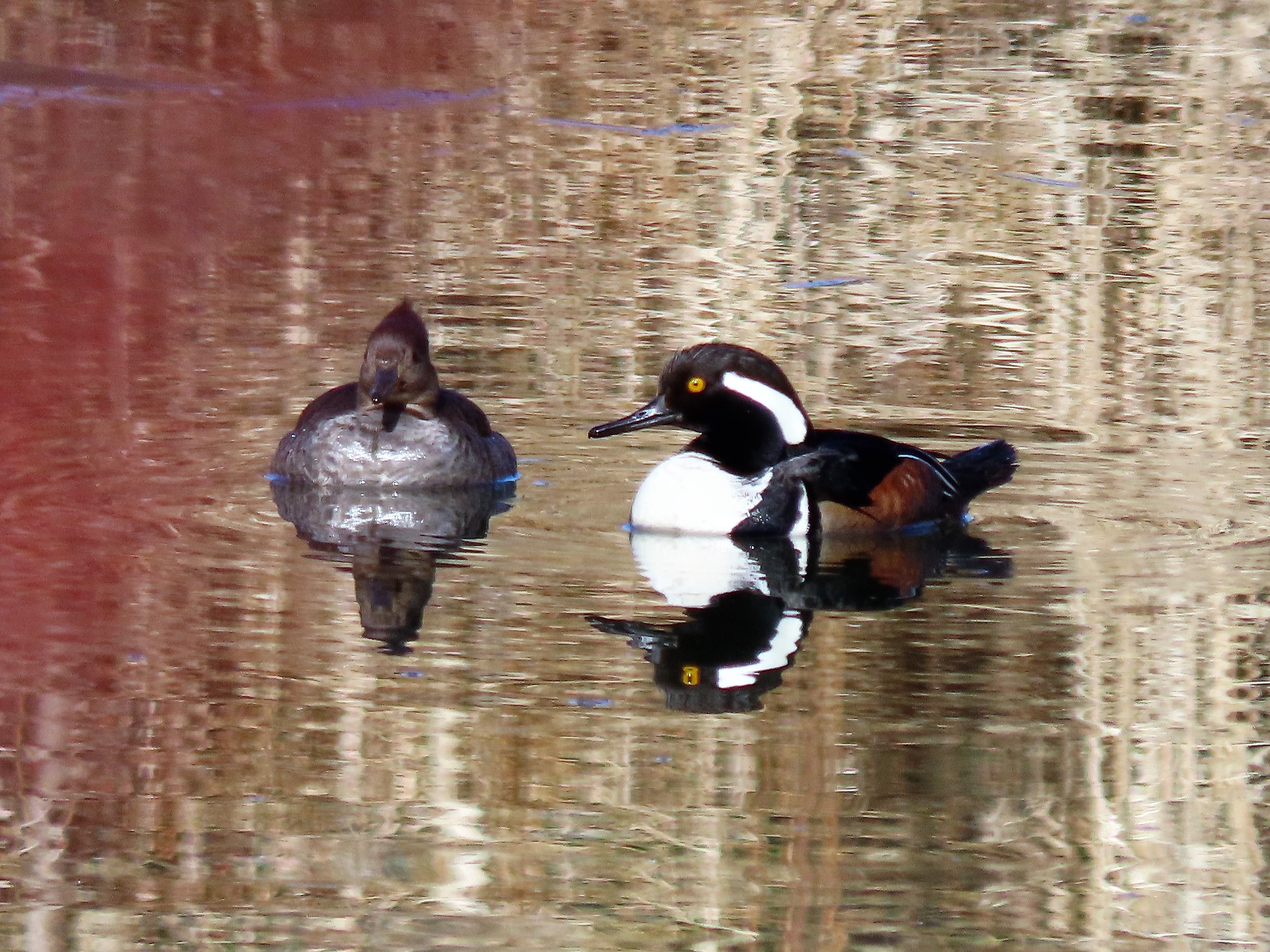
     Last Sunday we had our first COVID-19 vaccination and on the way to the clinic we stopped at a storm water management pond where a pair of Hooded Mergansers (Lophodytes cucullatus) were keeping company.


     It is such a handsome little duck. The hairdo on the female would rival Lily's earlier unruly coiffure!

     At SpruceHaven we saw our first Compton Tortoiseshell (Nymphalis l-album) of the spring. 


     The picture is lacking to say the least, but I don't even have another picture on file, so I present you with our only image of this species. To her credit Miriam followed this insect around for several minutes but it would touch down for only the briefest of moments. She did well to capture what she did.
     Three male Eastern Bluebirds (Sialia sialis) have returned to SpruceHaven, right on schedule, but in terms of posing for pictures they were barely more acquiescent than the butterfly.


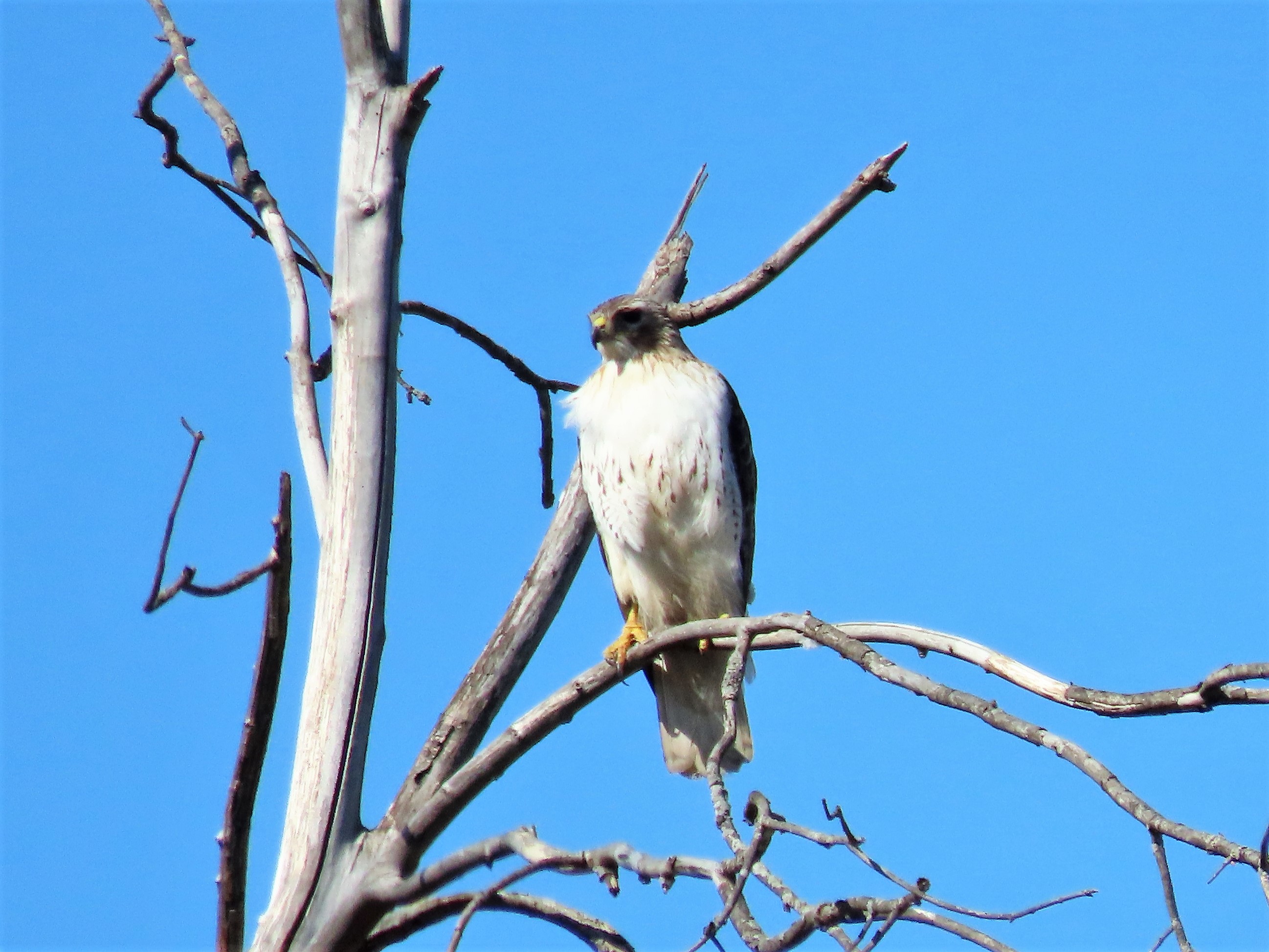
     On the way home we spotted an unusually pale Red-tailed Hawk (Buteo jamaicensis). Finally a willing accomplice in having a picture taken!

     It was very muddy along the Benjamin Park Trail when we went for a walk, not unexpected of course given the warm temperatures of late and the rapid snowmelt.


     Buds are popping everywhere.


     An Eastern Comma (Polygonia comma) fluttered and teased us, but finally landed and we were able to capture an image for posterity.


     Already, so soon after emerging, the right wing looks a little worse for wear.
     Mourning Cloaks (Nymphalis antiopia), always one of the earliest butterflies of the spring, were seen several times, but declined to tarry a while, and went on their way.
     The following picture was taken on the same trail in a previous year, so it is authentic and shows this handsome species well.


     Each day holds the potential for recent arrivals at this time of the year. We'll see what the next post brings.

Land Acknowledgement

We acknowledge that the land on which we are situated are the lands traditionally used by the Haudenosaunee, Anishinaabe, and Neutral People. We also acknowledge the enduring presence and deep traditional knowledge, laws, and philosophies of the Indigenous Peoples with whom we share this land today. We are all treaty people with a responsibility to honour all our relations.

Followers