Showing posts with label Marsh Marigold. Show all posts

Friday, May 07, 2021

Still Close to Home


      The restrictions on movement imposed by the Provincial Government in response to COVID are in effect until 20 May, so at least for a while we will not be wandering far afield.

28 April 2021
Benjamin Park Trail, Waterloo, ON

     How fortunate we are to have this trail so close to our house. From our front door to the start of the trail is less than five minutes walk.
     Virginia Spring Beauty (Claytonia verginica) comes in both white and pink forms - absolutely stunning either way.


     I think you could set out in a dour mood and be instantly transformed as soon as you came across these very aptly named spring beauties.
     Black-and White Warbler (Mniotilta varia) is generally one of the earliest neotropical warblers to arrive back in southern Ontario and this year was no exception.


    It is a very appealing little bird and in many respects emulates our resident nuthatches as it clambers up and down trunks and branches, sometimes upside down, searching for spider eggs, insect larvae and other tasty treats.


     This individual entertained us for a few minutes before moving off to another section of the woods.


     Daffodils (family Amaryllidaceae) are common in woodlands, along highway verges and in meadows, and I am never quite sure how they got there and which species I am dealing with. They are incredibly attractive, and I am going with Wild Daffodil (Narcissus pseudonarcissus). 


     If any of my botanical friends care to offer further elucidation or correction, feel free to do so.
     Once again, I must own up to a little confusion. I am pretty sure that the blossom shown below is some kind of cherry (Genus Prunus) - but that is where my "educated" guess ends.


     I have no doubt that there are people reading this blog with far greater botanical knowledge than I, and help is eagerly sought and appreciated.
     Field Forget-me-not (Myosotis scorpioides) is familiar to all, and about this one I have no doubt.


01 May 2021
Benjamin Park Trail, Waterloo, ON

     White Trillium (Trillium grandiflorum) is beginning to bloom throughout the region and woodlands are carpeted with Ontario's Provincial Flower.


     Black-capped Chickadees (Poecile atricapillus) are eagerly seeking nest cavities in which to raise a family, and every potentially suitable hole needs to be thoroughly checked.


    A really close inspection is necessary.


     And if it looks good, it's time to start on some spring cleaning.


     Mourning Cloaks (Nymphalis antiopa) may still be commonly found flitting through any suitable stretch of woodland.


02 May 2021

Conservation Meadows Storm Water Management Area, Waterloo, ON

     Canada Geese (Branta canadensis) are breeding all over the region. Some protective males seem to prefer an elevated vantage point to exercise dominance over their breeding territory.


     The individual above flew down, making a great commotion, when a dog strayed too close to its partner on the nest.


     What the dog was doing off leash, wandering around at will, is another matter entirely.

Small wetland on Beaver Creek Road, Waterloo, ON

     I was all set to take a picture of a displaying Red-winged Blackbird (Agelaius phoeniceus), but by the time I pressed the button, it had left.
     The picture of the tree with its emerging leaves, however (Acer, sp), is quite delightful by itself.


Lakeside Park, Kitchener, ON

     Turtles of all types are emerging from their long hibernation beneath the mud, Midland Painted Turtles (Chrysemys picta marginata) among them.


     Families of Canada Geese are popping up everywhere.


     The geese at Lakeside Park are so habituated to the constant presence of humans they display no hostility even if you are quite close to their young.
     The goslings are the very epitome of cuteness.


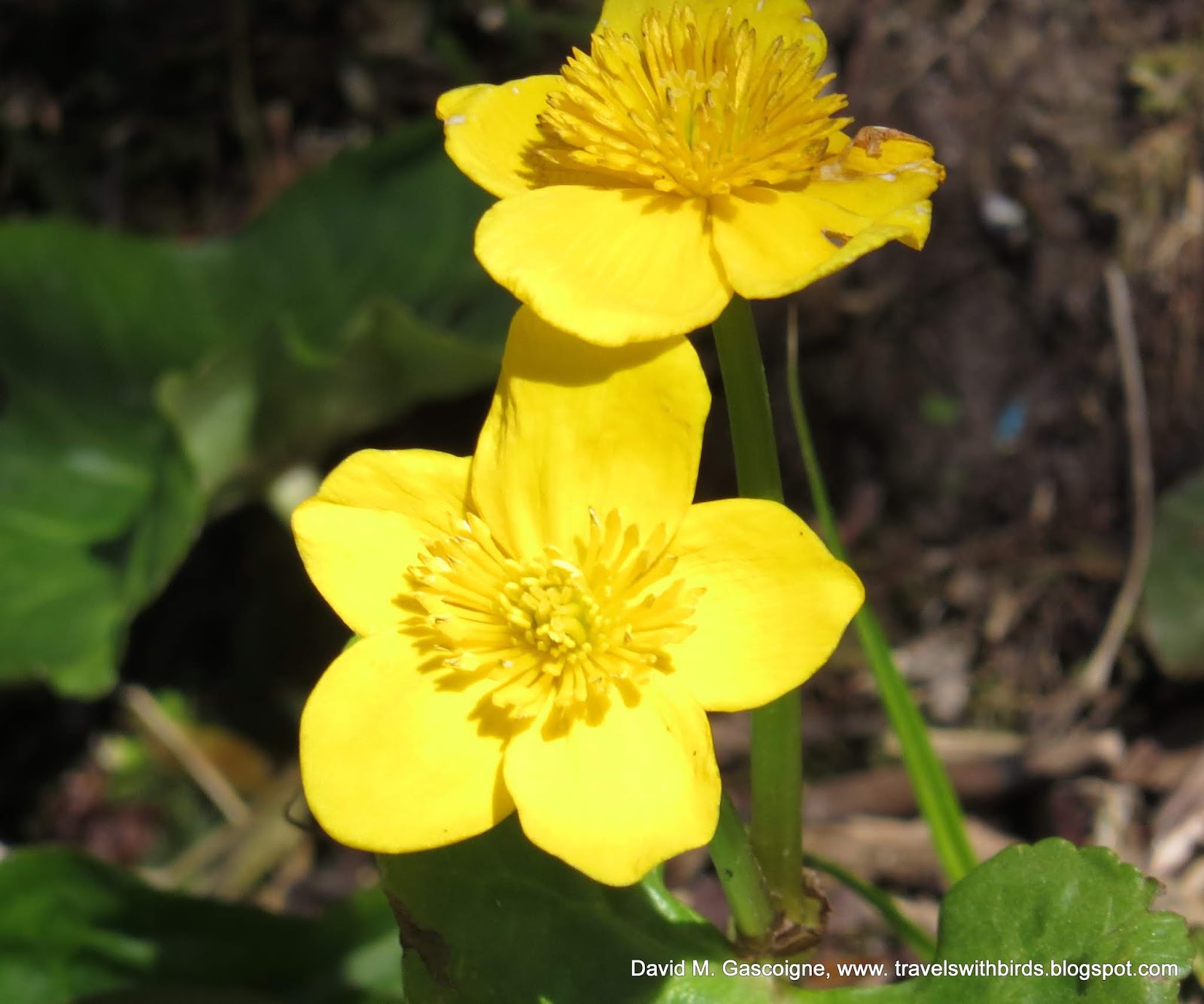
     Marsh Marigolds (Caltha palustris), a personal favourite, are punctuating wetlands throughout the region.


     Blue Jays (Cyanocitta cristata) were abundant and noisy. It's hard to get an accurate count since it is always possible to tally the same bird twice as it moves around in the trees, but twenty might be a conservative estimate.


          There are many old trees with cavities suitable for nesting and this one looks as though a staircase has been constructed up to the front entrance.


     Miriam and I have not had especially good luck finding warblers this spring, so we were happy to come upon this male American Yellow Warbler (Setophaga aestiva) gleaning insects from the emerging leaves.


     A male Common Grackle (Quiscalus quiscula) seems to be elongating his body as much as possible,  to give the appearance of being bigger and more desirable to a passing female, one might surmise.


     Perhaps some enterprising young adventurers had ambitions for castaway survival when they started to build a shelter, but no doubt thought better of it and went home for dinner.


     This female duck had found a quiet place to rest, to escape the over-zealous attention of several males, perhaps.     


     It has all the features of a Mallard (Anas platyrynchos) x American Black Duck (Anas rubipres) hybrid.
     I am already accumulating pictures from several local walks for the next post, so stay tuned for more soon!


Thursday, May 14, 2020

The Past Few Days

11 May 2020
Our Backyard

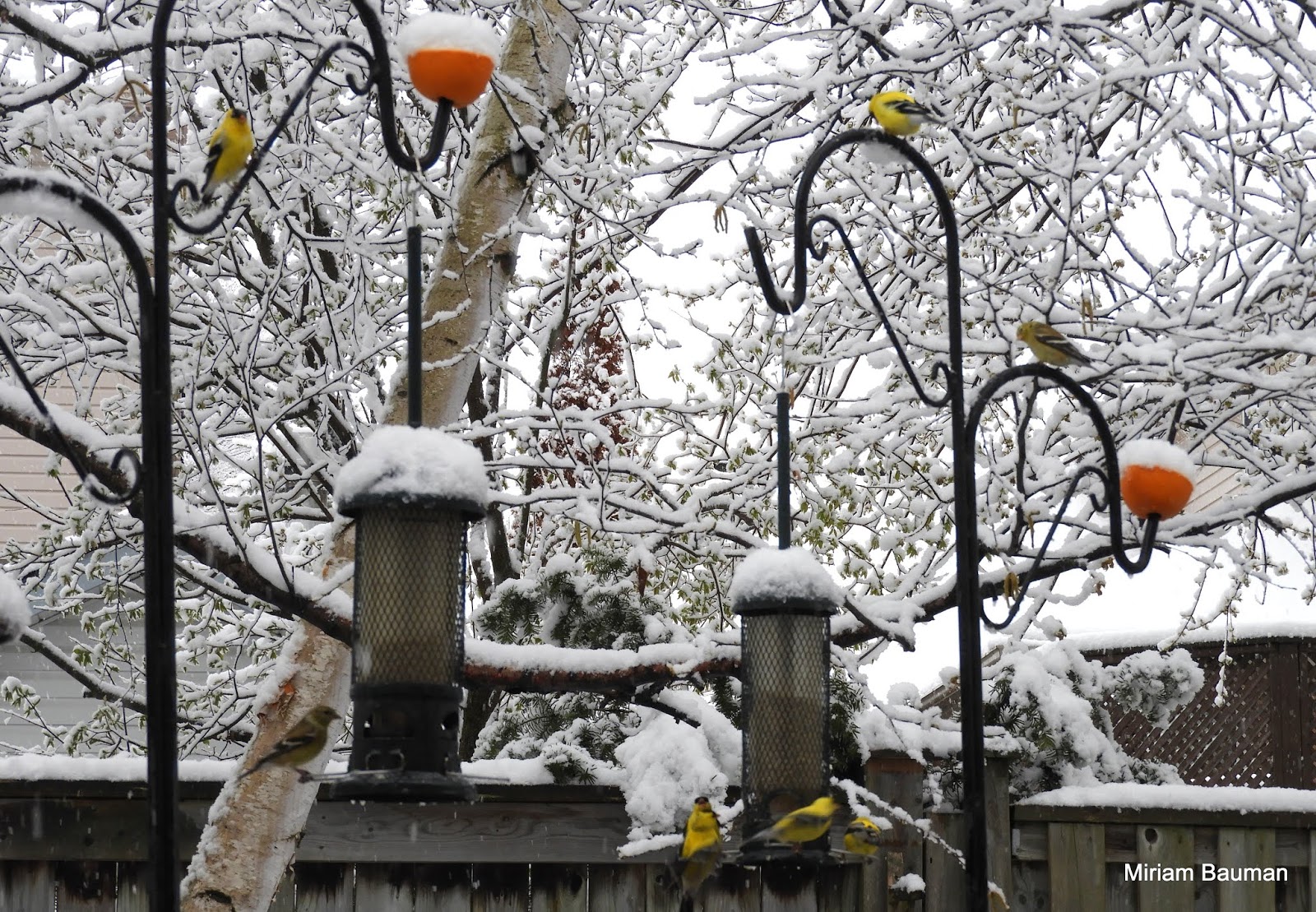
     One might be forgiven for going off the deep end when you see what we awoke to.


     Snow on 11 May is a cruel joke to say the least. This was not just a light dusting, mark you, it was a serious amount of snow. Cold, wet, white, unkind snow.  One does not expect to see the oranges set out for Baltimore Orioles (Icterus galbula) have a topping of white.
     American Goldfinches (Spinus tristis) are with us all year, and seemed unfazed by the strange weather.


     There are some who might be inclined to say it looks pretty. Count me not among them! It is very pretty in January, delightful even; in May it is an abomination.


     Perhaps these House Finches (Haemorhous mexicanus) found a ready supply of food especially welcome this morning.


     The first Rose-breasted Grosbeak (Pheucticus ludovicianus), a male, to visit our yard this spring, must have been equally dismayed at the unreasonableness of it all.


     At least breakfast was laid on for him.
     This was certainly not a morning for coffee on the deck for his human benefactors.


13 May 2020
Killbear Storm Water Management Area

     There are several storm water management ponds in the area, all now grandly named, and there are three that I check regularly. It is quite amazing how these miniscule artificial wetlands become magnets for birds and I have seen a wide range of species on and about them. I shudder to think about the quality of the water but dabbling ducks feed on a regular basis and on all three ponds Canada Geese (Branta canadensis) have raised young this year.
     It was not a bird, however, that attracted my attention this time; it was a flower. There were two tiny stands of Marsh Marigold (Caltha palustris), a vivid gash of colour against the sombre bank. The one I could get to was a single plant, and the other across the pond seemed barely more.


     How wonderful to see nature reclaim these spaces. I am not sure how this plant is propagated, whether the seeds are wind borne, or carried in on the feathers or feet of a bird, or in the fur of a mammal, but however it is accomplished the result is exhilarating. I was elated to discover this floral gem. 

13 May 2020
Benjamin Park Trail, Waterloo, ON

     It was still cool for the time of year, but bright and sunny, and Miriam and I decided to go for a walk.
     Ruby-crowned Kinglets (Regulus calendula) were hopping around in their trademark frantic way, gleaning insects from branches and leaves.


     As you may see in the picture below many of the trees have still not leafed out and there is more than a vestige of winter in the landscape.


     I was keen to take pictures of the carpet of Trilliums (Trillium grandiflorum) for Marit, but the carpet is more like a series of throw rugs, and some of the flowers are still not open.


     The open blooms are gorgeous, however, and one of the signature pleasures of Ontario woodlands.


     May-apple (Podophylum peltatum) is thrusting through the soil all over the place.


     There were few birds, but we did see both Swainson's Thrush (Catharus ustulatus) and Hermit Thrush (Catharus guttatus). The Swainson's Thrush was deep in the undergrowth and impossible to photograph, but the Hermit Thrush was a little more visible.


      In the picture below you can see the diagnostic rufous tail which the bird raises every time it alights.


     A lone female Mallard seemed content to poke around in the creek, no doubt finding food aplenty.


14 May 2020
Our Backyard

     This morning was quite remarkable as there was a flurry of birds in constant motion, and it has continued unabated all day so far.
     The account you are about to read involves the scene before 08h:00.
     Apart from the birds a large Eastern Cottontail (Sylvilagus floridanus) sat contentedly on the patio. Perhaps it had been in the backyard all night.


     It goes without saying that Grey Squirrels (Sciurus carolinensis) were in attendance too, devising new ways to drive me crazy no doubt!


     Three Baltimore Orioles (Icterus galbula), two males and a female, visited the oranges set out for them.


     Common Grackles (Quisculus quiscula) strutted and postured, ever handsome and confident, swaggering ostentatiously and putting rout to any squirrel that approached a little too close.


     A tiny Chipping Sparrow (Spizella passerina) was content to watch the goings on below, descending once in a while to snatch a seed that had been knocked out of the feeders by others.


     Mourning Doves (Zenaida macroura) are always among the first birds to arrive, sometimes even just before daylight, and this morning was no exception.


     A pair of Rose-breasted Grosbeaks made sure that they got their share of seed before moving on.


     Two or three American Robins (Turdus migratorius) visit our yard every day, taking advantage of invertebrate prey as well as the ready supply of sunflower hearts knocked to the ground by messy goldfinches.


     Curiously, we have been receiving regular visits from three House Finches, two males and a female. They often arrive together and there seems to be no animosity between the two males. When they have fed they leave together too.


     Blue Jays (Cyanocitta cristata) generally fly in directly, feed, and leave. Even the grackles don't mess with a Blue Jay!


     White-crowned Sparrows (Zonotrichia leucophrys) are still hanging in, fattening up on the way to their northern breeding grounds.


     White-throated Sparrow (Zonotrichia albicollis) on the other hand breeds locally, and perhaps the birds in our backyard have already gone as far as they are  about to go.


     American Goldfinch is the undisputed champion of our backyard birds. It visits in large numbers, and it is rare to look outside and not see several of them at the feeders and dotted throughout the trees. They are enchanting little birds and we delight in seeing them ever day.


     When you really stop to think about it, being kept close to home due to Covid-19 is not really so bad after all.

Bird species seen before 08h:00 - Mourning Dove, Downy Woodpecker, Blue Jay, American Crow, Black-capped Chickadee, American Robin, House Finch, American Goldfinch, Chipping Sparrow, White-crowned Sparrow, White-throated Sparrow, Baltimore Oriole, Common Grackle, Northern Cardinal, Rose-breasted Grosbeak.

Land Acknowledgement

We acknowledge that the land on which we are situated are the lands traditionally used by the Haudenosaunee, Anishinaabe, and Neutral People. We also acknowledge the enduring presence and deep traditional knowledge, laws, and philosophies of the Indigenous Peoples with whom we share this land today. We are all treaty people with a responsibility to honour all our relations.

Followers