Showing posts with label Eastern Comma. Show all posts

Thursday, April 07, 2022

Another Two Owls

     Following our good fortune in spending time with two owl species as reported in my last post, our owl success became even more notable with the sighting of two others.


4 April 2022


     The countryside of Waterloo Region is renowned for its wintering population of Snowy Owls (Bubo scandiacus) and over the years Miriam and I have had great success in locating many of these magnificent birds. 
     Most of them have probably already left our area to reoccupy their breeding grounds on the tundra, but a few remain. We were thrilled to see this individual perched on a fence post not far from the road.


     Obviously habituated to traffic it seemed quite unperturbed by us, and even when Miriam approached it with stealth and caution it showed no sign of apprehension.


     I think that even a person without prior knowledge of birds would be able to recognize a Snowy Owl; it is just so distinctive.
     Determining the sex of juvenile birds is not quite so simple, however. Based on experience, a plethora of reference books with many images, and my impression of the size of this bird, I am fairly sure it is a juvenile male. 
     As Scott Weidensaul, in his excellent Peterson Reference Guide to Owls of North America and the Caribbean points out, however, "Sexing Snowy Owls by plumage is considerably more complex and difficult than birders generally believe, and many previous assumptions about sex- and age-related plumage differences have proven to be unfounded or simplistic."
     Rest assured that young or old, male or female, pristine white, mottled or mesoptile, it is a bird to elevate the spirits. It might even make you contemplate the destruction we are wreaking on its habitat and spur you on to a more environmental conscience. Now that would be something to celebrate.

05 April, 2022

     There is a trail behind our house with which we have become very familiar, and have become adept at finding Eastern Screech Owls (Megascops asio) there.
     Unless sitting at the lip of their hole, they are usually well camouflaged, and for the uninitiated almost impossible to find.
     You will have to piece together all of the pictures below to get an impression of the complete owl!


     We were delighted to find the owl, akin to meeting up with an old friend.
     We also derived considerable pleasure from our first sighting of the year of Mourning Cloak (Nymphalis antiopa) and Eastern Comma (Polygonia comma).

Mourning Cloak
 

Eastern Comma

     They had better be vigilant. They would make a tasty snack for a hungry screech owl.
     Such is the way of nature!

Saturday, March 27, 2021

Lily and Other Beauties

      I know that many of you look forward to regular updates on our darling Lily, so here are a few shots from our latest walk.


     What a happy face!
     At least until mom tried to put on her sunglasses. However, once they were in place she seemed to forget they were even there.


     How about those teeth? She still has only two, but I suspect there are more to follow soon.


     She was happy to be out in bright sunshine, alert to everything going on around her. Having developed a special affection for dogs she follows each one and chats to them excitedly!
     We always take a picture of Heather and Lily as they are about to leave. Two beautiful young ladies if ever there were!


     It is always cause for elation and excitement to have a new bird visit the yard, so we were delighted to have an Eastern Towhee (Pipilo erythrophthalmus) pay us a very brief visit. Despite searching frequently since, it has not been seen again.
     Miriam did manage to get one reasonable picture through the bedroom window. It does not show the whole unobstructed bird unfortunately, but it was the best we could do.


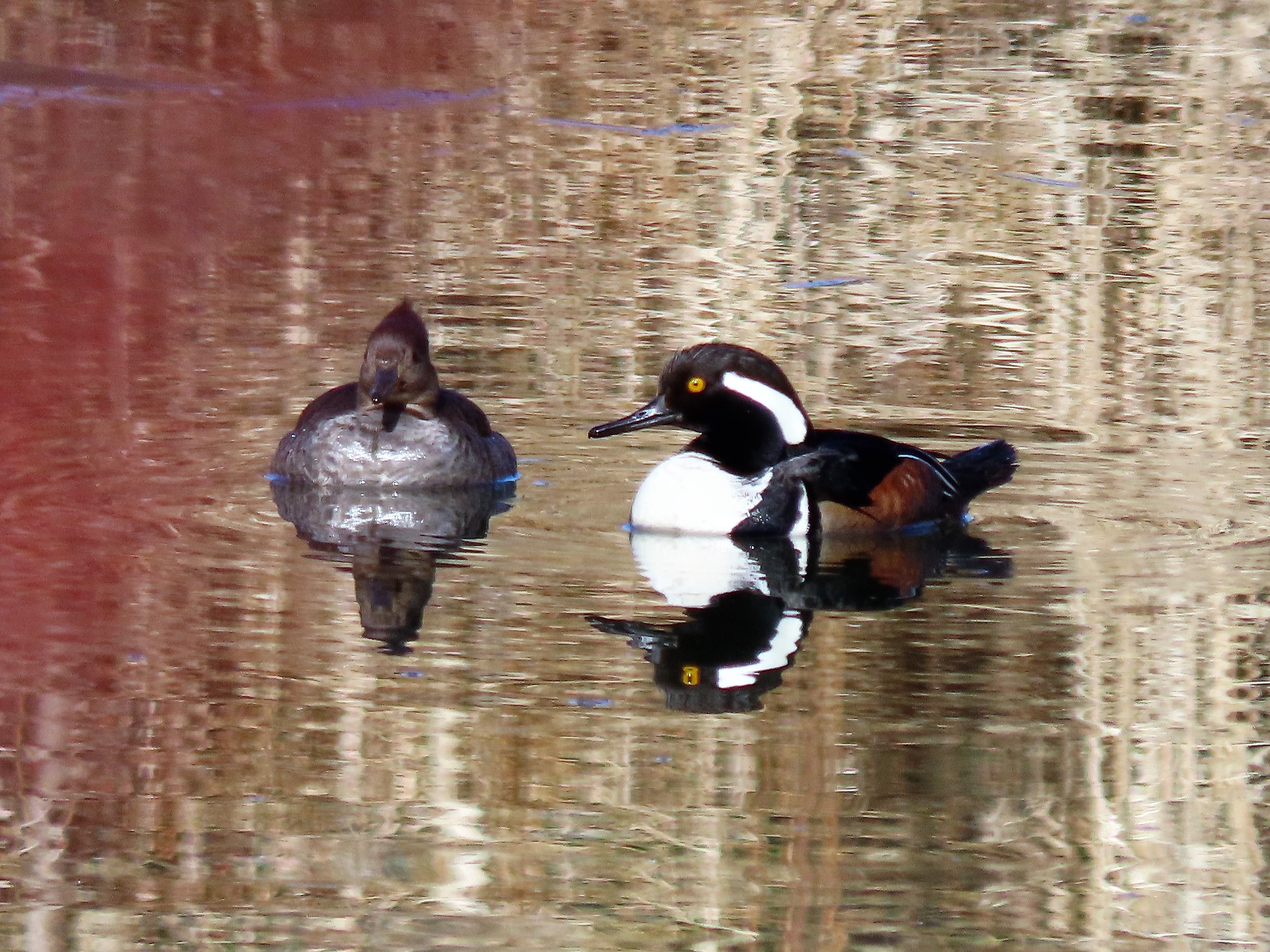
     Last Sunday we had our first COVID-19 vaccination and on the way to the clinic we stopped at a storm water management pond where a pair of Hooded Mergansers (Lophodytes cucullatus) were keeping company.


     It is such a handsome little duck. The hairdo on the female would rival Lily's earlier unruly coiffure!


     At SpruceHaven we saw our first Compton Tortoiseshell (Nymphalis l-album) of the spring. 


     The picture is lacking to say the least, but I don't even have another picture on file, so I present you with our only image of this species. To her credit Miriam followed this insect around for several minutes but it would touch down for only the briefest of moments. She did well to capture what she did.
     Three male Eastern Bluebirds (Sialia sialis) have returned to SpruceHaven, right on schedule, but in terms of posing for pictures they were barely more acquiescent than the butterfly.


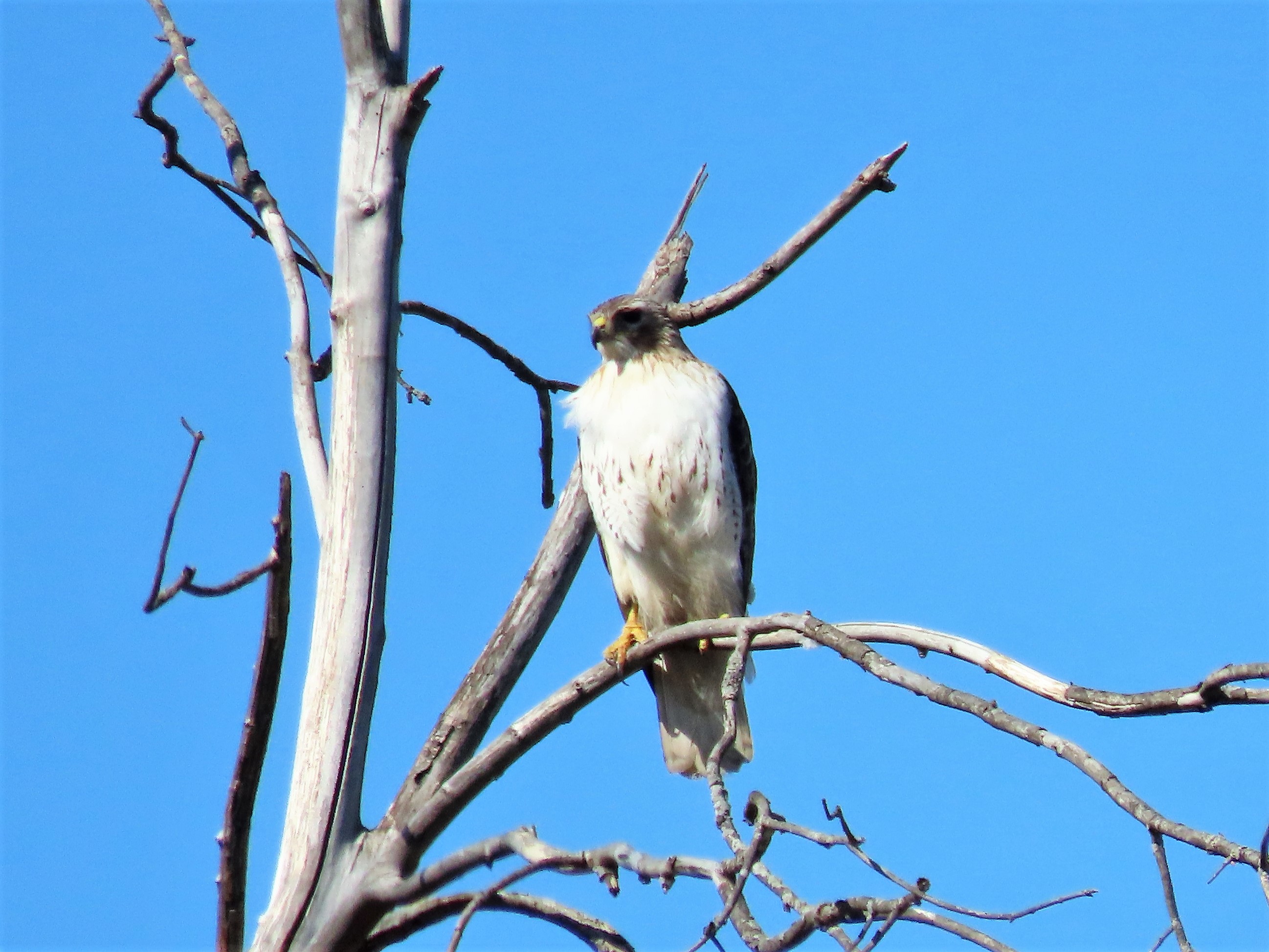
     On the way home we spotted an unusually pale Red-tailed Hawk (Buteo jamaicensis). Finally a willing accomplice in having a picture taken!


     It was very muddy along the Benjamin Park Trail when we went for a walk, not unexpected of course given the warm temperatures of late and the rapid snowmelt.


     Buds are popping everywhere.


     An Eastern Comma (Polygonia comma) fluttered and teased us, but finally landed and we were able to capture an image for posterity.


     Already, so soon after emerging, the right wing looks a little worse for wear.
     Mourning Cloaks (Nymphalis antiopia), always one of the earliest butterflies of the spring, were seen several times, but declined to tarry a while, and went on their way.
     The following picture was taken on the same trail in a previous year, so it is authentic and shows this handsome species well.


     Each day holds the potential for recent arrivals at this time of the year. We'll see what the next post brings.

Wednesday, July 22, 2020

Highlights from Recent Walks and Updates on Swallows and Ospreys

    Immediately parental duties are dispensed with Baltimore Orioles (Icterus galbula) begin their pre-basic moult, which is complete, in preparation for their long migration south. This individual shows evidence of moult.


     I suspect that the blue-grey bill of this species is a seldom noted feature, and many birders might be hard-pressed to correctly identify it, having besotted themselves with the black and orange splendour of this much-loved bird.


     The picture above shows the bill in excellent detail - from New World Blackbirds, Jaramillo and Burke (1999) - ".........with the lower mandible, and the cutting edge of the upper mandible, entirely blue-grey."
     Thanks, Miriam, for capturing this feature so well.
     A Savannah Sparrow (Passerculus sandwichensis) is a bird that invites anthropomorphism. The males seem to sing for the sheer pleasure of doing so!


     Birds are not the only creatures to capture our attention. I think I first saw this foal when it was mere days old and the passage of time has only added to its allure.


     It never strays far from mama, who furnishes security and food in one reliable package.


     There is another horse and foal in the same paddock, and both foals have the white badge on the forehead, perhaps indicating common fatherhood.
     American Robins (Turdus migratorius), both adult and young are seemingly everywhere!


     This Eastern Comma (Polygonia comma) remained high in the trees, perhaps a little more secure there from birds anxious to make lunch of it.


     Better beware, however, an Eastern Kingbird (Tyrannus tyrannus) was perched uncharacteristically in the uppermost foliage, and would make short work of a juicy butterfly given the chance.


     We have settled on Hillside Park, with an entry from Forwell Park, as our default after-dinner walk, providing a round-trip of about four kilometres, with a host of wildlife to occupy our curious minds.


     There appears to be a robust population of Northern Flickers (Colaptes auratus) with several nests. They have provided us with a good deal of pleasure. The eastern race is yellow-shafted, as the picture below illustrates, with the wing looking like a saucer or a piece of wood cut from a branch!


     The individual below is in a more conventional pose.


     Until recently we had not seen Great Crested Flycatcher (Myiarchus crinitus) this year. Our most reliable spot to find this species is The Mill Race Trail, which has been closed since the beginning of the pandemic. You will understand our delight when we located three together in Hillside Park.


     A female Brown-headed Cowbird probably poses little threat to potential host species by late July, most of which have completed egg laying for the year.


     As humans, as you all know, we can at times display an incredible degree of stupidity. We deliberately introduced the Gypsy Moth (Lymantria dispar) to defoliate our deciduous forests and woodlands, to follow up in short order with the Japanese Beetle (Papila japonica) to decimate leaf tissue and ripening fruit. 


     Don't hold your breath that we have finished with such folly.
     The Barn Swallows (Hirundo rustica) at SpruceHaven are into second broods, and seem to be thriving in the hot weather that causes so many of us to wilt.


     The pioneering pair of American Cliff Swallows (Petrochelidon pyrrhonota) in the meantime are busily adding to their nest. 


     It will be with a sense of triumph if I am able to report soon that nest construction has been completed and the female is incubating eggs. My fingers and toes are crossed I hope yours are too!
     The Western Ospreys (Pandion haliaeetus) at River Song continue to delight us, and we check on them several times a week. Parental dedication is the hallmark of this pair.


     We also a monitor another active osprey nest in Waterloo but it is both farther away and higher, so we are not given the intimate views we have with the River Song pair, but the degree of dedication to the welfare of the young seems less admirable. I have never, for example, seen the Waterloo pair shield the nestlings from the hot summer sun. Perhaps this is a young pair breeding for the first time, with much to learn.
     Covid-19 has impacted all of us in different ways, but perhaps for the person whose life is woven around the ever-changing, ever-fascinating, ever-satisfying world of nature, the effects have often been barely noticeable. 

Land Acknowledgement

We acknowledge that the land on which we are situated are the lands traditionally used by the Haudenosaunee, Anishinaabe, and Neutral People. We also acknowledge the enduring presence and deep traditional knowledge, laws, and philosophies of the Indigenous Peoples with whom we share this land today. We are all treaty people with a responsibility to honour all our relations.

Followers