Showing posts with label Great Crested Flycatcher. Show all posts

Friday, June 04, 2021

More Local Satisfaction and An Introduction to David's Dell

     Life continues as normally as can be expected given the circumstances, and we keep hoping that substantial easing of restrictions is in sight, but we stay the course whatever direction it takes, and hope for better days to come. 
     In the meantime we are not starved for exciting adventures in nature.

29 May 2021

Waterloo, ON

     Only a few minutes away from our home a pair of Western Ospreys (Pandion haliaeetus) has bred for several years, and we frequently check on the status of the nest. While in that area we seek out other treasures and the rewards are not slow in coming.
     Gazing through teasels (Genus Dipsacus) is pleasure enough.


     A Willow Flycatcher (Empidonax traillii) was trilling joyfully and was reasonably open for a picture. It would be nice if the branches weren't in front of the bird, but we are shooting in nature not in a studio, and everything can't be arranged to suit the photographer.


     Several Song Sparrows (Melospsiza melodia) sang to us in their usual robust fashion, undeterred by the presence of humans close by.


Laurel Creek Conservation Area, Waterloo, ON

     Making good use of our pass, we visited Laurel Creek once again.


     Our first stop was at the Dignity Memorial Grove.


     It is a commendable endeavour that local businesses have partnered with the Grand River Conservation Authority to plant trees. Would that more would join in such synergistic and wholly beneficial projects.
     There is provision within the grove to have a bench installed in memory of a friend or family member who has passed on - or is still living I suppose, but that appears not to be a practice as far as we could tell. 
     Here we saw our first ever Silvery Blue (Glaucopsyche lygdamus), a small butterfly, the male being wondrously blue on the upper wings, but as it usually lands with wings erect, this feature is unseen in the picture.

     
     We have settled on a small copse with a path through it as our favourite spot at Laurel Creek; quite arrogantly I have named it David's Dell.

     It is home to a very agreeable range of birds, including the gorgeous Great Crested Flycatcher (Myiarchus crinitus), a bird that announces its presence with a clear, emphatic whistle.


     Two or three Eastern Kingbirds (Tyrannus tyrannus) were busily flycatching in their usual perch- and-sally method.


     A Common Eastern Bumblebee (Bombus impatiens) has a full load of pollen as evidence of a successful bout of foraging.


     A honey bee, probably Western Honey Bee (Apis mellifera), was also active on the flowers laden with pollen and nectar.


     We know that at least two House Wrens (Troglodytes aedon) are present, and we suspect that we are hearing two very loud and persistent males singing while their partner is sitting on eggs.


   How joyful to hear this tiny bird pour forth his ardour for all the world to hear, his very body vibrating from the effort.


     An Eastern Wood Pewee (Contopus virens) is a little more restrained, but no less charming.


     The high pitch of its song is outside my hearing range but Miriam is able to detect it, and as she often does she operates her ears for both of us!


    What the heck, one more picture can't hurt!


31 May 2021
Laurel Creek Conservation Area, Waterloo, ON

     Let's visit David's Dell together.


     I guarantee that a pleasant time will be had by all.


     As has repeatedly been the case of late, a Great Crested Flycatcher was there to greet us.


     The House Wrens were singing loudly in the background - such a burbling, effervescent, rollicking song. No Oscar-winning motion picture ever had a soundtrack to rival it.
     But it was about to get a leap in magnitude better.
     I was focused on a wren, when Miriam said with deliberate casualness, "Do you want to see this cuckoo?"
     And there, as splendid as any bird might be, was a Black-billed Cuckoo (Coccyzus erythropthalmus). 


     To see a cuckoo of any species in North America is always memorable.


     Black-billed Cuckoo is one of the few species to seek out the caterpillars of defoliating moths and given the overwintering egg masses of Gypsy Moth (Lymantria dispar) there is food in abundance this year.


     Not only did we have fantastic views of the bird it showed no hesitation to stay and provide us with several additional minutes of enjoyment.


     Remember - we are five minutes from home!
     The only thing I could think of to top the sighting of the Black-billed Cuckoo would be a Yellow-billed Cuckoo (Coccyzus americana). Et voilà mes amis!
A Yellow-billed Cuckoo within a champion spitter's distance of its black-billed cousin.


      Were we prone to such practices we would have high-fived, danced a jig and said prayers of thanks.
Instead we concentrated on seeing the bird and Miriam took picture after picture.


     Are you enjoying your time in David's Dell? Are you glad you came along?


     This is by any measure a remarkable one/two punch!
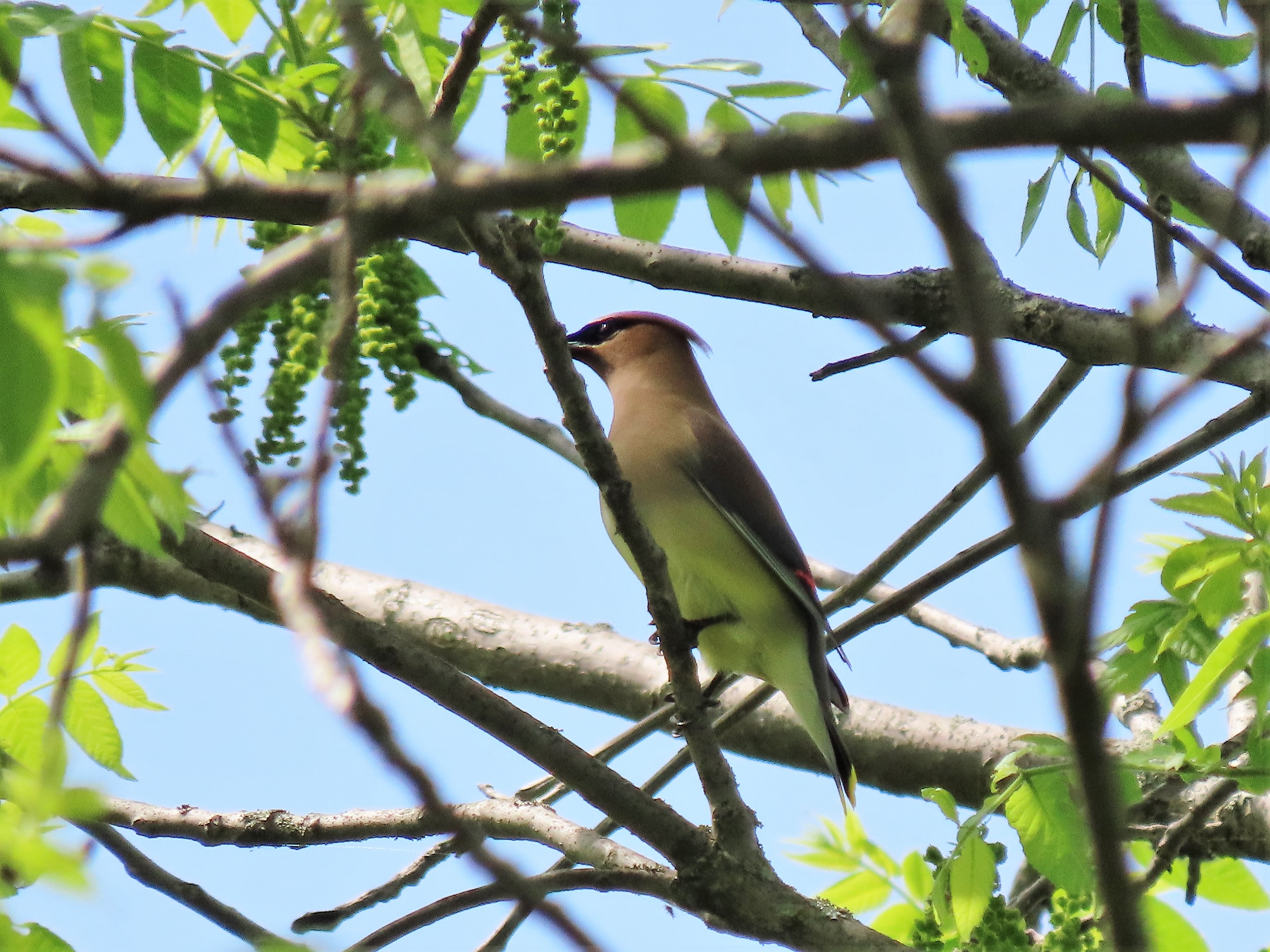
     A Cedar Waxwing (Bombycilla cedrorum) seemed inconsequential by comparison!

     And in the botanical department we did well too, finding a small patch of Yellow Lady's Slipper (Cypripedium parviflorum), a beautiful woodland orchid.


     On the way out of the park we spotted another Willow Flycatcher, Miriam having heard it first, but it was a little farther away than the one in David's Dell.


     A Great Blue Heron (Ardea herodias) resembling a creature from a primordial past flew effortlessly overhead.


     A solitary Wild Turkey (Meleagris gallopavo) in the meantime took a break.


02 June 2021
Laurel Creek Conservation Area, Waterloo, ON

     This was the last evening we would have the pass provided by the Waterloo Public Library, so we made a thermos of decaf coffee and along with two of Miriam's homemade cookies we went down to enjoy it in David's Dell.


     We have received so much enjoyment from the free pass we are resolved to buy an annual pass and continue our visits to GRCA properties. There are many more to explore.
  

Wednesday, July 22, 2020

Highlights from Recent Walks and Updates on Swallows and Ospreys

    Immediately parental duties are dispensed with Baltimore Orioles (Icterus galbula) begin their pre-basic moult, which is complete, in preparation for their long migration south. This individual shows evidence of moult.


     I suspect that the blue-grey bill of this species is a seldom noted feature, and many birders might be hard-pressed to correctly identify it, having besotted themselves with the black and orange splendour of this much-loved bird.


     The picture above shows the bill in excellent detail - from New World Blackbirds, Jaramillo and Burke (1999) - ".........with the lower mandible, and the cutting edge of the upper mandible, entirely blue-grey."
     Thanks, Miriam, for capturing this feature so well.
     A Savannah Sparrow (Passerculus sandwichensis) is a bird that invites anthropomorphism. The males seem to sing for the sheer pleasure of doing so!


     Birds are not the only creatures to capture our attention. I think I first saw this foal when it was mere days old and the passage of time has only added to its allure.


     It never strays far from mama, who furnishes security and food in one reliable package.


     There is another horse and foal in the same paddock, and both foals have the white badge on the forehead, perhaps indicating common fatherhood.
     American Robins (Turdus migratorius), both adult and young are seemingly everywhere!


     This Eastern Comma (Polygonia comma) remained high in the trees, perhaps a little more secure there from birds anxious to make lunch of it.


     Better beware, however, an Eastern Kingbird (Tyrannus tyrannus) was perched uncharacteristically in the uppermost foliage, and would make short work of a juicy butterfly given the chance.


     We have settled on Hillside Park, with an entry from Forwell Park, as our default after-dinner walk, providing a round-trip of about four kilometres, with a host of wildlife to occupy our curious minds.


     There appears to be a robust population of Northern Flickers (Colaptes auratus) with several nests. They have provided us with a good deal of pleasure. The eastern race is yellow-shafted, as the picture below illustrates, with the wing looking like a saucer or a piece of wood cut from a branch!


     The individual below is in a more conventional pose.


     Until recently we had not seen Great Crested Flycatcher (Myiarchus crinitus) this year. Our most reliable spot to find this species is The Mill Race Trail, which has been closed since the beginning of the pandemic. You will understand our delight when we located three together in Hillside Park.


     A female Brown-headed Cowbird probably poses little threat to potential host species by late July, most of which have completed egg laying for the year.


     As humans, as you all know, we can at times display an incredible degree of stupidity. We deliberately introduced the Gypsy Moth (Lymantria dispar) to defoliate our deciduous forests and woodlands, to follow up in short order with the Japanese Beetle (Papila japonica) to decimate leaf tissue and ripening fruit. 


     Don't hold your breath that we have finished with such folly.
     The Barn Swallows (Hirundo rustica) at SpruceHaven are into second broods, and seem to be thriving in the hot weather that causes so many of us to wilt.


     The pioneering pair of American Cliff Swallows (Petrochelidon pyrrhonota) in the meantime are busily adding to their nest. 


     It will be with a sense of triumph if I am able to report soon that nest construction has been completed and the female is incubating eggs. My fingers and toes are crossed I hope yours are too!
     The Western Ospreys (Pandion haliaeetus) at River Song continue to delight us, and we check on them several times a week. Parental dedication is the hallmark of this pair.


     We also a monitor another active osprey nest in Waterloo but it is both farther away and higher, so we are not given the intimate views we have with the River Song pair, but the degree of dedication to the welfare of the young seems less admirable. I have never, for example, seen the Waterloo pair shield the nestlings from the hot summer sun. Perhaps this is a young pair breeding for the first time, with much to learn.
     Covid-19 has impacted all of us in different ways, but perhaps for the person whose life is woven around the ever-changing, ever-fascinating, ever-satisfying world of nature, the effects have often been barely noticeable. 

Land Acknowledgement

We acknowledge that the land on which we are situated are the lands traditionally used by the Haudenosaunee, Anishinaabe, and Neutral People. We also acknowledge the enduring presence and deep traditional knowledge, laws, and philosophies of the Indigenous Peoples with whom we share this land today. We are all treaty people with a responsibility to honour all our relations.

Followers