Showing posts with label Black-billed Cuckoo. Show all posts

Friday, June 04, 2021

More Local Satisfaction and An Introduction to David's Dell

     Life continues as normally as can be expected given the circumstances, and we keep hoping that substantial easing of restrictions is in sight, but we stay the course whatever direction it takes, and hope for better days to come. 
     In the meantime we are not starved for exciting adventures in nature.

29 May 2021

Waterloo, ON

     Only a few minutes away from our home a pair of Western Ospreys (Pandion haliaeetus) has bred for several years, and we frequently check on the status of the nest. While in that area we seek out other treasures and the rewards are not slow in coming.
     Gazing through teasels (Genus Dipsacus) is pleasure enough.


     A Willow Flycatcher (Empidonax traillii) was trilling joyfully and was reasonably open for a picture. It would be nice if the branches weren't in front of the bird, but we are shooting in nature not in a studio, and everything can't be arranged to suit the photographer.


     Several Song Sparrows (Melospsiza melodia) sang to us in their usual robust fashion, undeterred by the presence of humans close by.


Laurel Creek Conservation Area, Waterloo, ON

     Making good use of our pass, we visited Laurel Creek once again.


     Our first stop was at the Dignity Memorial Grove.


     It is a commendable endeavour that local businesses have partnered with the Grand River Conservation Authority to plant trees. Would that more would join in such synergistic and wholly beneficial projects.
     There is provision within the grove to have a bench installed in memory of a friend or family member who has passed on - or is still living I suppose, but that appears not to be a practice as far as we could tell. 
     Here we saw our first ever Silvery Blue (Glaucopsyche lygdamus), a small butterfly, the male being wondrously blue on the upper wings, but as it usually lands with wings erect, this feature is unseen in the picture.

     
     We have settled on a small copse with a path through it as our favourite spot at Laurel Creek; quite arrogantly I have named it David's Dell.

     It is home to a very agreeable range of birds, including the gorgeous Great Crested Flycatcher (Myiarchus crinitus), a bird that announces its presence with a clear, emphatic whistle.


     Two or three Eastern Kingbirds (Tyrannus tyrannus) were busily flycatching in their usual perch- and-sally method.


     A Common Eastern Bumblebee (Bombus impatiens) has a full load of pollen as evidence of a successful bout of foraging.


     A honey bee, probably Western Honey Bee (Apis mellifera), was also active on the flowers laden with pollen and nectar.


     We know that at least two House Wrens (Troglodytes aedon) are present, and we suspect that we are hearing two very loud and persistent males singing while their partner is sitting on eggs.


   How joyful to hear this tiny bird pour forth his ardour for all the world to hear, his very body vibrating from the effort.


     An Eastern Wood Pewee (Contopus virens) is a little more restrained, but no less charming.


     The high pitch of its song is outside my hearing range but Miriam is able to detect it, and as she often does she operates her ears for both of us!


    What the heck, one more picture can't hurt!


31 May 2021
Laurel Creek Conservation Area, Waterloo, ON

     Let's visit David's Dell together.


     I guarantee that a pleasant time will be had by all.


     As has repeatedly been the case of late, a Great Crested Flycatcher was there to greet us.


     The House Wrens were singing loudly in the background - such a burbling, effervescent, rollicking song. No Oscar-winning motion picture ever had a soundtrack to rival it.
     But it was about to get a leap in magnitude better.
     I was focused on a wren, when Miriam said with deliberate casualness, "Do you want to see this cuckoo?"
     And there, as splendid as any bird might be, was a Black-billed Cuckoo (Coccyzus erythropthalmus). 


     To see a cuckoo of any species in North America is always memorable.


     Black-billed Cuckoo is one of the few species to seek out the caterpillars of defoliating moths and given the overwintering egg masses of Gypsy Moth (Lymantria dispar) there is food in abundance this year.


     Not only did we have fantastic views of the bird it showed no hesitation to stay and provide us with several additional minutes of enjoyment.


     Remember - we are five minutes from home!
     The only thing I could think of to top the sighting of the Black-billed Cuckoo would be a Yellow-billed Cuckoo (Coccyzus americana). Et voilà mes amis!
A Yellow-billed Cuckoo within a champion spitter's distance of its black-billed cousin.


      Were we prone to such practices we would have high-fived, danced a jig and said prayers of thanks.
Instead we concentrated on seeing the bird and Miriam took picture after picture.


     Are you enjoying your time in David's Dell? Are you glad you came along?


     This is by any measure a remarkable one/two punch!
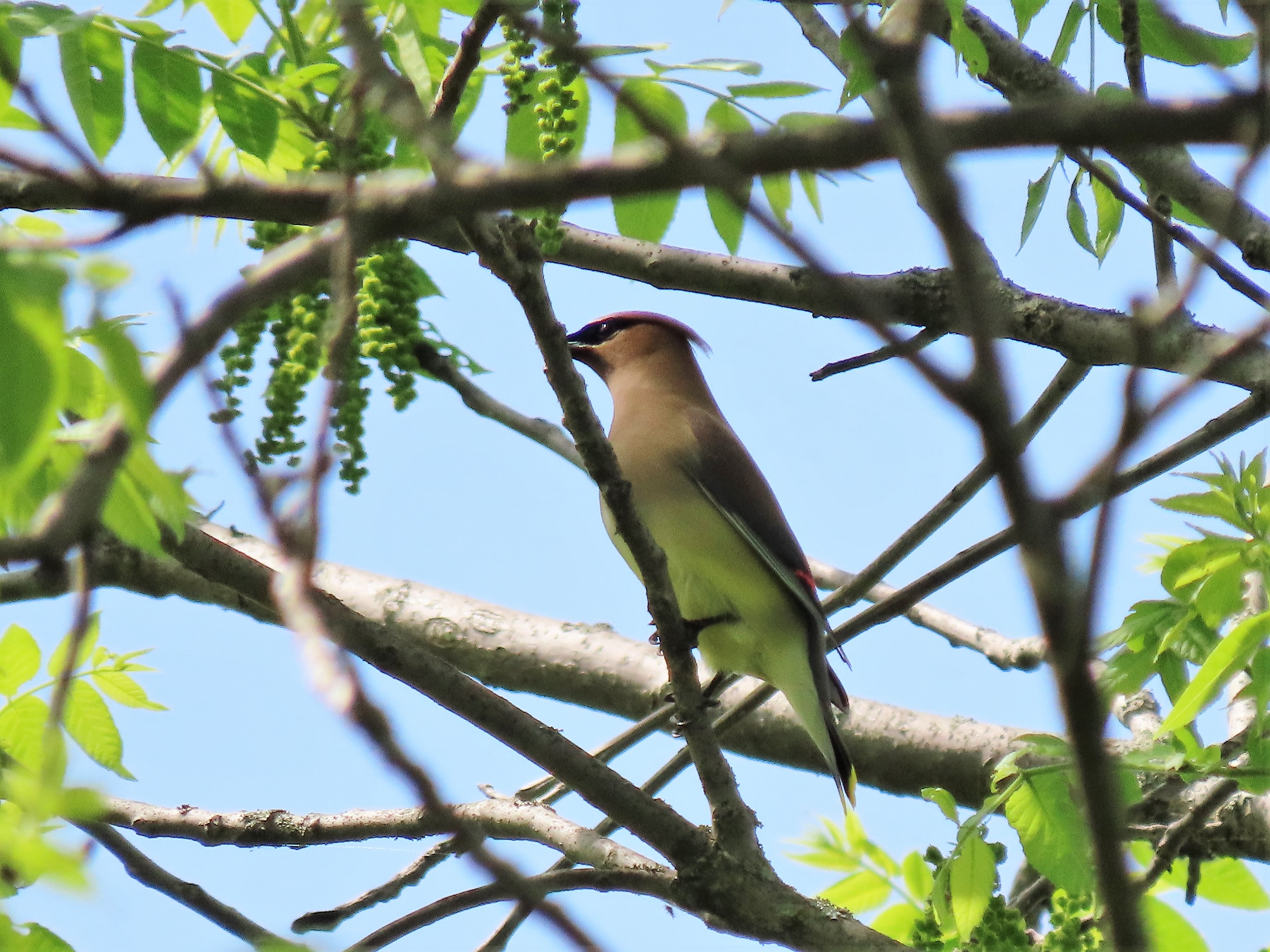
     A Cedar Waxwing (Bombycilla cedrorum) seemed inconsequential by comparison!

     And in the botanical department we did well too, finding a small patch of Yellow Lady's Slipper (Cypripedium parviflorum), a beautiful woodland orchid.


     On the way out of the park we spotted another Willow Flycatcher, Miriam having heard it first, but it was a little farther away than the one in David's Dell.


     A Great Blue Heron (Ardea herodias) resembling a creature from a primordial past flew effortlessly overhead.


     A solitary Wild Turkey (Meleagris gallopavo) in the meantime took a break.


02 June 2021
Laurel Creek Conservation Area, Waterloo, ON

     This was the last evening we would have the pass provided by the Waterloo Public Library, so we made a thermos of decaf coffee and along with two of Miriam's homemade cookies we went down to enjoy it in David's Dell.


     We have received so much enjoyment from the free pass we are resolved to buy an annual pass and continue our visits to GRCA properties. There are many more to explore.
  

Wednesday, September 25, 2019

Black-billed Cuckoo (Coulicou à bec noir) and Red-breasted Nuthatch (Sitelle à poitrine rousse) - and GRETA THUNBERG

21 September 2019

     When Kevin and I met dark and early at SpruceHaven on Saturday morning, we were pretty sure that our nets would not produce much, with overnight conditions perfect for passerine migration, and little reason for birds to hunker down overnight. And (remarkably!) we were right. 
     Very noteworthy, however, was a Black-billed Cuckoo (Coccyzus erythropthalmus), a species seldom observed, and one which we are fortunate to trap in migration in the fall, but in very small numbers, frequently just a single bird. This individual was in an advanced stage of moult.


     The other species of note, a common species mind you, was a Red-breasted Nuthatch (Sitta canadensis), the first ever caught in our nets. This is probably a resident bird and we will keep our eyes open for a bird with a band on its leg at the feeders in the winter.


All species banded 21 September: Black-billed Cuckoo (1), Black-capped Chickadee (2), Red-breasted Nuthatch (1), Song Sparrow (5), Common Yellowthroat (1). Total: 10 individuals of 5 species.

     Recently, I came across a quote attributed to the great sculptor, Henry Moore. He said, "The secret of life is to have a task, something you devote your entire life to, something you bring everything to, every minute of the day for your whole life. And the most important thing is - it must be something you cannot possibly do."
     My thoughts immediately turned to that inspirational young Swedish girl, Greta Thunberg, barely more than a child and not quite a woman, who has inspired the world, with her message of environmentalism, and her challenge to the established order.


     There are those cynics who dismiss her, politicians who display nothing but their short-sighted ignorance, sarcasm and boorishness, those who choose to ignore science and do harm, but the world has embraced, and will continue to embrace, this dynamic, thoughtful, committed, passionate young advocate, who works tirelessly for all of us.
     You were a great sculptor Henry Moore, but in one fundamental way you were wrong. Greta will get it done.

Thursday, June 06, 2019

A visit to Hood Century Farm and Brimstock Farm

04 June 2019

Hood Century Farm, Flamborough, ON

     Between inclement weather and one or the other of us being away, it had been a while since the last rendezvous of "Tuesday Rambles with David" so we were happy to meet at Hood Century Farm for a chance to see a range of grassland species. Carol, Judy and Mary were unable to be there, but joined by Franc, Francine and Jim, Miriam and I had a very enjoyable visit to one of our favourite spots.
     Even as we drove into the farm Barn Swallows (Hirundo rustica) and Tree Swallows (Tachycineta bicolor) were swooping and gliding over our heads, and a Brown Thrasher (Toxostoma rufa) was wrestling prey into submission on the ground, from where it flew to an overhead wire for a picture.


     Since the bird did not immediately ingest this morsel, I suspect that it is feeding young.
     This was certainly the case with Eastern Bluebirds (Sialis sialia), an event to give us great satisfaction. It is not so many years ago that the future of this species was seriously imperilled, so each encounter with a breeding pair is cause for great celebration. The provision of nest boxes has radically improved the fortunes of bluebirds, a clear case where human intervention has been both helpful and successful.


     Tree Swallows are equally dependent on humans for nesting space; most pairs now occupying nest boxes as opposed to natural cavities.


     Eastern Meadowlarks (Sturnella magna) were difficult to see, being primarily occupied with the serious business of breeding, but Franc was able to capture this wonderful shot of a bird in flight.


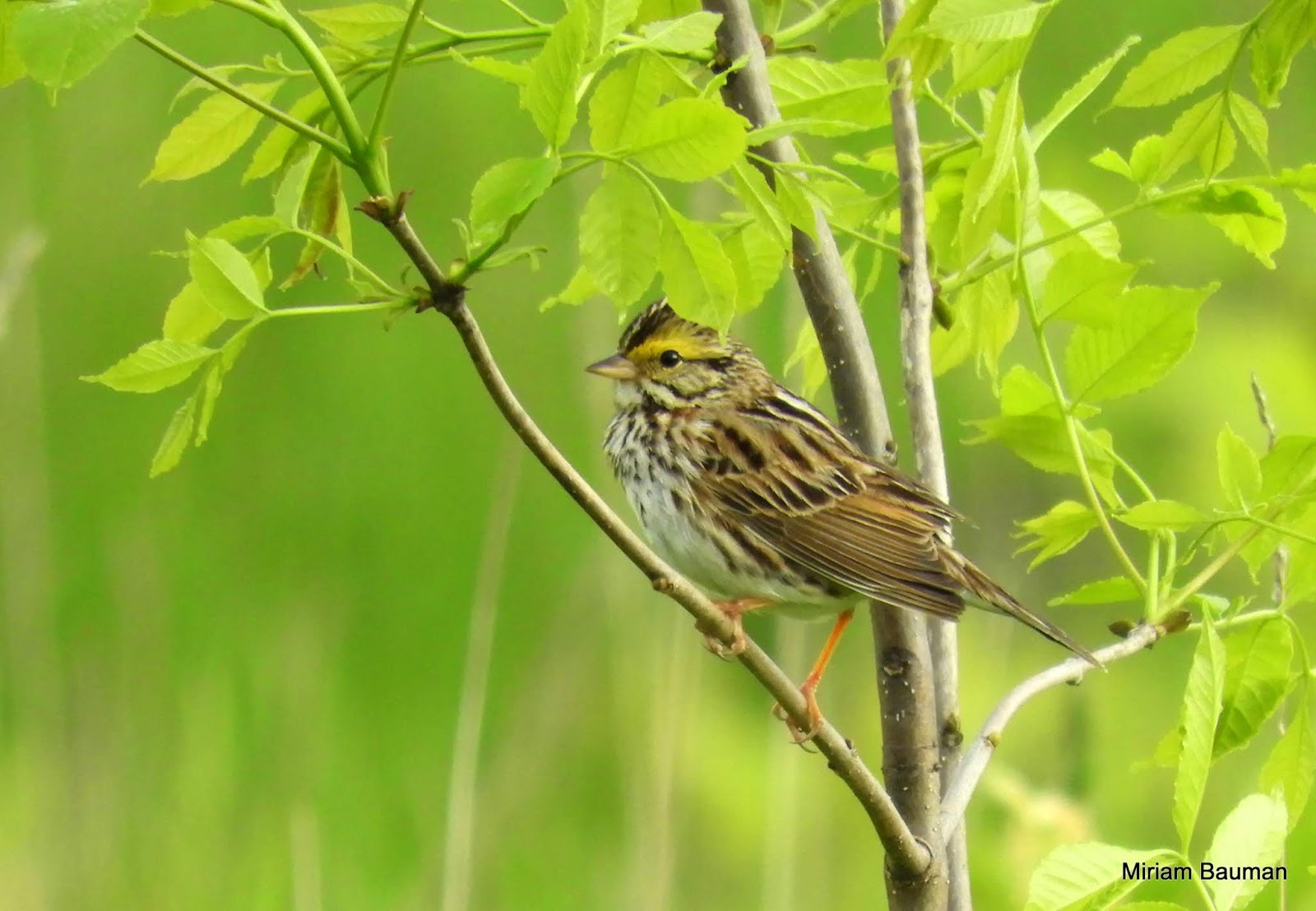
     If a vote were to be held to nominate "the" grassland sparrow, Savannah Sparrow (Passerculus sandwichensis) would garner my vote. It is ubiquitous in suitable habitat and quite prone to showing itself. Many a novice birder has first identified a native sparrow with confidence by studying Savannah Sparrow.


     The bird I most associate with this location is Bobolink (Dolichonyx oryzivorus) and one is guaranteed to see males fluttering across the meadows singing their delightful burbling song. I have seen this a thousand times. Does it ever become less delightful? Never!


     The bird that made Francine jump up and down, squeal, chortle and dance an impromptu jig was Black-billed Cuckoo (Coccyzus erythropthalmus), a species she had been seeking for a long time. 


     We saw the bird several times and often it perched for a few minutes, but never in an ideal position for photographs, which did not lessen in any way the exhilaration we all felt at seeing it. I suspect Francine may have dreamed about it all night!
     Cedar Waxwings (Bombycilla cedrorum) were much more obliging.


     Up by the house a male Ruby-throated Hummingbird (Archilocus colubris) was not about to let a free meal go to waste and took full advantage of the feeder with its energy-rich delivery of sugar water.


     A Mourning Dove (Zenaida macroura) rested quietly in a tree.


     All the while Franc was regaling us with stories of his recent visit to Slovenia and Croatia, with tales of hoopoes and pratincoles, bee-eaters and orioles, lapwings and hobbies. I will look forward to seeing his pictures.
     As always, it was a very pleasant visit and it did not escape any of us that it is a rare privilege to visit this enchanted place.

Brimstock Farm

     Brian and Barb Markle, longstanding friends of Miriam, permitted us to visit their farm near Amulree in Perth County, where they are exemplary stewards of the land, farming in a fashion to permit wildlife to coexist with livestock on a working farm. No cut of hay is made until after the grassland birds have finished nesting for the season, and Bobolinks and other species associated with this habitat abound.


     It was a rare pleasure to walk through meadows with grass and other plants at knee-height, with the cheerful song of ardent male Bobolinks to guide the way. Tree Swallows and Eastern Bluebirds have both found a home in nest boxes placed along the fence rows and the grass resonates with the sound of insects, a rich source of food for grassland birds with young to feed.
     Red-winged Blackbirds (Agelaius phoeniceus) were common, as might be expected, and this beautiful female was no doubt gathering food for a nest full of hungry mouths.


     We spotted our first Monarch (Danaus plexippus) of the year on the lilac bush near the house.


     And a male Downy Woodpecker (Dryobates pubescens) entertained us at one of the feeders.


     There is a good deal of additional habitat to be explored here and I suspect that much remains to be discovered. I hope to be permitted to return.

Land Acknowledgement

We acknowledge that the land on which we are situated are the lands traditionally used by the Haudenosaunee, Anishinaabe, and Neutral People. We also acknowledge the enduring presence and deep traditional knowledge, laws, and philosophies of the Indigenous Peoples with whom we share this land today. We are all treaty people with a responsibility to honour all our relations.

Followers