Showing posts with label Red-breasted Nuthatch. Show all posts

Monday, May 10, 2021

Interesting Discoveries All Around Us

     It sounds as though the record is stuck on the turntable I know, but due to government-imposed lockdown in the Province of Ontario, we are not venturing far afield. There is much of interest to be found locally, however, so please join me to look at what we have been seeing in the Kitchener-Waterloo area.

03 May 2021
In our backyard, Waterloo, ON

     American Robin (Turdus migratorius) is an exceedingly common species, and it is rarely that we glance out the window without seeing up to three individuals in the yard, including this interesting bird displaying signs of leucism. 


     It seems to enjoy our company for it puts in an appearance several times a day - or do you think it might just be for the food?

04 May 2021
Laurel Creek Reservoir, Waterloo, ON

     The marshes are filled with Red-winged Blackbirds (Agelaius phoeniceus), with ardent males competing with each other to woo more than one female, for this is a highly polygynous species. I suspect that the handsome fellow below will do well in the courtship games.


04 May 2021
Wilmot Township, Region of Waterloo, ON

     While driving, I spotted a couple of Turkey Vultures (Cathartes aura) in a field, evidently keenly interested in something, likely carrion. I was unable to detect what captured their attention, but when I stopped to take a picture one bird moved off a short distance while the other stayed put.


     Clearly it was a prize that outweighed any impetus to flee from a prying human.

05 May 2021
In our backyard, Waterloo, ON

     A male Red-bellied Woodpecker (Melanerpes carolinus) is a regular at our feeders, generally stopping for a quick snack before moving on.


     It is always a male that visits and we assume that it is the same bird each time.

05 May 2021
Conestogo, ON

     A pair of Bald Eagles (Haliaeetus leucocephalus) has bred successfully for several years in a large nest in a large tree alongside the Conestogo River, almost in town, in fact.
     We were unable to view any activity at the nest, which becomes harder to see as the trees leaf out, but one of the pair was perched on a nearby snag.


     Caspian Terns (Hydroprogne caspia) have returned to grace our waterways and we saw our first individual of the year patrolling up and down the river, plunging in to capture fish, to great success based on our observation.


05 May 2021
RIM Park, Waterloo, ON

     Northern Flicker (Colaptes auratus), unlike most woodpeckers, feeds primarily on the ground, searching for ants.


     It is not often that we see Northern Cardinal (Cardinalis cardinalis) on the ground but this male seemed to have business there.


     I suspect that a juicy beetle or some other equally appealing snack had caught his eye.
     As sometimes happens, Miriam and I had no sooner finished saying to each other that we had not seen our first Rose-breasted Grosbeak (Pheucticus ludovicianus), when, as though on cue, we heard one sing - and there it was!


     Our skills as botanists are rudimentary, but improving, happily, and you will indulge me I am sure while I present a few woodland plants.
     Is a Downy Yellow Violet (Viola pubescens) not guaranteed to put a smile on your face?


     Common Blue Violet (Viola sororia), also known as Wooly Blue Violet, is found in colours ranging from purple to white.


     There are several species of Wood-sorel (Genus Oxalis) dotted throughout the woodlands of southern Ontario, and this is one of them. Based on the many references I have consulted I think it is Oxyalis griffithii. Confirmation would be welcomed.


     Canada or Wood Anemone (Anemone canadensis) adds a touch of beauty wherever it is found.


     Fawn Lily (Genus Erythronium) was not hard to spot, and is a delightful component of a woodland stroll.


     Cut-leaved Toothwort (Cardamine concatenata is a classic plant of moist woodlands, always a joy to locate and emblematic of the habitat.


     My trivial and superficial journey into the world of plants will bring you pleasure, I hope; it does for me as I search, discover and learn, but if you wish to get to know a talented botanist, overflowing with knowledge, a dedicated environmentalist with a first rate blog, please visit my great friend Juan Tarrero Sarabia here
     Some of you will perhaps remember the impressive fence I featured on an earlier blog. I think a male Song Sparrow (Melospiza melodia) found it equally impressive as a perch from which to serenade any passing female whose interest he might be able to capture.


     Or perhaps a dais in a tree is better platform after all.


07 May 2021
In our backyard, Waterloo, ON

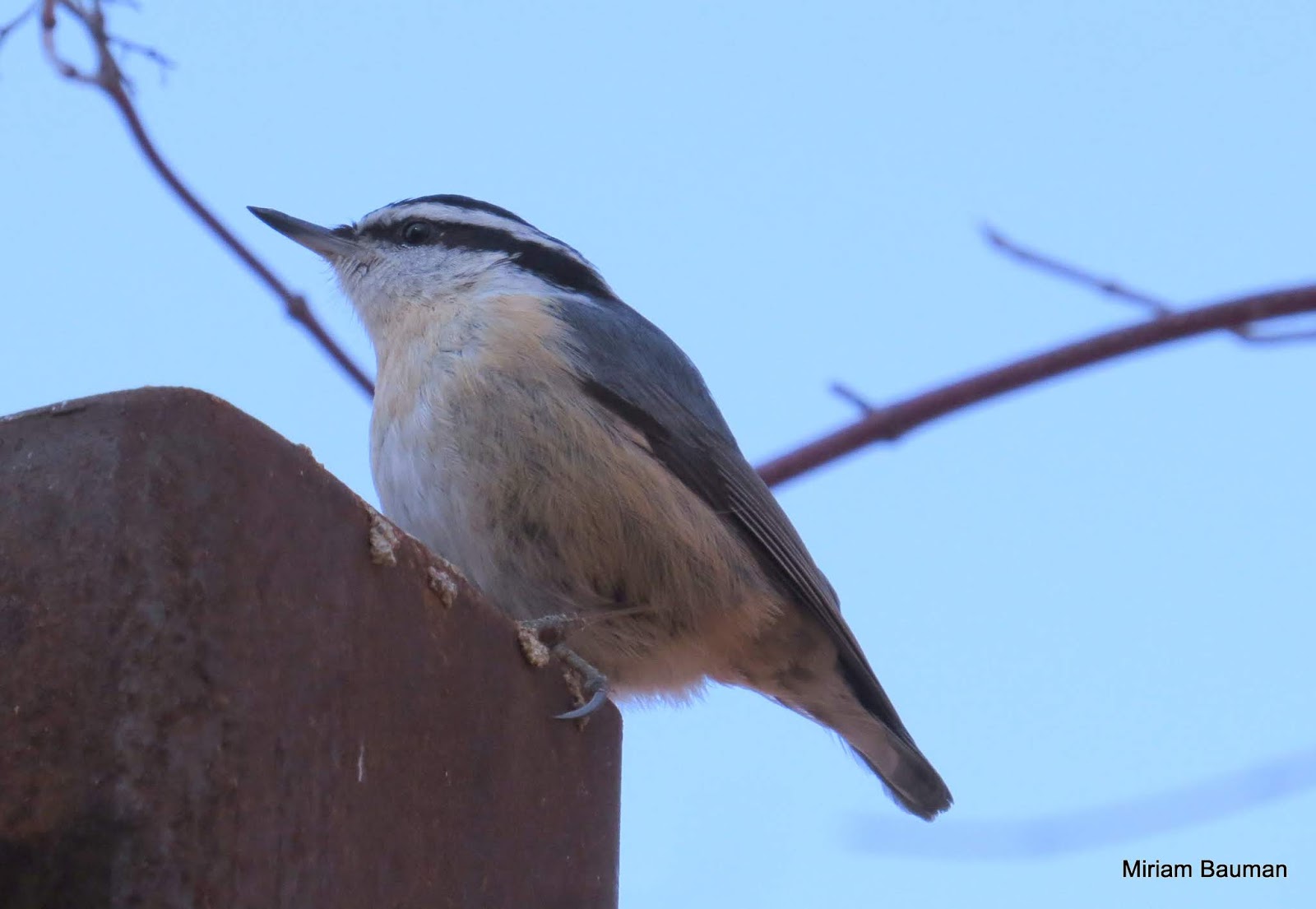
     All winter long we were visited by both White-breasted Nuthatch (Sitta carolinensis) and Red-breasted Nuthatch (Sitta canadensis). The white-breasted seems to be seeking its fortune elsewhere, but the Red-breasted Nuthatch still comes to our feeders, often flying off with food, so perhaps there are young mouths to feed.


     Blue Jays (Cyanocitta cristata) are nothing short of ubiquitous this year and at times there are as many as ten in our yard.


     I am sure you will vicariously share in our joy at having so many of these wonderfully attractive birds visit us.


     A couple of days earlier we had set out oranges and grape jelly in anticipation of the arrival of the first Baltimore Oriole (Icterus galbula) so we were elated to see this handsome male arrive.


07 May 2021
Hillside Park, Waterloo, ON

     This is one of the several colour variations of Common Blue Violet.


    Ground Ivy (Glechoma hederacea), sometimes called Gill-over-the-ground is common throughout our area.


     Birding was in general a little slow, but this Great Blue Heron (Ardea herodias) surveyed the world from a loft perch.


     The most disappointing, but very predictable, facet of our walk was to observe, over and over again, the impact of that highly destructive animal Homo ignoramus disgusticus
     Hillside Park is a lovely place, a sylvan urban oasis with a creek running through it. But Homo ignoramus
can fix that in a hurry. Who wants pristine when a shopping cart can be chucked into the stream?


     The cart has to be deliberately taken there and equally deliberately tossed into the water, so nefarious intent is clear from the outset.
     And let's have a little more trash long the banks.


     That coffee was delicious, steaming hot and bold in taste, but it's all done so let's get rid of the cup and its plastic lid.


     There are houses alongside the creek through one section, all well-maintained, with pride of ownership visible for all to see. One homeowner had replaced his fence, only to have it bedaubed with graffiti mere days later.


     Why the idiots in our society think it's okay to vandalize the property of others is quite beyond my level of understanding. And what satisfaction they derive from doing it I am incapable of figuring out.
     By any reasonable measure, by even the least reasonable measures in fact, humans are disgusting, and we are sewing the seeds of our own destruction as we continue to pollute without end, fill the oceans with plastic, decline to mend our ways, and trash every green and pure place we have. We pay taxes for our cities to create and maintain parkland and immediately set about to despoil and degrade it.
     I despair that we have shown time and again that we are incapable of change. We know what is happening, we understand the science, the implications are clear, yet we do nothing to mend our ways.

08 May 2021 
Lakeside Park, Kitchener, On

     Song Sparrow is common as you will have come to realize, but it is a wonderful little bird, and males pour their heart into song, their whole bodies shaking with the excitement of it all.


     I never tire of hearing them announce their presence to all who care to know.
     White Spruce (Picea glauca) has male and female trees, and this female is producing a heavy crop of cones.


     Several Myrtle Warblers (Setophaga coronata) were flitting around gleaning insects, and it was hard to focus the camera on them before they moved again. This is not a very good picture but it was the best that I could get.


     Had Miriam been with me I am sure she would have done better!
     Our lockdown continues until 20 May, but whether to open up again will be debated before the restrictions are lifted, so look for more local news rather than from any forays farther afield. Oh to be able to travel again!

Saturday, September 26, 2020

Two Nuthatches Visit our Feeders

      It is not unusual for us to have a nuthatch visit our bird feeders, but in most years we have either Red-breasted Nuthatch (Sitta canadensis) or, (more frequently), White-breasted Nuthatch (Sitta carolinensis) and neither Miriam nor I can recall having both species visit at the same time. 
     This year has been the exception to the rule and both have been regular visitors, once even appearing on different sides of the same feeder. It has given us a lot of pleasure to welcome these birds.

Red-breasted Nuthatch

     This is the smaller of the two species, with an overall length of about 120mm (4.75 in.).


     In common with White-breasted Nuthatch it is all business when it visits the feeders. It quickly snatches a seed and flies off to cache it under the bark of a tree, or in a crevice, sometimes even in a fissure in the mortar of a wall. Sunflower seeds seem to be its preferred choice of food.


     Once we spot a bird, it goes to and from the feeder several times before disappearing for a few hours, only to return again.


     It has been great fun to watch the antics of this charismatic little bird.

White-breasted Nuthatch

     Both longer and bulkier than Red-breasted Nuthatch, White-breasted Nuthatch averages 155mm (6 in.) and has a noticeably longer, slightly upturned bill.


     It is a very handsome bird, with chestnut flanks and a dark eye set in a white cheek.


     It often announces its presence with its relatively high-pitched nasal nit, nit sound, an easy song to learn, and one of the first to be remembered and recognized by those unfamiliar with bird vocalization.
     It will take a variety of seeds, but shows great fondness for peanuts, which it extracts from the feeder with ease.


Feeding from the hand

     Both species are quite confiding and with a little patience can be coaxed into feeding from the hand.


     These birds are resident in southern Ontario and we will look forward to enjoying their presence throughout the winter. I have no doubt they will sparkle like jewels set against the winter snow - that pleasure is still to come!


Wednesday, September 25, 2019

Black-billed Cuckoo (Coulicou à bec noir) and Red-breasted Nuthatch (Sitelle à poitrine rousse) - and GRETA THUNBERG

21 September 2019

     When Kevin and I met dark and early at SpruceHaven on Saturday morning, we were pretty sure that our nets would not produce much, with overnight conditions perfect for passerine migration, and little reason for birds to hunker down overnight. And (remarkably!) we were right. 
     Very noteworthy, however, was a Black-billed Cuckoo (Coccyzus erythropthalmus), a species seldom observed, and one which we are fortunate to trap in migration in the fall, but in very small numbers, frequently just a single bird. This individual was in an advanced stage of moult.


     The other species of note, a common species mind you, was a Red-breasted Nuthatch (Sitta canadensis), the first ever caught in our nets. This is probably a resident bird and we will keep our eyes open for a bird with a band on its leg at the feeders in the winter.


All species banded 21 September: Black-billed Cuckoo (1), Black-capped Chickadee (2), Red-breasted Nuthatch (1), Song Sparrow (5), Common Yellowthroat (1). Total: 10 individuals of 5 species.

     Recently, I came across a quote attributed to the great sculptor, Henry Moore. He said, "The secret of life is to have a task, something you devote your entire life to, something you bring everything to, every minute of the day for your whole life. And the most important thing is - it must be something you cannot possibly do."
     My thoughts immediately turned to that inspirational young Swedish girl, Greta Thunberg, barely more than a child and not quite a woman, who has inspired the world, with her message of environmentalism, and her challenge to the established order.


     There are those cynics who dismiss her, politicians who display nothing but their short-sighted ignorance, sarcasm and boorishness, those who choose to ignore science and do harm, but the world has embraced, and will continue to embrace, this dynamic, thoughtful, committed, passionate young advocate, who works tirelessly for all of us.
     You were a great sculptor Henry Moore, but in one fundamental way you were wrong. Greta will get it done.

Friday, March 22, 2019

Tuesday Rambles with David - Long Point, Norfolk County, ON

19 March 2019

     The last day of winter was a bright, sunny day and a visit to Long Point, where Tundra Swans (Cygnus columbianus) should be arriving in their thousands seemed like a fine plan. Judy and Mary had other arrangements for the day, but we met up with Franc, Carol, Jim and Francine to begin a rewarding session of birding.
     Our first stop was at Port Rowan harbour where the sheer number and variety of waterfowl out on the bay was staggering. Most were far out, however, and seemed to be moving farther away as we watched.


     There were many Tundra Swans and a few were reasonably close.


     In the distance we could also see two Bald Eagles (Haliaeetus leucocephalus) perched against the shoreline, no doubt ever vigilant for a duck in trouble.
     We scanned the harbour from a couple of different vantage points and while the spectacle of such a huge concentration of waterfowl was very exciting, it was also distant. However, we were confident that as we explored other areas of the Long Point complex closer views would be possible.
     Our next stop was at the Lee Brown Waterfowl Management Reserve, but the water there was still frozen solid and not a duck was to be found. In this general area Tundra Swans historically have congregated by the thousands and I have been present when a bare field having barely shed its cloak of snow is transformed back to white by thousands of swans descending on the dun coloured soil. Today was no exception, there was a constant procession of swans coming in, called noisily to each other, in sheer exuberance perhaps to be returning to their Arctic nesting grounds, going home so to speak.


     This annual rite of spring is one of the greatest of all natural spectacles to be witnessed in Ontario, an event that fills me with awe each time I see it.
     Sandhill Cranes (Grus canadensis) populate Long Point and the environs year round, but we saw only five individuals the whole day.


   Turkey Vultures (Cathartes aura) have returned to the province and a couple were spotted in a conifer, one spreading its wings, perchance to capture the warmth of the sun.


     Carol had spotted a Great Blue Heron (Ardea herodias) and while we were watching it another bird flew in. It played hide and seek with us for a while but finally showed itself reasonably well. An Eastern Towhee (Pipilo erythrophthalmus) is always a pleasing sighting.


     We moved along to the headquarters of Bird Studies Canada where the assortment of species can sometimes be very rewarding.


      As you might imagine Miriam could not resist taking a picture of this barn quilt.


     In recent years barn quilts have popped up in many counties in southern Ontario and they add a pleasant dimension to the rural landscape. I find them very attractive.
     The pond at Bird Studies Canada was still frozen, but we noticed something at the lip of the entrance to a nesting box designed for Wood Ducks (Aix sponsa) and, knowing that it is not unusual for Eastern Screech Owls (Megascops asio) to opportunistically occupy these boxes, were delighted at what we found.


     The box was far away but you can see the owl quite clearly taking advantage of the warmth in the sun's rays. This view was especially exciting for Carol who had never been with us before when we had located a screech owl.
     For the past couple of years when we visit Long Point, Carol's sister Betty who lives there, always permits us to take our lunch to enjoy it inside at her house, a very kind gesture indeed. If she is not at home Carol knows where to find a key to the front door, but today Betty was there to welcome us, and we were all delighted to see her. A fresh pot of coffee enabled us to enjoy our lunch with a steaming hot drink.
     Our next stop was at the Long Point Bird Observatory and in homage to my good friend, Phil Slade, an English blogger who interned at Long Point many years ago, I am including a couple of pictures that might bring back fond memories for him.


       It seemed that we could barely turn our heads without seeing scores of Common Grackles (Quiscalus quiscula) and Red-winged Blackbirds (Agelaius phoeniceus).


     This Red-winged Blackbird seemed to exhibit partial leucism, the first time I have seen the condition in this species. 


     As is so often the case, a Mourning Dove (Zenaida macroura) perched quietly in a tree, aloof from the raucous scrum of blackbirds and sparrows below.


     Red-breasted Nuthatch (Sitta canadensis) was a very common species, being seen frequently throughout the woodlot.


     On our way back along the causeway we stopped at various points and a Merlin (Falco columbarius) accounted for the absence of songbirds in the immediate vicinity.


     Its crop was bulging so I suspect it might have just eaten and was resting to aid in digestion.
     The ice on the bay was starting to melt a little at the edges but in general it was still locked in ice.


     An American Beaver (Castor canadensis) had embarked on a particularly ambitious venture! When the ice recedes it will perhaps return to finish the task.


     Invasive phragmites are a real problem throughout Ontario's wetlands, and while a major (and expensive) attempt at removal is underway at Long Point, it remains a serious issue.


     Hooded Mergansers (Lophodytes cucullatus) aplenty were seen close to shore, males outnumbering females each time we saw them.


     Ring-necked Duck (Aythya collaris) was also quite common. In the photograph below you can actually see the very faint ring for which this species is named - a name (along with a few others) that seems to have been conferred by a taxonomist with a perverse sense of humour!


     We saw literally thousands of Tundra Swans but only two Mute Swans (Cygnus olor) the entire day.


     But there were many, many Canvasbacks (Aythya valsineria).


     Just before leaving the causeway to begin our journey home we pulled over to the side for one last look at the Tundra Swans, a fitting end to a day of excellent birding, another encounter with nature at its best.


     We will return in the fall when the swans undertake their reverse migration to winter off the Atlantic coast. À la prochaine, mes amis!

Land Acknowledgement

We acknowledge that the land on which we are situated are the lands traditionally used by the Haudenosaunee, Anishinaabe, and Neutral People. We also acknowledge the enduring presence and deep traditional knowledge, laws, and philosophies of the Indigenous Peoples with whom we share this land today. We are all treaty people with a responsibility to honour all our relations.

Followers