Showing posts with label Canvasback. Show all posts

Sunday, March 14, 2021

A Squirrel, Snow, Swans, Sandhills - and Lily.

      We are still not into full mobility and sociability levels due to COVID restrictions, so this post is an amalgam of odds and ends over the past week or so.

06 March 2021

     During the depths of winter, water left in the bird bath froze, and it was my practice to scatter a little cracked corn on it, so that the birds could get to it but it was out of reach of the rabbits that invade our yard nightly and hoover up everything on the ground.
     During a recent period of thaw, a circle of ice was floating in water and I pushed it off so that the birds could drink. Corn was embedded in the ice, and an enterprising squirrel was quick to discover it.


     Food in its own personal fridge!


     The upright model too.


07 March 2021

     We went for a short drive through the countryside looking for signs of spring, but these Mennonite ladies trudging through snowy fields reminded us that winter is not quite done with us yet.


     Red-tailed Hawks (Buteo jamaicensis) are paired off now and anticipating the breeding season ahead.


     Horned Larks (Eremophila alpestris) are also getting ready for nuptial arrangements and the challenging task of raising young.


09 March 2021
A Visit to Long Point, ON

     This was a day marked by excellent birding, with no less than thirteen new species for the year, but photographic opportunities were generally absent. Most of the waterfowl was far out; we had wonderful views through our scope, but the distance to the birds precluded picture-taking.
     On the way down to Long Point, near Walsingham, ON, we came upon a small group of Eastern Bluebirds (Sialia sialis), freshly returned from the south no doubt, and ready to begin work on the next generation. Several nesting boxes were waiting for them, doubtless cleaned out and ready for occupancy - no deposit required and residency is rent-free!


     Red-tailed Hawk was ubiquitous, as expected, but their familiarity makes them no less desirable.


     When we arrived at Port Rowan, there was open water offshore, but the shoreline was still locked in ice.


     There were so many Redheads (Ayhtya americana) that any attempt at a count ended in mere conjecture, but certainly there were thousands.


     A male House Sparrow (Passer domesticus) announced to others of his kind that he had already claimed this nest box.


     It was nothing short of uplifting to see a Song Sparrow (Melospiza melodia) putting his all into defending a territory and inveigling a female to join him there.


     Bird Studies Canada has been renamed simply Birds Canada, but its headquarters remain a beacon of inspiration for all who care for birds.


     Many Sandhill Cranes (Antigone canadensis) were migrating high over our heads, their haunting, spine-tingling call saturating the morning air, but we found only two individuals on the ground, well beyond photographic range unfortunately.


     The same situation was replicated with Tundra Swans (Cygnus columbianus); hundreds passed over us and landed on the bay, some as far as a kilometre away.


     The inability to take pictures did not detract one iota from the magnificent experience of witnessing  these birds "coming home." The serene beauty of flights of swans and cranes never fails to register awe, no matter how many times one has viewed the spectacle of migration.
     A Common Starling (Sturnus vulgaris) showed that it is also ready for spring and affairs of the heart!


     Turkey Vulture (Cathartes aura) is a species that seems to return to Ontario earlier each year; in fact a few have even been recorded on Christmas Bird Counts, indicating that small numbers may remain here throughout the winter.
     It is a bird that one sees most frequently in the air, circling in search of carrion, so an individual obligingly perched is a bonus.


     Turkey Vultures roost in trees overnight and are equipped with the conventional anisodactyl foot configuration of perching birds (three toes forward, one back).


     It has been said that beauty is in the eye of the beholder, and I will leave it your judgement whether this bird is beautiful.


     Once airborne it is a study in grace and symmetry; here it flexes its wings in preparation for launch!


     By now, I am quite certain, you have decided that it is indeed beautiful, so I will let a few extra portraits speak for themselves.


     You have Miriam's permission to enlarge and frame any of these images for placement at your dining room table. Be sure to send pictures.
     Just before stopping for lunch a few Tundra Swans were close enough to get at least an acceptable shot.


     Eastern Chipmunks (Tamias striatus) have emerged from hibernation and were busily scurrying hither and yon, chattering noisily to all who cared to listen, and even those who didn't.


     American Tree Sparrows (Spizelloides arborea) have kept us company all winter, and will soon be departing for their breeding grounds amid the dwarf birches and willows of the Arctic tundra.


     On our way along the causeway as we made our way home, we stopped at a couple of vantage points to scan the water, and discovered huge rafts of Canvasbacks (Aythya valisineria).


     Following a tranquil winter, undisturbed by mobs of summer vacationers and day trippers, Long Point is slowly awakening from its winter repose.


     No doubt business owners are hoping that they will be able to open up and make a little money following the pecuniary evisceration brought about by COVID lockdowns.


     We wish them well, but to tell the truth, the lack of crowds has been wonderful. I am quite certain that the birds agree.

Lily

     This precious little girl gets livelier, more aware, and without a doubt more beautiful each day. No further words are needed; feel free to make your own captions!


     "See you all again soon," says Lily.

Friday, March 22, 2019

Tuesday Rambles with David - Long Point, Norfolk County, ON

19 March 2019

     The last day of winter was a bright, sunny day and a visit to Long Point, where Tundra Swans (Cygnus columbianus) should be arriving in their thousands seemed like a fine plan. Judy and Mary had other arrangements for the day, but we met up with Franc, Carol, Jim and Francine to begin a rewarding session of birding.
     Our first stop was at Port Rowan harbour where the sheer number and variety of waterfowl out on the bay was staggering. Most were far out, however, and seemed to be moving farther away as we watched.


     There were many Tundra Swans and a few were reasonably close.


     In the distance we could also see two Bald Eagles (Haliaeetus leucocephalus) perched against the shoreline, no doubt ever vigilant for a duck in trouble.
     We scanned the harbour from a couple of different vantage points and while the spectacle of such a huge concentration of waterfowl was very exciting, it was also distant. However, we were confident that as we explored other areas of the Long Point complex closer views would be possible.
     Our next stop was at the Lee Brown Waterfowl Management Reserve, but the water there was still frozen solid and not a duck was to be found. In this general area Tundra Swans historically have congregated by the thousands and I have been present when a bare field having barely shed its cloak of snow is transformed back to white by thousands of swans descending on the dun coloured soil. Today was no exception, there was a constant procession of swans coming in, called noisily to each other, in sheer exuberance perhaps to be returning to their Arctic nesting grounds, going home so to speak.


     This annual rite of spring is one of the greatest of all natural spectacles to be witnessed in Ontario, an event that fills me with awe each time I see it.
     Sandhill Cranes (Grus canadensis) populate Long Point and the environs year round, but we saw only five individuals the whole day.


   Turkey Vultures (Cathartes aura) have returned to the province and a couple were spotted in a conifer, one spreading its wings, perchance to capture the warmth of the sun.


     Carol had spotted a Great Blue Heron (Ardea herodias) and while we were watching it another bird flew in. It played hide and seek with us for a while but finally showed itself reasonably well. An Eastern Towhee (Pipilo erythrophthalmus) is always a pleasing sighting.


     We moved along to the headquarters of Bird Studies Canada where the assortment of species can sometimes be very rewarding.


      As you might imagine Miriam could not resist taking a picture of this barn quilt.


     In recent years barn quilts have popped up in many counties in southern Ontario and they add a pleasant dimension to the rural landscape. I find them very attractive.
     The pond at Bird Studies Canada was still frozen, but we noticed something at the lip of the entrance to a nesting box designed for Wood Ducks (Aix sponsa) and, knowing that it is not unusual for Eastern Screech Owls (Megascops asio) to opportunistically occupy these boxes, were delighted at what we found.


     The box was far away but you can see the owl quite clearly taking advantage of the warmth in the sun's rays. This view was especially exciting for Carol who had never been with us before when we had located a screech owl.
     For the past couple of years when we visit Long Point, Carol's sister Betty who lives there, always permits us to take our lunch to enjoy it inside at her house, a very kind gesture indeed. If she is not at home Carol knows where to find a key to the front door, but today Betty was there to welcome us, and we were all delighted to see her. A fresh pot of coffee enabled us to enjoy our lunch with a steaming hot drink.
     Our next stop was at the Long Point Bird Observatory and in homage to my good friend, Phil Slade, an English blogger who interned at Long Point many years ago, I am including a couple of pictures that might bring back fond memories for him.


       It seemed that we could barely turn our heads without seeing scores of Common Grackles (Quiscalus quiscula) and Red-winged Blackbirds (Agelaius phoeniceus).


     This Red-winged Blackbird seemed to exhibit partial leucism, the first time I have seen the condition in this species. 


     As is so often the case, a Mourning Dove (Zenaida macroura) perched quietly in a tree, aloof from the raucous scrum of blackbirds and sparrows below.


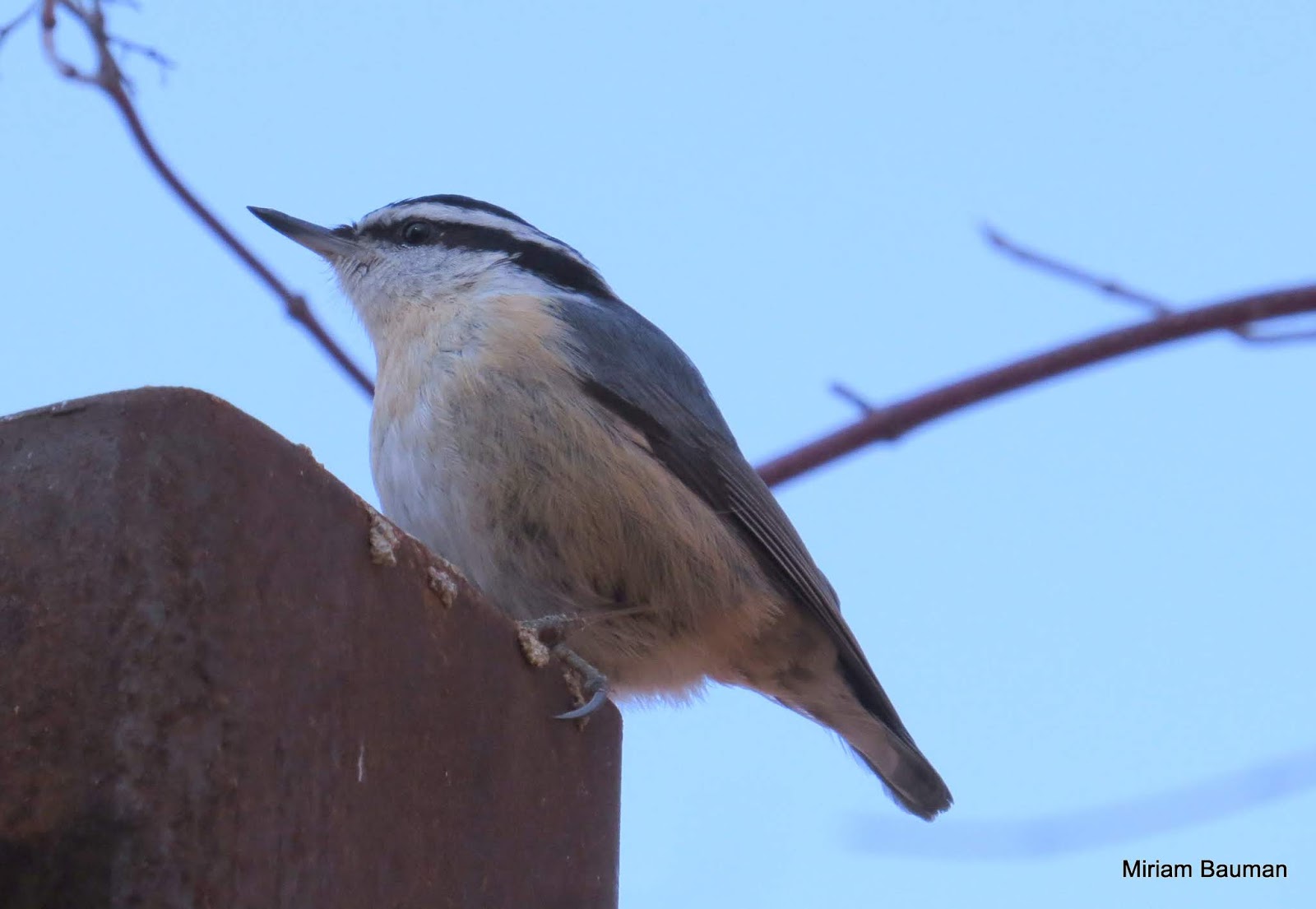
     Red-breasted Nuthatch (Sitta canadensis) was a very common species, being seen frequently throughout the woodlot.


     On our way back along the causeway we stopped at various points and a Merlin (Falco columbarius) accounted for the absence of songbirds in the immediate vicinity.


     Its crop was bulging so I suspect it might have just eaten and was resting to aid in digestion.
     The ice on the bay was starting to melt a little at the edges but in general it was still locked in ice.


     An American Beaver (Castor canadensis) had embarked on a particularly ambitious venture! When the ice recedes it will perhaps return to finish the task.


     Invasive phragmites are a real problem throughout Ontario's wetlands, and while a major (and expensive) attempt at removal is underway at Long Point, it remains a serious issue.


     Hooded Mergansers (Lophodytes cucullatus) aplenty were seen close to shore, males outnumbering females each time we saw them.


     Ring-necked Duck (Aythya collaris) was also quite common. In the photograph below you can actually see the very faint ring for which this species is named - a name (along with a few others) that seems to have been conferred by a taxonomist with a perverse sense of humour!


     We saw literally thousands of Tundra Swans but only two Mute Swans (Cygnus olor) the entire day.


     But there were many, many Canvasbacks (Aythya valsineria).


     Just before leaving the causeway to begin our journey home we pulled over to the side for one last look at the Tundra Swans, a fitting end to a day of excellent birding, another encounter with nature at its best.


     We will return in the fall when the swans undertake their reverse migration to winter off the Atlantic coast. À la prochaine, mes amis!

Land Acknowledgement

We acknowledge that the land on which we are situated are the lands traditionally used by the Haudenosaunee, Anishinaabe, and Neutral People. We also acknowledge the enduring presence and deep traditional knowledge, laws, and philosophies of the Indigenous Peoples with whom we share this land today. We are all treaty people with a responsibility to honour all our relations.

Followers