Showing posts with label House Wren. Show all posts

Friday, July 02, 2021

Our Backyard and Beyond

 17 June 2021
Our Backyard, Waterloo, ON

     Our backyard continues to remain a safe haven for a range of wildlife, with food, water and shelter present, and native vegetation aplenty.
     I cannot think of a day when at least a couple of Mourning Doves (Zenaida macroura) are not there from first light until the end of day, and at times in the winter there have been more than twenty.
     Its familiarity does not detract from its delicate beauty.


     Evening Primrose (Oenothera biennis) is blooming prolifically at present and delights us when we sit out on the patio.


     Common Grackles (Quiscalus quiscula) are regular visitors to the feeders, and it is not surprising that they have been bringing their young to visit.


     The fledglings lack the iridescent sheen and the yellow eyes of their parents.


     They are fully capable at this stage of taking care of themselves, but waste no opportunity nevertheless to cadge from mom and dad - usually with great success.
     A regular visitor is a male Northern Cardinal (Cardinalis cardinalis) seemingly in the process of moulting his head feathers.


     We call him Scruffy - in the most affectionate way I hasten to add!
     This fledgling cardinal was constantly begging from its parents.


     And it worked every time!


     His patient, long-suffering and devoted mother is seen below.


18 June 2021
Laurel Creek Conservation Area, Waterloo, ON


     Other than for a few very common species, it was difficult to find birds; and the fact that the park was quite busy did not help the situation, so we applied our energies to insects primarily.
     The is a Hover Fly in the genus Cheilosia, commonly known as Blacklets.


     That's as far as I can get with the ID. There are almost 500 of these creatures worldwide, and they all look very similar to the uninitiated eye, and many of them are impossible to identify visually.
     Similarly, I am unable to name the species of the following Sweat Bee in the genus Lasioglossum.


     A very familiar Virginia Ctenucha (Ctenucha virginica) gave us no trouble at all.


     This is the larva of a Leaf Beetle in the family Chrysomelidae. A handsome little creature, don't you agree?


     Spotted Grass Moth (Rivula propinqualis) is quite common at this time of the year, but easily overlooked.


     Herb-Robert (Geranium robertianum) does not seem to host many insects or their larvae; in fact the odour of its crushed leaves is claimed to repel mosquitoes.


     This American Robin (Turdus migratorius) was gathering food to take back to the nest to feed its young.


     It is conventional wisdom that most bird species find the Gypsy Moth caterpillar distasteful but this individual seems to have included them on its menu. Miriam and I have also witnessed Common Starling (Sturnus vulgaris) battering Gypsy Moth larvae against the ground and either consuming them or flying off with a beak full.
     We were very happy to find a cooperative Hobomok Skipper (Poanes hobomok),


     Northern Crescents (Phyciodes cocyta) can be seen flitting everywhere.


     The caterpillar of the Gypsy Moth is quite beautiful but its impact on a deciduous forest is devastating.


     Following is a picture of a Long-legged Fly in the family Dolichopodidae.


     Shown below is a pond spreadwing in the genus Lestes , but I am unable to extend the ID beyond that.


     Spotted Spreadwing (Lestes congener) would be my educated guess, but if anyone feels confident to confirm or refute this supposition I would be happy to hear from you.
     Clemen's Skeletonizer (Acoloithus falsarius) is an impressive name for a tiny insect!


     This species is known from wineries, but I am not sure whether it is a great hazard to the grape crop.
     There are over 35,000 Long-horned Beetles (family Cerambycidae) in the world, and identification other than by an expert in this taxon is extremely difficult. I am fairly confident based on the research I have done, and on probability, this individual belongs in the genus Oberea.


     As I have mentioned in previous posts, Bluets (Genera Coenagrion and Enallagma) are also difficult to identify as to species without having the insect in the hand, and sometimes under a microscope.


     Daisy Fleabane (Erigeron pulchellus) is widespread and attractive.


     We caught movement out of the corner of our eye and were happy to find a Common Carpet Moth, also known as White-banded toothed Carpet (Epirrhoe alternata).


     It is not often that we see American Yellow Warbler (Setophaga aestiva) on the ground.


      It has a bill full of food, no doubt to be relayed back to hungry nestlings.
     Calico Pennant (Celithemis elisa) is an exceptionally handsome dragonfly, and Miriam captured a couple of great shots of a male.


23 June 2021
RiverSong Banquet Hall, St. Jacobs, ON


     After a long hiatus when COVID restrictions prohibited lunch on the patio, it was finally possible to resume this very pleasant activity.
     I am quite sure that this newly fledged Grey Catbird (Dumetella carolinensis) was very happy to see us.


     Better it get up off the ground and into the dense bushes where it will be appreciably safer.
     A Red-spotted Purple (Limenthis arthemis astyanax) went about its business unconcerned, although it too would be wise to be vigilant. We saw both Eastern Phoebe (Sayornis phoebe) and Eastern Wood Pewee (Contopus virens), both of whom would find a large butterfly a very tasty treat.


     Widow Skimmer (Libellula luctuosa) was quite common, and this is a male in prime condition.


Much of the Canada Goldenrod (Solidago canadensis) was brown and withered and has been subjected to a full frontal attack by a beetle of some kind. I am unable to identify the larvae. (See YAM's comment below).


     The cheery song of the House Wren (Troglodytes aedon) was seldom out of earshot, and it was a delight to be in the company of this ebullient musician.


26 June 2021
A drive through the country, Region of Waterloo, ON

     It was hot and sticky, not the kind of weather to go for a walk, so we decided on a drive through the country.
     And what could be more pleasant than this?


     This foal was sticking close to mom, but when the mare approached Miriam at the fence, obviously hoping for a carrot or an apple, the foal was not reluctant to make friends too.


     Scenes such as this are the stuff of pure delight.


     A Savannah Sparrow (Passerculus sandwichensis) signified its approval.


     As might be expected in late June, young birds are popping up everywhere.
     This recently fledged Tree Swallow (Tachycineta bicolor) was waiting patiently for devoted parents to fly by and stuff an insect into its waiting bill.


     Looks like mom is coming right now!


     And young Barn Swallows (Hirundo rustica) were no less anxious to be fed.


     This Common Starling, bashing a Gypsy Moth caterpillar into submission, no doubt had hungry mouths back at the nest to take care of.


     Until the next time, be sure to get out and enjoy nature. There is nothing quite like it!   


Friday, June 04, 2021

More Local Satisfaction and An Introduction to David's Dell

     Life continues as normally as can be expected given the circumstances, and we keep hoping that substantial easing of restrictions is in sight, but we stay the course whatever direction it takes, and hope for better days to come. 
     In the meantime we are not starved for exciting adventures in nature.

29 May 2021

Waterloo, ON

     Only a few minutes away from our home a pair of Western Ospreys (Pandion haliaeetus) has bred for several years, and we frequently check on the status of the nest. While in that area we seek out other treasures and the rewards are not slow in coming.
     Gazing through teasels (Genus Dipsacus) is pleasure enough.


     A Willow Flycatcher (Empidonax traillii) was trilling joyfully and was reasonably open for a picture. It would be nice if the branches weren't in front of the bird, but we are shooting in nature not in a studio, and everything can't be arranged to suit the photographer.


     Several Song Sparrows (Melospsiza melodia) sang to us in their usual robust fashion, undeterred by the presence of humans close by.


Laurel Creek Conservation Area, Waterloo, ON

     Making good use of our pass, we visited Laurel Creek once again.


     Our first stop was at the Dignity Memorial Grove.


     It is a commendable endeavour that local businesses have partnered with the Grand River Conservation Authority to plant trees. Would that more would join in such synergistic and wholly beneficial projects.
     There is provision within the grove to have a bench installed in memory of a friend or family member who has passed on - or is still living I suppose, but that appears not to be a practice as far as we could tell. 
     Here we saw our first ever Silvery Blue (Glaucopsyche lygdamus), a small butterfly, the male being wondrously blue on the upper wings, but as it usually lands with wings erect, this feature is unseen in the picture.

     
     We have settled on a small copse with a path through it as our favourite spot at Laurel Creek; quite arrogantly I have named it David's Dell.

     It is home to a very agreeable range of birds, including the gorgeous Great Crested Flycatcher (Myiarchus crinitus), a bird that announces its presence with a clear, emphatic whistle.


     Two or three Eastern Kingbirds (Tyrannus tyrannus) were busily flycatching in their usual perch- and-sally method.


     A Common Eastern Bumblebee (Bombus impatiens) has a full load of pollen as evidence of a successful bout of foraging.


     A honey bee, probably Western Honey Bee (Apis mellifera), was also active on the flowers laden with pollen and nectar.


     We know that at least two House Wrens (Troglodytes aedon) are present, and we suspect that we are hearing two very loud and persistent males singing while their partner is sitting on eggs.


   How joyful to hear this tiny bird pour forth his ardour for all the world to hear, his very body vibrating from the effort.


     An Eastern Wood Pewee (Contopus virens) is a little more restrained, but no less charming.


     The high pitch of its song is outside my hearing range but Miriam is able to detect it, and as she often does she operates her ears for both of us!


    What the heck, one more picture can't hurt!


31 May 2021
Laurel Creek Conservation Area, Waterloo, ON

     Let's visit David's Dell together.


     I guarantee that a pleasant time will be had by all.


     As has repeatedly been the case of late, a Great Crested Flycatcher was there to greet us.


     The House Wrens were singing loudly in the background - such a burbling, effervescent, rollicking song. No Oscar-winning motion picture ever had a soundtrack to rival it.
     But it was about to get a leap in magnitude better.
     I was focused on a wren, when Miriam said with deliberate casualness, "Do you want to see this cuckoo?"
     And there, as splendid as any bird might be, was a Black-billed Cuckoo (Coccyzus erythropthalmus). 


     To see a cuckoo of any species in North America is always memorable.


     Black-billed Cuckoo is one of the few species to seek out the caterpillars of defoliating moths and given the overwintering egg masses of Gypsy Moth (Lymantria dispar) there is food in abundance this year.


     Not only did we have fantastic views of the bird it showed no hesitation to stay and provide us with several additional minutes of enjoyment.


     Remember - we are five minutes from home!

     The only thing I could think of to top the sighting of the Black-billed Cuckoo would be a Yellow-billed Cuckoo (Coccyzus americana). Et voilà mes amis!
A Yellow-billed Cuckoo within a champion spitter's distance of its black-billed cousin.


      Were we prone to such practices we would have high-fived, danced a jig and said prayers of thanks.
Instead we concentrated on seeing the bird and Miriam took picture after picture.


     Are you enjoying your time in David's Dell? Are you glad you came along?


     This is by any measure a remarkable one/two punch!
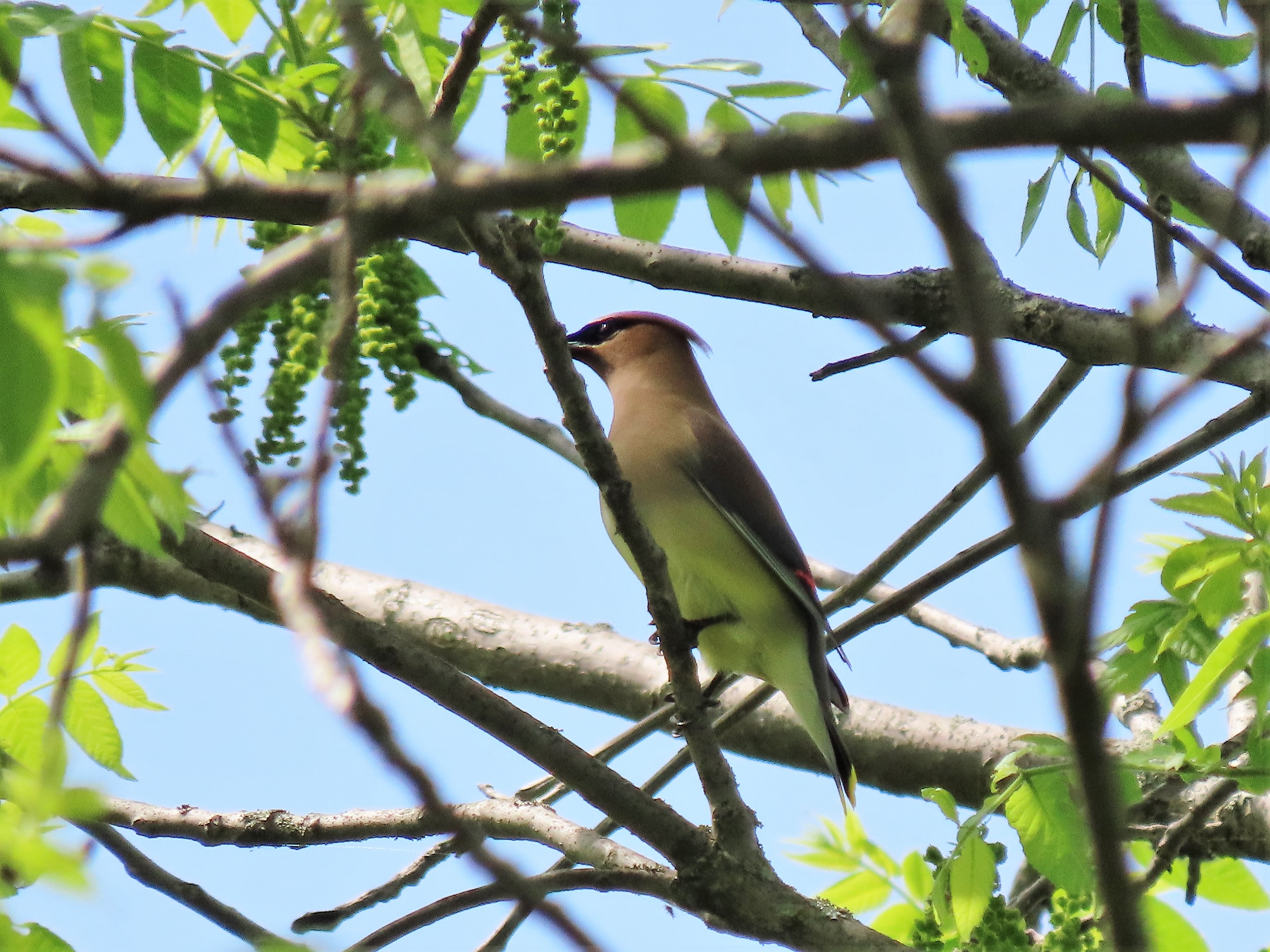
     A Cedar Waxwing (Bombycilla cedrorum) seemed inconsequential by comparison!


     And in the botanical department we did well too, finding a small patch of Yellow Lady's Slipper (Cypripedium parviflorum), a beautiful woodland orchid.


     On the way out of the park we spotted another Willow Flycatcher, Miriam having heard it first, but it was a little farther away than the one in David's Dell.


     A Great Blue Heron (Ardea herodias) resembling a creature from a primordial past flew effortlessly overhead.


     A solitary Wild Turkey (Meleagris gallopavo) in the meantime took a break.


02 June 2021
Laurel Creek Conservation Area, Waterloo, ON

     This was the last evening we would have the pass provided by the Waterloo Public Library, so we made a thermos of decaf coffee and along with two of Miriam's homemade cookies we went down to enjoy it in David's Dell.


     We have received so much enjoyment from the free pass we are resolved to buy an annual pass and continue our visits to GRCA properties. There are many more to explore.
  

Land Acknowledgement

We acknowledge that the land on which we are situated are the lands traditionally used by the Haudenosaunee, Anishinaabe, and Neutral People. We also acknowledge the enduring presence and deep traditional knowledge, laws, and philosophies of the Indigenous Peoples with whom we share this land today. We are all treaty people with a responsibility to honour all our relations.

Followers