Showing posts with label Franc Gorenc. Show all posts

Tuesday, June 08, 2021

Sand Martins (Bank Swallows) and Lily

     Franc and Carol have purchased a large RV and needed a place to store it while they are not travelling the highways and byways. And there is a whole interesting sidebar to the place they chose.
     Almost as soon as they entered they saw Sand Martins (Riparia riparia) flying around (this species is known as Bank Swallow in North America). One does not encounter Sand Martins frequently these days. It is a species at risk, its population continent-wide having declined a staggering 98% over the past forty years.
     They knew that I would be interested in seeing this colony, in addition to a group of Barn Swallows nesting in one of the buildings, and kindly invited me to go there with them.


     Let me add right away that the photographs in this section are Franc's. Anyone who has ever tried to capture a swallow in flight knows the challenges involved, and the images are quite remarkable.
     The colony appears to be of a decent size with nest tunnels excavated in different sections of a suitable cutaway bank.


     The swallows enter and exit the holes at such speed it is impossible to get a picture unless they pause briefly at the entrance.


     Franc has vowed to return with a tripod, a seat, more time and a surplus of patience to see if he can do better!
     What was of greatest interest, however, was not the natural bankside nest site. Large concrete blocks have been used as a retaining wall, and there is a hole in the centre of each block, used to lift them if I am not mistaken.


     The swallows have readily adapted to this nesting habitat and were observed constantly flying in and out of the holes. There is apparently sufficient space for nest construction inside the block and room for the bird to turn around to go back to foraging.
     The blocks, lined up one after the other must in some way resemble a natural site.
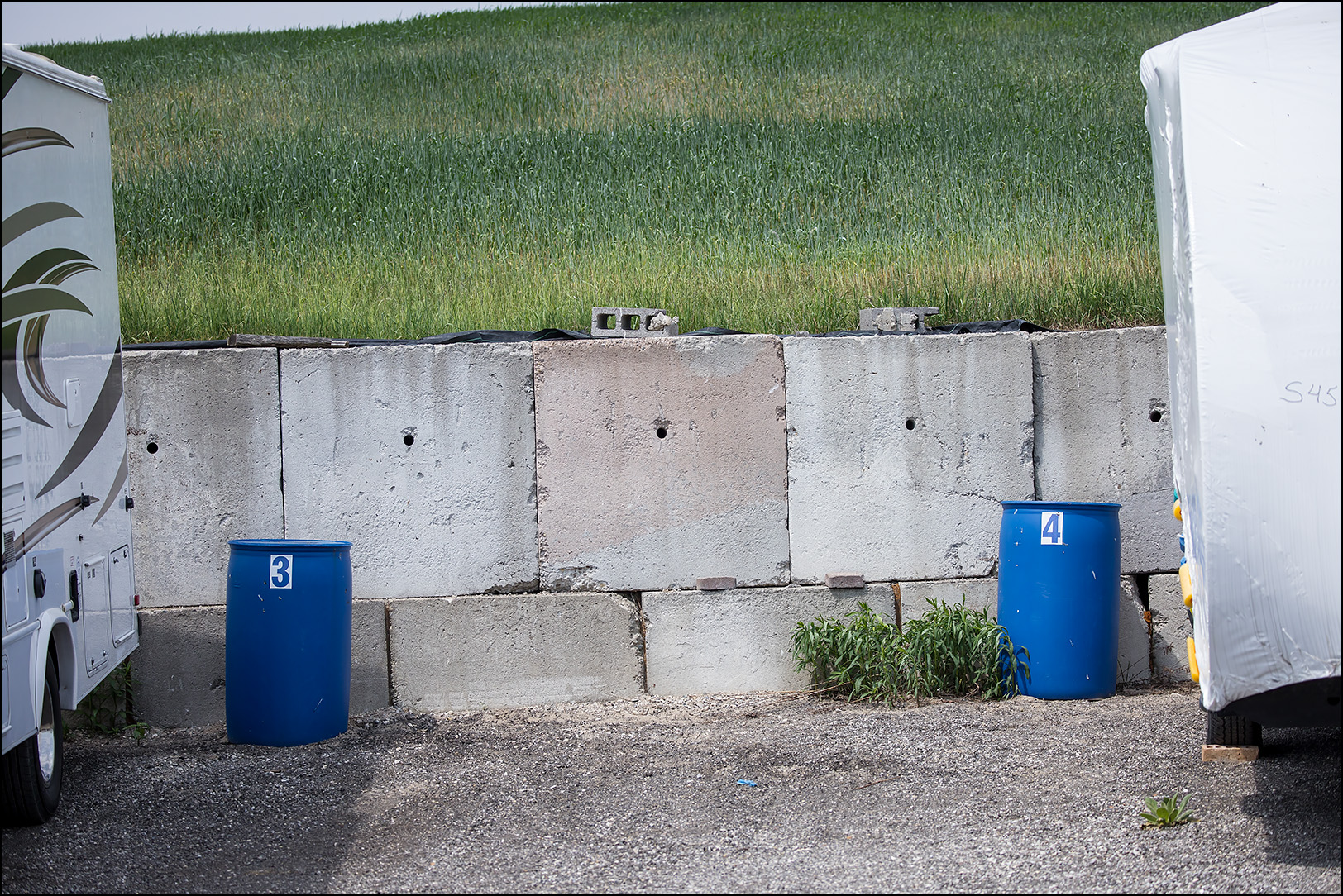

     Maybe we can talk the owner into installing a second layer!


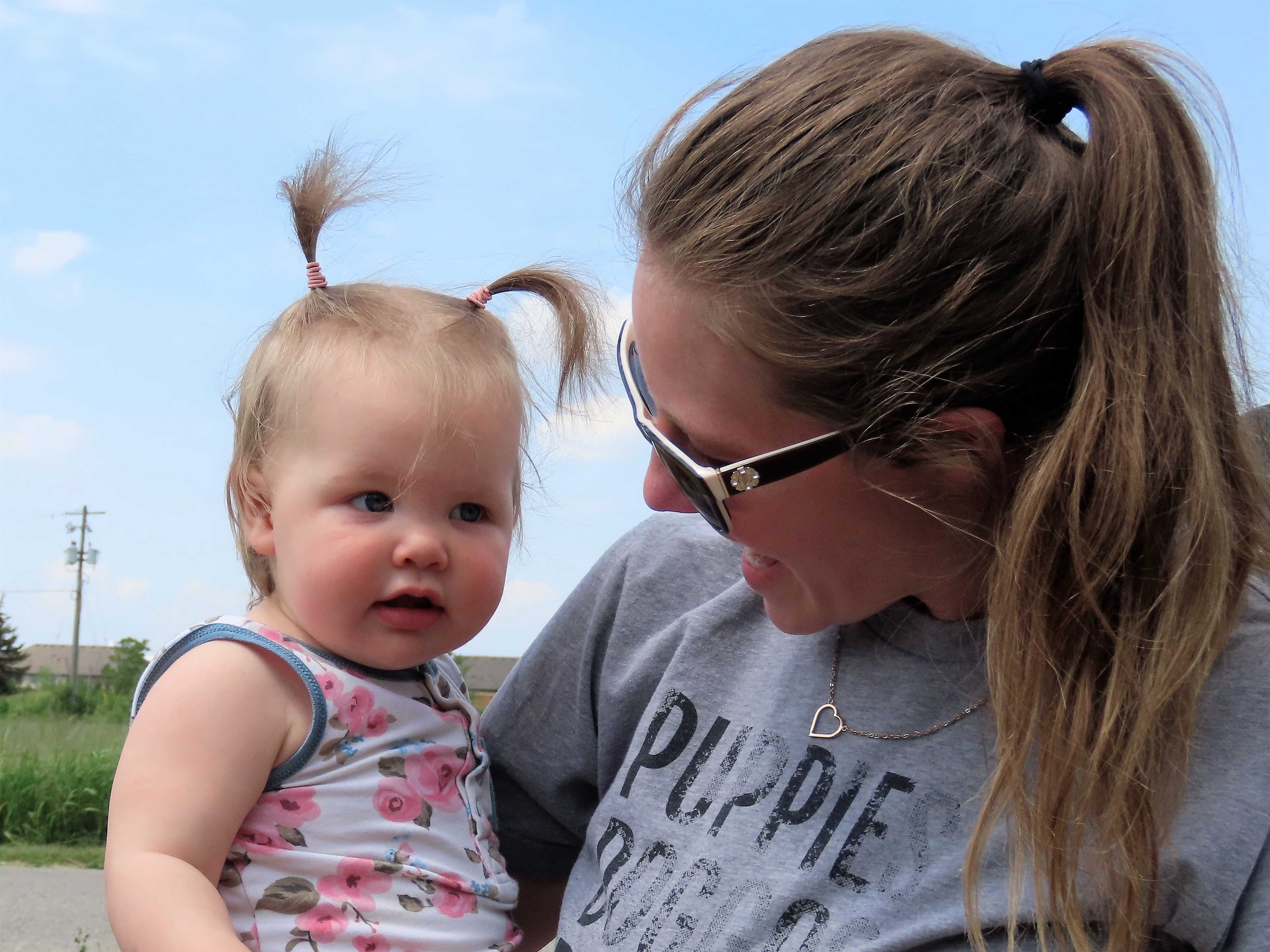
     The current regulations in regard to COVID permit groups of five people from different households to get together outdoors, so we were finally, after several weeks, able to resume our walks with Heather and Lily. It is hard to believe but on 20 June, a mere twelve days from now Lily will be a year old.
     
Mommy slathering on sunscreen.

I will have to decide whether I like that or not.

I already tossed one shoe on the ground. Here comes the next!

Gotta let everyone know who's in charge here!

Time to say goodbye. See you next Friday.

     Heather and Lily wish everyone a happy summer. See you again soon.

Thursday, October 08, 2020

Tuesday Rambles with David - The Mill Race, St. Jacobs, ON

 06 October 2020

     The pandemic has meant that we have not been able to meet frequently this year to conduct our normal Tuesday walks, but of late we have ventured out together a few times. It has been possible to maintain a semblance of social distancing, we have dispensed with our customary hugs, and since being outside carries less risk of transmission of the virus we felt safe in resuming our rambles. And eight participants is well below the provincial guidelines for outdoor gatherings.
     Today we were all present, and the Mill Race seemed like a great place to walk. Both Mary and Francine had appointments in the early afternoon, so a local trail demanding only a couple of hours to complete was just the ticket. 
     The Conestogo River, just metres from the parking area, looked tranquil and inviting, tinged by the suffused light of an autumn morn.


     A Great Blue Heron (Ardea herodias) methodically worked the river in search of breakfast.


     We entered the trail together, eager to explore.


     Falling leaves no doubt evoke in all of us the urge to kick them up to regain the spirit of our erstwhile youth, but perhaps in the twilight of our years a flotilla on the water is more appealing. It is without doubt a tapestry waiting to be painted by a skilled artist.


     From this point on, Miriam yielded the camera-wielding duties to Franc, who in his normal fashion produced images of such crispness and clarity, they beg to be exhibited for all the world to see.
     Many American Robins (Turdus migratorius) were feeding on berries of various kinds, and hatch-year birds joined adults to fatten up for migration, although in recent years many have remained here to tough out the winter.


     Black-capped Chickadee (Poecile atricapillus) is a perennial favourite with everyone, even with non-birders who can barely tell a robin from a pumpkin!


     White-breasted Nuthatch (Sitta carolinensis) is often found keeping company with chickadees, especially outside the breeding season, and with a little patience can be coaxed into feeding from the hand. 
      I  think that Franc has captured the very essence of a nuthatch in this picture. It is by any reckoning a gorgeous shot.


     We happened upon a small flock of Pine Siskins (Spinus pinus) busily feeding and going about their business, a gathering that captivated all of us.

     Of course, birds are not the only creatures we encounter on the Mill Race and Eastern Chipmunks (Tamias striatus) have learned to follow humans, where the reward of a free meal may confidently be expected. 


     This little rodent does not encounter the hostility often directed at other members of his extended family. Perhaps its cousins all need to invest in stripes!
     I have saved the best till last. A late migrating Yellow-billed Cuckoo (Coccyzus americanus) darted out from some dense vegetation and perched very obligingly for us in a small tree no more than ten metres away.


     Not only was this bird very accommodating it stayed there for at least ten minutes, all the while in full view. The stillness of the morning air was interrupted only by the staccato fire of Franc's camera.


     This is an uncommon species north of Lake Erie - see Godfrey (1986) - ".....commonly in Lake Erie region but rarely north to Manitoulin Island, Sudbury and Ottawa". It was my first sighting ever in Waterloo Region.


     It is a very handsome bird, and unlike many cuckoos throughout the world is not a brood parasite, but builds a nest and raises its own young.


     As you may see, one rarely experiences a more cooperative bird and Franc was able to capture it in various poses.
    I have to note that this species is a bit of a holy grail for Francine, a bird of her dreams, a fantasy to be fulfilled, a quest for El Dorado. 
     Unfortunately, Francine had walked far ahead of us and was not present for this heavenly apparition!
     There seems to be little doubt that by some karmic engagement, the cuckoo had Francine in mind when it showed up so boldly, anxious to charm her. Where is she, it seemed to say? 
     Finally, having tarried long, and revealed itself in every way possible, having perched, preened and waited, it decided to bid farewell. With a wave of its foot and a cry of "Goodbye" it went on its way.


     Don't fret, Francine. I have lived here for eighteen years and this is my first local Yellow-billed Cuckoo, so I expect that in 2038 it will be your turn.
     A little patience is all that is required!


Tuesday, November 12, 2019

An Eagle or Two.

08 November 2019

     It was Judy who suggested we should go and look for eagles. 
     Sounded like a fine idea to me, so I canvassed the members of our Tuesday group, and had but two other takers, Miriam and Franc. The others had prior commitments or simply did not wish to go.
     The period covering the first two weeks of November is the prime time for southward movements of Golden Eagle (Aquila chrysaetos). The winds have to be right, strong north-westerlies being ideal, and Friday's forecast seemed made to order. A consensus was reached; hawk watching we would go!
     Our destination was the aptly named Hawk Cliff, near the lakeside community of Port Stanley in Elgin County, hard by the upland contours of the land as it skirts along the north shore of Lake Erie. The conditions could not have been more perfect, both for migrating raptors and for human observers. At times hawk-watching can resemble nothing so much as an exercise in masochism, undertaken by people otherwise quite normal in their lives. Not so today. The sun shone, the temperature was a mere smidgen below zero, and the winds came as close to perfection as could be.
     Judy was the only one with an intimate knowledge of the area and she found a perfect clearing for us from which to scan the sky. A farmer had very obligingly cleared some of the corn from his field, and that which was left standing gave us a windbreak, and a clear view of the usual flight path of migrating raptors. 


       We set down our chairs and settled in to begin the vigil, warmly dressed, and with a thermos of hot coffee. Barely had our behinds nestled into the seat than Miriam said, "Two hawks coming in." And so began a non-stop movement that was as spectacular as any I have witnessed. Our chairs were not occupied again until lunch time!
     The sky was filled with birds; all the raptors we might hope to see. Additionally, hundreds of American Crows (Corvus brachyrynchos) were moving through and there was activity in every direction. Even when the passage of hawks and eagles slowed for a moment there was a constant stream of Turkey Vultures (Cathartes aura) which did not abate all day.


    I have to tell you that Judy is a retired anesthesiologist; a profession requiring a calm head and a steady hand. That description bore faint resemblance to "Hawk Watch Judy," who was as giddy as a newly emerged mayfly in summer. "Look here, David," she said, and as I did she yelled, "Oh, look over there." As my eyes pivoted she screamed, "Golden Eagle coming in to the left" - and so on. It was that kind of day. It was hawk watching at its very best.
    Red-tailed Hawks (Buteo jamaicensis) were the most numerous of the raptors, and we saw this polymorphic hawk in every plumage imaginable, and in every age class. We saw them high, we saw them low. At times they cruised above our head, and circled lazily: at other times they hurtled through as though they had a thermal to catch.


     Franc, fully expecting the birds to be higher, had taken a monopod and a larger lens than he normally would, and he felt he was hampered somewhat by his choice of equipment. Nevertheless, he achieved results for the record book, high quality images displaying the birds at their best. Ever modest, he demurs at the suggestion that we are mightily impressed with his results. I will let you be the judge.
     The holy grail of raptor watching in southern Ontario is without doubt  Golden Eagle (Aquila chrysaetos). Sometimes, even with dedicated effort, and freezing hands and feet, with face reddened from the biting wind, and several journeys to renowned locations, you can miss the migration entirely. Today we had five, possibly six individuals, since we were not quite sure whether one bird had doubled back on us.


     For those not familiar with the species, a Golden Eagle derives its name from its golden nape, clearly visible in the pictures above.
     We were all in awe. These birds cut through the winds like a hot knife through butter. They render you speechless with their strength and power. They are indeed royalty and we are but peasants in their presence.
     Bald Eagle (Haliaeetus leucocephalus) is far more common than in times past, but it does not suffer at all from familiarity. It is an impressive bird by any measure, adult or juvenile.


     Red-shouldered Hawk (Buteo lineatus) is not a species I see frequently during the breeding season, some years not at all, so a cohort of them on migration is always a welcome opportunity.


     As far as I recall we saw but one Northern Harrier (Circus hudsonius), and Franc managed to get a picture.


     There were small numbers of other raptors, including Merlin (Falco columbarius) and American Kestrel (Falco sparverius), but the main excitement is covered above.
     I wish to express my deep gratitude to Franc for downloading and editing his pictures so quickly. He set aside other files he was working on to get me these images for my blog. To Judy, "Thanks for suggesting the outing in the first place."
     The final shout-out I would offer is to Brian K. Wheeler for his book Raptors of the East which I reviewed for Princeton University Press when it was published last year. It simply is the very best. You need nothing else!


Wednesday, July 17, 2019

Tuesday Rambles with David - RIM Park, Waterloo, ON

16 July 2019

     By 08h:00 it was already quite hot, and the forecast was for a scorcher of a day, with thunderstorms in the afternoon. But the morning was great for a walk, and Miriam and I were joined by Franc and Carol, and Jim and Francine.
     A Great Blue Heron (Ardea herodias) was standing at the water's edge in the strangest pose, and initially we wondered whether it was injured.


     Soon enough, however, it folded its wings back into their normal position, and looked like any Great Blue Heron you are likely to encounter.


     As if to prove the point that all was well, it began stalking for prey, in that slow, deliberate manner of herons.


     In the parking lot at RIM Park there are two active nests of Western Osprey (Pandion haliaetus), quite close together actually, atop the tall light standards that illuminate the parking areas at night.


     At least one nest had young and periodically they would stretch above the rim of the nest, but we were never quick enough to get a picture.
     It is interesting to note that these pairs tolerate each other and we have never witnessed any hostility between them. I suppose it speaks to the fact that the biomass of fish in the Grand River is adequate for both pairs to secure food without conflict. 
     Orchard Oriole (Icterus spurius) is a species that appears to have extended its range in recent years, and we encountered both males and females carrying food, and one fledged juvenile.


     The grassland areas were lush and full of insect prey, and the orioles and other species were taking advantage of a ready source of food. A female Red-winged Blackbird (Agelaius phoeniceus) was carrying food to hungry mouths.


     A newly fledged Eastern Kingbird (Tyrannus tyrannus) waited patiently for dedicated adults to bring food.


     Male Ruby-throated Hummingbirds (Archilochus colubris) are noted for their fierce defence of territory and no doubt this individual had no intention of letting rivals enter his space.


     The City of Waterloo has located a number of nest boxes throughout the area and House Wrens (Troglodytes aedon) appear to have had a banner nesting season, for we witnessed evidence of breeding in three different boxes.


     This recently fledged youngster had found it convenient to occupy the roof of the nest box and wait for devoted parents to bring food.


     In addition to the birds we so eagerly sought, the park was alive with wildflowers of many hues. 
     Tiger Lilies (Lilium lancifolium) nodded in the wind in extravagant splendour.


     This species was introduced from Asia as a garden plant but quickly became established in the wild. In fact several similar species are commonly referred to as Tiger Lily and are ubiquitous through many regions of the province.
     We saw a few Cedar Waxwings (Bombycilla cedrorum) but always back-lit, or in deep shade. 


     This frugivorous species, which nests quite late, is now busy with the serious business of nest construction and egg-laying, and the breeding season will command each pair's attention for several weeks yet.
     As we left to return home an Eastern Meadowlark (Sturnella magna) was singing lustily from an overhead wire. We are not sure whether it was a fond goodbye or a cry of good riddance!


     It was a very pleasant morning, and weather permitting we will do it again next week.

Land Acknowledgement

We acknowledge that the land on which we are situated are the lands traditionally used by the Haudenosaunee, Anishinaabe, and Neutral People. We also acknowledge the enduring presence and deep traditional knowledge, laws, and philosophies of the Indigenous Peoples with whom we share this land today. We are all treaty people with a responsibility to honour all our relations.

Followers