10 June, 2023
A meander through the countryside
There is a spot on Three Bridges Road, St. Jacobs where someone routinely fills a bird feeder with seed and replenishes cakes of suet when they have been eaten.
This young Raccoon (Procyon lotor) was making short work of this one.

Probably the best the birds could do was to glean the crumbs that fell to the ground.
A Great Blue Heron (Ardea herodias) had other food on its mind.

One usually associates herons with fish, amphibians, and other aquatic species but they are very adept at stalking through a grassland and capturing rodents, sometimes as large as Groundhogs (Marmota monax), and snakes. A lightening strike from a heron, delivered with pinpoint accuracy, permits few prey to escape their fate.
A Song Sparrow (Melospiza melodia) probably has little to fear, but all the same, better to be wary.

We are fortunate that Cedar Waxwing (Bombycilla cedrorum) is resident in southern Ontario so that we may enjoy it throughout the year.

14 June, 2023
Near Milverton, ON
There is a thrift store in Milverton that we check if we are close by; Miriam has found some great fabric buys there and I have been equally fortunate with books.
An additional bonus this time around was a field with young Eastern Meadowlarks (Sturnella magna) and young Killdeer (Charadrius vociferus).
The birds were moving around quite a bit and were in and out of long grass but we are pretty sure there were two attentive adults and four young of each species.
Here is a couple of the recently fledged meadowlarks.


And a devoted parent still delivering food.

Baby Killdeer are fuzzy, super-cute, little replicas of their parents, born precocial and ready to leave the nest and forage for themselves within hours of hatching.

The adults remain close by, however and are a virtual paradigm of the distraction display for which many ground-nesting birds are renowned.


As is true for all parents, once in a while you just need to take a break!

18 June, 2023
Lakeside Park, Kitchener, ON

Lakeside Park is yet another pleasant oasis in a sea of urbanization and a visit there is always enjoyable.
Bluets (genus Enallagma) are especially difficult to identify as to species, especially the males for whom detailed examination of the claspers is required. Since we do not catch, but only observe odenates, specific identification is frequently well nigh impossible.

The above individual is probably a Marsh Bluet (Enallagma ebrium), but I cannot say with certainty.
A male Red-winged Blackbird (Agelaius phoeniceus) presents no such difficulty.

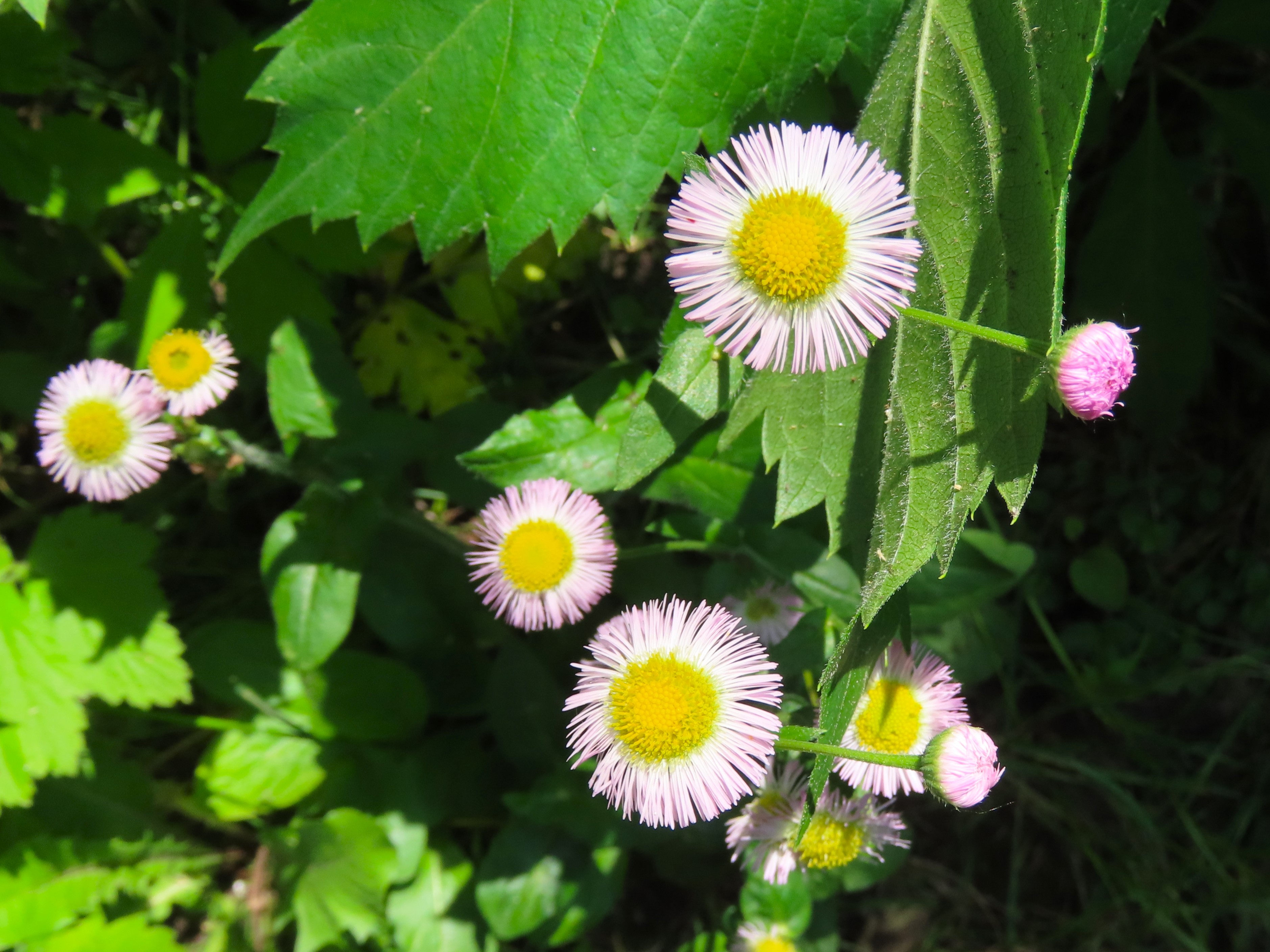
Philadelphia Fleabane (Erigeron philadelphicus) prospers widely, even in disturbed areas with relatively poor soil.
This young Northern Flicker (Colaptes auratus) provides evidence of a successful breeding season - at least for one family.

Downy Woodpecker (Dryobates pubescens) is familiar to all.

Common Grackle (Quiscalus quiscula) is quite aggressive at bird feeders and for that reason is disliked by some, but I find it an interesting and attractive bird.

The lake looked serene on a warm June day.

A flotilla of Canada Geese (Branta canadensis) is the watery equivalent of cattle grazing peacefully in a field.

This young Red-winged Blackbird was finding its way in life.

It's hard to know at this stage whether it's a male or a female, but if a male, this is what he will look like when he grows up.

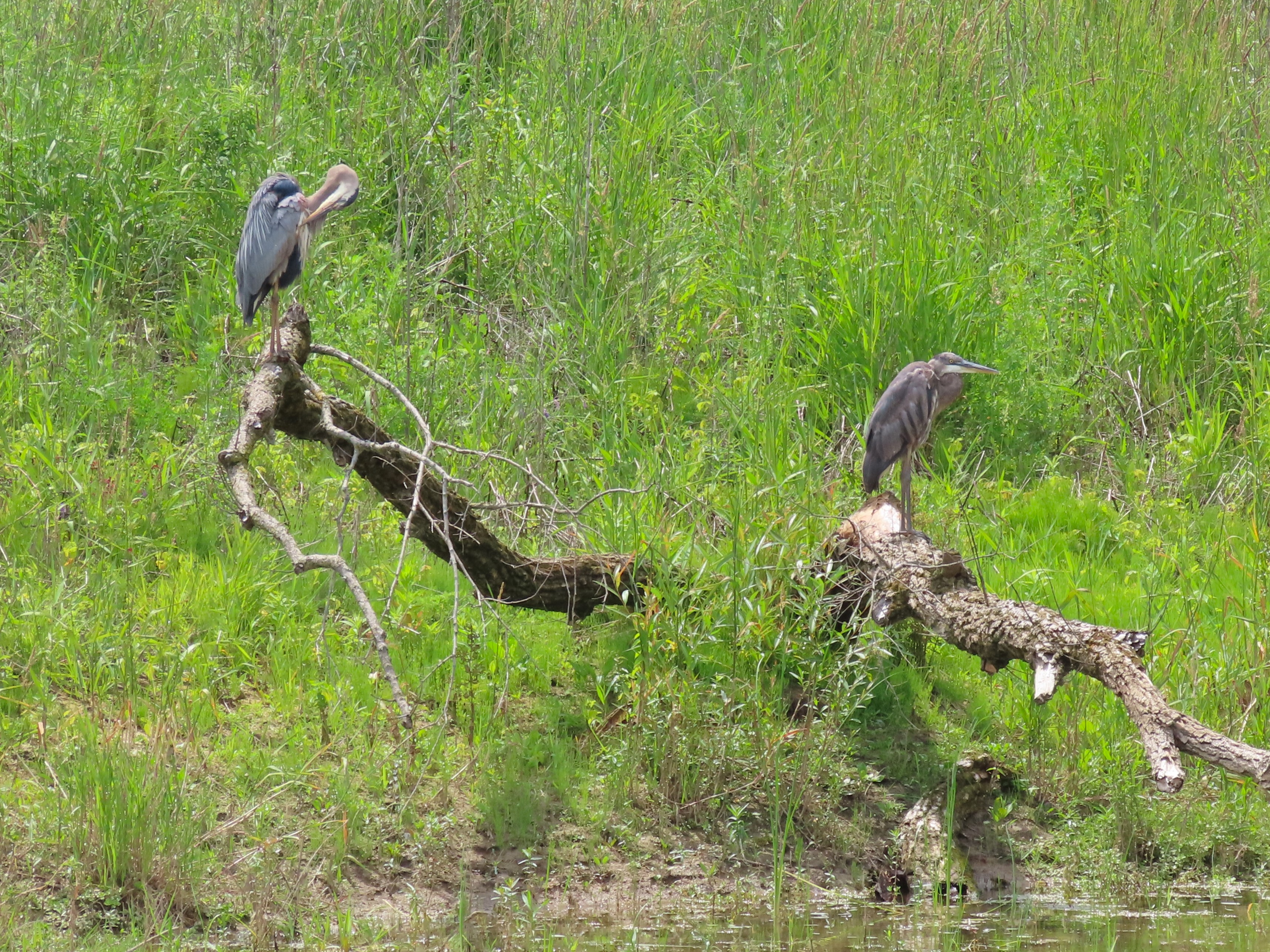
A Great Blue Heron was poised at the water's edge.

As soon as we see our first Common Whitetail (Plathemis lydia) - and they are very easy to identify - they seem to be everywhere.

One sees the cycle of predation quite clearly with this species as they hawk for mosquitoes and other insects over the water, all the while being eagerly sought by predators higher up the food chain. I think we may heave a sigh of relief as humans that we are generally not considered food by other animals, all the while plundering every species on Earth for our own satisfaction.
As mentioned above, Bluets usually resist identification, and I am unsure of this species.

In similar vein the following species poses a challenge, but I am leaning towards Skimming Bluet (Enallagma germinatum), with some level of confidence, though not a hundred percent.

The Great Blue Heron we had seen earlier decided that a different part of the lake was more favourable and made a spectacular landing.

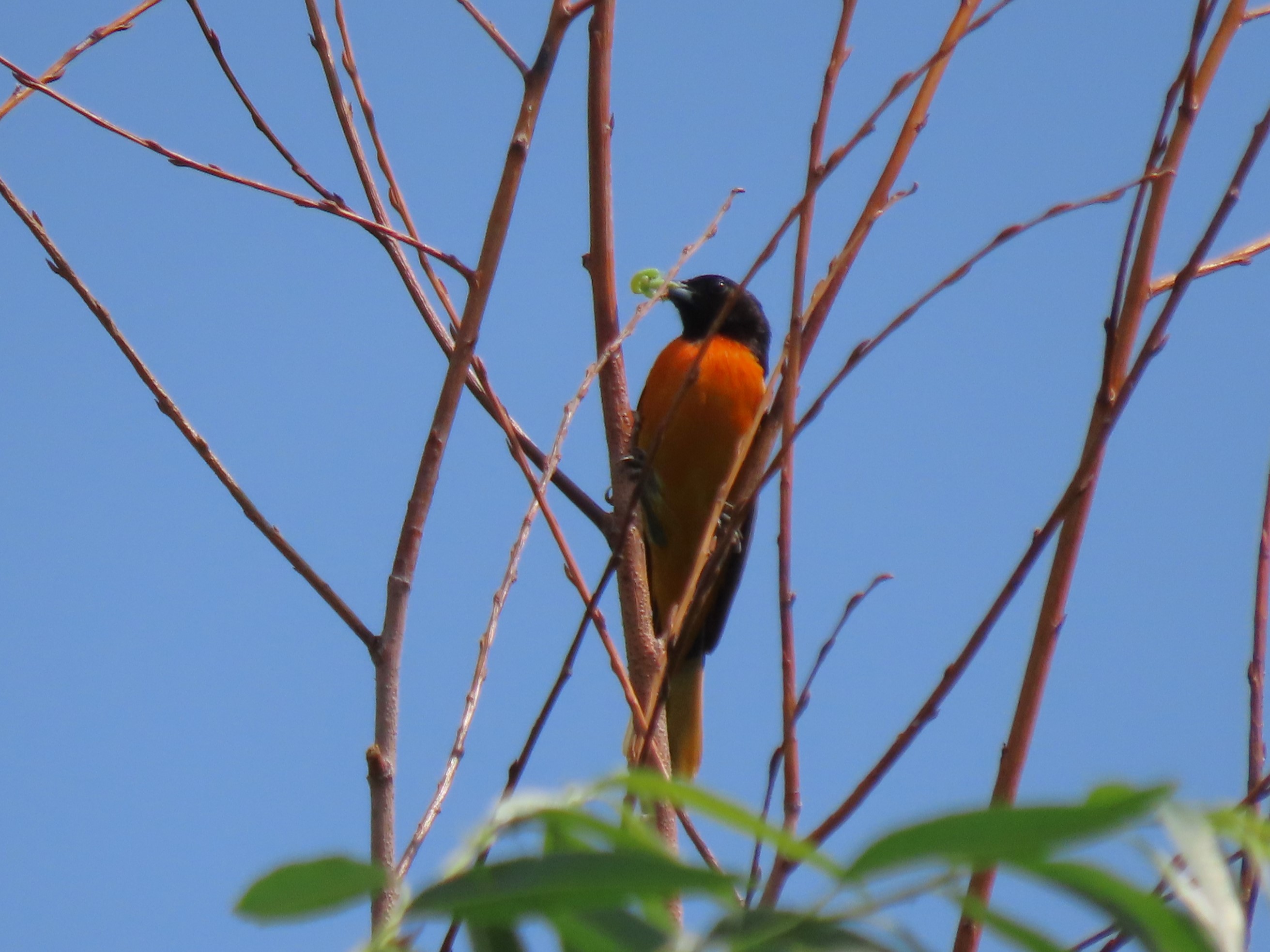
A short while ago I was bemoaning our loss of caterpillars, but I found myself cheering for this Baltimore Oriole (Icterus galbula) father who had captured a good supply of food for his hungry brood.
Such is the cycle of life.
Miriam loves Eastern Cottontails (Sylvilagus floridanus); Miriam delights in Eastern Cottontails - as long as they are not in her garden merrily chewing her flowers to the ground.

Then they become a visitor from Hell! This one in the park merited our approval and appreciation.
A juvenile Common Starling (Sturnus vulgaris) was one more example of nature renewing itself.

24 June, 2023
Another meander through the countryside
Three Bridges Road in St. Jacobs has a bridge spanning the Conestogo River and it is a reliable spot to look for Great Blue Heron.

On this occasion at least two Killdeer were also present.

You will no doubt remember that we are at the epicentre of Mennonite culture in southern Ontario, and at a meeting house on Three Bridges Road, Eastern Bluebirds (Sialia sialis) have successfully raised young for many years. This spring, however, we had not seen one, so were delighted to view a male, albeit on the farthest-most point of the fence surrounding the graveyard.

It remains still to locate a female, and evidence that a pair bond was formed and nesting occurred. Wish us luck!
It follows that because there are so many Old Order Mennonites (and Amish) who follow their traditional ways there are many horses too. They are domesticated, of course, yet remain the focus of our affection.

For the second day in a row the temperature has exceeded thirty degrees and I am saddened when I see these poor beasts trotting along pulling a conveyance of one description or another.
In Ontario (and in all likelihood in other jurisdictions) it is possible to rent swans for the season and a farm we pass regularly does just that. Obviously accustomed to people, and associating them with food, they swim towards us expectantly as soon as we stop the car.

I have cracked corn in the garage, and if only I thought ahead of time I could have taken some with me.
Red-winged Blackbirds are hard to miss.

On Bricker School Line, near Wallenstein, a Red-tailed Hawk (Buteo jamaicensis) surveyed his territory from atop a utility pole.

A little farther along several Savannah Sparrows (Passerculus sandwichensis) were very obliging in terms of posing for pictures.

Once again, we see evidence of the critical role caterpillars play in the next generation of birds.
An Eastern Meadowlark sang to us joyfully, his clear notes bouncing along on the warm air, yet he remained far away.

At the bridge on Broadway Street in Hawkesville, a substantial colony of American Cliff Swallows (Petrochelidon pyrrhonota) was destroyed a few years ago when serious flooding of the Conestogo River occurred. It was good to see that the birds are reclaiming their former nesting site.

Blue Flag-Iris (Iris virginica) is found in wet areas, marshes and alongside rivers and is quite seductive on a languid summer's day.

25 June, 2023
Mike Schout Wetlands Preserve, New Hamburg, ON

Miriam and I made our first visit to this impressive wetland reserve that recently had its official opening.
The project began in 2019 when Mike Schout approached the Township of Wilmot about utilizing 55 acres of undevelopable floodplain land that was given to the Township to create a preserve that would combine wildlife, the environment, learning, and the health and well-being of the community, that all could enjoy for years to come.
Bravo, Mike. Thank you on behalf of naturalists everywhere.

We were greeted by a stand of beautiful Purple-flowered Raspberry (Rubus odoratus).

A Western Honey Bee (Apis mellifera) was industriously probing the flowers for sweet nectar.

Many nest boxes have been erected and this was the only one that seems to have been claimed by House Sparrows (Passer domesticus). I doubt that any potential competitor would be anxious to challenge this male standing guard.

Viper's Bugloss (Echium vulgare) is an attractive wildflower that tolerates soil that would not support more delicate species.

A platform has been provided for a pair of Ospreys (Pandion haliaetus) - perhaps next year it will be occupied.

I was impressed by the creative use of branches to serve as perches for the birds. It seems such an elementary addition yet one seldom sees it here, as contrasted with similar structures in Europe where it is standard.
An Osprey was seen fishing over the Nith River; it doubtless already has a home but perhaps one of its young may claim this spot next spring.

Killdeers were abundant and have obviously found this preserve very much to their liking.

Tree Swallows (Tachycineta bicolor), that surpassingly beautiful denizen of its aerial realm, have claimed most of the nest boxes and several contained young with bottomless appetites, keeping their devoted parents busy.

I am not sure of the identify of this bee feeding on Tickseed (Coreopsis).

Here is a section of the strong, well-engineered boardwalk as we walked around.

'Tis the time of year for butterflies to be on the wing and a Northern Crescent (Phyciodes cocyta) was a delightful addition to our enjoyment of the day.

Brown-headed Cowbirds (Molothrus ater) have found the wetland exactly to their liking, it appears, no doubt able to exploit the various nests of other birds.

Here is another shot of the superlative boardwalk.

You will note the strategically placed logs to provide habitat for aquatic species and convenient basking platforms for turtles. This wetland has been carefully planned and executed, and all involved have every reason to be pleased with the outcome.
This Grey Tree Frog (Hyla versicolor) is exquisitely patterned and may well have been the highlight of this visit.

Not only have nesting structures been erected for Ospreys there are additional structures to encourage the formation of a heronry, with suitable platforms next to a forested area. Quite brilliant in my opinion.

Sweet Pea (genus Lathyrus) is always delightful. Even the name is pleasing.

Several Spotted Sandpipers (Actitis macularius) were bobbing and teetering in typical fashion.

Grape Midge Galls (genus Vitisiella) were in evidence.

Common Whitetails were as common here as they had been mere days earlier at Lakeside Park.

A young Tree Swallow waited patiently for its parents to swoop by, stuffing insects into its waiting bill.

We observed only one Northern Rough-winged Swallow (Stelgidopteryx serripennis), but there may have been some high fliers that we missed.

At one point eight Killdeers were present together, frequently bathing. This individual was drying off.

It is a sad fact that most ducklings do not make it for more than a few days, being picked off by hawks, snapping turtles, herons, foxes and other predators.
This female had succeeded in raising only one of a brood that probably began as eight or ten.

A type of Water-Plantain (genus Alisma) was thriving in a couple of spots.

Yet another Spotted Sandpiper was seen.

The intelligent planning that has gone into this location includes an area with suitable substrate for turtles to lay their eggs.

Not surprisingly, there were Small Milkweed Bugs (Lygaeus kalmii), so strikingly marked.

This Red-winged Blackbird had a very odd appearance, having lost all the feathers from its head.

I have not found any confirmation that this condition is part of the moulting sequence, but not having seen it often in a bird that is very common renders that supposition unlikely. Perhaps a parasitic overload is the reason for its denuded state. The bird appeared to be otherwise healthy.
This odd individual marked the end of our circumambulation of the wetland.

We are very happy to have discovered it and will return often to explore it in different seasons.
Bravo Mike Schout! Bravo Wilmot!