Showing posts with label Great Blue Heron. Show all posts

Sunday, November 08, 2026

Nature Makes Me Happy

     My whole life revolves around nature; it is the constant in my life. In one form or another it consumes most of my waking hours. In recent years the term Vitamin G has been coined, especially as it refers to those engaged in forest bathing in one or more of its various manifestations. Vitamin G stands for Vitamin Green and is known to be extremely beneficial to health and wellbeing. I have never taken part in ritualized activity as it relates to the embrace of the living world, but I have no doubt that a lifetime spent in the outdoors has provided me more than my fair share of Vitamin G. Perhaps we might even call it Vitamin Gascoigne!

     The pursuit of natural history yields new surprises, new challenges, new excitement and new delights every day. I know when I go to bed at night the next day will be a great day.

     Here are just three recent events that made me happy.

Eastern Parson Spider (Herpyllus ecclesiasticus)

     This familiar spider frequently enters houses where it emerges at night to actively pursue prey rather than lying in wait. It will render yeoman service in controlling other insect pests that seek shelter in the cracks and crevices of your house during the winter.
     It is generally found on the floor or on low walls.
     One individual has taken up residence in the shower in our second bathroom, and spends a good part of the day sheltering underneath the soap dish.


     Unless we have visitors staying with us we seldom use this shower so the arrangement works perfectly well for all of us.
     If you are lucky enough to have a Parson Spider in your house be sure not to touch it. It will bite defensively and it is quite painful. Left its own devices it will get rid of errant mosquitoes, stink bugs, wasps or other invaders - and all at no charge! The very definition of a welcome guest!

Rufous Hummingbird (Selasphorus rufus)

     This tiny little warrior, measuring barely 10cm, and weighing a mere 3 to 4 grams, is known to wander in fall migration, and we were thrilled when an individual put in an appearance at the hummingbird feeders of a house within walking distance of our own home.


     We have seen this species frequently in western North America, where it undertakes an incredible migration from northern Mexico to breed in Alaska, but never before in Ontario. Its winter range has expanded in recent years as a result of the climate crisis, and it may routinely be found north of its traditional non-breeding zone.
     It is pugnacious and aggressive at feeders, driving away competitors big and small. 


     The owners of the house appeared very pleased with their famous visitor and provided a guest book for all to sign, and suggested donations to be consolidated and turned over to a local wildlife group.
     We were happy to contribute and wish this little voyageur safe passage if and when it decides to orient itself southwest, to spend the winter in more amenable conditions than are on their way here.

Great Blue Heron (Ardea herodias)

     This is a bird that we see often, but for all its familiarity there is never less pleasure upon seeing it again.
     We were both surprised (and elated) to be able to approach this bird (probably a juvenile) within about twenty feet.

 
     We were as stealthy as we could be, and the bird seemed totally preoccupied with catching fish that it failed to notice us.


     It was having great success, capturing one fish after another. They were quite small and it would take quite a few fish to satisfy a hungry appetite, but most strikes were successful.


     A familiar bird; an unfamiliar close encounter. 
     Pretty special in my world!

Friday, February 18, 2022

A Couple of Recent Walks through Snowy Woods

08 February 2022
Hillside Park, Waterloo, ON

     The first sight to greet us was a Great Blue Heron (Ardea herodias) perched stoically in a tree, weathering the storm like the rest of us.


     Most Great Blue Herons migrate at the approach of winter, but a few hardy individuals always remain, and over the past twenty years or so I have seen this species here in every month of the year. They are opportunistic feeders, and in addition to capturing prey in open water, will take waterfowl, rodents, rabbits and other mammals, anything they can capture really. As long as they are able locate food they appear to be capable of tolerating harsh weather.
     It was a snowy day in the park.

Sunday, November 14, 2021

Outing for Waterloo Region Nature to Linear Trail and Riverside Park, Cambridge, ON

The latest in the series of outings conducted for Waterloo Region Nature saw us visit two local birding hotspots in Cambridge, ON

10 November 2021
Linear Trail, Cambridge, ON

Leader: David M. Gascoigne

Members: Miriam Bauman, Lynn Conway, Lisa DenBesten, Bob Fraser, Karl Malhotra, Curtiss MacDonald

Lynn, Miriam, Bob, Curtiss, Lisa, Karl


Sunday, September 26, 2021

Vacation in Atlantic Canada - Part 2

     Before parting company with Rick and Marie, Marie marked up a map for us with suggested places to visit. Chief among these was Prince Edward Island National Park at Greenwich about which she rhapsodized more than a little. Initially our mind was made up to go there, but later Miriam said, "You know, it's about an hour and a half each way. Do we really want to spend three hours of a day on PEI in a car?" We mulled it over and little by little reoriented our thoughts towards the north shore around Cavendish, a mere half hour or so from Baker Shore.
     That was our plan until Lynne came to chat with us at breakfast. We told her of our plans. She set us straight in a hurry! "You must go to Greenwich," she said, "It's fabulous there." She went into all the reasons we should go, including the fact that it was a lovely drive, and in short order we were convinced.
     Greenwich it would be.

09 September 2021
Baker Shore - Greenwich National Park - St. Peter's Harbour - Savage Harbour - Baker Shore

     Following another of Darrell's incredible breakfasts, our drive up to the park was uneventful, a little slow at times around Charlottetown, but there were no serious delays.
     We arrived in great spirits buoyed by Lynne's description of all that we would see.


     The walk to the dunes and the beach was a modest 4.6 km round trip, and we set off. The Mi'kmaq First Nation has a long history with this area, and a reconstruction of a typical encampment has been established, the tepee having been constructed in the traditional manner.


     One is invited to explore the rich heritage of these original custodians of the land.


     Initially we traversed a forested area and were soon at a large marsh that is crossed by means of a floating boardwalk.


     I had visions of the bird life during the breeding season and could only salivate at the number of interesting species that could be found there with the investment of a few hours.


     There was both wet, boggy habitat and an expanse of open water.


     Lynne had been very enthusiastic about the range of ecosystems we would encounter and now we understood why. Miriam and I were already ecstatic about this wonderful place.


     The dunes were in sight.


     Every so often we would look back to see where we had come from.


     A path led to the top of the dunes.....


     ..... and this is what greeted us on the other side.


     It was utterly wonderful and sparsely occupied by people. Perhaps some, unaccustomed to walking, elected not to do the whole route.
     One of our most exciting bird sightings of our entire trip took place as a single Northern Gannet (Sula bassanus) cruised along the inshore waters, close to the beach. I am sure that most gannets have already departed for the open ocean and this was a straggler on its way to join them. It's a spectacular bird to see.
     We walked along the beach, entranced, by everything - the dunes, the coastal vegetation, the sand, the ebb and flow of the water - and shorebirds!
     By my best estimate there were about twenty Sanderlings (Calidris alba).


     In fact there may have been more because they scurried along, took brief flights, the flock split, some landed close by, others farther up the beach, and they were hard to count.


     There seemed to be about half as many Semipalmated Plovers (Charadrius semipalmatus) as Sanderlings.


     Sometimes it's good to take a nap.


     These birds really did entertain us. It was a happy experience to share their beach.


     Eventually, however, it was time to leave.


     Thank you, Marie, for suggesting this magical place, and thank you, Lynne, for making sure that we made the visit. 
     We hope to do it again one day.
     Marie had also mentioned St. Peter's Harbour and Savage Harbour as attractive destinations, and we checked in at both locations.
     The following pictures were taken during that period, but I confess to being unsure exactly where.

Fishers' huts

American Herring Gull (Larus smithsonianus)

Great
Great Black-backed Gull (Larus marinus)

Great Blue Heron (Ardea herodias)

     We stopped for dinner at a restaurant in Summerside called either Two Brothers, or Brothers Two, I was never quite sure from their logo. Miriam had a sweet chili stir fry while I had a cup of seafood chowder and a Buddha Salad. All was very tasty.
     We returned to our room at Baker Shore, well satisfied with another great day on Prince Edward Island.   


Monday, May 03, 2021

Long Point and Columbia Lake

24 April 2021
Long Point, Norfolk County, ON

     We decided that a visit to Long Point was in the cards, so armed with lunch we left for a day at Lake Erie. The weather was passable and we agreed it would be good to get away for a change of scenery.
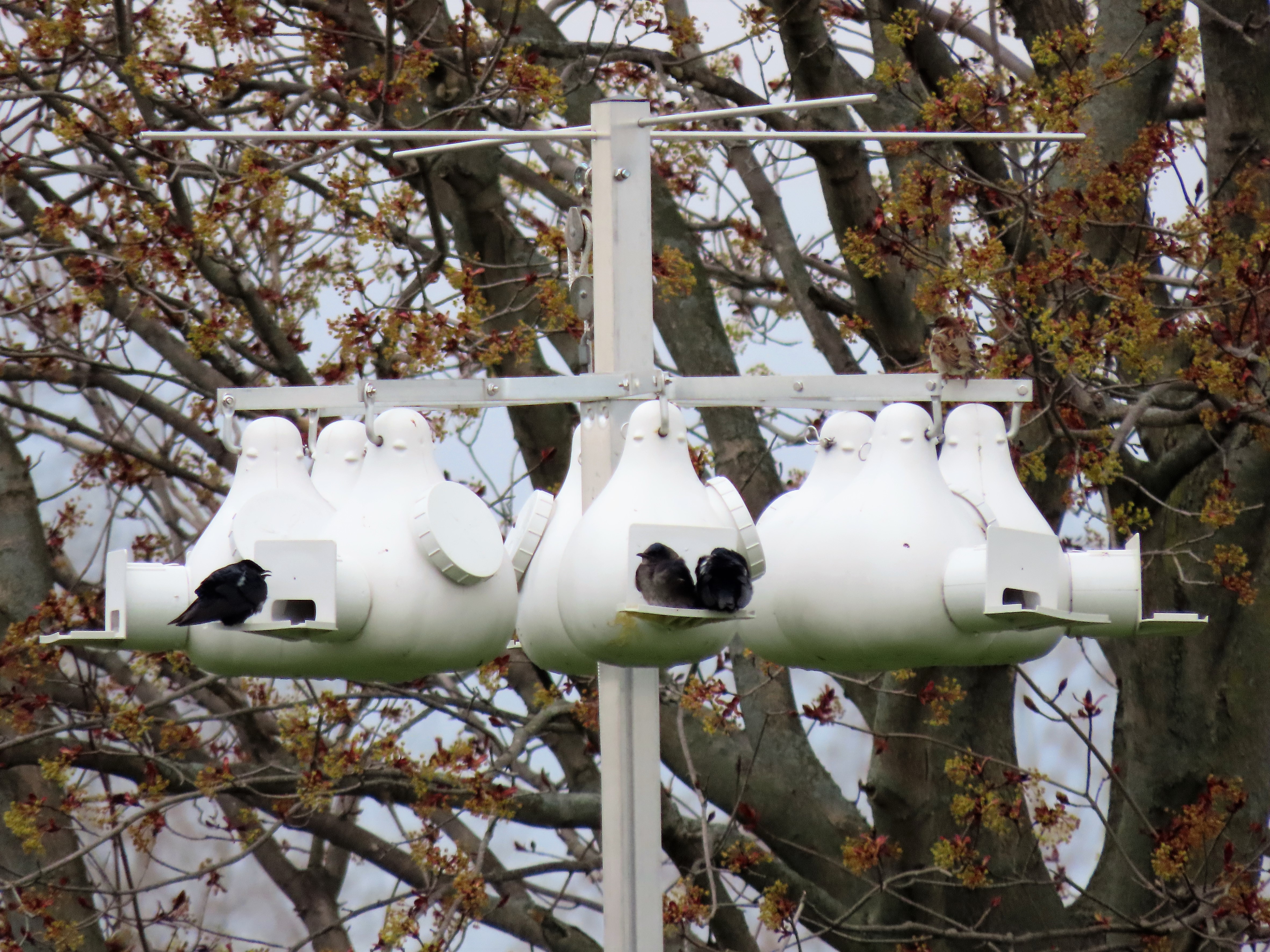
     The last time we went to Long Point we noticed a property with many Purple Martin (Progne subis) houses in readiness for the return of the birds, and it was good to see that serious attention was now being paid to the accommodation on offer.


     If I am not mistaken all rooms are heir conditioned!
     In Port Rowan harbour there were many Bonaparte's Gulls (Chroicocephalus philadelphia) patrolling close to shore and dropping to the water to snatch fish.


     We spent much of our time along the causeway, where Ring-necked Duck (Aythya collaris) was easily found.


     Killdeer (Charadrius vociferus) seemed to be everywhere, and Miriam astutely noticed this pair when one obliging bird gave another a boost in order to see a little farther!


     No doubt the view was appealing because no sooner had the upper bird dismounted he jumped back up for a second look!
     Ah, those Killdeers!


     I am used to seeing Killdeers feed in typical plover fashion, running along and stopping to pick up prey located visually, but this individual seems to have found a choice morsel in the water.


     Blue-winged Teal (Spatula discors) is a handsome duck, and as the genus name implies, is equipped with a bill reminiscent of a shoveler.


     Agreeably, several pairs were dabbling quite close to shore.


     We concluded that the area must have been especially conducive to filter feeding, for several Northern Shovelers (Spatula clypeata) were present alongside the Blue-winged Teal.


     Males seemed to outnumber females by a wide margin.


     A Lesser Yellowlegs (Tringa flavipes) was busy feeding alongside the ducks.


     A case could be made that a male Wood Duck (Aix sponsa) is a candidate for the title, "World's Most Handsome Duck". No doubt some might dispute that claim, but it would certainly rank in the top five, I would think.


     We found a very agreeable spot to park and have our lunch, looking out over a marsh.


     Way off in the distance a couple of Bald Eagles (Haliaeetus leucocephalus) were scanning the lake. It's not a great picture, but it was a long way off.


     Earlier we had seen a lone Lesser Yellowlegs, but while we ate lunch, several birds in a feeding frenzy, dashing here and there, and sieving through the water, entertained us royally.


     No trip to Long Point is complete without a visit to the Long Point Bird Observatory at Old Cut, especially during spring migration, but COVID once again exerted its evil influence.


     We had to be content with a walk down to the shore to gaze out over Lake Erie.


     It was all in all a very pleasant day.

27 April 2021
Columbia Lake, Waterloo, ON


     Our local waterways seemed to be universally bereft of gulls this year and not a single one was seen at Columbia Lake. I am not sure why this should be, but the sighting of a gull is getting to be a surprise. 
     A Greater Yellowlegs (Tringa melanoleuca) probed the shallows for food.


     Tawny Cotton-grass (Eriophorum virginicum) looked especially attractive.


     It is also known as Bog Cotton, quite a lovely name, really.
     Common Reed (Phragmites australis) is elegant and beautiful, but highly invasive, and damaging to native vegetation in a wetland.


     Once established it is extremely difficult to eradicate.
     The star of the show was a Great Blue Heron (Ardea herodias) at the pinnacle of its breeding plumage, and looking very handsome indeed.


     With great patience it stalked its prey.


     Is this not a study in concentration?


     With one lightening jab, we knew that fish was on the menu.


     After downing the fish in one swallow, the heron gave its plumage a good shake before flying off a couple of hundred metres along the shore to try its luck there.


     We are now into peak spring migration so we will have to see what we can bring you next time, even though we will be unable to visit some of the best hot spots - like the Long Point Observatory, they are all closed!

Land Acknowledgement

We acknowledge that the land on which we are situated are the lands traditionally used by the Haudenosaunee, Anishinaabe, and Neutral People. We also acknowledge the enduring presence and deep traditional knowledge, laws, and philosophies of the Indigenous Peoples with whom we share this land today. We are all treaty people with a responsibility to honour all our relations.

Followers