24 April 2021
Long Point, Norfolk County, ON
We decided that a visit to Long Point was in the cards, so armed with lunch we left for a day at Lake Erie. The weather was passable and we agreed it would be good to get away for a change of scenery.
The last time we went to Long Point we noticed a property with many Purple Martin (Progne subis) houses in readiness for the return of the birds, and it was good to see that serious attention was now being paid to the accommodation on offer.
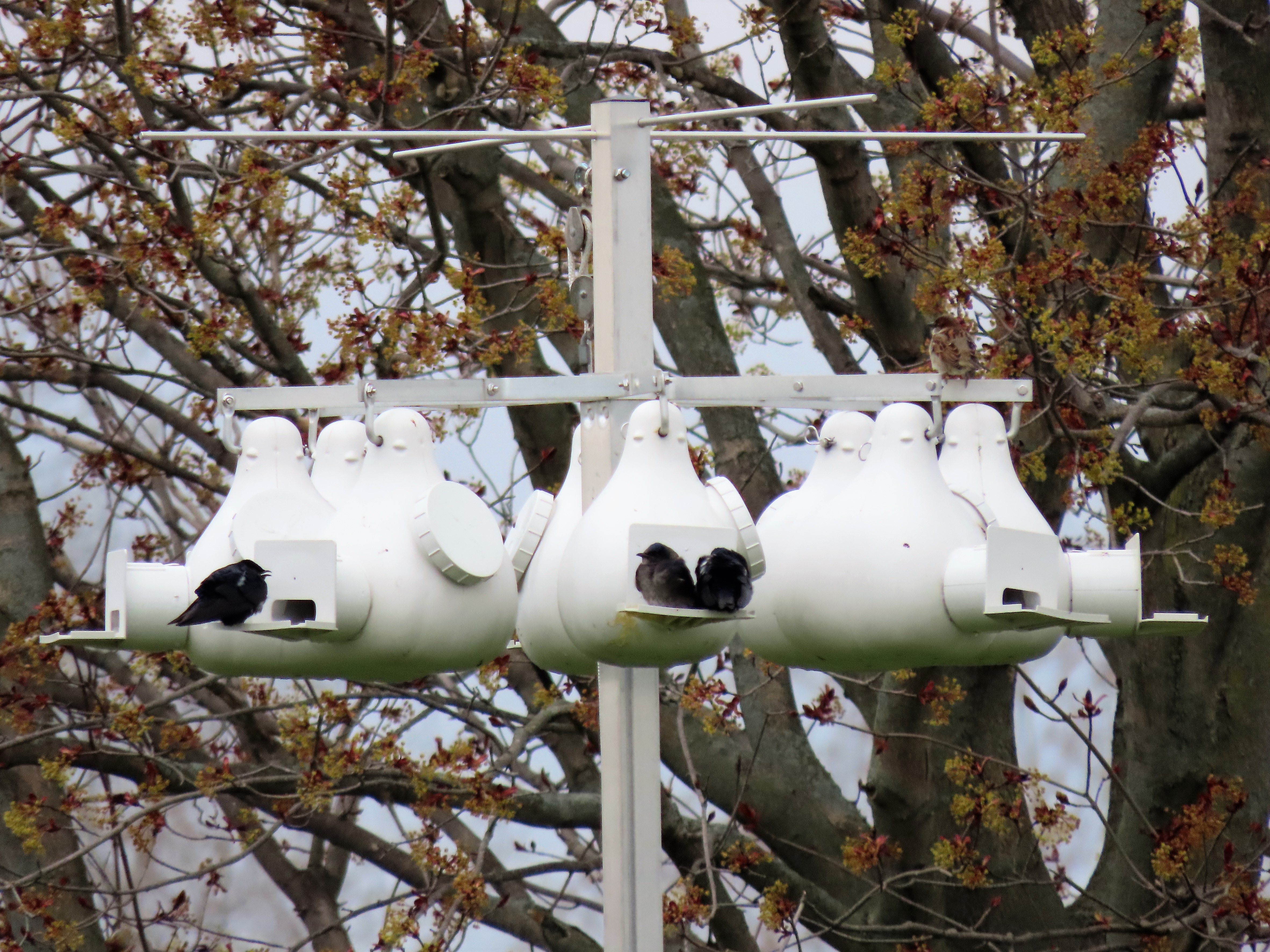
If I am not mistaken all rooms are heir conditioned!
In Port Rowan harbour there were many Bonaparte's Gulls (Chroicocephalus philadelphia) patrolling close to shore and dropping to the water to snatch fish.

We spent much of our time along the causeway, where Ring-necked Duck (Aythya collaris) was easily found.

Killdeer (Charadrius vociferus) seemed to be everywhere, and Miriam astutely noticed this pair when one obliging bird gave another a boost in order to see a little farther!

No doubt the view was appealing because no sooner had the upper bird dismounted he jumped back up for a second look!
Ah, those Killdeers!


I am used to seeing Killdeers feed in typical plover fashion, running along and stopping to pick up prey located visually, but this individual seems to have found a choice morsel in the water.

Blue-winged Teal (Spatula discors) is a handsome duck, and as the genus name implies, is equipped with a bill reminiscent of a shoveler.

Agreeably, several pairs were dabbling quite close to shore.

We concluded that the area must have been especially conducive to filter feeding, for several Northern Shovelers (Spatula clypeata) were present alongside the Blue-winged Teal.

Males seemed to outnumber females by a wide margin.

A Lesser Yellowlegs (Tringa flavipes) was busy feeding alongside the ducks.

A case could be made that a male Wood Duck (Aix sponsa) is a candidate for the title, "World's Most Handsome Duck". No doubt some might dispute that claim, but it would certainly rank in the top five, I would think.

We found a very agreeable spot to park and have our lunch, looking out over a marsh.

Way off in the distance a couple of Bald Eagles (Haliaeetus leucocephalus) were scanning the lake. It's not a great picture, but it was a long way off.

Earlier we had seen a lone Lesser Yellowlegs, but while we ate lunch, several birds in a feeding frenzy, dashing here and there, and sieving through the water, entertained us royally.

No trip to Long Point is complete without a visit to the Long Point Bird Observatory at Old Cut, especially during spring migration, but COVID once again exerted its evil influence.

We had to be content with a walk down to the shore to gaze out over Lake Erie.

It was all in all a very pleasant day.
27 April 2021
Columbia Lake, Waterloo, ON

Our local waterways seemed to be universally bereft of gulls this year and not a single one was seen at Columbia Lake. I am not sure why this should be, but the sighting of a gull is getting to be a surprise.
A Greater Yellowlegs (Tringa melanoleuca) probed the shallows for food.

Tawny Cotton-grass (Eriophorum virginicum) looked especially attractive.

It is also known as Bog Cotton, quite a lovely name, really.
Common Reed (Phragmites australis) is elegant and beautiful, but highly invasive, and damaging to native vegetation in a wetland.

Once established it is extremely difficult to eradicate.
The star of the show was a Great Blue Heron (Ardea herodias) at the pinnacle of its breeding plumage, and looking very handsome indeed.

With great patience it stalked its prey.

Is this not a study in concentration?

With one lightening jab, we knew that fish was on the menu.

After downing the fish in one swallow, the heron gave its plumage a good shake before flying off a couple of hundred metres along the shore to try its luck there.

We are now into peak spring migration so we will have to see what we can bring you next time, even though we will be unable to visit some of the best hot spots - like the Long Point Observatory, they are all closed!