Showing posts with label Bald Eagle. Show all posts

Thursday, January 05, 2023

A Changeable Winter in Southern Ontario

28 December, 2022
Snow in the countryside

     In the days leading up to Christmas and the few days afterwards, a good deal of snow fell in southern Ontario as part of a blizzard that swept over much of the province. Initially many roads were impassable, and some provincial highways were closed, but conditions improved somewhat and we took a drive to gaze at our winter wonderland.


     It was really quite magical, with scene after scene worthy of a picture postcard.


     Snow was heavy on the boughs and the branches of conifers sagged beneath the weight.


     Shrubs and leafless deciduous trees had an icing sugar look about them.


     Snow was king!


     We cast about and searched for Snowy Owls (Bubo scandiacus) while we were out, but had no success. There have been a few reports of birds sighted, but quite sparse, not even approaching the numbers usually recorded by this time of year. 
     It is a cause for great concern that Snowy Owl populations are diminishing rapidly throughout their northern breeding range, where melting permafrost destroys nesting habitat and interferes with the life cycle of Brown Lemmings (Lemmus sibiricus), their principal food, vital to breeding success. 

29 December, 2022
Bechtel Park, Waterloo, ON

     The woods at Bechtel Park are a lovely place to walk, marred ufortunately by the unceasing sound of nearby expressway traffic. 
     If one can shut that out, it is a glorious walk in winter, where a frozen creek adds beauty to the sylvan glade.


     Although it was not evening, it was not a stretch to evoke the timeless words of Robert Frost, "The woods are lovely, dark and deep."


     We find our beauty in woodlands, where nature in its changing seasons provides a far finer decoration than any Christmas tinsel could ever do. 
      What would you rather see, a synthetic bauble on a Christmas tree, or a Downy Woodpecker (Dryobates pubescens) on the bark of a living tree?


     Why cut down those pine boughs to wither and die, to be tossed aside when festivities end? Left alone in the forest they will provide joy for all, and habitat for myriad creatures.
     I wonder what an Eastern Screech Owl (Megascops asio) thinks of all the bipedal creatures that pass below his home?


     If he knows us well, he does not hold us in high esteem, of that I am sure.
     In Canada alone, a country with a modest population we throw away each year in excess of 500,000 tonnes of wrapping paper, tinsel, bows etc, much of it not recyclable (and what is recyclable is mostly not recycled anyway), and it winds up in the landfill. We do it year after year. Surely there is a better way.

02 January, 2022
At home, Waterloo, ON

     Snow has given way to rain, temperatures have gone from bone-chilling cold to body-penetrating damp, and the ground has lost its insulating coat of snow.
     Mourning Doves (Zenaida macroura) no doubt enjoy the warmer conditions, but overall it is not good for birds or humans alike.


03 January 2023
At home, Waterloo, ON

     There is something uniquely appealing about nuthatches; perhaps it's their habitat of moving down a tree head first, or simply their visual appeal. We are very fortunate that our two resident species visit our feeders daily.

White-breasted Nuthatch (Sitta carolinensis)

Red-breasted Nuthatch (Sitta canadensis)

03 January, 2023
Wellington County, ON

     The following shot, taken on a dull, rainy day gives you a good impression of the extent to which the deep snow of a mere few days earlier has disappeared.


     We were in prime Snowy Owl territory and scanned for them without success. Any birds present would have stood out against a green or brown substrate.
     It was a good day for Bald Eagle (Haliaeetus leucocephalus) sightings, but all were quite far off and we were shooting through light rain and mist, so we will not be entering these pictures into the local show!


     In one location, there were four Bald Eagles in one tree, and two more off to the side in another tree. I use this picture only to show you the concentration of birds.


     The weather continues to be unseasonable and miserable, with gloom, rain and poor light. I hope that soon we will return to a normal winter with cold temperatures and bright sunshine. Then we'll get some good shots! I promise!

Tuesday, March 22, 2022

Let's Go and Find a Bald Eagle's Nest, Miriam.....

 20 March, 2022

World Sparrow Day

     I had no idea that a day had been set aside to honour House Sparrows (Passer domesticus) and in fact 20 March, 2022 was the tenth anniversary of this auspicious marker.
     In commemoration, I give you a handsome male from our backyard.


A Raptor-ous Day

     Our goal in setting out was to find a Bald Eagle (Haliaeetus leucocephalus) nest reported to Miriam by her niece, Julie. As it turned out the day turned into a raptor bonanza.
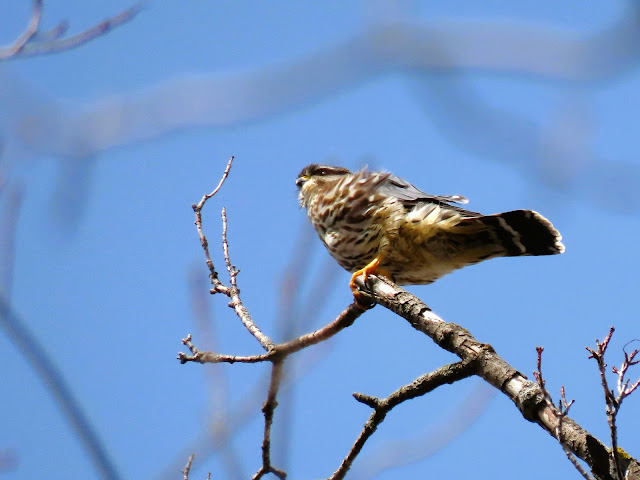
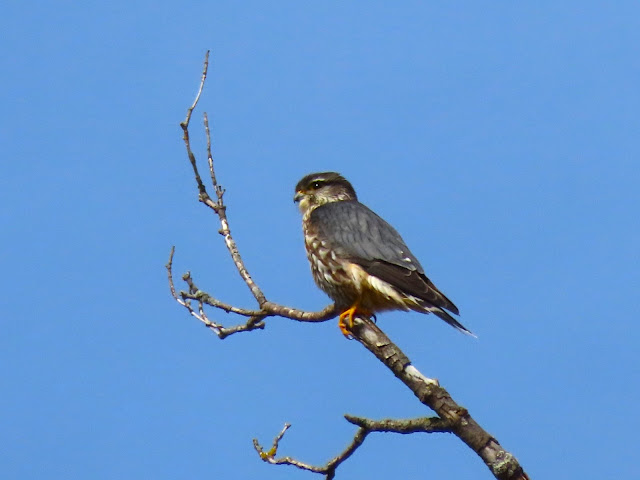
     It was not long before we detected a very cooperative Merlin(Falco columbarius) perched at the  top of a tree.


     Rarely does one have the opportunity to enjoy this spectacular little falcon for ten minutes, but this was one of those days.


     Miriam moved stealthily towards it without causing it concern, and was at one point almost underneath the bird.
     We still had the Bald Eagle in mind, but we were already filled with elation.
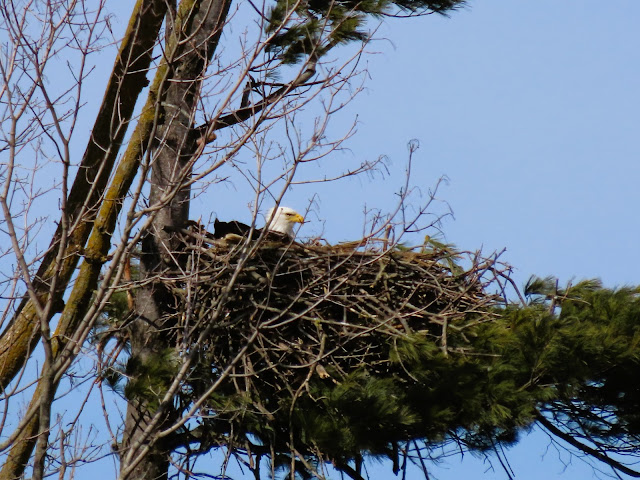
     We are familiar with the general location of the eagle's nest as described by Julie, and had little trouble finding it. In fact a couple of old birding friends were already there when we arrived. 


     We were advised that the eggs have now been incubated for twenty-one days. Normal incubation period for a Bald Eagle is 34 - 35 days so hatching is not too far off.
     The recovery of the Bald Eagle across the continent is a sign of hope for raptorial species that are no longer persecuted by humans. Left to their own devices they have the ability to thrive. In the process they provide incredible joy to gob-smacked humans. A Bald Eagle's nest may no longer be rare; it is no less special though.
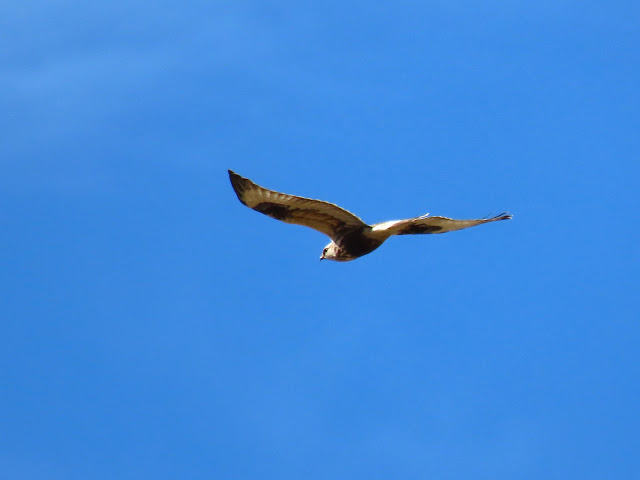
     Rough-legged Buzzards (Buteo lagopus) have for the most part left our area by now, but this individual patrolled the sky above us.


There were of course other birds to be enjoyed. American Robins (Turdus migratorius) seem to be everywhere, feeding together and starting to pair off in anticipation of breeding.


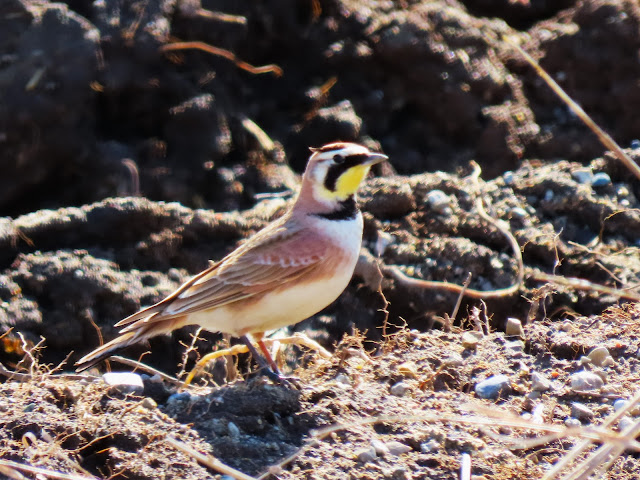
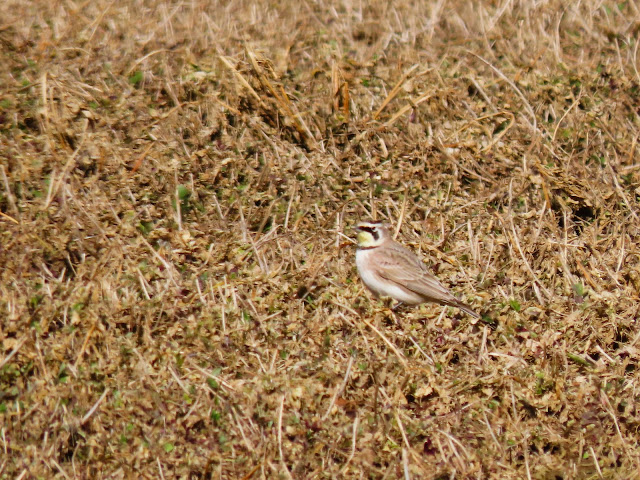
     Horned Larks (Eremophila alpestris) were not hard to find either.


     Areas that mere days ago were still snow-covered are now bare, soon to green up as the magical transformation to spring occurs.


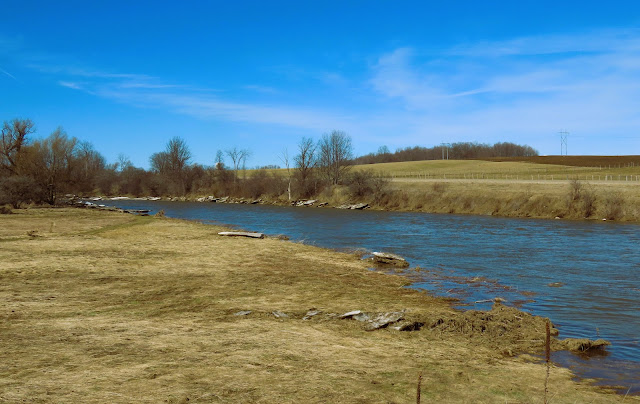
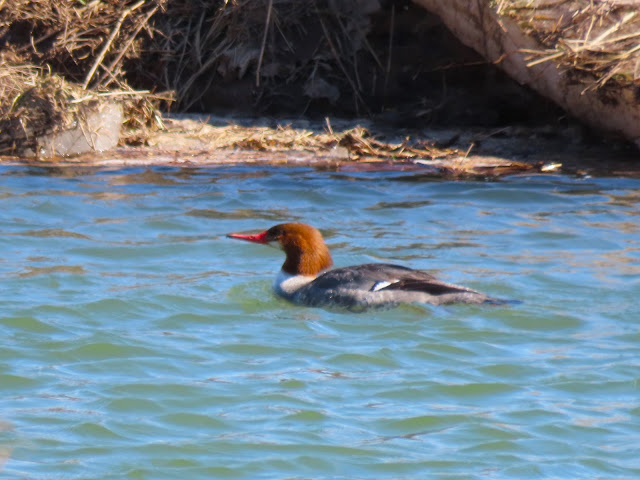
     Rapidly flowing streams and rivers, swollen by snow melt, carried Common Mergansers (Mergus mergansers) on the current.

Common Merganser ♂

Common Merganser ♀

     And there were more Horned Larks.


     We circled back to take another look at the eagle's nest and this shot will give you an idea of how distant the nest is from the only convenient vantage point to see it.


     The bird on the nest had turned to face the other way. 


      Both sexes share incubation duties but the female does most of the daytime shift.
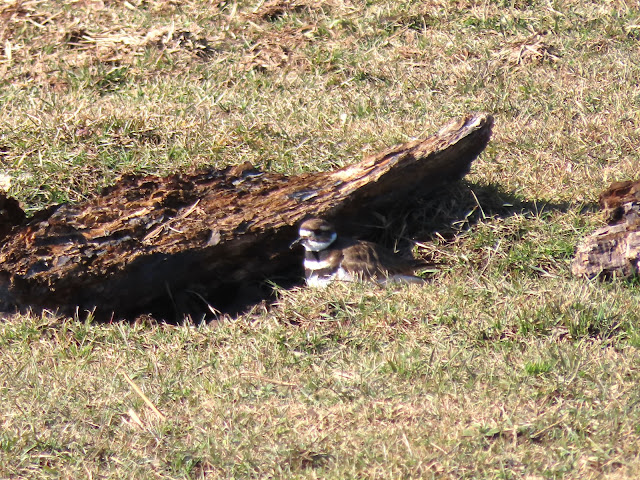
      Killdeer (Charadrius vociferus), that most delightful of plovers, scurried around sodden fields and ploughed land.


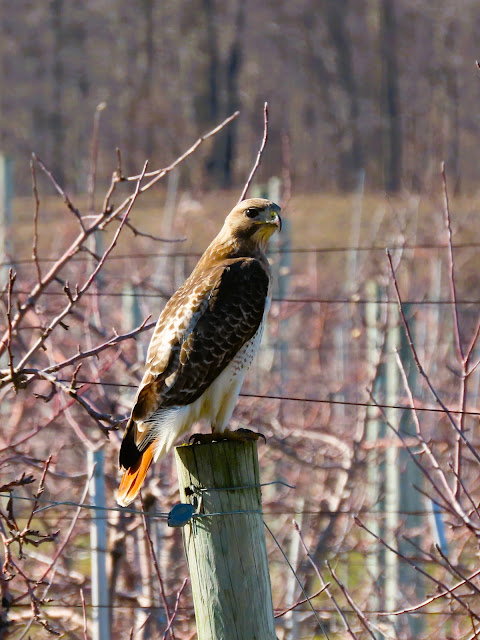
     In continuation of our good fortune with raptors we thought ourselves exalted when this handsome Red-tailed Hawk (Buteo jamaicensis) did not immediately fly off, not exhibiting the usual healthy caution hawks have for humans who throughout history have signalled death from the barrel of a gun.


     Our final raptor of the day was an American Kestrel (Falco sparverius) in an area where we have seen a pair in the past. I suspect they breed there, but I can't confirm it. This is one species that is very difficult to photograph. Almost as soon as you stop the car they fly off. 


Fairy Blogmother

     As you know, I recently had a makeover on my blog, and I am delighted with its new, clean look and greatly improved functionality. I was ably assisted in this endeavour by Linda Primmer, the Fairy Blogmother.
     Linda is kind, considerate, patient, competent, unflappable, charming, friendly and reasonable in every way. I have no hesitation in saying that if you too need a new look, don't hesitate to contact Linda with complete confidence.

www.myfairyblogmother.com
www.lifeandlinda.com

A Great Way to End the Day

     A little while after arriving home, right after dinner in fact, we watched a You Tube video of a Berlin Philharmonic performance of Beethoven's Violin Concerto with Daniel Barenboim conducting and  Yitzhak Perlman as the featured soloist. Surely this kind of music is one of the hallmarks of western civilization; a civilization one had reason to question  not so many years ago, and given what is happening in Ukraine, one cannot help but think that the veneer of civilization is precariously thin.
     There is clear irony that two unbelievably talented Jewish musicians were performing with Germany's finest orchestra, one of the greatest orchestras in the word in fact, when mere years ago they would have been dispatched to the gas chambers, or perhaps have fallen victim to the Einzatzgruppen. 
     And now, we have another Jew, desperate to save his country from the aggression of another psychopath, calling on the world for help, and watching as his cities are destroyed and people are being slaughtered or forced to flee. We have been here before. We never learn, do we?
     Better I focus on the birds and the music, on the joy they bring. It's hard not to despair for the future of humanity, however.

Wednesday, February 09, 2022

Amherst Island and Ottawa

     For a couple of years, my oldest grandson, Sam, has been hankering to visit Amherst Island, but you all know what effect COVID has had on everyone's travel plans. Finally, with restrictions lifted a little we were able to make it there.
     Miriam and I travelled up to Belleville the previous afternoon to spend the night, before meeting my daughter, Caroline, son-in-law, Andrew, Sam and his girlfriend, Mel, the following day at the Amherst Island ferry. We were also joined by our friend and fellow naturalist, Wendy, who was visiting her daughter in Kingston, and took advantage of the opportunity to tag along with us to see what we could find.

5 February 2022
Amherst Island, Lennox and Addington County, ON

     Miriam and I were the very first in line at the ferry terminal and settled in to wait for the others to arrive. 
As it turned out the absence of information on the notice board should have provoked a few questions in our minds, but more about that later.


     As best I recall it was around minus 25 degrees and Canada Geese (Branta canadensis) and Mallards (Anas platyrynchos) huddled in a little open water near the dock.

Wednesday, January 12, 2022

Waterloo Region Nature Outing to Long Point, Norfolk County, ON

      It is getting hard to remember a time when COVID didn't affect almost every decision we make. In the wake of the rapid spread of the Omicron variant new provincial restrictions on assembly have been imposed on a weary populace, and there is now a limit of ten people on an outdoor gathering.
     At the last moment one participant's family contracted COVID and another had difficulty getting a caregiver for a younger family member, so we were eight that made a visit to the the Long Point area, along the northern shore of lake Erie.
     It was a cold day, but suitably dressed, we sallied forth in high spirits and with great expectations. 


     Once again, we proved the point that you can clothe yourself properly and deal with cold, yet oppressive heat is impossible to escape, especially when accompanied by high humidity.
     And by midday the temperature soared to a heady minus 9.5 degrees! No one had to worry about the mayo on a sandwich curdling in the hot sun!
     
Leader: David M. Gascoigne

Members: Miriam Bauman, Lisa Den Besten, Tina Den Besten, Bob Fraser, Angie Koch, Wendy Shaw, Zach Summerhayes.

Angie, Bob, David, Tina, Lisa, Wendy, Zach

Thursday, December 09, 2021

Bald Eagle (Pygargue à tête blanche)


     The history of the Bald Eagle (Haliaeetus leucocephalus) across North America is an odd mixture of disinterest, abuse and tragedy. Until relatively recently Bald Eagles had a bounty on their heads, and hunters received financial reward for killing them. There is a level of unfathomable irony in the United States that the Bald Eagle was adopted as its national symbol, displayed in every manner imaginable to incite sentiments of strength, power and patriotism, yet its extermination was a sanctioned goal.

Thursday, October 14, 2021

Vacation in Atlantic Canada - Part 5

 14 September 2021
Mahone Bay - Graves Island - Mahone Bay, NS

     Sunrise over the bay was always spectacular (at least it was on the mornings we were there) and Miriam made sure that we recorded it for posterity.


     After breakfast we left for Graves Island, about a forty-minute drive from our B&B. 
     The journey along the coast was marked by picturesque views and ocean vistas, and we stopped frequently.


     There seemed to be a general arrival of Common Loons (Gavia immer) and we spotted several.


     It is a spectacular bird and all the ones that we saw were still in breeding plumage.


     As might be expected American Herring Gull (Larus smithsonianus) was much more common.


     It did not take long before we crossed over to Graves Island.


     It is a beautiful spot, with many first rate camping sites for those enjoying that kind of vacation.
     We set out to walk the perimeter of the island, a distance of 3.2km - an easy walk on level ground.


     I don't think that we were ever out of earshot of American Crow (Corvus brachyrynchos).


     Many of the ferns looked different from those we have in Ontario. This attractive species is called Eastern Hay-scented Fern (Dennstaedtia punctilobula) and was quite common on Graves Island.


     Goldenrod (Solidago sp.) was prolific, and well patronized by insects, but I am unable to narrow this plant down to the species level.


     Similarly, the following flower seems to be some kind of aster (Asteraceae) but I am unsure of the species.


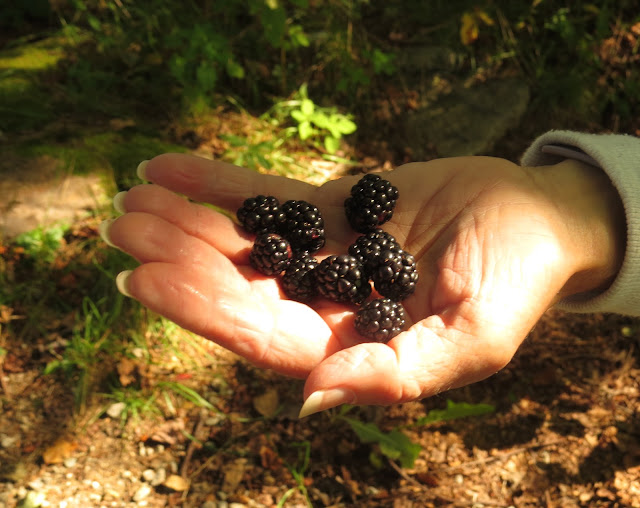
     Wild blackberries made for a great snack.


     Blue-headed Vireos (Vireo solitarius) were having great success foraging for insects as they fattened up for their long migration south.


      Northern Parulas (Setophaga americana) were equally industrious.


     It was a very enjoyable walk, with many charming vistas to punctuate our stops.


     American Yellow Warbler (Setophaga aestiva) is late to arrive in spring and departs early in the fall. It seemed to be beyond its normal departure date for the species but we were happy to see this individual still foraging for insects.


     It was Miriam who had discovered Graves Island while checking an app on line, and we continued to dwell on our good fortune on being able to enjoy this beautiful spot.


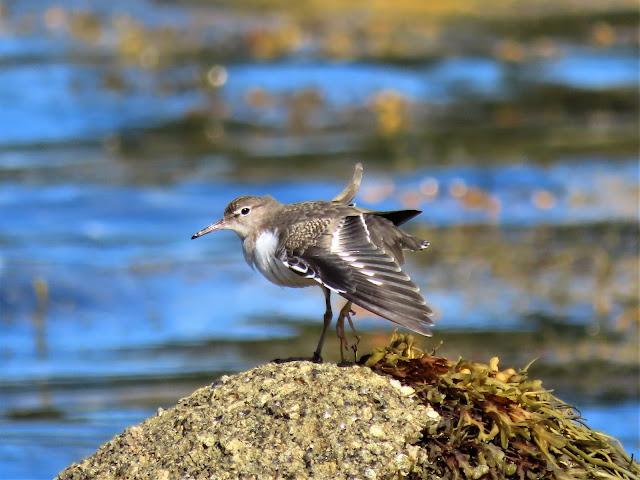
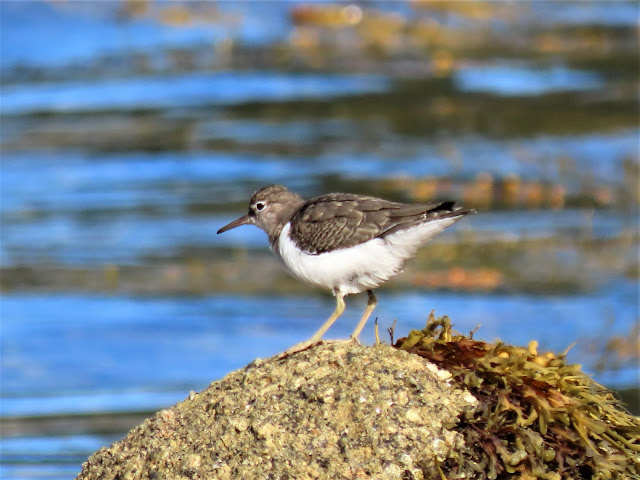
     A couple of Spotted Sandpipers (Actitis macularius) preened and postured directly in front of us.


     I don't think it's possible to walk through an eastern woodland without being scolded by American Red Squirrels (Tamiasciurus hudsonicus). 


     They are nothing if not feisty!
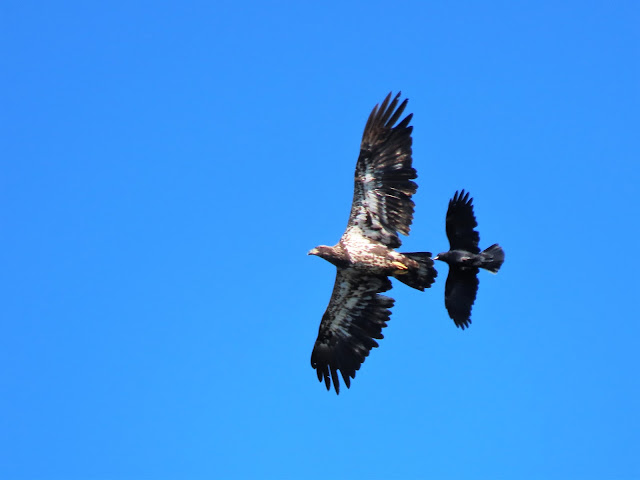
     The local American Crows were not at all happy about a subadult Bald Eagle (Haliaeetus leucocephalus) straying into "their" airspace, and they wasted no time in harassing it mercilessly.


     A small freshwater pond was home to several American Black Ducks (Anas rubripes).


     Black Ducks were far more common in Eastern Canada than they are back home in Ontario.


     Mallards (Anas platyrynchos) are not reluctant to interbreed with Black Ducks, and from time to time the array of intergrades is quite staggering.


     The female above seems to be all Mallard!
     Myrtle Warblers (Setophaga cononata) are among the latest warblers to leave their summer haunts, and they migrate shorter distances than most wood warblers.


     The undertail markings of warblers are diagnostic of the species and this individual is showing its distinctive pattern well. At times, when the birds are foraging among the leaves, you don't get much more than a glimpse at the underside of the tail, so time invested in learning the patterns contributes greatly to identifying the species. 
     Halloween is fast approaching. This tree looks like it was designed for hobgoblins and spooks!


     We arrived back in Mahone Bay for a late lunch at a restaurant with the humorous name of For Cod's Sake. We had to line up for about twenty minutes to gain entry, but it was well worth it. They cooked fish and chips the way fish and chips should be cooked. We left well satisfied and full to the brim!
     In late afternoon at our B&B a huge flock of Common Starlings (Sturnus vulgaris) paid us a visit, and we were treated to the closest we have come to a murmuration.


    There were many hatch-year birds in the aggregation, bearing testimonial to the success of these aggressive invaders.


     We were content not to concern ourselves with the question of alien versus native species and simply enjoyed the spectacle.


15 September 2021
Mahone Bay - Swissair Flight 111 Memorial - Peggy's Cove - Auld's Cove, NS

     We were always first in for breakfast and this morning was no exception. Once we had eaten we settled our bill, packed the car and headed for the open road.
     I don't think many would question that Peggy's Cove is the location most tourists wish to visit above all others when visiting Nova Scotia. So what to do, but set a course for Peggy's Cove?
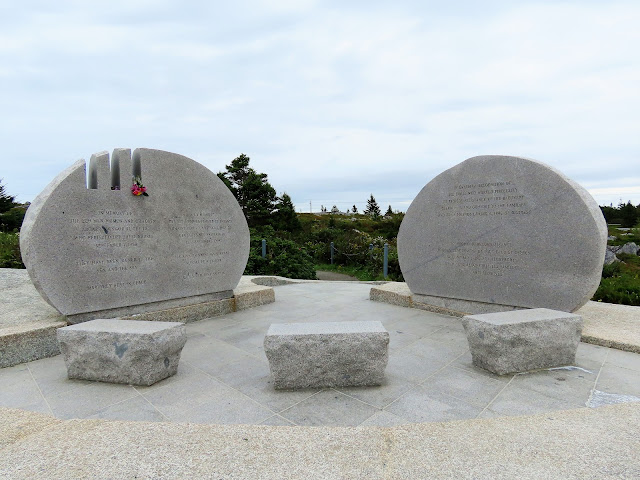
     A short distance outside town we saw a sign to the memorial marking the crash of Swissair Flight 111 on 2 September 1998, eight kilometres offshore from Peggy's Cove.


     The plane went down in the Atlantic Ocean and 229 passengers and crew all perished.


     The Government of Canada carried out a full investigation of the crash lasting more than four years at a cost of $57 million dollars.
      One cannot help but feel a sense of poignancy and the sharing of vicarious grief as one gazes out to sea.


     The memorial ensures that the victims of this awful tragedy will never be forgotten.
     We saw more cormorants along this stretch of coast than we had seen during most of our trip. They connect to a maritime coastline in such a perfect manner.


      Peggy's Cove lives up to its reputation as one of the most picturesque (some would say THE most picturesque) village on the entire Atlantic coast.


     The lighthouse dominates the landscape and is the focal point for most tourists. 


     There were many people there in mid September and the parking areas were full. I can barely imagine what it must be like in mid summer at the peak of the tourist season.
      It cannot be denied, however, that the entire area is beautiful, the coastline rugged, the views unmatched.


     An American Herring Gull viewed the whole scene with an air of déja vu.


     Miriam and I, however, were impressed and delighted in the entire experience, from clambering over rocks to wandering around the harbour.


     There is often a nagging question in the back of my mind when I am in Atlantic Canada whether the lobster traps one sees everywhere are working traps, or strategically located for the tourists.


     American Black Ducks in salt water was a first for me.


     It is hard not to be impressed by a Great Black-backed Gull (Larus marinus). It dominates the shore like no other bird, and brooks no interference.


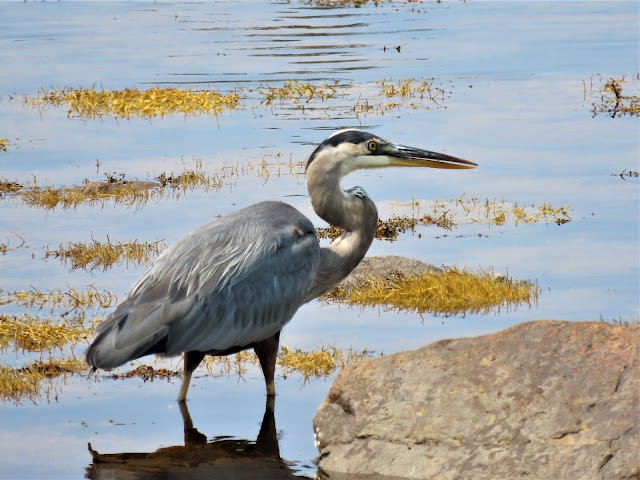
     A Great Blue Heron (Ardea herodias), ever patient, ever opportunistic, probed the water in characteristic fashion.


     The myriad organisms of the shore provide a fine bounty for intelligent American Crows, anxious to exploit every opportunity for a meal.


     We left Peggy's Cove, well satisfied with our visit, and drove directly to Auld's Cove where we had reserved a motel for three nights. The Cove Motel would serve our needs, but it has clearly seen better days and is in serious need of renovation and maintenance inside and out.


     We opted to have dinner in the restaurant at the motel. Miriam chose a seafood casserole and I had fish cakes and beans. Neither dish was memorable.
     The bed, however, was comfortable and we had a good night's sleep. We were about to embark on the last phase of our maritime odyssey with a trip around the legendary Cabot Trail.
     That will all be the subject of the next and final installment of the account of our vacation in Atlantic Canada.

Accommodation: The Cove Motel, 227 D-31 Road, Auld's Cove, NS B0H 1K0, 902 747-2700  Rating: 2.75 stars out of 5. 

Land Acknowledgement

We acknowledge that the land on which we are situated are the lands traditionally used by the Haudenosaunee, Anishinaabe, and Neutral People. We also acknowledge the enduring presence and deep traditional knowledge, laws, and philosophies of the Indigenous Peoples with whom we share this land today. We are all treaty people with a responsibility to honour all our relations.

Followers