Showing posts with label Conestogo Dam. Show all posts

Thursday, December 09, 2021

Bald Eagle (Pygargue à tête blanche)


     The history of the Bald Eagle (Haliaeetus leucocephalus) across North America is an odd mixture of disinterest, abuse and tragedy. Until relatively recently Bald Eagles had a bounty on their heads, and hunters received financial reward for killing them. There is a level of unfathomable irony in the United States that the Bald Eagle was adopted as its national symbol, displayed in every manner imaginable to incite sentiments of strength, power and patriotism, yet its extermination was a sanctioned goal.

Wednesday, December 02, 2020

A Snowy Owl (Harfang des neiges) and Other Birds

29 November 2020

     Miriam and I were deciding where we would go for a walk on an uncharacteristically sunny November day, when a telephone call from Jim and Francine announced that they had located their first Snowy Owl (Bubo scandiacus) of the season. They gave us precise directions to its location, and since Miriam finds this species enigmatic above all others, our die was cast. We got in the car and headed for Wellington County.
     The bird, a handsome female, was exactly where Jim and Francine had found it.


     The temperature hovered around seven degrees, and without a speck of snow to act as camouflage, the bird was not difficult to see.
     It was constantly surveying its surroundings, no doubt looking and listening for rodent prey. Owls are able to swivel their heads 270 degrees, and it would go from appearing to look right at us, to showing the back of its head.


     It preened a little, paying attention to all its feathers, including those down on its feet.


     Birds are known to be able to sleep with one eye open, as this owl seemed to do so from both the right and the left, while still being alert to any sign of danger.


     We watched the bird for about a half hour; finally Miriam reluctantly agreed that we should move on. 


     I don't think she can ever get enough of a good thing!
     This sighting was actually on the rural road where Miriam lived on a farm during her early childhood, not far from the Conestogo Dam to where we headed next.


     Before getting to the dam proper we pulled off on a wide shoulder to scan the reservoir.


     The dominant species on the water was Common Merganser (Mergus merganser) and the number was simply staggering.

Common Merganser ♂

Common Merganser ♀
     Males clearly outnumbered females, by a substantial margin, and we estimated that a thousand or more individuals was a conservative count. The following pictures will convey an impression of the density of mergansers present, and there were other species alongside them too.


     It was a grand spectacle that we enjoyed immensely.
    We saw only one Common Goldeneye (Bucephala clangula), but it is more than likely that we missed a few others, intermingled in the ever-moving mass of mergansers.


     Ring-billed Gulls (Larus delawarensis) were abundant.....


     ..... as were Canada Geese (Branta canadensis).


     And they seemed to enjoy the same stretch of shoreline together.


     A Mennonite buggy passed by us, bespattered and in need of a good clean. That chore will doubtless be added to someone's list of tasks once the sabbath is over.


     Downstream from the spillway there were groups of ducks and gulls.


     Mallard (Anas platyrynchos) was the commonest duck, although some mergansers sought their company, away from the mass of their congeners on the other side of the dam, and a small group of American Black Duck (Anas rubipres) remained aloof, too far out for a photograph.


     Ring-billed Gull was far and away the most common larid, but small groups of American Herring Gulls (Larus smithsonianus) made their presence known too.


     Sub-adult gulls of various ages and of different species seemed to favour each other's company.


     In years past I have seen both Iceland Gull (Larus glaucoides) and Glaucous Gull (Larus hyperboreus) at the Conestogo Dam, but try as I might today, I was unable to detect either of these species of any age. Perhaps it is a little early and as winter advances they may show up.
     Bald Eagles (Haliaeetus leucocephalus) verge on predictable here and no sooner had Miriam and I expressed surprise that that we had not seen one, this individual came into view.


     The plumage gives every indication that this is a bird fledged this year.


     There is no shortage of prey at the Conestogo Dam and Reservoir, both fish and ducks being in great supply, with ample conifers for roosting, so this bird has the potential to grown strong and healthy as it perfects its hunting skills. 


     May it live long and prosper.

Sunday, December 11, 2016

Tuesday Rambles with David - Glen Allen area

06 December 2016

     We were short one member of our group (Miriam's cold lingers on) and we added one (John Lichty) for our Tuesday morning ramble, so we still maintained our limit of eight participants.
     It was a grey, blustery day, the kind to chill your bones, when we all assembled at my house to car pool and set out for the hinterland. Judy, Mary and John came with me; Franc, Carol, Francine and Jim rode together in Franc's car. I needed to stop for gas; with that taken care of we headed to Three Bridges Road where we stopped briefly and checked out the weir on the Conestogo River. Birds were reluctant to show themselves and the scene along the river looked gloomy and uninviting.


     Back near the car, however, numerous birds were cheerfully going about their business and Franc swung his camera into action. What would an Ontario morning be without a Black-capped Chickadee Poecile atricapillus to serenade us with its familiar refrain?


     This female Downy Woodpecker Picoides pubescens was anxious for her moment in the spotlight too.


     The areas around Glen Allen and the Conestogo Dam in Wellington County beckoned us so we got back in the vehicles and drove there without stopping again. There is a bridge on County Road 12 that crosses the Conestogo River, just before turning into Glen Allen, where we always stop and check for winter ducks. Today there was nothing!
     When we got into the hamlet of Glen Allen we parked and walked alongside the river, and our fortunes changed for the better. In addition the sun was peeking from behind the clouds - just a little, I must say - but the light improved a tad.


     Franc was shooting almost from the moment he got out of the car.


     Ring-billed Gulls Larus delawarensis were present in huge numbers, with very small numbers of other larids, however.
     This individual puzzles me somewhat. Its head bears the hallmarks of a Ring-billed Gull, but lacking black on the wings, the rest of the body resembles an Iceland or Glaucous Gull. Perhaps it is a hybrid.


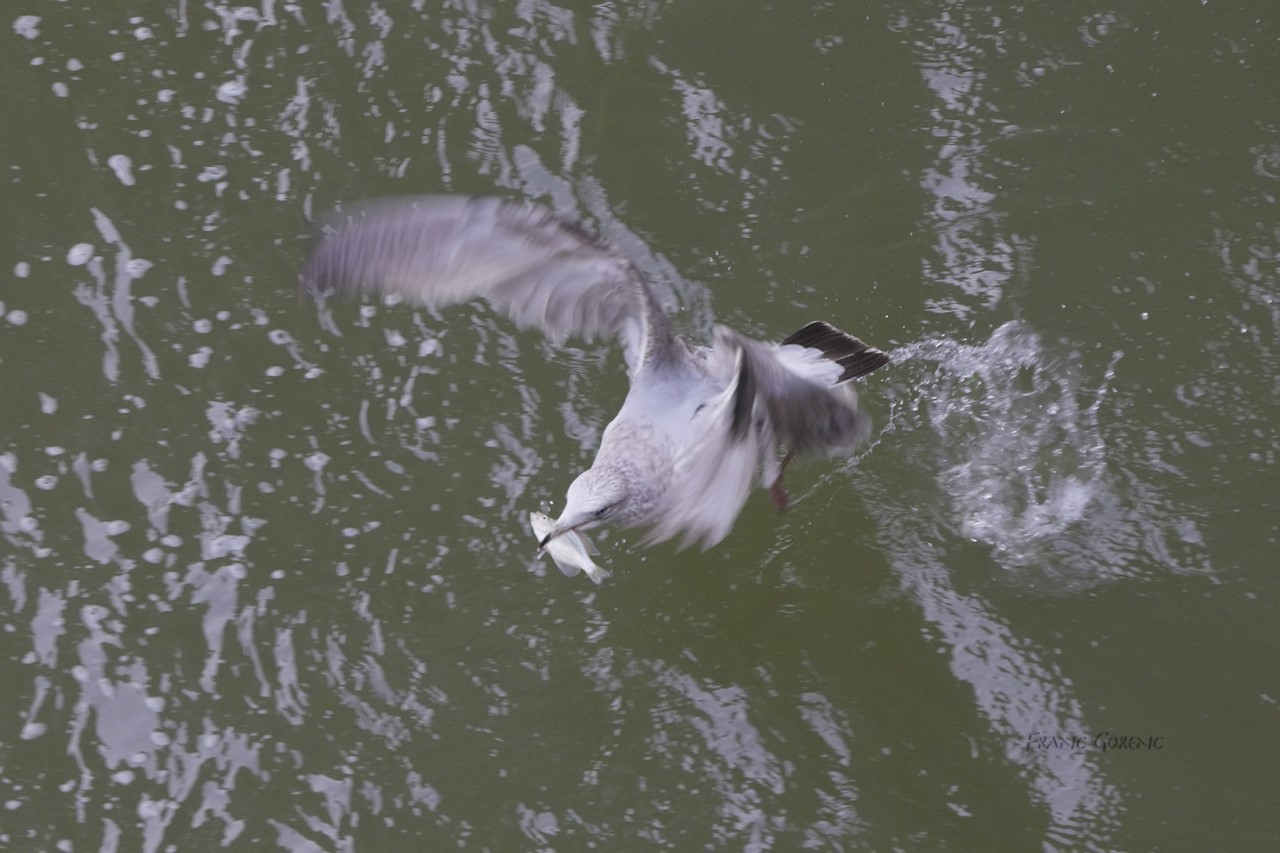
     There was an absolute abundance of fish and the gulls were enjoying fine feeding.
     Everyone was really getting into the spirit of birding now.


     Franc captured this admirable sequence of Ring-billed Gulls in flight.


     It was good to have Mary back with us.


     A few weeks ago, on one of our walks, Francine was delighted to find and identify her own Red-bellied Woodpecker Melanerpes carolinus so it was old hat for her to identify this one.


     A couple of Blue Jays Cyanocitta cristata were spotted in the same area.


     The Conestogo Dam was quite productive, but initially the birds were far out, including a third year (?) Bald Eagle Haliaeetus leucocephalus grappling with a large fish and being harassed by a couple of wily American Crows Corvus barchyrynchos trying to filch some of its meal.
     American Herring Gulls Larus smithsonianus were lined up on the concrete walls of the spillway, always on the lookout for food.


     Curiously, for the most part, Ring-billed Gulls and American Herring Gulls lined up on opposite walls facing each other.
      As was the case at Glen Allen, there was no shortage of fish for the hungry gulls.


     It pays to gulp down your food in mid air before some piratic congener steals the food right out of your mouth.


     Common Mergansers Merganser merganser were far and away the most common ducks and our patience was rewarded when they moved in quite close. The flock consisted mainly of females and juveniles, but some males were present also. This individual obliged with a take-off demonstration for us.


     Franc had no shortage of photographic opportunities. All he could have wished for was better light.


     On the way home we saw three species of raptor. Our first was a glorious female Northern Harrier Circus hudsonius followed in short order by a silver, grey male. Unfortunately, by the time we got the cars stopped, windows opened and camera primed they were out of photographic range.
     Better luck was had with a Rough-legged Hawk Buteo Lagopus...


     ...... and this Red-tailed Hawk Buteo jamaicensis.


     As always, it was a fine outing, with time spent well together. Agreeable companions, good birds - what else could one wish for? Sunshine - I heard Franc mumble! Ah well, you can't always have everything.
     Tune in next week for another episode of Tuesday Rambles with David.

Land Acknowledgement

We acknowledge that the land on which we are situated are the lands traditionally used by the Haudenosaunee, Anishinaabe, and Neutral People. We also acknowledge the enduring presence and deep traditional knowledge, laws, and philosophies of the Indigenous Peoples with whom we share this land today. We are all treaty people with a responsibility to honour all our relations.

Followers