If there is one constant in the lives of most of us right now, it is that COVID influences most of what we do.
We have not been able to walk and explore to the extent that we normally would, so I am featuring below some highlights encountered here and there.
27 March 2021
A drive through the countryside revealed signs of spring at every turn, including male Red-winged Blackbirds (Agelaius phoeniceus), hormonally supercharged, waiting for females to return to southern Ontario.
Red-breasted Merganser (Mergus serrator) is not an uncommon bird here, but it is almost exclusively found on large bodies of water such as Lake Ontario, and is unexpected inland.
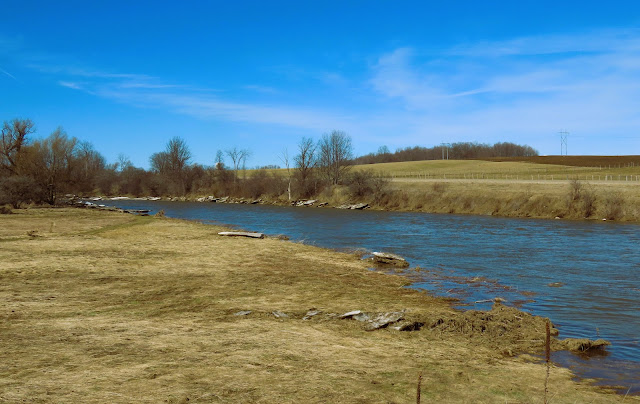
It gave us a great deal of satisfaction, therefore, to happen upon two pairs swimming together on the Conestogo River in Hawkesville.
The male's crest resembles what I suspect many people's tresses will look like as hairdressers are not permitted to open for at least another month! Two females looked a little better turned out, albeit clad in a more subdued fashion.
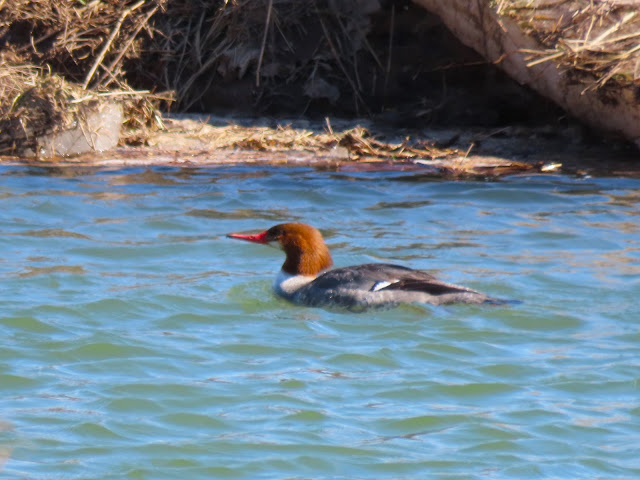
Common Merganser (Mergus merganser) unlike its red-breasted cousin, is to be expected on local waterways at this time of the year. The first bird we spotted was a female.
It's a safe bet that the sighting would not involve a lone bird; others were doubtless underwater chasing fish. In mere moments a couple of males surfaced to join the female.
And more appeared, swimming away like a flotilla of miniature craft.
A Blue Jay (Cyanocitta cristata), watching from the sidelines, seemed far less interested in this little squadron of ducks than we were.
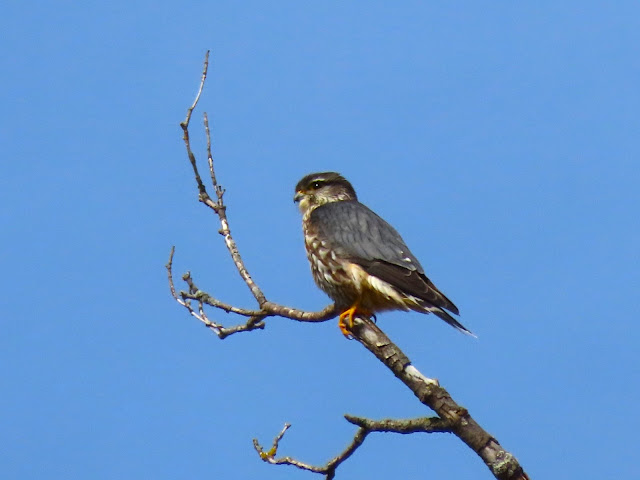
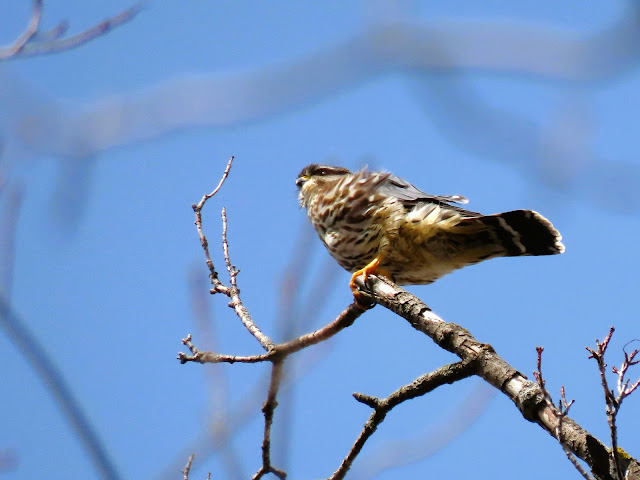
American Kestrel (Falco sparverius), formerly common, has become quite rare in recent years, and Miriam and I have been happy to see a pair regularly not far from our home. The male and female have been seen together throughout the year, but of late have started to show signs of pair-bonding prior to mating and initiating nesting.
They are very wary birds and getting a picture is difficult, a good picture almost impossible. I am happy to present the male in any event!
If I may be permitted a moment of personal reflection, the first time I ever took Miriam for a drive through the country in search of birds of prey, the first three birds we saw were male kestrels, each with a vole. It speaks to the abundance of both the birds and the biomass of prey that year. I doubt whether we will ever repeat such good fortune, but it remains a very fond memory for us, and was in good measure responsible for igniting Miriam's passion for birds.
03 April 2021
A pair of Hairy Woodpeckers (Dryobates villosus) visited our backyard and we were able to capture an image of the male on one of the feeders.
04 April 2021
Song Sparrows (Melospiza melodia) return early to southern Ontario.
At times it seems as though an ardent male is singing from high in the branches of every convenient tree, its joyful trill permeating the warm zephyrs of spring.
I have no idea what triggered it, but for the last several weeks I have been studying birds' feet and the different configurations of the toes, and other functional adaptations to lifestyle. Miriam takes a closeup of a bird's foot whenever she gets a chance. Here is the classic anisodactyl orientation of a songbird's foot - digits 2, 3 and 4 pointing forward and digit 1 (the hallux) pointing backwards.
When a songbird sleeps a special muscle "locks" into place and prevents the bird from falling off its perch. Now that you are as hooked as I am on feet perhaps I will soon regale you with leg scutellation patterns. I know that you are waiting with bated breath!
06 April 2021
Eastern Bluebirds (Sialia sialis) have returned to southern Ontario, and are already occupying territories and in some case are nesting. At least one nest box that I monitor now contains eggs.
The above pair was photographed at a Mennonite meeting house on Three Bridges Road, St. Jacobs, where they have occupied nest boxes for years. The bluebirds caused us no surprise, but a single gravestone certainly did.
Mennonites are plain folk, as you know and their graves markers are modest and uniform. Never is one bigger, more grand, more ostentations, more reflective of wealth, in a "better" part of the cemetery, than another. Neither Miriam nor I have ever seen ornamentation of this type at a tombstone in a Mennonite graveyard. Personally, I hope it is the last time.
07 April 2021
A Yellow-bellied Sapsucker (Sphyrapicus varius) very kindly decided to make our backyard a port of call this spring.
I suspect that they do so most years, but they generally don't stay more than a few minutes, so unless you are glancing out at the right moment, they pass through unnoticed.
We spotted them on the trail behind our house later in the day, and have seen them most days since.
08 April 2021
Fortunately, as mentioned above, we have a trail (Benjamin Park Trail) behind our house, and it has been especially appreciated during the months when the scourge of COVID has dictated the ebb and flow of our lives.
This male Downy Woodpecker (Dryobates pubescens) was initially seen busily excavating a nest hole, but I was walking alone that day and didn't have a camera with me.
It has made substantial progress on the excavation and upon first contact was half way into the hole with wood chips flying. Now, however, it seems to have abandoned this location and has not been seen again completing the work. Spring migrant birds are the biggest attraction for us on our walks, but the sheer splendour of spring ephemerals bursting through the soil, are cause for great celebration too.
I don't know whether I could pick a favourite, but Bloodroot (Sanguinaria canadensis), with its leaves curled around the flower when emerging, would be high on my list.
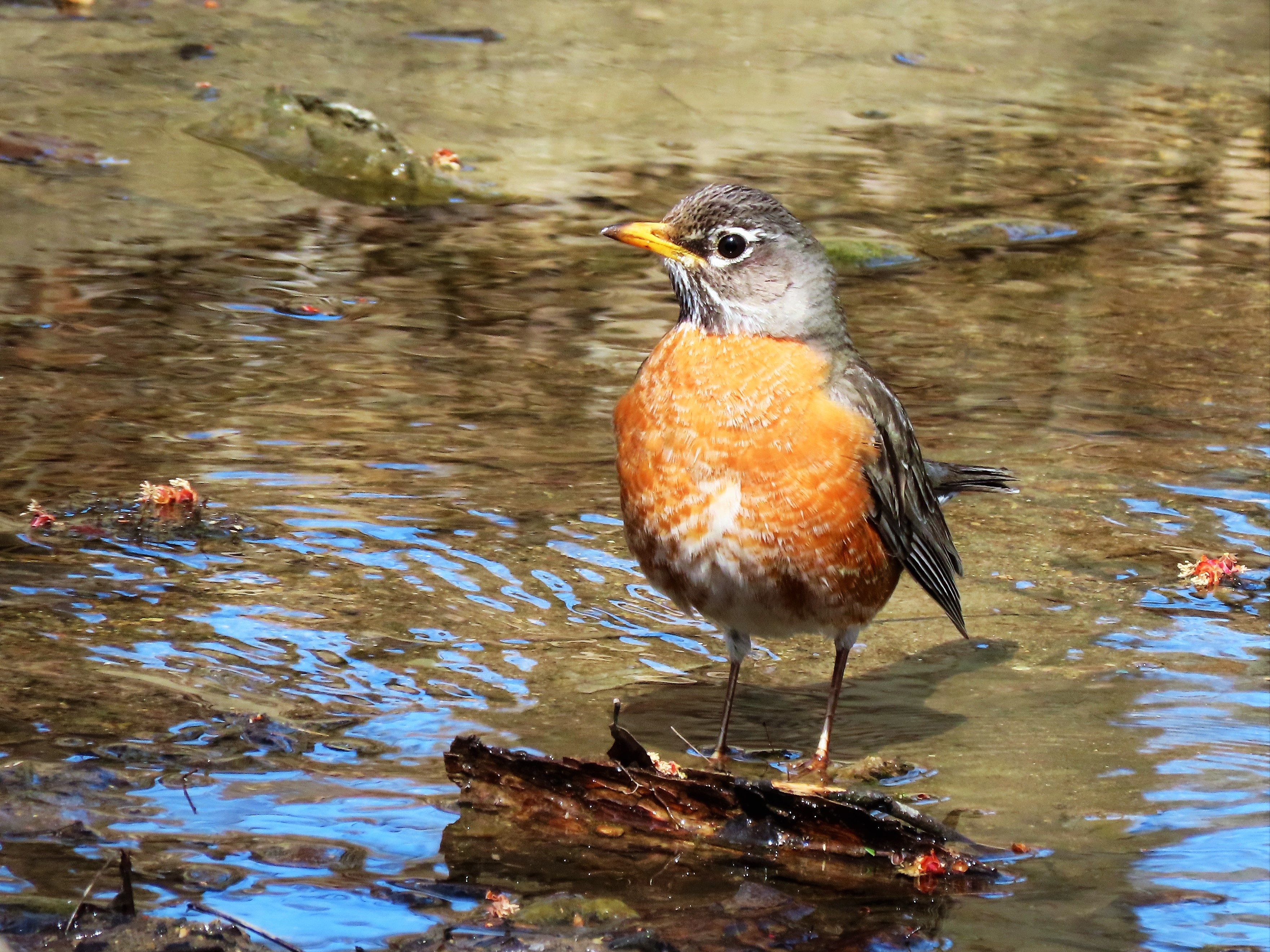
And it is an early bloomer too. I look for it eagerly each spring. American Robins (Turdus migratorius) seem to be everywhere and their cheery song resonates through forest, woodland and backyard alike.
Brown-headed Cowbirds (Molothrus ater) are no doubt already seeking suitable hosts for their eggs, although their principal victims have yet to arrive.
Mourning Cloaks (Nymphalis antiopa) flit through the air with consummate grace, even posing for a picture once in a while.
The event which has brought us the most joy along the trail has been the discovery of an Eastern Screech Owl (Megascops asio) roosting in a small Eastern White Pine (Pinus strobus).
To see an owl at any time is a source of high excitement, but this sighting on the Benjamin Park Trail has special significance. For a couple of years I knew where to find a pair of owls, made up of a red morph and a grey morph bird, and I am quite sure I had pinpointed the tree where they bred. In one of the purges against infected trees that happens so frequently that one wonders what will be left untouched, their tree was felled, and I had not been able to relocate them.
We have high hopes that this is a male resting during the daylight hours, with a partner taking care of young close by. Perhaps we will be able to verify that. The feet of the screech owl are zygodactyl, enabling them to snooze in peace without fear of falling from their perch.
The doleful call of Mourning Doves (Zenaida macroura) echoes constantly. Ironically, some people think it is an owl.
This species will breed over a good part of the year and males seem to be in a permanent frenzy, trying to coax often uncooperative females into the trysts that will ensure the survival of the species. Ah, those males; they have just one thing on their mind!
09 April 2021
Lungwort (Pulmonaria officinalis) is another flower that emerges early and populates forests and woodland glades.
How beautiful it is, with its blotchy leaves and glowing inflorescence.
Willows (Genus Salix) are among the first trees to add colour to the bare landscape of early spring.
There has been a bit of a craze recently with people depositing painted rocks bearing inspirational messages. The practice seems to be expanding to signs such as this one, attached to a sapling.
I think I am quite capable of getting my fuzzy, warm feeling without help. And I would prefer the beauty of the tree without a sign stapled to it. Sooner or later the placard is going to deteriorate and fall to the ground to join the other litter left by careless walkers, who think nothing of tossing everything from their masks to their paper cups and plastic lids on the ground, their drink cans and their bags of dog poop, and whatever else would impose such a burden on them to take home and dispose of properly. A pox on those who post these signs, however well-intentioned they may be.
Coltsfoot (Tussilago farfara) is one of the first plants to flower in spring and their little yellow buttons are a cheerful punctuation mark among the brown leaves of last fall.
Equally yellow are handsome American Goldfinches (Spinus tristis), transformed from their olive drab of winter. This male has almost completed the transition.
We could not resist a quick look at "our" screech owl, making sure than no one else was anywhere close to inquire about our upward glances.
Daffodils (Narcissus pseudonarcissus) may be found all over, and it is always a bit of a puzzle to me how they find their way to new locations.
Recently I saw them referred to as Hoop-petticoat, which seemed like a perfectly charming name, but it appears that this nomenclature refers to a domesticated variety. Siberian Squill (Scilla siberica) seems to increase in density each year, and while beautiful, is somewhat invasive in areas where conditions are right for it to thrive.
It was interesting to see several instances where the emerging plant pushes through dead leaves as it thrusts upward towards the light.
Finally, let me leave you with a lovely animal, and a plea.
This cat was seen wandering at will. It is obviously someone's cherished pet. It is sleek, handsome and patently well-cared for.
But please, and I say again, please, do not permit it to roam. It is a fearsome predator of native wildlife and can decimate populations of small rodents, ground nesting birds, young fledglings fresh out of the nest, and even salamanders and other amphibians. Furthermore, you are exposing it to risk to its own safety. Coyotes and foxes abound and a cat would be perfect prey for them. Pets are killed by urban canids every year, and feline fur and bone fragments have been found in the pellets of Great Horned Owls (Bubo virginianus). I am sure that most pet owners would be mortified to know that the death of their pet had been caused by their own neglect. A cat should be a house cat, safe from traffic, protected from predators, and there are myriad structures available now for cats to leave the home without endangering themselves or other creatures.
And they will not antagonize your neighbours by defecating in, and digging up their flowerbeds. And a good neighbour is worth a whole lot!