Showing posts with label Sand Martin. Show all posts

Tuesday, June 08, 2021

Sand Martins (Bank Swallows) and Lily

     Franc and Carol have purchased a large RV and needed a place to store it while they are not travelling the highways and byways. And there is a whole interesting sidebar to the place they chose.
     Almost as soon as they entered they saw Sand Martins (Riparia riparia) flying around (this species is known as Bank Swallow in North America). One does not encounter Sand Martins frequently these days. It is a species at risk, its population continent-wide having declined a staggering 98% over the past forty years.
     They knew that I would be interested in seeing this colony, in addition to a group of Barn Swallows nesting in one of the buildings, and kindly invited me to go there with them.


     Let me add right away that the photographs in this section are Franc's. Anyone who has ever tried to capture a swallow in flight knows the challenges involved, and the images are quite remarkable.
     The colony appears to be of a decent size with nest tunnels excavated in different sections of a suitable cutaway bank.


     The swallows enter and exit the holes at such speed it is impossible to get a picture unless they pause briefly at the entrance.


     Franc has vowed to return with a tripod, a seat, more time and a surplus of patience to see if he can do better!
     What was of greatest interest, however, was not the natural bankside nest site. Large concrete blocks have been used as a retaining wall, and there is a hole in the centre of each block, used to lift them if I am not mistaken.


     The swallows have readily adapted to this nesting habitat and were observed constantly flying in and out of the holes. There is apparently sufficient space for nest construction inside the block and room for the bird to turn around to go back to foraging.
     The blocks, lined up one after the other must in some way resemble a natural site.
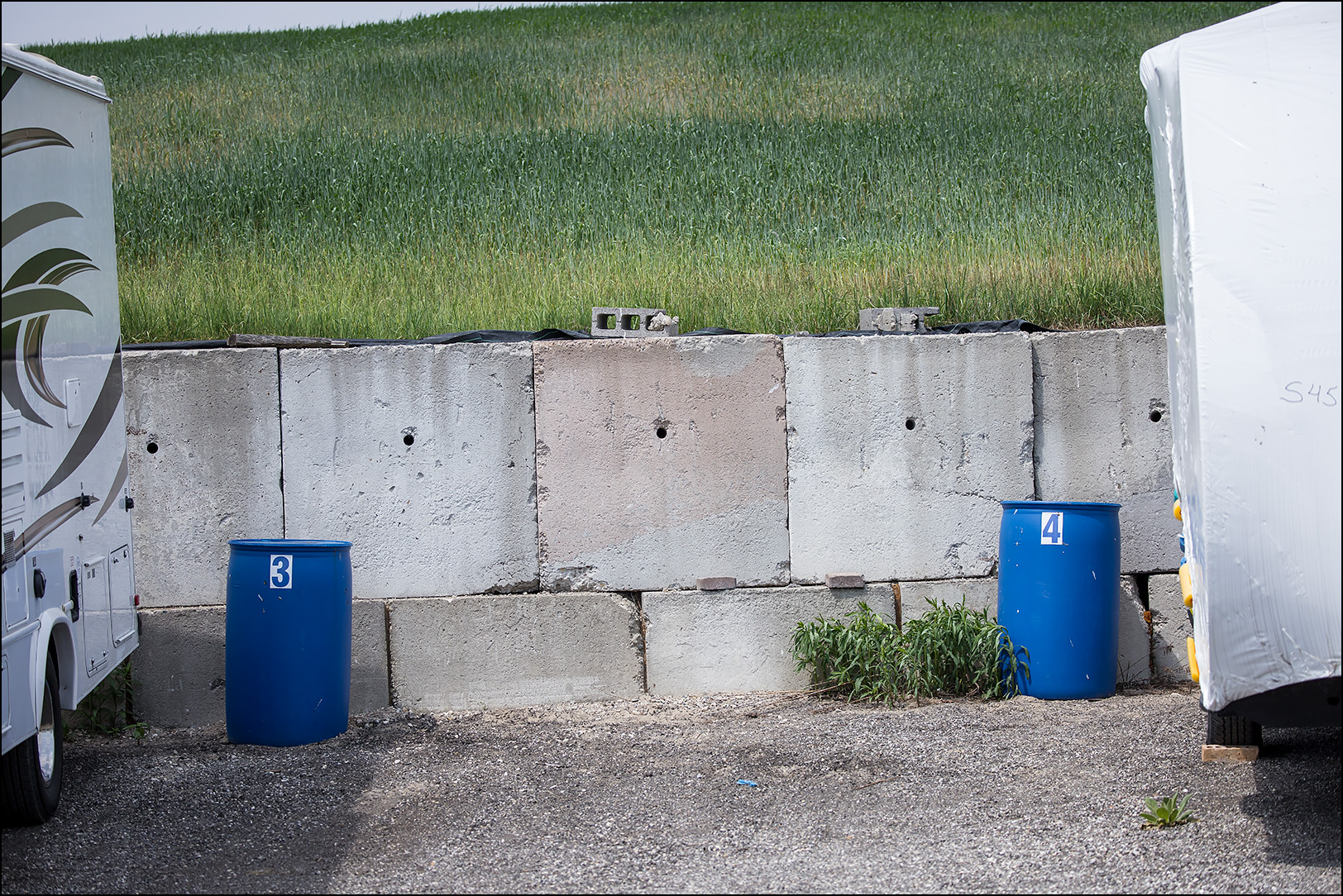

     Maybe we can talk the owner into installing a second layer!


     The current regulations in regard to COVID permit groups of five people from different households to get together outdoors, so we were finally, after several weeks, able to resume our walks with Heather and Lily. It is hard to believe but on 20 June, a mere twelve days from now Lily will be a year old.
     
Mommy slathering on sunscreen.

I will have to decide whether I like that or not.

I already tossed one shoe on the ground. Here comes the next!

Gotta let everyone know who's in charge here!

Time to say goodbye. See you next Friday.

     Heather and Lily wish everyone a happy summer. See you again soon.

Saturday, July 07, 2018

Nature in the Summer

     For the second year in a row I have been involved in monitoring an artificial mound designed to encourage Sand Martins (Riparia riparia) to nest there. 


     Unfortunately, this structure has been a complete failure both years. There has not been the slightest interest in it; in fact, I have never even seen a Sand Martin in the vicinity of it. I think there are various reasons why it has not been used and I hope that a serious reevaluation will be made by the Land Trust responsible for it. I will be happy to share my ideas and I hope that if anyone reading this account has experience with a structure like this they will offer any critiques or suggestions they may have.
     I know that in Europe walls with pipes filled with sand have been used successfully and perhaps that is the answer here. Whether a wall has even been tried in North America I have no idea, but I have been unable to find evidence of it. Location is certainly a factor too.
     Butterflies abound in mid summer and there were lots of Northern Pearly-eye (Enodia anthedon) flitting around in the meadows. Fortunately the odd one landed on a desirable piece of vegetation, at least long enough to take a picture.


     A male Baltimore Oriole (Icterus galbula) was singing its head off; I am not quite sure why at this late stage in the breeding season, perhaps in defence of territory.


     After such a strenuous performance a little preening was in order.


     Upon leaving the reserve, as I pulled away in my car, I spotted a large Eastern Garter Snake (Thamnophis sirtalis sirtalis) basking in the middle of the gravel road. I stopped the car and got out gingerly and walked around the vehicle to the back so that the sun would be behind me for a picture. Careful as I might have been, I had obviously spooked the snake and it was slithering away quickly into the grass. I succeeded in getting only one picture before it disappeared from view. At least it was no longer in danger of being run over.


     After lunch Miriam and I decided to go out and check a few local spots, given the fact that the temperature was a pleasant 24 degrees, in sharp contrast with the hot spell we have been having recently, when air temperatures have been soaring to 35 degrees, and with humidity factored in, into the low forties - not pleasant at all.
     A pair of Western Ospreys (Pandion haliaeetus) have nested on a communications tower for the past few years and two birds were on the nest.


     I suspect that these two birds are the young of the year, now as big as their parents and ready to fledge at any time.
     Cedar Waxwings (Bombycilla cedrorum) are common and we were surprised to see only one individual.


     In fact birds were very scarce, perhaps resting during the heat of the day. Turkey Vultures (Cathartes aura) were taking advantage of the thermals and it was rarely that we looked up without seeing a couple soaring overhead.
     It was easier to find butterflies, with Cabbage White (Pieris rapae) being the most common species.


    Clouded Sulphur (Colias philodice) was a close second.


     A lone Killdeer (Charadrius vociferus), feeding at the edge of a pond which is rapidly drying up, appeared to be benefitting from the lack of competition.


     We spotted several Eastern Commas (Polygonia comma) but it took a bit of patience to wait for one to land. In fact, no sooner had one landed than a second one joined it.


     Queen Anne's Lace (Daucus carota) is blooming everywhere, and we checked for the caterpillar of the Carrot Seed Moth ((Sitochroa palealis) which uses Queen Anne's Lace as a host plant and we were able to find a few.


     The meadows are a riot of wildflowers at present.


     Lots of Common Milkweed (Asclepias syriaca) was in bloom but try as we might we were unable to locate even one caterpillar of a Monarch (Danaus plexippus), and we have seen only two or three of this enigmatic butterfly this year.


     Japanese Beetle (Popilla japonica) is a serious invasive pest and seems to be quite catholic in its taste. I have lost count of the number of native plants on which I have seen it feeding.


     A couple of other butterflies rounded out our walk. If I am not mistaken this is our first Spring Azure (Celastrina lucia) of the year and it is already July!


     A Northern Crescent (Phyciodes cocyta) was partially hidden in the grasses, but Miriam managed to capture this shot.


     We saw several other interesting species of various taxa during our walk, most without photographs and a couple upon which we are awaiting ID confirmation. 
     It was great to be out and about on a fine summer's day. We will do it many times again before the cool winds of fall nip at our cheeks.

Monday, June 11, 2018

Tuesday Rambles with David - The Linear Trail, Cambridge, ON

05 June 2018

     For the first time in a long time our entire group of eight was together and it was good to see Mary back with us.
     This is not the most productive time of the year for birding, but for the careful observer there is still a lot of high quality activity, and careful observation reveals many secrets. Eight pairs of eyes and ears makes possible what for a single observer might well go undetected.
     A breeding pair of Baltimore Orioles (Icterus galbula) is always an exciting find and, if I am not mistaken, it was Franc's sharp eyes that first noticed the male flying to a well concealed nest.


     The pendant nest of this species is a wonder to behold. I recently saw a nest in a spruce tree, the first time I have ever seen it in a coniferous tree, but this one was in a deciduous tree as is usually the case.
     The female was incubating inside the nest and the male was feeding her.


     He was an attentive partner and delivered food consistently while we watched.


     If we get back down to the Linear Trail in the next couple of weeks I am sure we will see both parents feeding their hungry chicks.
     Carolina Wren (Thryothorus ludovicianus), formerly rare in Waterloo Region, is becoming more and more common as it is able to tolerate our recent milder winters. This individual is perhaps about to deliver food to its young.


     The Grand and Speed Rivers meet at the trail and considerable activity is featured along this riparian zone. Sand Martins, aka Bank Swallows (Riparia riparia) were actively hawking for insects above the river.


     And this American Herring Gull (Larus smithsonianus) scanned the water for anything that looked good enough to eat.


     I have several times seen Common Grackles (Quiscalus quiscula) perched at the water's edge ready to pounce on minnows or tadpoles and I presume that this individual was feeding in that fashion.


     Cedar Waxwings (Bombycilla cedrorum) were also taking advantage of the insect swarms above the river to do a little flycatching of their own.


     A Song Sparrow (Melospiza melodia) singing from an elevated perch is a standard feature of spring in southern Ontario.


     Great Crested Flycatcher (Myiarchus crinitus) is a splendid addition to our avifauna when neotropical migrants return and this year they are either more numerous than usual or we have just been lucky locating them.


     Downy Woodpecker (Dryobates pubescens) is our most common picid, easily located, always entertaining, delightful in every way - kind of like seeing your favourite cousin - or Carol Gorenc; you have seen her many times before but familiarity never dims the pleasure.


     A Blue Jay (Cyanocitta cristata) is a flash of colour, sometimes a crescendo of sound, a model of cheekiness and always a bird to make you thankful that it lives among us.


     Grey Catbird (Dumetella carolinensis) inhabits dense thickets and jumbled hedgerows, chortling its musical song, with the characteristic catlike mew at the end. Now that it is nesting it is somewhat more secretive, but with a little persistence can still be located.


     This young Brown-headed Cowbird (Molothrus ater) was perhaps waiting for its surrogate parent to come along and feed it.


     Doves have been used since time immemorial as a symbol of peace and this Mourning Dove (Zenaida macroura) seemed to fit the mould. 


     I am sure it was happy to see us all reunited. 
     To my fellow ramblers, Miriam, Franc, Carol, Jim, Francine, Judy and Mary - thanks for your company. It is always a pleasure.

Land Acknowledgement

We acknowledge that the land on which we are situated are the lands traditionally used by the Haudenosaunee, Anishinaabe, and Neutral People. We also acknowledge the enduring presence and deep traditional knowledge, laws, and philosophies of the Indigenous Peoples with whom we share this land today. We are all treaty people with a responsibility to honour all our relations.

Followers