Friday, May 07, 2021

Still Close to Home


      The restrictions on movement imposed by the Provincial Government in response to COVID are in effect until 20 May, so at least for a while we will not be wandering far afield.

28 April 2021
Benjamin Park Trail, Waterloo, ON

     How fortunate we are to have this trail so close to our house. From our front door to the start of the trail is less than five minutes walk.
     Virginia Spring Beauty (Claytonia verginica) comes in both white and pink forms - absolutely stunning either way.


     I think you could set out in a dour mood and be instantly transformed as soon as you came across these very aptly named spring beauties.
     Black-and White Warbler (Mniotilta varia) is generally one of the earliest neotropical warblers to arrive back in southern Ontario and this year was no exception.


    It is a very appealing little bird and in many respects emulates our resident nuthatches as it clambers up and down trunks and branches, sometimes upside down, searching for spider eggs, insect larvae and other tasty treats.


     This individual entertained us for a few minutes before moving off to another section of the woods.


     Daffodils (family Amaryllidaceae) are common in woodlands, along highway verges and in meadows, and I am never quite sure how they got there and which species I am dealing with. They are incredibly attractive, and I am going with Wild Daffodil (Narcissus pseudonarcissus). 


     If any of my botanical friends care to offer further elucidation or correction, feel free to do so.
     Once again, I must own up to a little confusion. I am pretty sure that the blossom shown below is some kind of cherry (Genus Prunus) - but that is where my "educated" guess ends.


     I have no doubt that there are people reading this blog with far greater botanical knowledge than I, and help is eagerly sought and appreciated.
     Field Forget-me-not (Myosotis scorpioides) is familiar to all, and about this one I have no doubt.


01 May 2021
Benjamin Park Trail, Waterloo, ON

     White Trillium (Trillium grandiflorum) is beginning to bloom throughout the region and woodlands are carpeted with Ontario's Provincial Flower.


     Black-capped Chickadees (Poecile atricapillus) are eagerly seeking nest cavities in which to raise a family, and every potentially suitable hole needs to be thoroughly checked.


    A really close inspection is necessary.


     And if it looks good, it's time to start on some spring cleaning.


     Mourning Cloaks (Nymphalis antiopa) may still be commonly found flitting through any suitable stretch of woodland.


02 May 2021

Conservation Meadows Storm Water Management Area, Waterloo, ON

     Canada Geese (Branta canadensis) are breeding all over the region. Some protective males seem to prefer an elevated vantage point to exercise dominance over their breeding territory.


     The individual above flew down, making a great commotion, when a dog strayed too close to its partner on the nest.


     What the dog was doing off leash, wandering around at will, is another matter entirely.

Small wetland on Beaver Creek Road, Waterloo, ON

     I was all set to take a picture of a displaying Red-winged Blackbird (Agelaius phoeniceus), but by the time I pressed the button, it had left.
     The picture of the tree with its emerging leaves, however (Acer, sp), is quite delightful by itself.


Lakeside Park, Kitchener, ON

     Turtles of all types are emerging from their long hibernation beneath the mud, Midland Painted Turtles (Chrysemys picta marginata) among them.


     Families of Canada Geese are popping up everywhere.


     The geese at Lakeside Park are so habituated to the constant presence of humans they display no hostility even if you are quite close to their young.
     The goslings are the very epitome of cuteness.


     Marsh Marigolds (Caltha palustris), a personal favourite, are punctuating wetlands throughout the region.


     Blue Jays (Cyanocitta cristata) were abundant and noisy. It's hard to get an accurate count since it is always possible to tally the same bird twice as it moves around in the trees, but twenty might be a conservative estimate.


          There are many old trees with cavities suitable for nesting and this one looks as though a staircase has been constructed up to the front entrance.


     Miriam and I have not had especially good luck finding warblers this spring, so we were happy to come upon this male American Yellow Warbler (Setophaga aestiva) gleaning insects from the emerging leaves.


     A male Common Grackle (Quiscalus quiscula) seems to be elongating his body as much as possible,  to give the appearance of being bigger and more desirable to a passing female, one might surmise.


     Perhaps some enterprising young adventurers had ambitions for castaway survival when they started to build a shelter, but no doubt thought better of it and went home for dinner.


     This female duck had found a quiet place to rest, to escape the over-zealous attention of several males, perhaps.     


     It has all the features of a Mallard (Anas platyrynchos) x American Black Duck (Anas rubipres) hybrid.
     I am already accumulating pictures from several local walks for the next post, so stay tuned for more soon!


Monday, May 03, 2021

Long Point and Columbia Lake

24 April 2021
Long Point, Norfolk County, ON

     We decided that a visit to Long Point was in the cards, so armed with lunch we left for a day at Lake Erie. The weather was passable and we agreed it would be good to get away for a change of scenery.
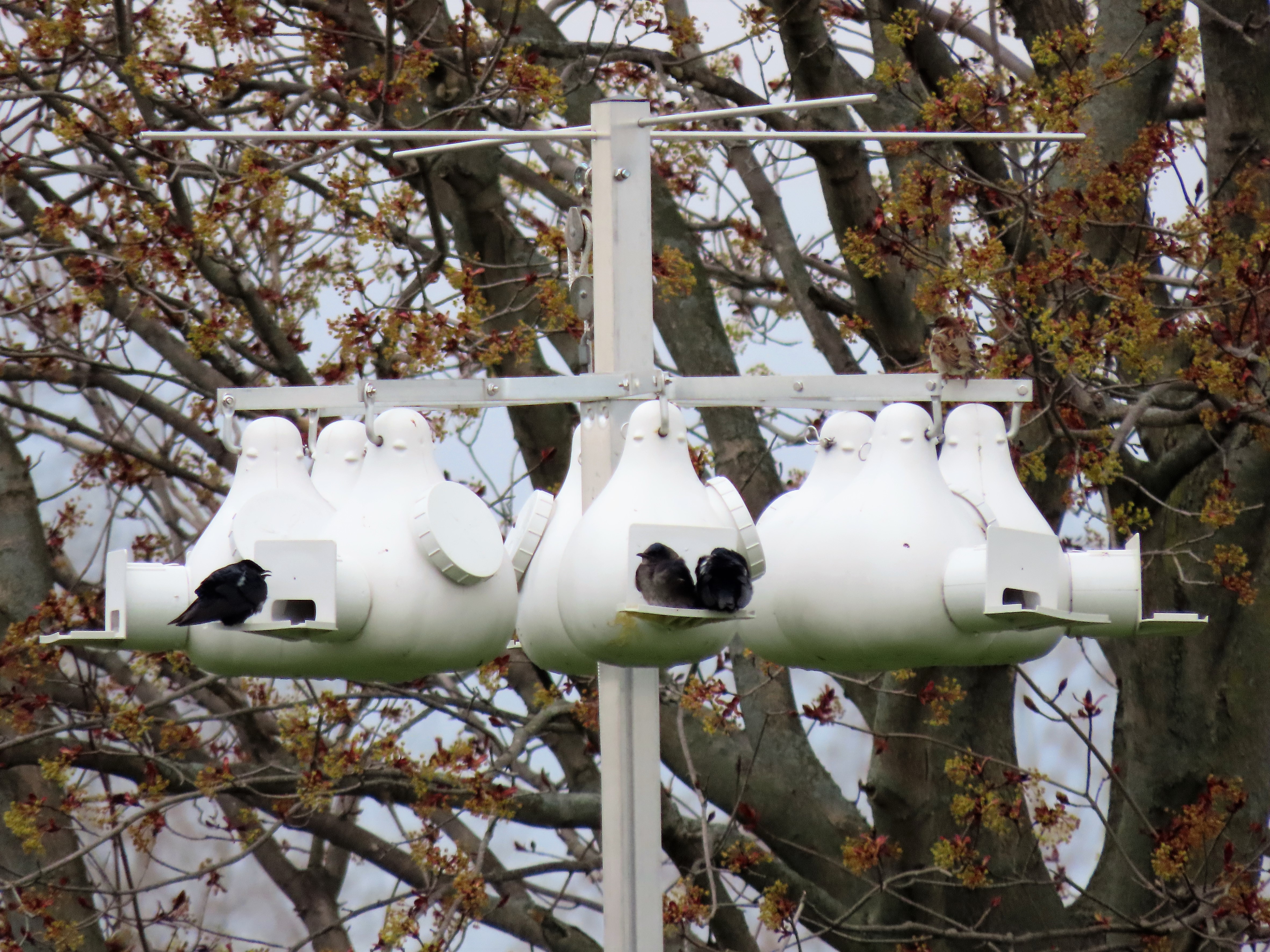
     The last time we went to Long Point we noticed a property with many Purple Martin (Progne subis) houses in readiness for the return of the birds, and it was good to see that serious attention was now being paid to the accommodation on offer.


     If I am not mistaken all rooms are heir conditioned!
     In Port Rowan harbour there were many Bonaparte's Gulls (Chroicocephalus philadelphia) patrolling close to shore and dropping to the water to snatch fish.


     We spent much of our time along the causeway, where Ring-necked Duck (Aythya collaris) was easily found.


     Killdeer (Charadrius vociferus) seemed to be everywhere, and Miriam astutely noticed this pair when one obliging bird gave another a boost in order to see a little farther!


     No doubt the view was appealing because no sooner had the upper bird dismounted he jumped back up for a second look!
     Ah, those Killdeers!


     I am used to seeing Killdeers feed in typical plover fashion, running along and stopping to pick up prey located visually, but this individual seems to have found a choice morsel in the water.


     Blue-winged Teal (Spatula discors) is a handsome duck, and as the genus name implies, is equipped with a bill reminiscent of a shoveler.


     Agreeably, several pairs were dabbling quite close to shore.


     We concluded that the area must have been especially conducive to filter feeding, for several Northern Shovelers (Spatula clypeata) were present alongside the Blue-winged Teal.


     Males seemed to outnumber females by a wide margin.


     A Lesser Yellowlegs (Tringa flavipes) was busy feeding alongside the ducks.


     A case could be made that a male Wood Duck (Aix sponsa) is a candidate for the title, "World's Most Handsome Duck". No doubt some might dispute that claim, but it would certainly rank in the top five, I would think.


     We found a very agreeable spot to park and have our lunch, looking out over a marsh.


     Way off in the distance a couple of Bald Eagles (Haliaeetus leucocephalus) were scanning the lake. It's not a great picture, but it was a long way off.


     Earlier we had seen a lone Lesser Yellowlegs, but while we ate lunch, several birds in a feeding frenzy, dashing here and there, and sieving through the water, entertained us royally.


     No trip to Long Point is complete without a visit to the Long Point Bird Observatory at Old Cut, especially during spring migration, but COVID once again exerted its evil influence.


     We had to be content with a walk down to the shore to gaze out over Lake Erie.


     It was all in all a very pleasant day.

27 April 2021
Columbia Lake, Waterloo, ON


     Our local waterways seemed to be universally bereft of gulls this year and not a single one was seen at Columbia Lake. I am not sure why this should be, but the sighting of a gull is getting to be a surprise. 
     A Greater Yellowlegs (Tringa melanoleuca) probed the shallows for food.


     Tawny Cotton-grass (Eriophorum virginicum) looked especially attractive.


     It is also known as Bog Cotton, quite a lovely name, really.
     Common Reed (Phragmites australis) is elegant and beautiful, but highly invasive, and damaging to native vegetation in a wetland.


     Once established it is extremely difficult to eradicate.
     The star of the show was a Great Blue Heron (Ardea herodias) at the pinnacle of its breeding plumage, and looking very handsome indeed.


     With great patience it stalked its prey.


     Is this not a study in concentration?


     With one lightening jab, we knew that fish was on the menu.


     After downing the fish in one swallow, the heron gave its plumage a good shake before flying off a couple of hundred metres along the shore to try its luck there.


     We are now into peak spring migration so we will have to see what we can bring you next time, even though we will be unable to visit some of the best hot spots - like the Long Point Observatory, they are all closed!

Saturday, May 01, 2021

Backyard Highlights

      Our backyard is always a source of activity, but at this time of year the pace picks up considerably.
     This robust and very handsome House Finch (Haemorhous mexicanus) is a lucky fellow for he is often accompanied by three females. 


     They should be paired off and nesting by now, but this Lothario thinks perhaps that a seraglio is preferable to the demands of raising kids. And who can quarrel with that?
     We have had this kettle, fashioned as a nest box, for several years, and in the past a family of Black-capped Chickadees (Poecile atricapillus) was raised in it. So, when Miriam spotted a pair investigating it anew, we were elated to think that we might once again be hosts to a brood of delightful chickadees.


     Outside and inside they checked.


     All was cleaned and dusted, spick and span, with just a couple of wood chips in there to mimic a natural cavity, exactly as we had done previously.


     But for whatever reason, it seems not to meet with their approval, for there has not been a repeat visit. And to think that food is always close at hand, with water to splash in - what more could they ask for?


     There are even fresh maple buds to snack on.


     We have three nest boxes out there waiting for occupancy and so far they have all been spurned. House Wrens (Troglodytes aedon) should be returning to southern Ontario any day now, so we still hold out hope.
     A male Brown-headed Cowbird (Molothrus ater) is an exceedingly handsome bird, whose most urgent goal in the spring of the year is to inseminate as many females as possible, so that eggs can be laid in the nests of unwitting hosts. 


     None of the chores of child-rearing are in the cards for this species.
     It is interesting perhaps to contemplate the host/guest arrangement for brood parasitic species, and to ponder that hospitality and hostility, both exhibited by host species, have the same etymological root. 


     The important thing is not to be anthropomorphic about it, and to accept that this breeding system is as much a part of the natural cycle as any other. Rejoice in diversity. Don't condemn it.
     American Goldfinches (Spinus tristis) are with us all year, and by now have achieved the complete splendour of their breeding attire. Witness this striking male.


     Who among us ever looked so good?


     The other day on television I saw images of shambling old celibates shuffling about their palace, wallowing in the gilded excesses of the Vatican; how they pale by comparison to a Northern Cardinal (Cardinalis cardinalis) who lives a life without ever resorting to moral equivocation.


     Leucism is a term that seems to have fallen into disfavour of late, as not quite accurately describing the condition achieved when a genetic mutation prevents melanin from being deposited in tracts of plumage. I recently read a bit of a diatribe from a biologist who advocated abandoning the term altogether, but it seems to me that leucism is sufficiently well understood that it remains an adequate definition of the condition.
     An American Robin (Turdus migratorius) presenting this abnormality visits us daily.


     Pine Siskins (Spinus pinus) are still taking advantage of our feeders, but I suspect that they will soon leave us and we will not see them again until the winter.


     White-throated Sparrow (Zonotrichia albicollis) is a very welcome visitor to our backyard.


     It is among the very handsomest of sparrows and is equipped with one of the most evocative songs in all the world of birds.


     Several individuals have seen fit to pay us a visit this spring.


     Infrequently, but regularly, White-throated Sparrows pair with Dark-eyed Juncos (Junco hyemalis), resulting in Dark-eyed Junco x White-throated Sparrow hybrids.
     My good friend, Paul Bigelow, sent me some pictures taken by his wife, Pat, of this manifestation in their yard.


     You have the pure White-throated Sparrow above and the Dark-eyed Junco below, and you can clearly observe patterns of both in this bird.


     Kudos are due to Paul and Pat for spotting the bird and permitting me to use their pictures. 
     A female House Finch appears not to have paired up at all - and the season is moving on!


     Dark-eyed Juncos are lingering still, taking advantage of plentiful food no doubt, but any day now the last one will have left, and we will not see them again until the fall.


     We wish them well on their journey and hope that they send many youngsters south to visit us later in the year.
     This brief post serves to illustrate how fortunate we are to enjoy a backyard during COVID. I expect to bring you more delights soon. Until then, stay safe and get vaccinated as soon as you can!

Land Acknowledgement

We acknowledge that the land on which we are situated are the lands traditionally used by the Haudenosaunee, Anishinaabe, and Neutral People. We also acknowledge the enduring presence and deep traditional knowledge, laws, and philosophies of the Indigenous Peoples with whom we share this land today. We are all treaty people with a responsibility to honour all our relations.

Followers