Showing posts with label Warbling Vireo. Show all posts

Sunday, August 25, 2019

The First Weekend of Fall Bird Banding at SpruceHaven and a Visit by Wild Birds Unlimited, Kitchener, ON

   
24 August 2019

     There is always a sense of excitement and anticipation when we start afresh with our bird banding activities and this year was no exception. I met Kevin, dark and early, and we were soon afterwards joined by Ross, and set up five nets.
     It was cool when we started (8° C) and few birds were moving around. At that temperature nor were the mosquitoes fortunately!  
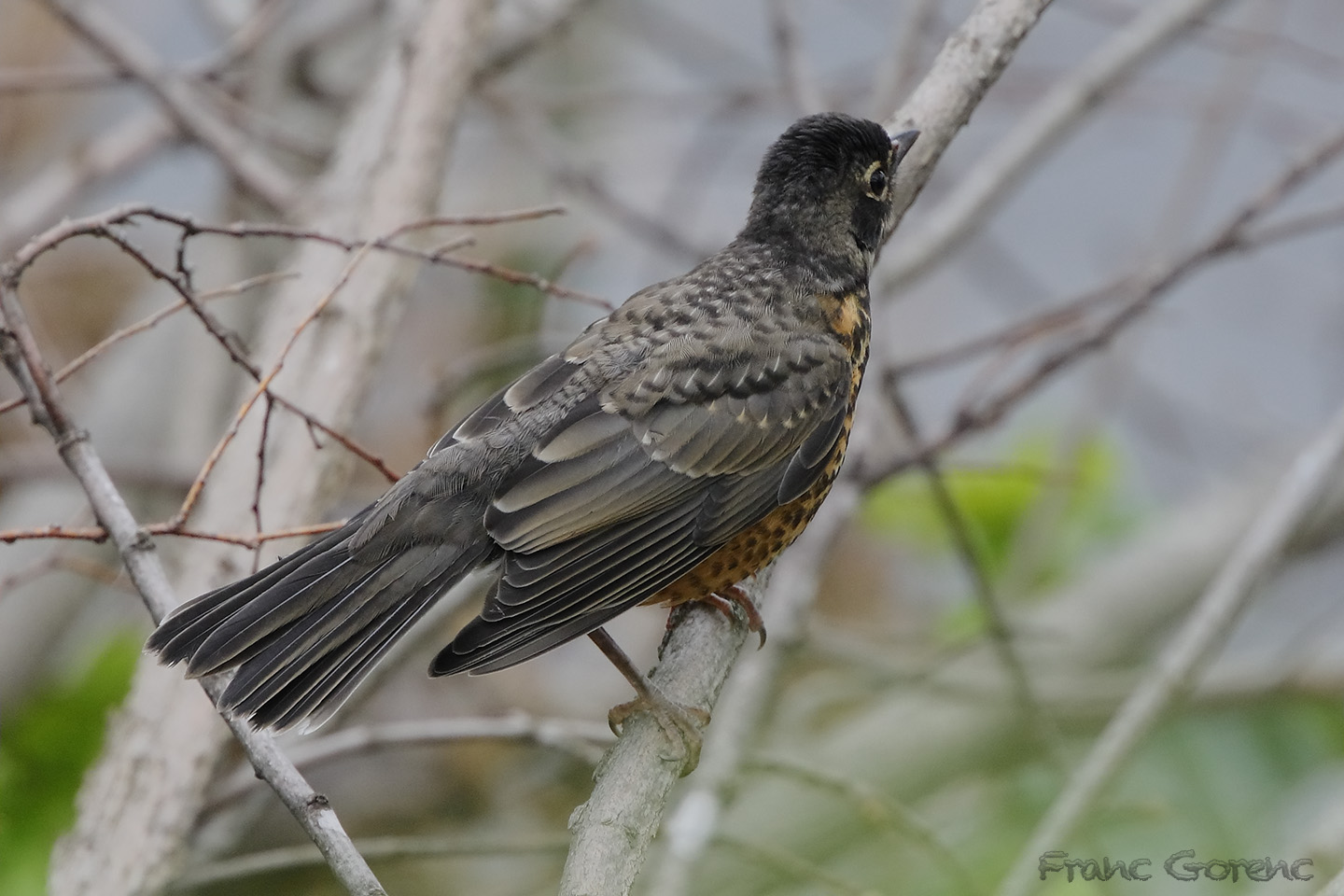
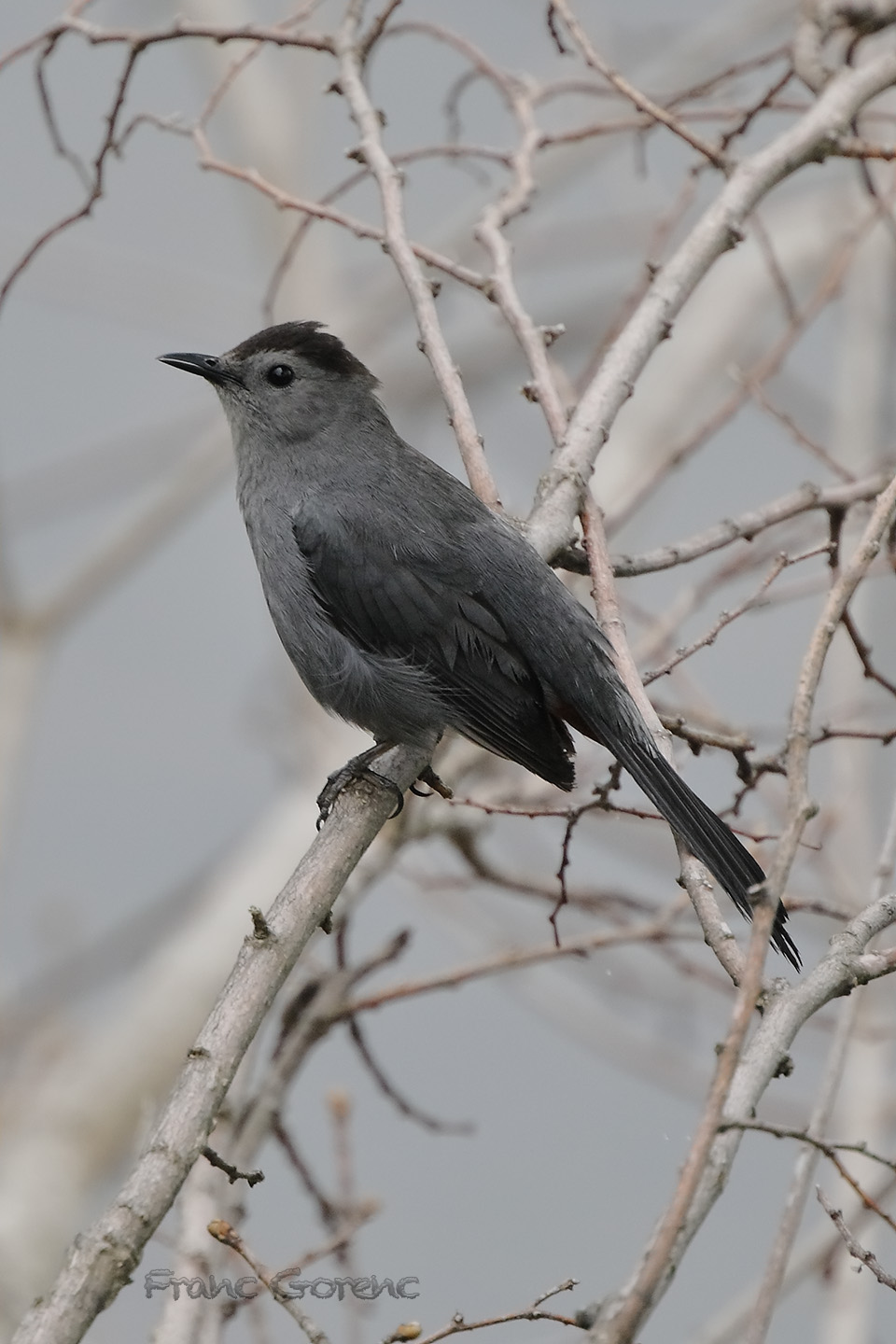
     We retraced our steps from the final net and in the very first one retrieved a juvenile Grey Catbird (Dumetella carolinensis). A Ruby-throated Hummingbird (Archilocus colubris) had also been ensnared, but since we do not have a permit to band hummingbirds it was released right away.
     This young Grey Catbird was acquiring new feathers as can be clearly seen below.


     A couple more rounds of the nets yielded nothing, but the day was warming and insects were starting to rise out of the grass, and our next circuit was more productive.
     A Common Yellowthroat (Geothlypis trichas), which undergoes at least partial moult before leaving the breeding grounds, was also showing evidence of moult in the tail feathers.


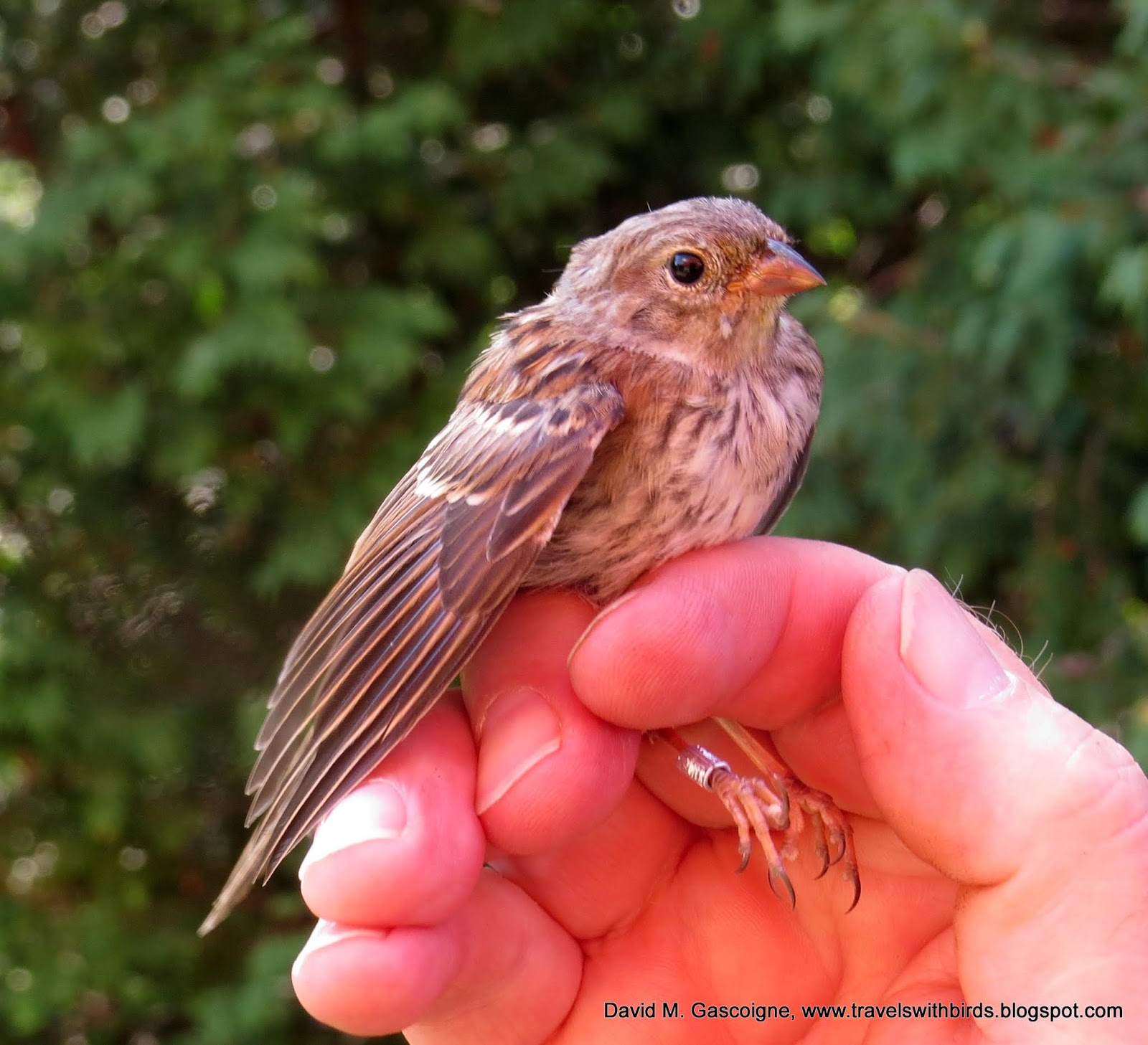
     It is relatively infrequently that we trap Field Sparrows (Spizella pusilla) so we considered ourselves exceptionally fortunate to capture two juveniles of this species.


     A Nashville Warbler (Leiothlypis ruficapilla) is somewhat more predictable, however.


     Song Sparrow (Melospiza melodia) is the most common new world sparrow in our area, so the only surprise was that we caught but one.


     House Wrens (Troglodytes aedon) have had a prolific breeding season this year, with several successful nests at SpruceHaven, and this young bird will soon be making its first migratory journey.


All birds banded 24 August: House Wren (1), Grey Catbird (1), Field Sparrow (2), Song Sparrow (1), Nashville Warbler (1), Common Yellowthroat (4)  Total: 10 individuals of 6 species.

25 August 2019

     It was our great pleasure to host a group of people under the aegis of Wild Birds Unlimited (wbukitchenerwaterloo@gmail.com) who were interested in all that goes on at Sprucehaven. It was a small but enthusiastic group, and it was my great pleasure to try to impart some of the magic of SpruceHaven to them. I was especially delighted to see children present.


     I do not have all the names of the people above but I will give the ones I know and I would be happy to add the the others if people would contact me. Along the back row, working from the left, unknown, Sharon Dillon-Martin, Tammy ?, Cathy Hale (Owner, Wild Birds Unlimited). In front are Darwin (great name!) and his sister, Joy. Tammy is their mom and is to be congratulated for bringing out her children to enjoy the wonders of nature.
     Kevin was unable to band with us this morning, but Ross came out to help and Heather was happy to make her first appearance of the season. Judy and Lorraine came out later.
     It was with a good deal of pleasure that we caught our first empidonax flycatcher, the morphology and biometrics of which narrowed it down to Least Flycatcher (Empidonax minimus).


      It was while processing this bird that a fly in the family Hippoboscidae, an obligate parasite of birds and mammals, dropped out of the feathers. (Picture courtesy of Ross Dickson)


     These flies are commonly referred to as flat flies and can compress their body and easily insert themselves into the feather tract of their avian host, being able to move sideways to sidle through the feathers. At least we did the bird the service of removing this bothersome intruder!
      A Black-capped Chickadee (Poecile atricapillus) is a resident species, and this individual that flew into our mist net was banded along with the migrants.


     The highlight of our banding session was a Mourning Warbler (Geothlypis philadelphia), a species we do not often capture, and in fact a species infrequently encountered in the field.


     A young male Rose-breasted Grosbeak (Pheucticus ludovicianus) let Heather know that he was not at all sanguine about being handled.


     It is not so bad when they seize your whole finger as above, but if they clamp down on the skin between your thumb and forefinger it is painful!
     A Warbling Vireo (Vireo gilvus) was our first capture of the season.


     Chipping Sparrows (Spizella passerina) breed locally so it is quite possible that this juvenile bird may have been born right at SpruceHaven. 


     Our final bird banded was a juvenile male American Goldfinch (Spinus tristis), a resident species. I expect we will trap a few more goldfinches before the season is done.


     It was a great weekend of banding, aided in no small measure by good weather, and the wonderful fellowship of bird enthusiasts, and a visit from Cathy and friends. 
     Ross will be back at it on Tuesday!

All birds banded 25 August: Least Flycatcher (1), Warbling Vireo (2), Black-capped Chickadee (1), Grey Catbird (1), American Goldfinch (1), Chipping Sparrow (1), Song Sparrow (9), Mourning Warbler (1), Common Yellowthroat (1), Rose-breasted Grosbeak (1). Total: 19 individuals of 10 species.


Sunday, September 03, 2017

Education at SpruceHaven for Children and Adults alike

02/03 September 2017

02 September

     It is not so long ago that Kevin and I were meeting at 05:30, but as a sure indication that the year is marching on, it is now 06:30 before it is light enough to do the rounds to unfurl the nets to get ready for another session of banding. The early morning chill is evident too; this morning it was a mere 4° when I left my driveway. The calendar does not indicate fall yet, but my mental process tells me that autumn is here once Labour Day arrives.
     The weather last night was clear and still, with little to prevent migrants from moving through, and we did not band large numbers this morning. We did, however, have some quality birds, and get confirmation that migration is truly well underway.
     New World wood warblers are justifiably considered to be a very handsome assemblage of birds, and no species is more emblematic of this fact than American Redstart (Setophaga ruticilla). This striking male was caught in our first round of the nets.


      My good friend, Josh Shea, the Natural Areas Coordinator for the City of Kitchener, visited this morning to escort a seven-year old boy named Roddie to see our birds up close. Josh has met Roddie through a programme run by the city at Huron Natural Area and has been impressed with the enthusiasm the youngster has for birds. Our banding session provided a fine opportunity for Roddie to see the birds up close and get a little more education to fuel his passion. 
     Here is part of the group of visitors today intently watching Kevin as he checks some finer point about the topography of a species.


     A Black-throated Green Warbler (Setophaga virens) was an enigmatic species for Roddie to observe up close, and the delight he experienced in so doing was evident to everyone.


     The plumage of many fall warblers is different from their breeding attire, and almost always muted at the very least, and we were able to explain these features to Roddie. Heather was anxious to engage him and always made it a point to provide the best experience possible, finally placing the bird in his hand (or that of his sister, Raya) before it flew away. Just look at the expression on the faces of those children! It speaks volumes.


     People are always fascinated at the process of weighing a small bird. Here a House Finch (Haemorhous mexicanus) puts up with the indignity of it all before being released, none the worse for wear.


     As you have now learned, Roddie was accompanied by his little sister, and they were both accompanied by their mother, Vashti - a more handsome trio was never assembled!


     I am filled with admiration for parents who make the time and take the trouble to expose their children to nature. Kudos to Vashti for coming out to see us and doing everything imaginable to foster and stimulate the interest of her children.
     I took a group shot, merely proving that photography is not my greatest skill!

Dave Westfall, Jim Huffman, Josh Shea, Roddie, Heather Polan, Kevin Grundy, Raya, Vashti and Francine Gilbert

     Kevin looks shy above and finally he skulked away to hide behind Vashti! Ah, the modesty of it all!


     On our next circuit of the nets we retrieved a Swainson's Thrush (Catharus ustulatus), our first migrant catharus of the fall.


     Heather had advised us earlier that her mother, Pat, would be coming to visit, and by now she had arrived to see exactly what her daughter does after getting up and leaving her house a little bleary-eyed each weekend morning. She could not have been more impressed! Heather has become a really proficient, competent bander. 


     In the picture above Heather is holding a Chestnut-sided Warbler (Setophaga pensylvanica), our final warbler of the day. Here it is in all its fall glory.


     By now the wind had picked up quite a bit and we closed the nets for the day. It was not a prolific day but it mattered little. We had a pleasing variety of species for our visitors to observe at close quarters and we were happy to have the opportunity to make new friends and spur on the children to a lifetime of connection with nature.

All species banded: Grey Catbird (1), Swainson's Thrush (1), American Robin (1), House Finch (1), American Goldfinch (1), American Redstart (1), Chestnut-sided Warbler (1), Black-throated Green Warbler (1), Song Sparrow (3).  Total: 11

03 September

     It was heavily overcast when we arrived, with the threat of rain ever present - not ideal conditions for bird banding, but we set the nets nonetheless and finally had not a bad day.
     Carrying on where we left off yesterday more warblers were captured, including our first Tennessee Warblers (Leiothlypis peregrina) of the fall. I apologize for the poor quality of the pictures, but for some reason today most of my pictures were blurry.


     Nashville Warblers (Leiothlypis ruficapilla) were also migrating through our area.


     Kevin and Heather were kept busy with their banding activities.


     Yesterday we heard a Warbling Vireo (Vireo gilvus) singing incessantly but never caught a glimpse of the bird. Today we trapped one in the nets.


     Kevin is planning a vacation later this month and will not be available for a couple of weeks, and we are unable to operate our nets without a registered bander holding a permit, so our good friend Ross Dickson has agreed to fill in for Kevin. Today Ross visited the nets and as always it was a pleasure to see him. It was a chance for him to meet Heather, and I am sure he is looking forward to banding with Heather and Daina in the coming weeks.

All species banded: Warbling Vireo (1), Cedar Waxwing (1), House Wren (1), American Goldfinch (2), Tennessee Warbler (5), Nashville Warbler (4), Common Yellowthroat (1), Song Sparrow (1).  Total: 16

Friday, July 14, 2017

Tuesday Rambles with David - The Linear Trail the second time around.

11 June 2017

     Last week we had a very productive outing to the Linear Trail in Cambridge, ON and covered about half its length. This week we decided to begin at the opposite end and work our way towards the point where we turned around last week. The weather was a little foggy, and the light far from ideal for photography, but we enjoyed a great walk filled with wildlife of different taxa.
     In the parking lot, before even embarking on the trail, we saw this Polyphemus Moth (Antheraea polyphemus), a stunning species. We initially thought that a woman parking her car had inadvertently run over it, but it was fluttering, and the driver of the vehicle, filled with remorse, carried it over to a tree. Without further ado it flew back towards us, so no harm seemed to have been done.

     In high spirits, we set out along the trail.


     We had not gone far, no more than four or five hundred metres, when our walk was abruptly brought to a halt.


        Quite what happened to the bridge is open to speculation, but it appears that someone attempted to drive over it with equipment exceeding the load-bearing capacity of the structure.


     Had we been children, we would have taken our shoes and socks off and waded across, but being a conservative bunch, and no doubt older and wiser (or is that less adventuresome?) we headed back to the parking lot.
     Common Whitetails (Plathemis lydia) were common. Here is an adult male...


     ...........and here is a juvenile male with its characteristic brown abdomen and pale diagonal dashes along each side.


     On the way back to our vehicles, Franc and I ventured off into a bushy area, filled with tangles and saplings of various heights, and plagued with mosquitoes unfortunately. In any event, we made our way down to the river and were rewarded with a great range of species.
     Common Tern (Sterna hirundo) is rare around here, but this year I have seen as many as three individuals at the Hespeler Mill Pond, and today Franc and I were treated to the delightful spectacle of seeing a delicate Common Tern, in superbly choreographed flight, alongside the bruiser of this family, Caspian Tern (Hydroproge caspia).
     The scientific name of Common Tern translates to Swallow Tern, and you can judge for yourself from the pictures below that it is aptly named.


     Franc had never seen a Common Tern before and was thrilled to be presented with such great opportunities for photographs.
     The powerhouse Caspian Tern was a study in contrast.


     A male Belted Kingfisher (Megaceryle alcyon) was perched just over the water, a little farther away than we might have liked, but photogenic nonetheless.


     A Great Blue Heron (Ardea herodias) stalked its prey, patiently waiting for every opportunity to make a lightening strike.


     Kildeer (Chardrius vociferus) is our most common shorebird and is frequently observed in large numbers, especially as we approach migration time. 


     As we picked our way back through the tangles, Grey Catbirds (Dumetella carolinensis) were frequently seen and heard, gurgling their delightful, cheery song, with a little mimicry thrown in for good measure, and ending on the miaow exclamation point from which the bird derives its name.


     Having donated our share of blood to the ravenous female mosquitoes we rejoined Miriam, Judy, Mary and Carol in the parking lot, and set off to park adjacent to the trail around its midpoint, so that we could traverse it back to the defunct bridge which had stopped us in our tracks.
     The birding was terrific. Bald Eagles (Haliaeetus leucocephalus), no longer subjected to idiotic and obscene levels of persecution, have made a resounding comeback across the continent and are now fairly common in the Grand River watershed. It was with enormous satisfaction that we saw two adults perched at the river's edge, quite far away, but close enough for a record shot.


     One of the birds flew a little closer and perched at mid height in the trees along the riverbank. It is indeed a majestic species.


     Ring-billed Gull (Larus delawarensis) is a skillful and opportunistic feeder and this individual had caught a catfish, a fine meal indeed. It is amazing what a bird can swallow!


     After all that exertion, and with a full belly, perhaps it needed to rest for a while.


    We have a watermelon in the fridge and I think that to match the feat of the gull I would have to swallow it whole!
     American Herring Gull (Larus smithsonianus) is less common at this time of year and this is the only individual we saw.


     American Robin (Turdus migratorius)is a prolific breeder and often has three broods in a single season.  Juveniles are seemingly everywhere. 


.    
     Spotted Sandpiper (Actitis macularius) is common along suitable watercourses and we saw several of them.


     It is always interesting to watch them zoom across the water with their typical rapid wing beats.


     There were several small flocks of Northern Rough-winged Swallows (Stelgidopteryx serripennis) and we were fortunate to have one perch for a picture.


     This male American Yellow Warbler (Setophaga aestiva) has lost his tail somehow. Perhaps sacrificing it saved him from a predator bent on making a meal out of him.


    House Wrens (Troglodytes aedon) were spotted several times, often announcing their presence by their rollicking song.


     Birds need to keep their plumage in prime condition and bathing is an important part of feather maintenance. This male American Goldfinch (Spinus tristis) is drying off after immersing at the river's edge.


     Japanese Beetle (Popilla japonica) is a serious invasive species, with adults damaging leaf tissues and ripening fruit of more than two hundred plants. This pair seems intent on making sure that we have more of them.


     Maybe Song Sparrows (Melospiza melodia) will eat a few!


     Warbling Vireos (Vireo gilvus) have a robust population along the Linear Trail.


     Mourning Dove (Zenaida macroura) is a very common species, of course, but this is an interesting shot.


     I always think that Northern Cardinal (Cardinalis cardinalis) is like an old friend that you never tire of seeing, no matter how often it happens. 


     Another great Tuesday ramble. Now we have to think about next week's destination.

All birds species: Canada Goose, Mallard, Great Blue Heron, Western Osprey, Bald Eagle, Sandhill Crane, Killdeer, Spotted Sandpiper, Ring-billed Gull, American Herring Gull, Caspian Tern, Common Tern, Mourning Dove, Chimney Swift, Ruby-throated Hummingbird, Belted Kingfisher, Downy Woodpecker, Northern Flicker, Eastern Phoebe, Warbling Vireo, Red-eyed Vireo, Blue Jay, Northern Rough-winged Swallow, Tree Swallow, House Wren, American Robin, Grey Catbird, Cedar Waxwing, Common Yellowthroat, Yellow Warbler, Song Sparrow, Northern Cardinal, Red-winged Blackbird, Common Grackle, Brown-headed Cowbird, Baltimore Oriole, House Finch, American Goldfinch, House Sparrow.   Total:  39 species.

Land Acknowledgement

We acknowledge that the land on which we are situated are the lands traditionally used by the Haudenosaunee, Anishinaabe, and Neutral People. We also acknowledge the enduring presence and deep traditional knowledge, laws, and philosophies of the Indigenous Peoples with whom we share this land today. We are all treaty people with a responsibility to honour all our relations.

Followers