Showing posts with label Chestnut-sided Warbler. Show all posts

Sunday, September 20, 2020

Fall, Moult, Lily and Warblers

 Hillside Park, Waterloo, ON

     As we move closer to the end of September, mornings are decidedly cool, the days are crisp, and the colours of autumn are manifest.


     Each day brings another reminder of fall, and the nights draw in closer. It is time to think of soups and stews, to dig out scarves and sweaters.
     Young American Robins (Turdus migratorius) are rapidly developing the skills they will need to survive, migrate, and return to breed next spring.


    Miriam and I watched this Great Blue Heron (Ardea herodias) for several minutes at close range. It seemed totally unperturbed by our presence as it went about its business.


     It was perhaps the most inefficient heron we have ever seen for we did not observe a single strike! At times it approached the creek bank and seemed to be seeking prey there, but as far as we could tell it went on its way hungry.


Riverside Park, Cambridge, ON


     For any number of reasons I did not get around to blogging about our Friday walk with Heather and Lily last week, so today you will be treated to two such outings!
     Before going any further, take a look at our precious little girl.


     It is remarkable to see the changes each week and Lily is now clearly following objects, reacting to sounds and quite possibly is able to distinguish colours. 
     Riverside Park attracts a number of people who bring bird seed in their pockets to deposit along the rail of the boardwalk, and the birds have learned where to come for a predictable source of food. Among them are Northern Cardinals (Cardinalis cardinalis), vivid red, and it is postulated that red may be the first colour that babies can clearly recognize. I am convinced that Lily reacted to a cardinal with a little throaty chuckle.


     As you may note, many of the birds are now in various stages of moult, and this male looked a little scruffy.
     The female didn't look appreciably better either.


     But for Lily, there were flashes of colour, the noise of birds quarreling, the whirring of the wings of a Mourning Dove (Zenaida macroura) and it appeared to me that she was absorbing it all. 


     I wonder if she noticed a Red-winged Blackbird (Agelaius phoeniceus) or two?


     In the centre of the picture below you will see a Common Grackle (Quiscalus quiscula) undergoing moult before migration.


     This Red-winged Blackbird is waiting for its tail feathers to grow back in.


     Lily is obviously happy to see Heather and Grandpa David!


     Her favourite activity, I think, is blowing bubbles!


     We were relieved to see this Eastern Yellowjacket (Vespula maculifrons) go about its business and not bother us.


     It does not even bear thinking about the anguish a sting from an angry female wasp would cause a baby - and an angry female will sting repeatedly at the least provocation.
     Purple-stemmed Angelica (Angelica atropurpurea) is a common plant in southern Ontario and was abundant at Riverside Park, in the wet swampy areas  it prefers.


     American Red Squirrels (Tamiasciurus hudsonicus) are aggressive creatures and always manage to secure their share of available food.


     This Blue Jay (Cyanocitta cristata) was not at his or her most elegant, but it is still a striking bird.


     There were several Blue Jays in the area, screeching loudly as they sailed in to perch or feed. I wonder whether Lily picked up on that? Will she learn the speech of birds along with the speech of humans? I suspect she will.
     A basking Midland Painted Turtle (Chrysemys picta marginata) paid no attention to all the commotion.


     Soon it will be trapped beneath the ice where it survives due to chemicals in the blood that effectively act as antifreeze.
     A Common Starling (Sturnus vulgaris) is a handsome bird often overlooked due to its familiarity.


     No matter that you do it a thousand times, to have a Black-capped Chickadee (Poecile atricapillus) come to your hand to feed is a rare treat and always a thrill.


     And how can I not end this account without a couple more looks at Lily and her mom? 


     It's all pretty special if you ask me!

RIM Park, Waterloo, ON

     Two days shy of her three-month birthday, we met Lily at RIM Park, having been transported there by her personal chauffeur, Heather - aka Mom!


     It was a cool morning and she was suitably dressed to stay warm.


      She was so good the whole time on this walk; she never fussed even for a moment. Usually, when we meet Heather and Lily each Friday, the whole purpose is to get together and birding becomes a bit of a secondary activity, with Lily demanding attention from time to time. This was the first time when we could all bird together and we had great success. 
     Migrating warblers and other small passerines are not the easiest subjects to photograph, so I have reached into the archives for pictures of some of the captivating neotropical migrants we saw.

American Redstart (Setophaga ruticilla)


Black-throated Green Warbler (Setophaga virens)


Chestnut-sided Warbler (Setophaga pensylvanica)


Nashville Warbler (Leiothlypis ruficapilla)


Myrtle Warbler (Setophaga coronata)


Common Yellowthroat (Geothlypis trichas)


Blue-headed Vireo (Vireo solitarius)


     It was a textbook fall day, cool, but with bright sunshine and we were very happy to be out together.
     And what shall I leave you with? A couple more pictures of Lily, of course!


     Ã€ la prochaine mes amis!
    

Saturday, September 15, 2018

Bird Banding at SpruceHaven

12 September 2018

     I met Ross dark and early, having driven through dense fog, but the conditions at SpruceHaven looked favourable for a good day at the nets. It was not long before we were joined by Judy and Merri-Lee and right from the get-go it was a productive session.
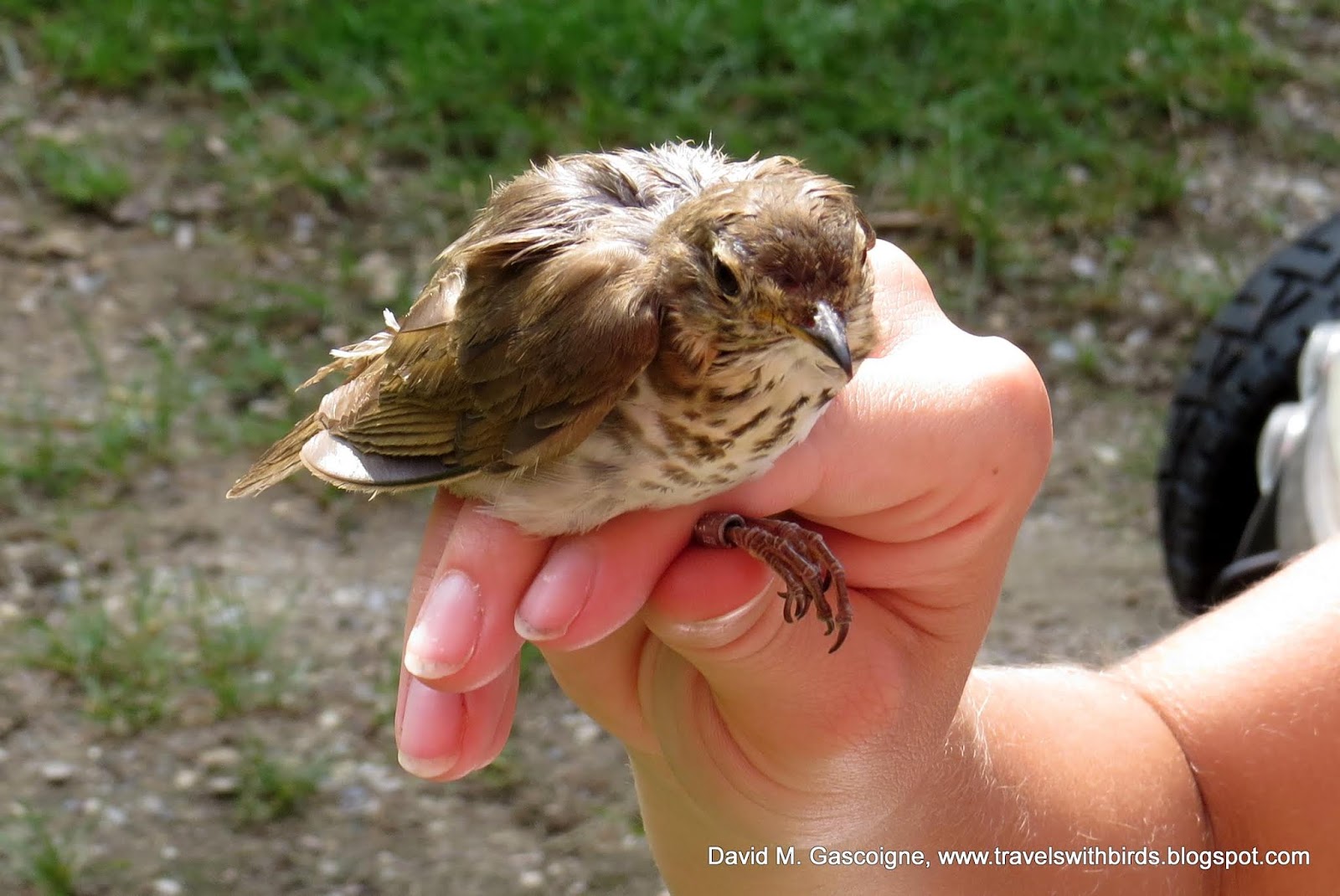
     One of our first captures was a Swainson's Thrush (Catharus ustulatus), an occasion to delve into the finer points of sexing and aging - an educational opportunity for all present.


     The picture below shows the tips of the greater coverts typical of a hatch year bird. The retained coverts often contain a cinnamon tip such as this example, sometimes more than one on each side of the bird. The tips in the first set of feathers wear rapidly so that it is very uncommon to find this feature in spring in a second year bird.


     This character is valid for all Catharus and other brown(ish) thrushes in North America, as well as for American Robin (Turdus migratorius). I wonder whether it is true for European species such as Turdus merula. Maybe Phil Slade might like to comment on this.
     A Chestnut-sided Warbler (Setophaga pensylvanica) presents quite a difference in appearance once it has shed breeding attire for its definitive basic plumage.


     Alder Flycatcher (Empidonax alnorum) and Willow Flycatcher (Empidonax traillii) are basically indistinguishable morphologically from each other, except at the extreme end of measurements, and are usually recorded as Traill's Flycatcher.


     Black-throated Green Warbler (Setophaga virens) retains enough of its breeding plumage into the fall, as to be quite easily recognized.


     Hints of morphology, but measurements primarily, enabled us to identify this bird as a Yellow-bellied Flycatcher (Empidonax flaviventri).


     The rusty crissum of this Grey Catbird (Dumetella carolinensis) is clearly visible on the bird below being held by Ross.


     I had to leave early, having other chores that had to be done, but after I left a hatch year Indigo Bunting (Passerina cyanea) was captured, our first ever in the nets at SpruceHaven and I am indebted to Merri-Lee for the photograph below.


     Tomorrow will mark the annual visit of Waterloo Region Nature to our banding operation. We hope that we will have a range of interesting species to show the people coming out to enjoy a morning at SpruceHaven.

All species banded 12 September: Yellow-bellied Flycatcher (1), Traill's Flycatcher (1), House Wren (1), Grey Catbird (1), Swainson's Thrush (2), American Goldfinch (16), Nashville Warbler (3), Common Yellowthroat (2), Magnolia Warbler(2), Chestnut-sided Warbler (1), Black-throated Green Warbler (1), Song Sparrow (3), Rose-breasted Grosbeak (1), Indigo Bunting (1).  Total: 36 birds of 14 species.
Retraps: House Wren (1), Swainson's Thrush (1), American Goldfinch (1), Common Yellowthroat (1), Song Sparrow (1).

Tuesday, August 21, 2018

Special Visitors to SpruceHaven

19 August 2018

     Regular readers of my blog will know that I do a weekly avian survey, spring and fall, at the University of Waterloo, for Professor Michael Drescher. In fact, I am now into my fourth year of this work.
     As we have chatted over the time I have been associated with Michael he has shared tidbits about his family, with an overwhelming sense of pride in his children, about whom he speaks in the doting tones one would expect from a dedicated father.
     Michael had told me earlier this spring that he was looking forward to a visit from his mother who lives in Germany and his sister from Australia. We both agreed that a visit to our banding operation at SpruceHaven would be interesting for everyone.
     Thus it was with great pleasure that we welcomed Michael and his family to SpruceHaven on Sunday morning.


     Going from left to right in the above picture are Andrea, (Michael's sister), Pippa, Michael, Allie, Anna and Marlies, (Michael's mother). In the foreground are Ross Dickson and Heather Polan, members of our crew.
     There was not a whole lot of activity at the nets, but the enthusiasm of our guests was not diminished and even though I had forgotten to advise them to wear rubber boots, they had no hesitation in risking wet feet to tour the nets with us.


     As you can see Pippa was entrusted with the important task of carrying one of the birds back to our banding table, and she performed like a true professional. She was very careful not to swing the bag at all and delivered her precious charge in a tranquil state. I think we have an ornithologist in the making!
     Heather, as always, was engaging and involved everyone in what she was doing, young and old alike. Ross, ever the teacher, described every organism we encountered!


     You can see the fascination on the faces of Pippa and Allie as Heather shows them the finer points of a hatch-year Northern Cardinal (Cardinalis cardinalis).
     Adults peered in too, all witnessing bird banding for the first time.


     All of the members of the Drescher family were the stars of the day, with Pippa and Allie attaining superstar status. But in the interests of illustrating why we get up long before the sun rises in the sky, here are a few pictures of some of the birds we banded.

Tennessee Warbler (Leiothlypis peregrina)


House Wren (Troglodytes aedon)
Chestnut-sided Warbler (Setophaga pensylvanica)
Swainson's Thrush (Catharus ustulatus)
 
     It was also interesting to be able to show our guests the caterpillar of a Milkweed Tussock Moth (Euchaetes egle), bristly and threatening like a creature from the underworld.


     This large moth was on the silo and we believe it to be a Bride Underwing (Catocala neogama), sometime referred to as simply The Bride, but we are awaiting confirmation on this identification - not always easy with moths!


     Michael and Anna, Pippa and Allie, Marlies and Andrea, what a pleasure it was to have you visit. Please come back any time. The welcome mat at SpruceHaven will always be spread out for you.

All birds banded 19 August: House Wren (2), Grey Catbird (1 new, 1 retrap), Swainson's Thrush (1), Americn Goldfinch (1), Tennessee Warbler (1), Common Yellowthroat (1 new, 1 retrap), Chestnut-sided Warbler (1), Song Sparrow (2), Northern Cardinal (1).  Total: 13 birds of 9 species.

Land Acknowledgement

We acknowledge that the land on which we are situated are the lands traditionally used by the Haudenosaunee, Anishinaabe, and Neutral People. We also acknowledge the enduring presence and deep traditional knowledge, laws, and philosophies of the Indigenous Peoples with whom we share this land today. We are all treaty people with a responsibility to honour all our relations.

Followers