Showing posts with label Michael Drescher. Show all posts

Tuesday, August 21, 2018

Special Visitors to SpruceHaven

19 August 2018

     Regular readers of my blog will know that I do a weekly avian survey, spring and fall, at the University of Waterloo, for Professor Michael Drescher. In fact, I am now into my fourth year of this work.
     As we have chatted over the time I have been associated with Michael he has shared tidbits about his family, with an overwhelming sense of pride in his children, about whom he speaks in the doting tones one would expect from a dedicated father.
     Michael had told me earlier this spring that he was looking forward to a visit from his mother who lives in Germany and his sister from Australia. We both agreed that a visit to our banding operation at SpruceHaven would be interesting for everyone.
     Thus it was with great pleasure that we welcomed Michael and his family to SpruceHaven on Sunday morning.


     Going from left to right in the above picture are Andrea, (Michael's sister), Pippa, Michael, Allie, Anna and Marlies, (Michael's mother). In the foreground are Ross Dickson and Heather Polan, members of our crew.
     There was not a whole lot of activity at the nets, but the enthusiasm of our guests was not diminished and even though I had forgotten to advise them to wear rubber boots, they had no hesitation in risking wet feet to tour the nets with us.


     As you can see Pippa was entrusted with the important task of carrying one of the birds back to our banding table, and she performed like a true professional. She was very careful not to swing the bag at all and delivered her precious charge in a tranquil state. I think we have an ornithologist in the making!
     Heather, as always, was engaging and involved everyone in what she was doing, young and old alike. Ross, ever the teacher, described every organism we encountered!


     You can see the fascination on the faces of Pippa and Allie as Heather shows them the finer points of a hatch-year Northern Cardinal (Cardinalis cardinalis).
     Adults peered in too, all witnessing bird banding for the first time.


     All of the members of the Drescher family were the stars of the day, with Pippa and Allie attaining superstar status. But in the interests of illustrating why we get up long before the sun rises in the sky, here are a few pictures of some of the birds we banded.

Tennessee Warbler (Leiothlypis peregrina)


House Wren (Troglodytes aedon)
Chestnut-sided Warbler (Setophaga pensylvanica)
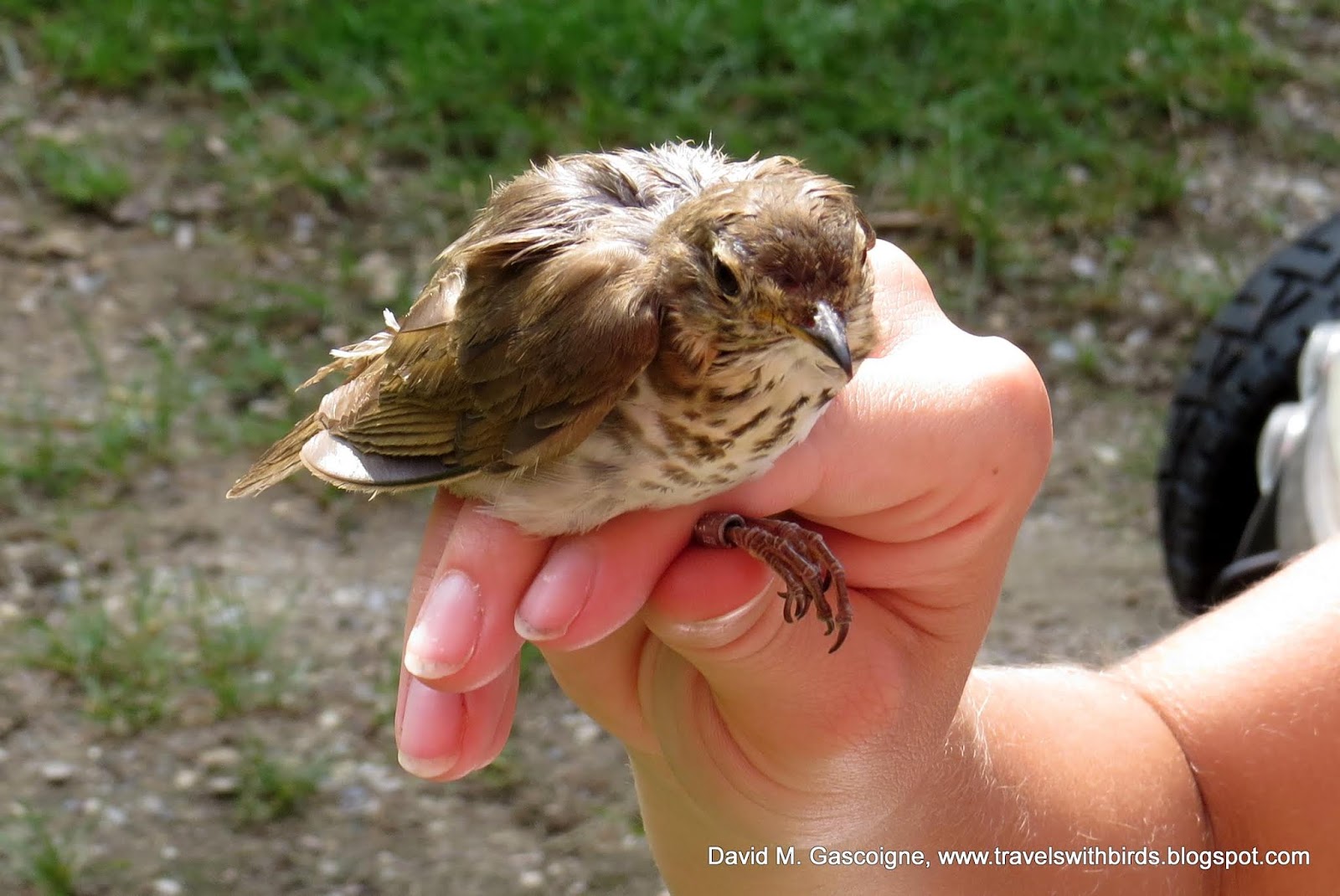
Swainson's Thrush (Catharus ustulatus)
 
     It was also interesting to be able to show our guests the caterpillar of a Milkweed Tussock Moth (Euchaetes egle), bristly and threatening like a creature from the underworld.


     This large moth was on the silo and we believe it to be a Bride Underwing (Catocala neogama), sometime referred to as simply The Bride, but we are awaiting confirmation on this identification - not always easy with moths!


     Michael and Anna, Pippa and Allie, Marlies and Andrea, what a pleasure it was to have you visit. Please come back any time. The welcome mat at SpruceHaven will always be spread out for you.

All birds banded 19 August: House Wren (2), Grey Catbird (1 new, 1 retrap), Swainson's Thrush (1), Americn Goldfinch (1), Tennessee Warbler (1), Common Yellowthroat (1 new, 1 retrap), Chestnut-sided Warbler (1), Song Sparrow (2), Northern Cardinal (1).  Total: 13 birds of 9 species.

Wednesday, May 09, 2018

Woodlot at the University of Waterloo, Waterloo, ON

09 May 2018

     For four years now I have been conducting a weekly avian survey, spring and fall, in the woodlot on the campus of the University of Waterloo, for Michael Drescher, Ph.D, Assistant Professor, School of Planning. It has been a distinct pleasure to do this, and Michael has been superb to work with.
     In addition to information on the birds encountered, I have always made Michael aware of other taxa observed, and this morning, for the first time ever, I came across an adult Red Fox (Vulpes vulpes) with four kits. They were seen on the bank of Laurel Creek, which flows through the woodlot. For the most part they were heavily concealed by Red Osier Dogwood (Cornus stolonifera) and other vegetation, and the photographs are not terrific, but the following shot shows the four kits.


     This picture shows the adult (presumably the female), again not especially clear, but definitive nonetheless.


     Another shot of the adult in Red Osier Dogwood......


     I expected to see high drama for a Canada Goose (Branta canadensis) was sitting on eggs very close to the foxes. In the second picture you can see just how close.


     I am not sure whether the foxes had not noticed the goose but they made no attempt to drive her from the nest in order to secure a nutritious feast of goose eggs. The goose got up from the nest, quite calmly, covered the eggs and left. Once the eggs were hidden beneath a layer of dried grasses the nest appeared to be nothing more than a pile of dead vegetation.
     One youngster, a little bolder than the others, or perhaps more foolhardy, came out into the open.


     A call from its mother caused it to leave in short order.


     It is around twenty years since I last saw a family of foxes and this morning's experience was quite magical for me. It is good to see this wily creature surviving in this way in the heart of a city; judging from the condition of the young they are feeding well.
    I located several other nests of Canada Goose, including this one.


    The female held tight on the nest while the male postured, hissed and honked at me, but I think we finally parted good friends!
    A male Hairy Woodpecker (Leuonotopicus villosus) foraged for a good while on fallen trees enabling a series of fairly decent pictures.


     In the next picture you can see the divided red patch on the male, one of the characters that separates this species from the similar, but smaller Downy Woodpecker (Dryobates pubescens).


     This individual appeared to be enjoying good feeding and remained in view for several minutes.


     I observed several Grey Catbirds (Dumetella carolinensis) and this one even stayed in one place long enough to have its picture taken.


     As I made my way back to the parking lot I saw the first family of Canada Geese for the year. The parents are quick to move their goslings onto the lawns where the living is easy!


     Before we know it they will be all grown up.


Land Acknowledgement

We acknowledge that the land on which we are situated are the lands traditionally used by the Haudenosaunee, Anishinaabe, and Neutral People. We also acknowledge the enduring presence and deep traditional knowledge, laws, and philosophies of the Indigenous Peoples with whom we share this land today. We are all treaty people with a responsibility to honour all our relations.

Followers