Showing posts with label University of Waterloo. Show all posts

Wednesday, January 24, 2024

Catch-up

     As I look back over my files there is lots to catch up on, incredibly going all the way back to November.
     So, here goes!

03 November, 2023
University of Waterloo Agricultural Land and Columbia Lake

     The field had been freshly ploughed and a large congregation of crows (I could say a Murder of Crows, but it seems so artificial and no one actually uses this archaic term) was plundering the worms and arthropods brought to the surface by the disturbance of the soil.


     Strangely, (at least it seemed so to me), no gulls had joined the fray, but on nearby Columbia Lake, American Herring Gulls (Larus smithsonianus) and a Ring-billed Gull (Larus delawarensis) were swimming together.


     Mallards (Anas platyrynchos) were their usual appealing selves.


12 November, 2023
Three Bridges Road and The Mill Race, St. Jacobs, ON

     There was an engaging display of equine affection at the Mennonite meeting house on Three Bridges Road, as the horses waited patiently for the service to end, when they could head for home.


     It is a rare occasion when a Downy Woodpecker (Dryobates pubescens) will feed from the hand, so I was pleasantly surprised when this bold male decided that the seeds were not for chickadees alone.


     Having cached its seed in a secure location underneath the bark of a tree it was content to perch for a moment or two, declining the opportunity of a repeat performance.


     Very rarely, a Blue Jay (Cyanocitta cristata) will alight on a hand too, although it has been a long time since I enjoyed the pleasure.


     If I were ever asked to assign a new name to the Mill Race Trail, I would have no hesitation in selecting Chickadee Trail. Black-capped Chickadee (Poecile atricapillus) is by a considerable margin the most frequently seen bird, and the most endearing too.


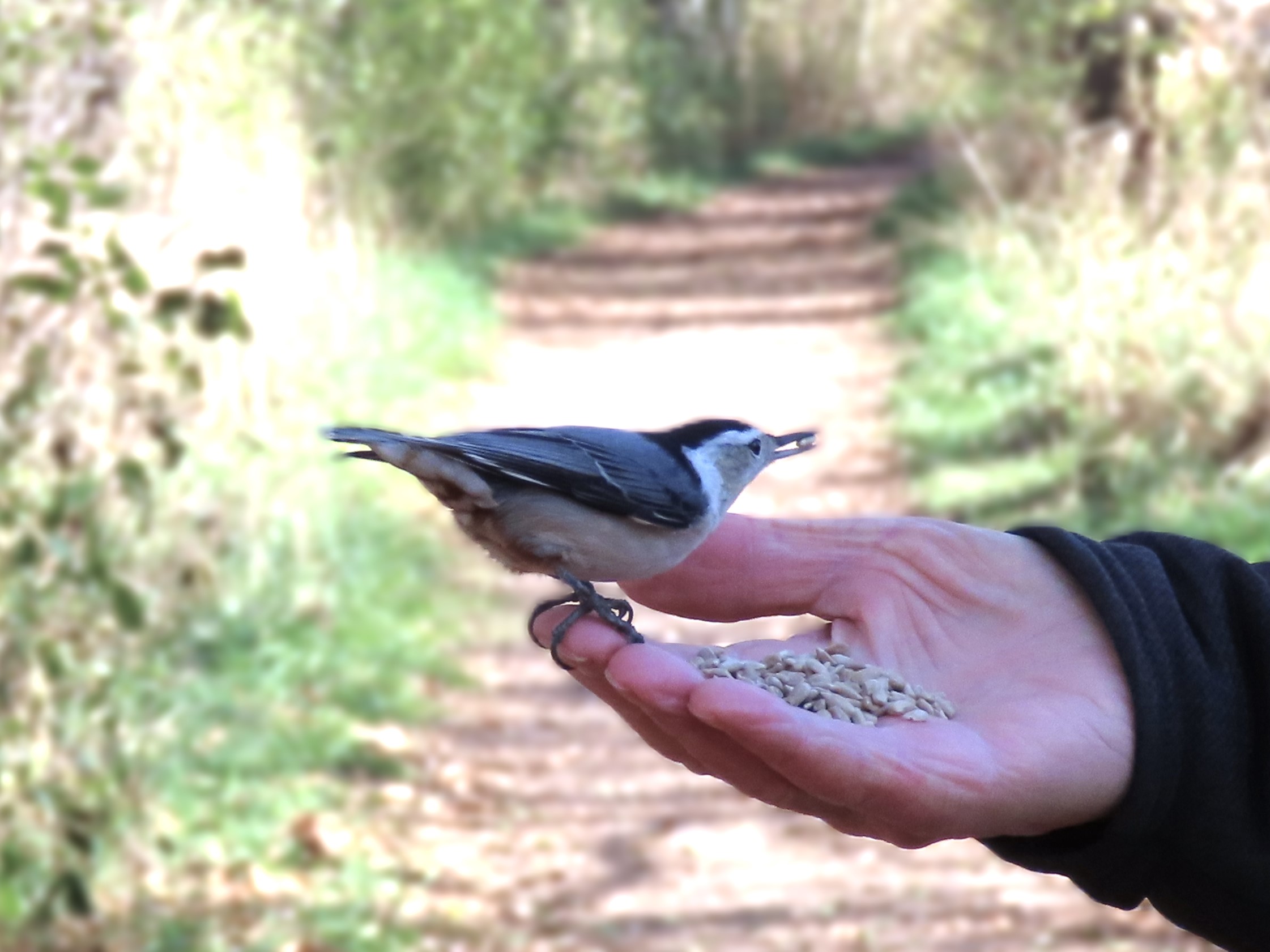
     White-breasted Nuthatch (Sitta carolinensis) would be a strong candidate for second spot.


     They are often found in close association with each other.


     A regular occupant of the Conestogo River in winter is Common Merganser (Mergus merganser).


     On this day they seemed to have formed a ladies club, for nary a male was seen.
     A flotilla of Canada Geese (Branta canadensis) rivals children skating on a frozen pond as an enduring symbol of Canada.


     A White-breasted Nuthatch importuned us for a final snack before we returned to our car.

     See you again soon!

13 November, 2023
Bannister Lake and F.W.R. Dickson Wilderness Area, New Dumfries, ON

     A quick stop at Bannister Lake yielded about thirty Sandhill Cranes (Antigone canadensis) scattered around the distant shore.


     It is a cause for considerable joy each time Trumpeter Swans (Cygnus buccinator) are sighted away from the main flock in Burlington, indicating that the long struggle to reintroduce this extirpated species to Ontario has succeeded. Miriam and I know of a location in Waterloo Region where they have bred successfully for at least two years.


     At nearby F.W.R. Dickson Wilderness Area the marquis billing still goes to Tufted Titmouse (Baeolophus bicolor), a species I am convinced is undergoing range expansion and will, within a few years, become quite common.


     In the meantime, legions of photographers descend en masse, bringing food and props to impart a natural feel to their shots.
     Not surprisingly, other birds are quick to take advantage of anthropogenic largesse.

Dark-eyed Junco (Junco hyemalis)
 
     American Tree Sparrow (Spizelloides arborea) is, to my eye, an exceptionally attractive bird, subtly muted in colour, exhibiting delicacy as few other species do.


     No one is surprised that Blue Jays muscle other birds off the food to make sure that they claim their share.


     White-breasted Nuthatches were persistent and successful.


     American Goldfinch (Spinus tristis) is not clad in robes of gold at this time of year, yet is nevertheless extremely attractive.


     Northern Cardinals (Cardinalis cardinalis) gathered seed from the fence rail, but were equally content to gorge on berries.


     Red-bellied Woodpeckers (Melanerpes carolinus) were back and forth, yet never in a position for that perfect shot.


     There's always next time.
     A very hardy Asian Lady Beetle (Harmonia axyridis) trundled along searching for a safe spot to spend the winter.


     There is more - but let's save that for another time.

Wednesday, May 30, 2018

A few Odds and Ends from the Woodlot

30 May 2018

     As regular readers of this blog will know I do a weekly bird survey at the University of Waterloo, but I always take note of other interesting discoveries too. 
     Most birds are now breeding, much of their song has become muted, they are secretive and we are entering the "slow" period for birders. It will be quiet until the hatch years birds birds fledge and join the adult population.
     The first bird I saw this morning was this leucistic American Robin (Turdus migratorius). 


     Leucism is a condition in which there is a partial loss of pigmentation, resulting in white, pale or patchy colouration of the feathers - but not the eyes as in albinism.
     Each year we see a few American Robins manifesting leucism to one degree or another, so perhaps this species, or Turdus thrushes in general, have some inherent susceptibility to this condition. I will have to do a little research!
     A pair of Northern Flickers (Colaptes auratus) was busy feeding young with a veritable shuttle service being maintained by the two parents.


     Mourning Dove (Zenaida macroura) is a very common bird, but for some reason I do not often encounter them in the woodlot. This individual was kind enough to stay put while I took a picture.


     For the most part Mallard (Anas platyrynchos) drakes take no part in raising their young, so it was quite unusual to see this devoted father taking on his full share of responsibility for his offspring.


     The sheer cuteness factor of recently hatched ducklings will never be diminished.


     Just before leaving the woodlot I came across this Hippodamia glacialis ladybug.


     It is quite large as ladybugs go, and is native to North America, making it a pleasing find when there are so many alien species that have found their way to this continent by one means or another.
     I have a couple more weeks to go until we suspend the monitoring until late August, but perhaps the woodlot has other secrets to reveal before we wind it up for the spring. 

Wednesday, May 09, 2018

Woodlot at the University of Waterloo, Waterloo, ON

09 May 2018

     For four years now I have been conducting a weekly avian survey, spring and fall, in the woodlot on the campus of the University of Waterloo, for Michael Drescher, Ph.D, Assistant Professor, School of Planning. It has been a distinct pleasure to do this, and Michael has been superb to work with.
     In addition to information on the birds encountered, I have always made Michael aware of other taxa observed, and this morning, for the first time ever, I came across an adult Red Fox (Vulpes vulpes) with four kits. They were seen on the bank of Laurel Creek, which flows through the woodlot. For the most part they were heavily concealed by Red Osier Dogwood (Cornus stolonifera) and other vegetation, and the photographs are not terrific, but the following shot shows the four kits.


     This picture shows the adult (presumably the female), again not especially clear, but definitive nonetheless.


     Another shot of the adult in Red Osier Dogwood......


     I expected to see high drama for a Canada Goose (Branta canadensis) was sitting on eggs very close to the foxes. In the second picture you can see just how close.


     I am not sure whether the foxes had not noticed the goose but they made no attempt to drive her from the nest in order to secure a nutritious feast of goose eggs. The goose got up from the nest, quite calmly, covered the eggs and left. Once the eggs were hidden beneath a layer of dried grasses the nest appeared to be nothing more than a pile of dead vegetation.
     One youngster, a little bolder than the others, or perhaps more foolhardy, came out into the open.


     A call from its mother caused it to leave in short order.


     It is around twenty years since I last saw a family of foxes and this morning's experience was quite magical for me. It is good to see this wily creature surviving in this way in the heart of a city; judging from the condition of the young they are feeding well.
    I located several other nests of Canada Goose, including this one.


    The female held tight on the nest while the male postured, hissed and honked at me, but I think we finally parted good friends!
    A male Hairy Woodpecker (Leuonotopicus villosus) foraged for a good while on fallen trees enabling a series of fairly decent pictures.


     In the next picture you can see the divided red patch on the male, one of the characters that separates this species from the similar, but smaller Downy Woodpecker (Dryobates pubescens).


     This individual appeared to be enjoying good feeding and remained in view for several minutes.


     I observed several Grey Catbirds (Dumetella carolinensis) and this one even stayed in one place long enough to have its picture taken.


     As I made my way back to the parking lot I saw the first family of Canada Geese for the year. The parents are quick to move their goslings onto the lawns where the living is easy!


     Before we know it they will be all grown up.


Land Acknowledgement

We acknowledge that the land on which we are situated are the lands traditionally used by the Haudenosaunee, Anishinaabe, and Neutral People. We also acknowledge the enduring presence and deep traditional knowledge, laws, and philosophies of the Indigenous Peoples with whom we share this land today. We are all treaty people with a responsibility to honour all our relations.

Followers