Showing posts with label Three Bridges Road. Show all posts

Thursday, May 15, 2025

Local Sightings

18 April, 2025
Three Bridges Road, St. Jacobs

     There is a spot along Three Bridges Road, near the bridge over the Conestogo River, where birds are attracted to suet and seed left by incognito nature lovers.


     Sometimes the comings and goings resemble Union Station at rush hour, and for the patient photographer the opportunities are many.
     A Mourning Dove (Zenaida macroura) strutted daintily in all its gentle splendour.


     Cheerful, friendly Black-capped Chickadees (Poecile atricapillus) enlivened the scene, as they always do.


     Downy Woodpecker (Dryobates pubescens) is generally quick to exploit the abundance of food on hand and it is not unusual to see three or four on the same tree, or scouring the ground for spilled seed, or juicy ants or other invertebrates.


     Red-winged Blackbirds (Agelaius phoeniceus) have recently returned to Southern Ontario to breed in our marshes and are a splendid addition to the avifauna of the region.


     A couple more Downy Woodpeckers -


     And a second Mourning Dove joined the throng.


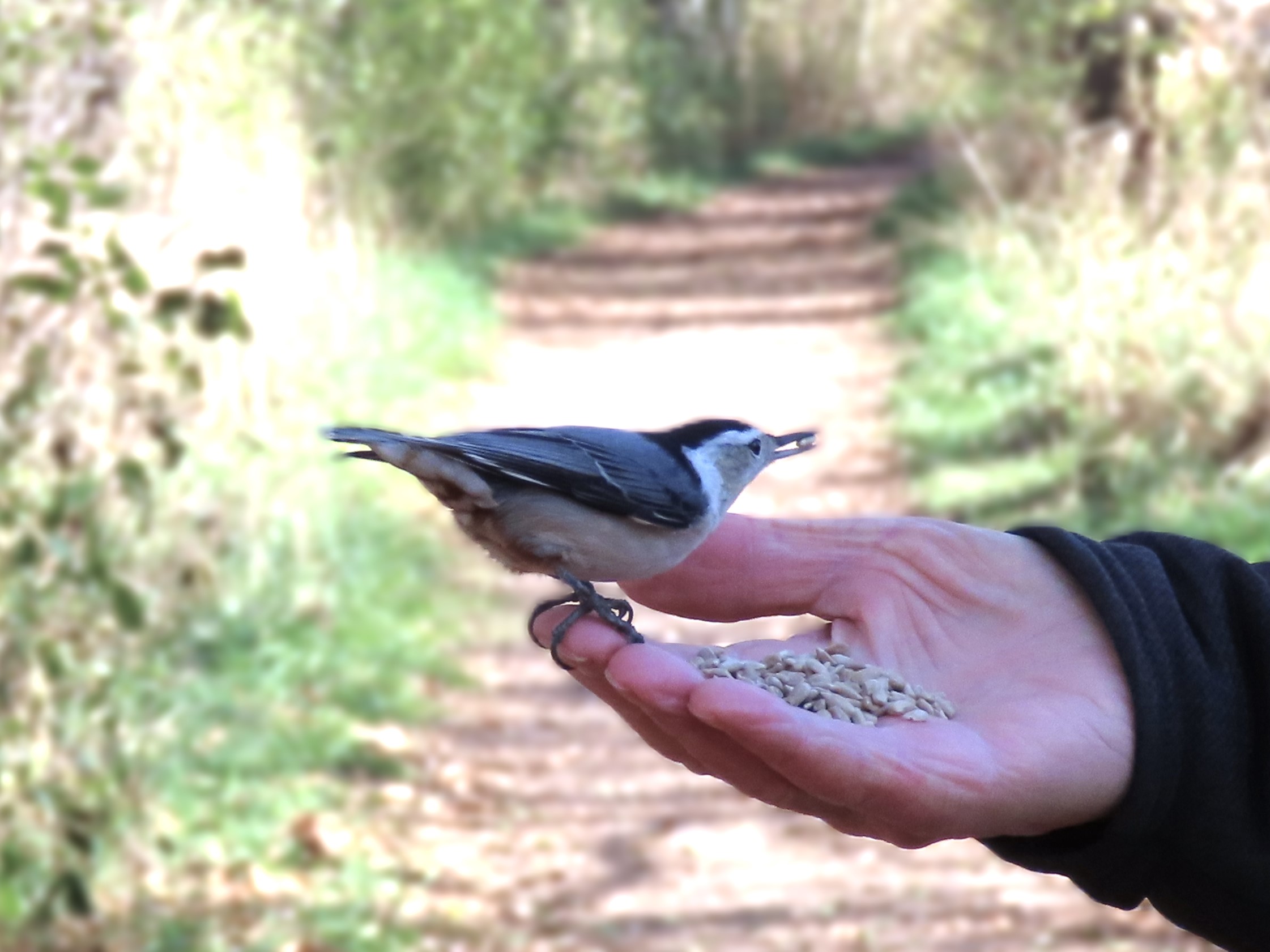
     There is something uniquely appealing about nuthatches in general, and White-breasted Nuthatch (Sitta carolinensis) never fails to widen the smile on my face.


     Song Sparrows (Melopspiza melodia) are singing from every perch, but this individual was on lunch break.


20 April, 2025
Laurel Creek Conservation Area, Waterloo, ON

     Our friend, Pam, has invested in an annual pass to the properties of the Grand River Conservation Authority, so we all went to Laurel Creek together.
     Black-capped Chickadees, knowing that two-legged mammals are probably bringing food, greeted us instantly.


     Pam was quick to oblige.


     Lesser Scaup (Aythya affinis) seemed content to snooze away the morning.


     A small group of Common Mergansers (Merganser merganser), all females, were more active.


     I don't think we were ever out of earshot of Song Sparrows.


     A male Red-winged Blackbird in prime condition is an impressive fellow. This individual is sure to impress the ladies.


     Here is the object of his passion, aloof, reserved - yet compliant too.


     American Robins (Turdus migratorius) charmed us with their always cheerful song.


     This is a nest from last year, that of an American Yellow Warbler (Setophaga petechia) perhaps.


     Canada Geese (Branta canadensis) were high overhead, honking vociferously.


     A Northern Cardinal (Cardinalis cardinalis) poured forth his glorious melody too.


     The whole area resounded with bird song, that age old serenade of spring.
     Snail shells (class Gastropoda) seemed to be everywhere, but not a live snail in sight.


     I was mildly amused by this barrier erected to deter Canada Geese from invading the beach area.


     Did someone not realize that geese can fly and with a couple of flaps of the wing be over the fence?


     A male and a female Tree Swallow (Tachycineta bicolor) were perched at opposite ends of a dead stump, seemingly not quite ready to get together.


     The lake was tranquil.


     More chickadees importuned shamelessly for food.


     One can never tire of these little bundles of joy.
      Violets (genus Viola) are in bloom.


     This enchanting little plant is nestled in the Bittercresses and Toothworts (genus Cardamine).


     The "find" of the morning was our first Pine Warbler (Setophaga pinus) of the season, singing and searching for insects.


     He was quite an acrobat too.


     An old nest of Aerial Yellowjackets (genus Dolichovespula) evoked memories of nervous picnics as these stinging machines buzzed around.


Lakeside Park, Kitchener, ON

     Having enjoyed our morning walk through Laurel Creek so much, it seemed like a good idea to visit Lakeside Park in the afternoon.


     We spotted a female Mallard (Anas platyrynchos) quietly resting, partly camouflaged, perhaps seeking seclusion away from the attention of amorous males.


     A Midland Painted Turtle (Chrysemis marginata picta) clambered out of the water to bask in the warm sunshine.


     Quite oblivious to the turtle, a Canada Goose settled down onto the nest.


     A single Pied-billed Grebe (Podylimbus podiceps) patrolled up and down; probably his partner is incubating eggs.


     A budding Box Elder (Acer negundo) is a wonderful sight.


     We wandered around, met an old friend, and were charmed by a Canada Goose as we headed back to the car.


     Isn't nature wonderful?


Wednesday, January 24, 2024

Catch-up

     As I look back over my files there is lots to catch up on, incredibly going all the way back to November.
     So, here goes!

03 November, 2023
University of Waterloo Agricultural Land and Columbia Lake

     The field had been freshly ploughed and a large congregation of crows (I could say a Murder of Crows, but it seems so artificial and no one actually uses this archaic term) was plundering the worms and arthropods brought to the surface by the disturbance of the soil.


     Strangely, (at least it seemed so to me), no gulls had joined the fray, but on nearby Columbia Lake, American Herring Gulls (Larus smithsonianus) and a Ring-billed Gull (Larus delawarensis) were swimming together.


     Mallards (Anas platyrynchos) were their usual appealing selves.


12 November, 2023
Three Bridges Road and The Mill Race, St. Jacobs, ON

     There was an engaging display of equine affection at the Mennonite meeting house on Three Bridges Road, as the horses waited patiently for the service to end, when they could head for home.


     It is a rare occasion when a Downy Woodpecker (Dryobates pubescens) will feed from the hand, so I was pleasantly surprised when this bold male decided that the seeds were not for chickadees alone.


     Having cached its seed in a secure location underneath the bark of a tree it was content to perch for a moment or two, declining the opportunity of a repeat performance.


     Very rarely, a Blue Jay (Cyanocitta cristata) will alight on a hand too, although it has been a long time since I enjoyed the pleasure.


     If I were ever asked to assign a new name to the Mill Race Trail, I would have no hesitation in selecting Chickadee Trail. Black-capped Chickadee (Poecile atricapillus) is by a considerable margin the most frequently seen bird, and the most endearing too.


     White-breasted Nuthatch (Sitta carolinensis) would be a strong candidate for second spot.


     They are often found in close association with each other.


     A regular occupant of the Conestogo River in winter is Common Merganser (Mergus merganser).


     On this day they seemed to have formed a ladies club, for nary a male was seen.
     A flotilla of Canada Geese (Branta canadensis) rivals children skating on a frozen pond as an enduring symbol of Canada.


     A White-breasted Nuthatch importuned us for a final snack before we returned to our car.


     See you again soon!

13 November, 2023
Bannister Lake and F.W.R. Dickson Wilderness Area, New Dumfries, ON

     A quick stop at Bannister Lake yielded about thirty Sandhill Cranes (Antigone canadensis) scattered around the distant shore.


     It is a cause for considerable joy each time Trumpeter Swans (Cygnus buccinator) are sighted away from the main flock in Burlington, indicating that the long struggle to reintroduce this extirpated species to Ontario has succeeded. Miriam and I know of a location in Waterloo Region where they have bred successfully for at least two years.


     At nearby F.W.R. Dickson Wilderness Area the marquis billing still goes to Tufted Titmouse (Baeolophus bicolor), a species I am convinced is undergoing range expansion and will, within a few years, become quite common.


     In the meantime, legions of photographers descend en masse, bringing food and props to impart a natural feel to their shots.
     Not surprisingly, other birds are quick to take advantage of anthropogenic largesse.

Dark-eyed Junco (Junco hyemalis)
 
     American Tree Sparrow (Spizelloides arborea) is, to my eye, an exceptionally attractive bird, subtly muted in colour, exhibiting delicacy as few other species do.


     No one is surprised that Blue Jays muscle other birds off the food to make sure that they claim their share.


     White-breasted Nuthatches were persistent and successful.


     American Goldfinch (Spinus tristis) is not clad in robes of gold at this time of year, yet is nevertheless extremely attractive.


     Northern Cardinals (Cardinalis cardinalis) gathered seed from the fence rail, but were equally content to gorge on berries.


     Red-bellied Woodpeckers (Melanerpes carolinus) were back and forth, yet never in a position for that perfect shot.


     There's always next time.
     A very hardy Asian Lady Beetle (Harmonia axyridis) trundled along searching for a safe spot to spend the winter.


     There is more - but let's save that for another time.

Land Acknowledgement

We acknowledge that the land on which we are situated are the lands traditionally used by the Haudenosaunee, Anishinaabe, and Neutral People. We also acknowledge the enduring presence and deep traditional knowledge, laws, and philosophies of the Indigenous Peoples with whom we share this land today. We are all treaty people with a responsibility to honour all our relations.

Followers