Showing posts with label Tennessee Warbler. Show all posts

Tuesday, September 10, 2019

Bird Banding at SpruceHaven and Plastics

08 September 2019

     Just Kevin and I met to do a little bird banding and as is my normal practice I am showing below pictures of birds we have not previously trapped this fall.
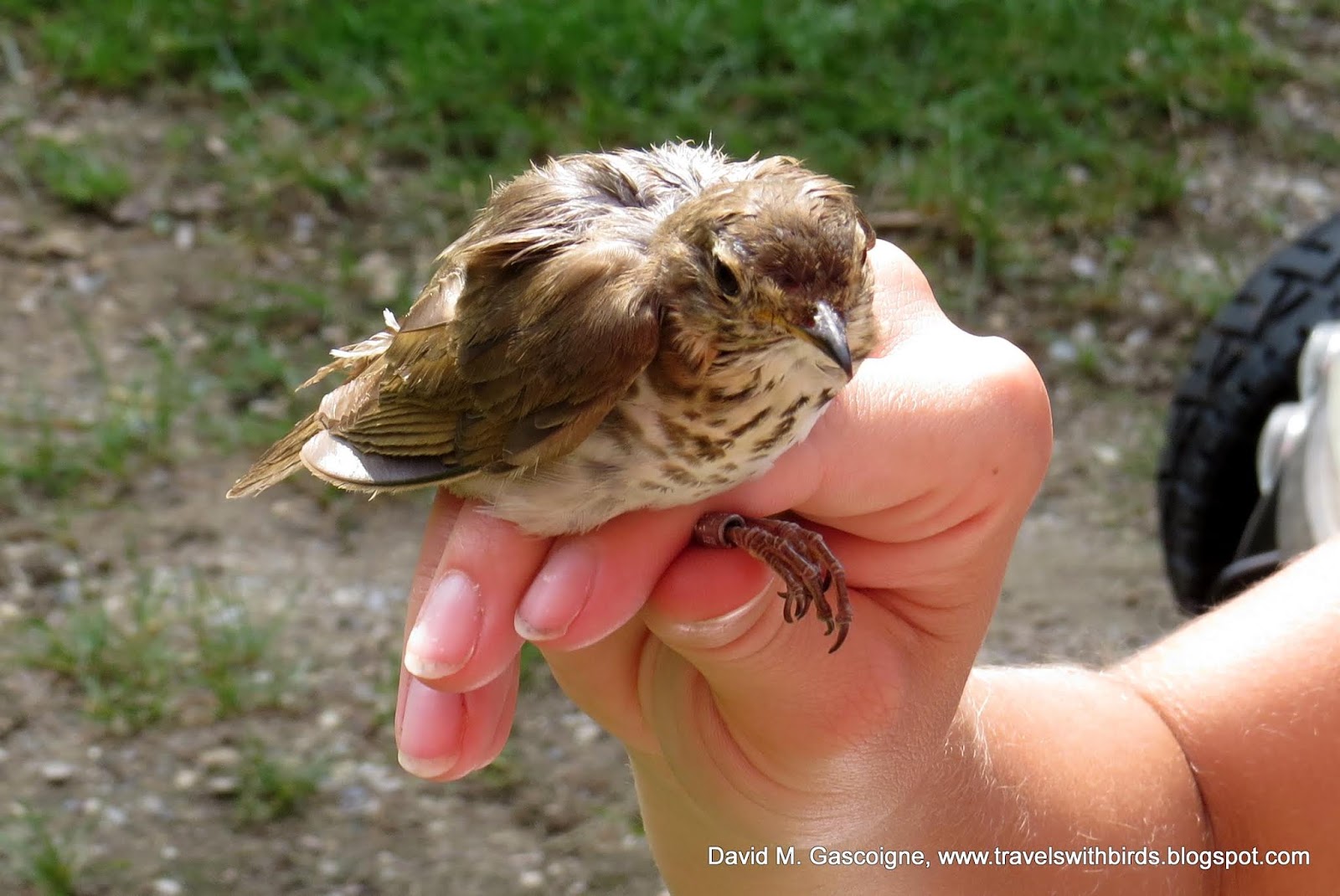
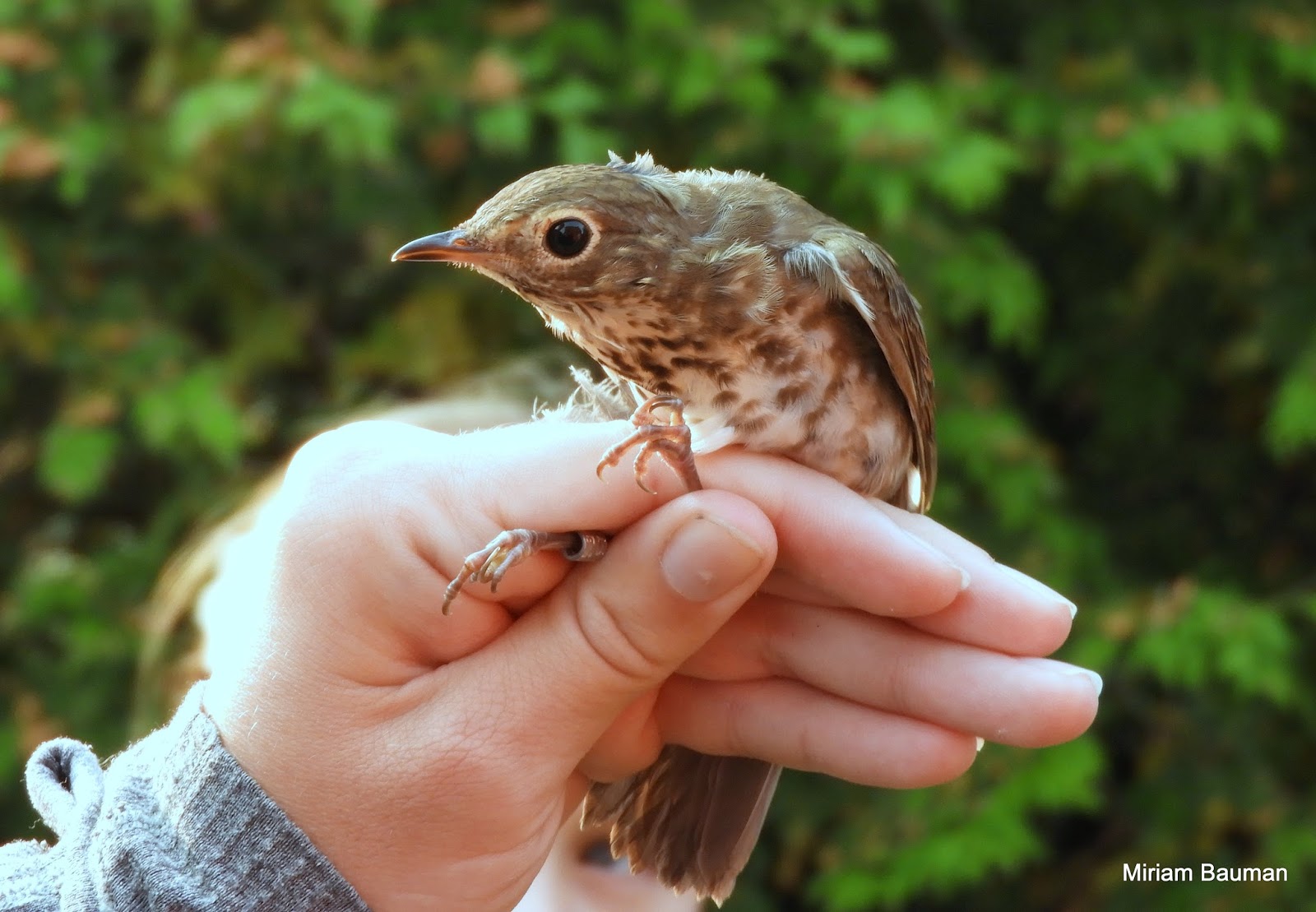
     Our very first bird in the nets was a Veery (Catharus fuscescens), perhaps the most beautiful of all the Catharus thrushes, although I confess that this assessment is entirely subjective. The photograph does not do the bird justice.


     It should be noted, with a good measure of consternation, despair and disgust that these birds, along with other species covered in this post, are winging their way southwards to spend the northern winter in Amazonia, which is burning, entirely due to political ignorance, indifference and human greed at its worst, and the willingness of the voters of many countries to elect right wing ideologues who dismiss climate change.
     What will happen to these migratory species when they arrive at their wintering grounds? Where will they go? What will they feed on?
     All of these questions remain to be answered, but it is clear that they are going to be in serious trouble and many will not return next year.
     Our warblers are now embarking on the hazardous business of migration, this Tennessee Warbler (Leiothlypis peregrina) being among them.


     The state of Tennessee seemed to feature prominently this morning with the capture of this Nashville Warbler ( Leithlypis ruficapilla) also.


     The third warbler captured was a female Black-throated Blue Warbler (Setophaga caerulescens).


     These tiny gems, these little jewels that brighten our lives every year, were already in substantial jeopardy due to habitat loss and numerous other factors. The widespread conflagration in Amazonia will only exacerbate already precarious conditions and at some point they will cease to survive.

All species banded 08 September: Grey Catbird (3), Veery (1), Song Sparrow (7), Tennessee Warbler (1), Nashville Warbler (1), Common Yellowthroat (1), Black-throated Blue Warbler (1). Total: 15 individuals of 7 species.

Plastics

     Please click on the link below.


     If this does not shock you then I think you have pretty much lost the capacity to be shocked. The scope of this problem is enormous and our environment, both on land and in the oceans is being affected by plastic pollution.
     Yet you can do something about it. Easily. Tomorrow. You can't solve the problem entirely, and you can't remove plastic from your life entirely, but there is a great deal that you can do; indeed you must do.
     You can refuse to use, ever, under any circumstances a plastic water bottle. It is very easy to fill your own bottle. You can refuse to eat at restaurants that use disposable plastic cups and lids, plastic straws, styrofoam plates and the like. Please tell the owner of the restaurant why you are doing this and you will see that changes will start to take place. When you go to a takeout coffee chain insist that they fill your reusable cup and decline their plastic lined paper cups and lids.
     Take your own cloth bag to the grocery store and use it instead of plastic bags. There is no need to put a tomato in one plastic nag, an avocado in another, an onion in another, and so on. Take your own bread bags to the bakery and refuse their bags.
     You can start on all of this right away and you can set an example for your friends and family. The time for excuses and rationalization is past.
     If you are unwilling to do this you have effectively signed a pledge that you do not care one iota for the health of the planet, the state of the environment, the future of your children and grandchildren. You have made the declaration that you are a willing contributor to the tide of pollution entering our oceans and clogging our landfills (and some of these materials leach toxic substances and will be around for 500 years). The decision is up to you.
     But this issue threatens the very future of life on the planet and the quality of our food. I hope that you will be on the right side of history.

Sunday, September 09, 2018

Northern Parula (Paruline à collier) at SpruceHaven

08 September 2018

     Fall seemed to have arrived overnight and it was cool when Ross, Heather, Judy and I assembled to band some migrant birds. There was a little wind but in the sheltered areas where we locate our nets it was calm, and when the sun came out, even though the temperature never got much above 17°, it was quite pleasant.
     The prize catch of the day was our very first Northern Parula (Setophaga americana) at SpruceHaven, and I mean ever observed let alone caught in the mist nets. 


     This truly beautiful little bird was a rare treat indeed. 
     It breeds in the northern boreal forest with extensive lichen for nest construction and winters primarily in the Caribbean. In fact we have seen this species on each of our three visits to Cuba, where it is common. Small numbers remain on the mainland as far south as Nicaragua and Costa Rica.


     We wish our bird safe passage to wherever it is headed.
     Magnolia Warblers (Setophaga magnolia) are also still moving through and we caught three of them. This is a familiar species but we all still marvel at the sheer beauty of this tiny bird flying all the way to Central America.


     All the neotropical warblers have distinctive undertail patterns and can be identified by that character alone. This is very helpful since the bird is often observed high in the treetops and the underparts are more visible than the upperparts.


     Zonotrichia sparrows are to be expected as we advance towards mid September and we caught our first White-throated Sparrow (Zonotrichia albicollis) of the fall.


     House Finch (Haemorhous mexicanus) is a fairly common local species, but surprisingly it is captured infrequently. Today we trapped two of them in the same net.


     This bird is a specialist seed eater and has a large powerful bill.


     A momentary lapse of attention caused Heather a little pain as the bird grabbed onto the the skin between her fingers. All in a day's work I suppose!
     This note is primarily for Phil Slade - Judy brought delicious cinnamon buns she made the night before. I ate two!
     We had planned to band again this morning but it was a mere 9° at 06h:00 with strong, gusty winds - unsuitable conditions for banding. Keep your fingers crossed along with us for propitious weather next weekend and we'll have more to report.

All species banded 08 September: House Finch (2), American Goldfinch (11), Tennessee Warbler (1), Magnolia Warbler (3), Northern Parula (1), White-throated Sparrow (1). Total:  19 individuals of 6 species.
Retraps: Grey Catbird (1), American Goldfinch (1), Common Yellowthroat (1). Total: 3 individuals of 3 species.

Tuesday, August 21, 2018

Special Visitors to SpruceHaven

19 August 2018

     Regular readers of my blog will know that I do a weekly avian survey, spring and fall, at the University of Waterloo, for Professor Michael Drescher. In fact, I am now into my fourth year of this work.
     As we have chatted over the time I have been associated with Michael he has shared tidbits about his family, with an overwhelming sense of pride in his children, about whom he speaks in the doting tones one would expect from a dedicated father.
     Michael had told me earlier this spring that he was looking forward to a visit from his mother who lives in Germany and his sister from Australia. We both agreed that a visit to our banding operation at SpruceHaven would be interesting for everyone.
     Thus it was with great pleasure that we welcomed Michael and his family to SpruceHaven on Sunday morning.


     Going from left to right in the above picture are Andrea, (Michael's sister), Pippa, Michael, Allie, Anna and Marlies, (Michael's mother). In the foreground are Ross Dickson and Heather Polan, members of our crew.
     There was not a whole lot of activity at the nets, but the enthusiasm of our guests was not diminished and even though I had forgotten to advise them to wear rubber boots, they had no hesitation in risking wet feet to tour the nets with us.


     As you can see Pippa was entrusted with the important task of carrying one of the birds back to our banding table, and she performed like a true professional. She was very careful not to swing the bag at all and delivered her precious charge in a tranquil state. I think we have an ornithologist in the making!
     Heather, as always, was engaging and involved everyone in what she was doing, young and old alike. Ross, ever the teacher, described every organism we encountered!


     You can see the fascination on the faces of Pippa and Allie as Heather shows them the finer points of a hatch-year Northern Cardinal (Cardinalis cardinalis).
     Adults peered in too, all witnessing bird banding for the first time.


     All of the members of the Drescher family were the stars of the day, with Pippa and Allie attaining superstar status. But in the interests of illustrating why we get up long before the sun rises in the sky, here are a few pictures of some of the birds we banded.

Tennessee Warbler (Leiothlypis peregrina)


House Wren (Troglodytes aedon)
Chestnut-sided Warbler (Setophaga pensylvanica)
Swainson's Thrush (Catharus ustulatus)
 
     It was also interesting to be able to show our guests the caterpillar of a Milkweed Tussock Moth (Euchaetes egle), bristly and threatening like a creature from the underworld.


     This large moth was on the silo and we believe it to be a Bride Underwing (Catocala neogama), sometime referred to as simply The Bride, but we are awaiting confirmation on this identification - not always easy with moths!


     Michael and Anna, Pippa and Allie, Marlies and Andrea, what a pleasure it was to have you visit. Please come back any time. The welcome mat at SpruceHaven will always be spread out for you.

All birds banded 19 August: House Wren (2), Grey Catbird (1 new, 1 retrap), Swainson's Thrush (1), Americn Goldfinch (1), Tennessee Warbler (1), Common Yellowthroat (1 new, 1 retrap), Chestnut-sided Warbler (1), Song Sparrow (2), Northern Cardinal (1).  Total: 13 birds of 9 species.

Thursday, September 21, 2017

Bird Banding and a Visit by Waterloo Region Nature

16 & 17 September 2017


16 September

     In addition to our normal banding operations at SpruceHaven this past weekend, we were delighted to welcome about twenty-five members of Waterloo Region Nature and several other interested members of the community. The weather cooperated and the visit was a great success.
     A few eager participants arrived early and got to witness the banding of the first birds from our nets. Any time a child can release a bird is a cause for great delight.


     I am inclined to believe that based on the sheer expression of pleasure on this young girl's face we are stimulating a love for nature that will last her a lifetime.
     Heather demonstrated her banding proficiency and impressed everyone with her skill, knowledge and dexterity.


     The small contingent of early arrivals looked happy enough to wait for the main onslaught to arrive.


     And they didn't have to wait long as more and more people started to arrive, anxious to enjoy their morning at SpruceHaven.


     The bird banding component of the tour is one of the most popular aspects, enabling people to see birds up close, often representing species hitherto unknown to them. We are always happy to have so many questions to answer, and  to help people understand a little more of avian populations and their movements.


     Sometimes there is a detailed discussion of some of the finer points of a species and we are able to talk about plumage, moult, age and sex, in addition to remarks about the bird's general distribution and relationship to other species.


     This Cape May Warbler (Setophaga tigrina) was the first representative of this species we had ever caught in our nets and was in fact an addition to our species list for SpruceHaven, now standing at 120 by the way.


     Swainson's Thrush (Catharus ustulatus) is not uncommon at this time of the year as it moves through in migration, but the capture of this individual provided a great opportunity to engage in a little discourse on Catharus thrushes.


     Children of all ages were engaged!


     Heather, as always, was magnificent with the young children, and derived a good deal of pleasure helping them to experience a brief moment of intimate contact with a wild creature.


     I began the tour by giving everyone an overview of our Barn Swallow (Hirundo rustica) operation, and there was no shortage of interested observers inside and out.


     Once that was completed we set out to regather at the Motus tracking tower.


     It was an attentive group that assembled to hear how we came to get the tower installed at Sprucehaven and to learn of the valuable information we hope to gather by radio tracking Barn Swallows, a member of the guild of birds collectively known as aerial insectivores, all of which are in serious jeopardy.


     Miriam discovered this caterpillar feeding on Queen Anne's Lace (Daucus carota) and we learned that it morphs into an aptly named moth, Carrot Seed Moth (Sitochroa palealis), an invasive species from Europe. Given the proliferation of the plant, itself a well-established invasive, one might well expect this moth to become very common indeed.


     We were not as successful in identifying this bug, so if anyone can help please leave a comment below.


     Our next stop was at the woodlot.


     Here we have developed a very successful salamander monitoring operation, and have now turned over the entire project to the ecology lab at the University of Waterloo. The boards are monitored weekly at the appropriate time of the year, and all data is contributed to the ongoing herpetology atlas under the auspices of Ontario Nature. The activity also provides a valuable opportunity for the students to hone their field study skills.


     The interested observers above were treated to a show of three Eastern Red-backed Salamanders (Plethodon cinereus) when we turned over one of the boards.


     For some this was their first experience with this taxon. Their interest was admirable!


     Along the way back from the woodlot, Miriam espied a Spring Peeper (Pseudacris crucifer). I was far ahead leading the group to the next stop and unfortunately I missed seeing it. This is a species one hears in the spring in a deafening chorus as thousands of frogs vocalize in courtship frenzy. I have never, however, seen one of these diminutive frogs.


     Here we are, strung out along the perimeter of the field, currently with a crop of alfalfa - but we have other plans for this habitat!


     Our final stop was near several of our nest boxes where we had an excellent breeding season, attracting both Eastern Bluebird (Sialia sialis) and Tree Swallow (Tachycineta bicolor); both are species that need help from their human friends.


     A Seven-spotted Ladybug (Coccinella septapunctata) was a pleasant surprise.


     The formal part of our tour was at an end and we headed across the alfalfa field back to the house.


     As always, in their kind and gracious fashion, Dave, Sandy and Jamie welcomed us all into their lovely home to enjoy coffee and refreshments. It was an opportunity for everyone to chat about nature and enjoy the spirited company of like-minded people.


All species banded 16 September: Swainson's Thrush (1), Nashville Warbler (7), American Redstart (1), Cape May Warbler (1), Magnolia Warbler (2), Blackpoll Warbler (5), Song Sparrow (2), American Goldfinch (1).  Total: 20 birds representing 8 species.

17 September 

     After the hubbub of yesterday, Sunday was a quiet day, with just our regular crew busily banding birds.
     I have featured a Black-and white Warbler (Mniotilta varia) before, but it never hurts to look at another picture of this gorgeous little bird.


     Daina was taking her turn banding this morning and here she carefully attends to a Nashville Warbler (Leiothlypis ruficapilla), one of six we trapped in our nets.


     A Lincoln's Sparrow (Melopsiza lincolnii), a very delicately marked little sparrow, was our first indication that fall migration was underway for this species.


     Many of you will have read Miriam's excellent post about the Monarchs ( Danaus plexippus) and we were very interested to find the chrysalis of this species hanging from the outside of the barn. 


     Perhaps by the time we all get together again on Saturday the butterfly will have hatched and embarked on its long journey to Mexico.

All species banded 17 September: Blue-headed Vireo (1), House Wren (2), Swainson's Thrush (1), American Goldfinch (1), Black-and-white Warbler (1), Tennessee Warbler (3), Nashville Warbler (6), Magnolia Warbler (2), Blackpoll Warbler (2), Wilson's Warbler (2), Song Sparrow (5), Lincoln's Sparrow (1).  Total: 27 birds representing 12 species.

Land Acknowledgement

We acknowledge that the land on which we are situated are the lands traditionally used by the Haudenosaunee, Anishinaabe, and Neutral People. We also acknowledge the enduring presence and deep traditional knowledge, laws, and philosophies of the Indigenous Peoples with whom we share this land today. We are all treaty people with a responsibility to honour all our relations.

Followers