Showing posts with label Wilson's Warbler. Show all posts

Monday, September 03, 2018

Quality not Quantity

01 September - 02 September 2018

     The pace of avian migration starts to really accelerate as we get into September and we detected this trend in some of the species we banded this past weekend. The number of birds we trapped was not huge, but we caught some consequential species that contribute to our knowledge of birds not seen at SpruceHaven during the breeding season, but moving through as they depart Ontario to spend the northern winter in Central and South America.
     Neotropical Warblers and Flycatchers (among others) are two distinct families that can provide identification challenges at times and our constant companion is "Pyle," the bird bander's indispensable guide. 


     As any bird bander will tell you, a bird in the hand can look quite different from the bird you observe flitting around in a tree, or in flight. And by having the bird in the hand and being able to take wing measurements, weight, and  examine other characteristics it is in most cases possible to identify the sex and age of the bird.
     Take for example, this Black-billed Cuckoo (Coccyzus erythropthalmus). 


     Pyle tells us that the orbital ring in an after hatch year bird is red (as opposed to greenish or dusky in a hatch year bird) and that the the shape and pattern of the outer rectrices show a rounded tip with a white terminus. 


     The red orbital ring is shown in the picture above and the details of the rectrices are shown below.


     Putting all this information together we can confidently identify this bird as an adult (AHY) bird.
     You can see the mosquito bites on Ross' forearm above - the price bird banders pay for plying their craft at this time of the year. 
     We were able to identify this Wilson's Warbler (Cardellina pusilla) as a hatch year male based on the large, but mottled cap, and other plumage characters.


     It was very pleasing to be able to process a Yellow-bellied Flycatcher (Empidonax flaviventri), a species we see infrequently. 


    Whether this species could have been identified in the field is open to question. Empidonax flycatchers are notoriously difficult when they are not singing and several species are very similar indeed. Compound this lack of vocalization once the breeding season has passed, with less than perfect light conditions, rapid movement high in treetops and the fact that the bird is smaller than most leaves, and identification sometimes verges on alchemy! One has to be content often with the designation Empidonax species.
     Take a look at these two pictures of Black-throated Blue Warbler (Setophaga caerulescens) taken from my files.


Male
Female (picture from Internet Bird Collection)


     The minute white flash, along with other characters, enables us to confidently identify this bird as a hatch year female Black-throated Blue Warbler.
     In a female hatch year Nashville Warbler (Leiothlypis ruficapilla) the characteristic rufous patch on the head of this species is absent, as shown in the photograph below. The buffy eye ring is also diagnostic. 


     Bird banding is fascinating, challenging and very rewarding. Over time it contributes in no small measure to our understanding of the life histories of birds.
     Banders the world over are linked by a common passion and a dedication to helping the birds we love. For an excellent treatment of bird banding (ringing) in the UK see the excellent blog of my good friend Phil Slade  https://anotherbirdblog.blogspot.com

All species banded 1, 2 September: Black-billed Cuckoo (1), Yellow-bellied Flycatcher (1), Traill's Flycatcher (1), House Wren (1), Nashville Warbler (1), Magnolia Warbler (3), Black-throated Blue Warbler (1), Wilson's Warbler (1), Song Sparrow (3).  Total: 13 birds of 9 species.  
Retraps: Grey Catbird (1), Common Yellowthroat (1), Magnolia Warbler (1), Song Sparrow (1).


Thursday, September 21, 2017

Bird Banding and a Visit by Waterloo Region Nature

16 & 17 September 2017


16 September

     In addition to our normal banding operations at SpruceHaven this past weekend, we were delighted to welcome about twenty-five members of Waterloo Region Nature and several other interested members of the community. The weather cooperated and the visit was a great success.
     A few eager participants arrived early and got to witness the banding of the first birds from our nets. Any time a child can release a bird is a cause for great delight.


     I am inclined to believe that based on the sheer expression of pleasure on this young girl's face we are stimulating a love for nature that will last her a lifetime.
     Heather demonstrated her banding proficiency and impressed everyone with her skill, knowledge and dexterity.


     The small contingent of early arrivals looked happy enough to wait for the main onslaught to arrive.


     And they didn't have to wait long as more and more people started to arrive, anxious to enjoy their morning at SpruceHaven.


     The bird banding component of the tour is one of the most popular aspects, enabling people to see birds up close, often representing species hitherto unknown to them. We are always happy to have so many questions to answer, and  to help people understand a little more of avian populations and their movements.


     Sometimes there is a detailed discussion of some of the finer points of a species and we are able to talk about plumage, moult, age and sex, in addition to remarks about the bird's general distribution and relationship to other species.


     This Cape May Warbler (Setophaga tigrina) was the first representative of this species we had ever caught in our nets and was in fact an addition to our species list for SpruceHaven, now standing at 120 by the way.


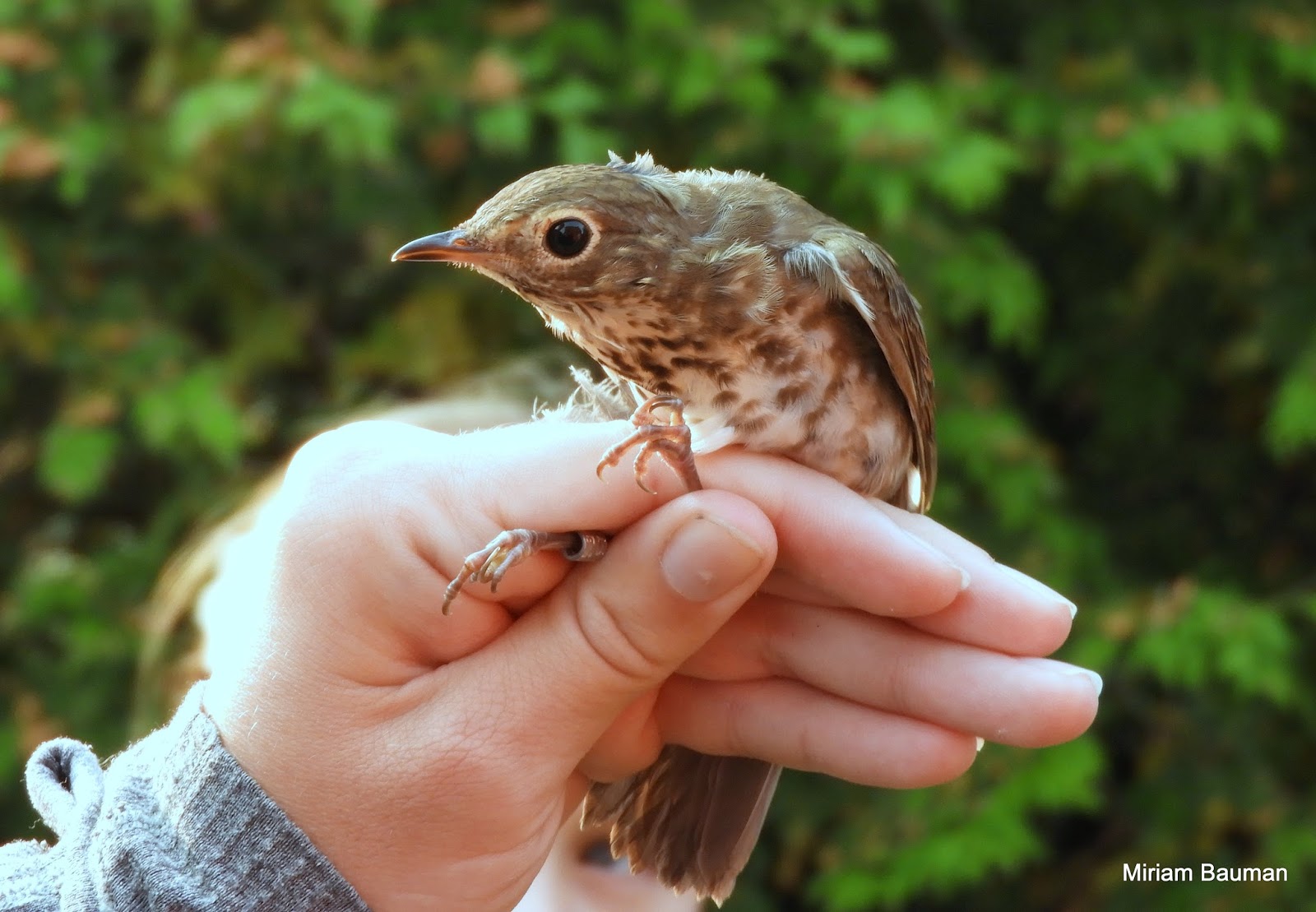
     Swainson's Thrush (Catharus ustulatus) is not uncommon at this time of the year as it moves through in migration, but the capture of this individual provided a great opportunity to engage in a little discourse on Catharus thrushes.


     Children of all ages were engaged!


     Heather, as always, was magnificent with the young children, and derived a good deal of pleasure helping them to experience a brief moment of intimate contact with a wild creature.


     I began the tour by giving everyone an overview of our Barn Swallow (Hirundo rustica) operation, and there was no shortage of interested observers inside and out.


     Once that was completed we set out to regather at the Motus tracking tower.


     It was an attentive group that assembled to hear how we came to get the tower installed at Sprucehaven and to learn of the valuable information we hope to gather by radio tracking Barn Swallows, a member of the guild of birds collectively known as aerial insectivores, all of which are in serious jeopardy.


     Miriam discovered this caterpillar feeding on Queen Anne's Lace (Daucus carota) and we learned that it morphs into an aptly named moth, Carrot Seed Moth (Sitochroa palealis), an invasive species from Europe. Given the proliferation of the plant, itself a well-established invasive, one might well expect this moth to become very common indeed.


     We were not as successful in identifying this bug, so if anyone can help please leave a comment below.


     Our next stop was at the woodlot.


     Here we have developed a very successful salamander monitoring operation, and have now turned over the entire project to the ecology lab at the University of Waterloo. The boards are monitored weekly at the appropriate time of the year, and all data is contributed to the ongoing herpetology atlas under the auspices of Ontario Nature. The activity also provides a valuable opportunity for the students to hone their field study skills.


     The interested observers above were treated to a show of three Eastern Red-backed Salamanders (Plethodon cinereus) when we turned over one of the boards.


     For some this was their first experience with this taxon. Their interest was admirable!


     Along the way back from the woodlot, Miriam espied a Spring Peeper (Pseudacris crucifer). I was far ahead leading the group to the next stop and unfortunately I missed seeing it. This is a species one hears in the spring in a deafening chorus as thousands of frogs vocalize in courtship frenzy. I have never, however, seen one of these diminutive frogs.


     Here we are, strung out along the perimeter of the field, currently with a crop of alfalfa - but we have other plans for this habitat!


     Our final stop was near several of our nest boxes where we had an excellent breeding season, attracting both Eastern Bluebird (Sialia sialis) and Tree Swallow (Tachycineta bicolor); both are species that need help from their human friends.


     A Seven-spotted Ladybug (Coccinella septapunctata) was a pleasant surprise.


     The formal part of our tour was at an end and we headed across the alfalfa field back to the house.


     As always, in their kind and gracious fashion, Dave, Sandy and Jamie welcomed us all into their lovely home to enjoy coffee and refreshments. It was an opportunity for everyone to chat about nature and enjoy the spirited company of like-minded people.


All species banded 16 September: Swainson's Thrush (1), Nashville Warbler (7), American Redstart (1), Cape May Warbler (1), Magnolia Warbler (2), Blackpoll Warbler (5), Song Sparrow (2), American Goldfinch (1).  Total: 20 birds representing 8 species.

17 September 

     After the hubbub of yesterday, Sunday was a quiet day, with just our regular crew busily banding birds.
     I have featured a Black-and white Warbler (Mniotilta varia) before, but it never hurts to look at another picture of this gorgeous little bird.


     Daina was taking her turn banding this morning and here she carefully attends to a Nashville Warbler (Leiothlypis ruficapilla), one of six we trapped in our nets.


     A Lincoln's Sparrow (Melopsiza lincolnii), a very delicately marked little sparrow, was our first indication that fall migration was underway for this species.


     Many of you will have read Miriam's excellent post about the Monarchs ( Danaus plexippus) and we were very interested to find the chrysalis of this species hanging from the outside of the barn. 


     Perhaps by the time we all get together again on Saturday the butterfly will have hatched and embarked on its long journey to Mexico.

All species banded 17 September: Blue-headed Vireo (1), House Wren (2), Swainson's Thrush (1), American Goldfinch (1), Black-and-white Warbler (1), Tennessee Warbler (3), Nashville Warbler (6), Magnolia Warbler (2), Blackpoll Warbler (2), Wilson's Warbler (2), Song Sparrow (5), Lincoln's Sparrow (1).  Total: 27 birds representing 12 species.

Land Acknowledgement

We acknowledge that the land on which we are situated are the lands traditionally used by the Haudenosaunee, Anishinaabe, and Neutral People. We also acknowledge the enduring presence and deep traditional knowledge, laws, and philosophies of the Indigenous Peoples with whom we share this land today. We are all treaty people with a responsibility to honour all our relations.

Followers