Showing posts with label Mourning Warbler. Show all posts

Sunday, August 25, 2019

The First Weekend of Fall Bird Banding at SpruceHaven and a Visit by Wild Birds Unlimited, Kitchener, ON

   
24 August 2019

     There is always a sense of excitement and anticipation when we start afresh with our bird banding activities and this year was no exception. I met Kevin, dark and early, and we were soon afterwards joined by Ross, and set up five nets.
     It was cool when we started (8° C) and few birds were moving around. At that temperature nor were the mosquitoes fortunately!  
     We retraced our steps from the final net and in the very first one retrieved a juvenile Grey Catbird (Dumetella carolinensis). A Ruby-throated Hummingbird (Archilocus colubris) had also been ensnared, but since we do not have a permit to band hummingbirds it was released right away.
     This young Grey Catbird was acquiring new feathers as can be clearly seen below.


     A couple more rounds of the nets yielded nothing, but the day was warming and insects were starting to rise out of the grass, and our next circuit was more productive.
     A Common Yellowthroat (Geothlypis trichas), which undergoes at least partial moult before leaving the breeding grounds, was also showing evidence of moult in the tail feathers.


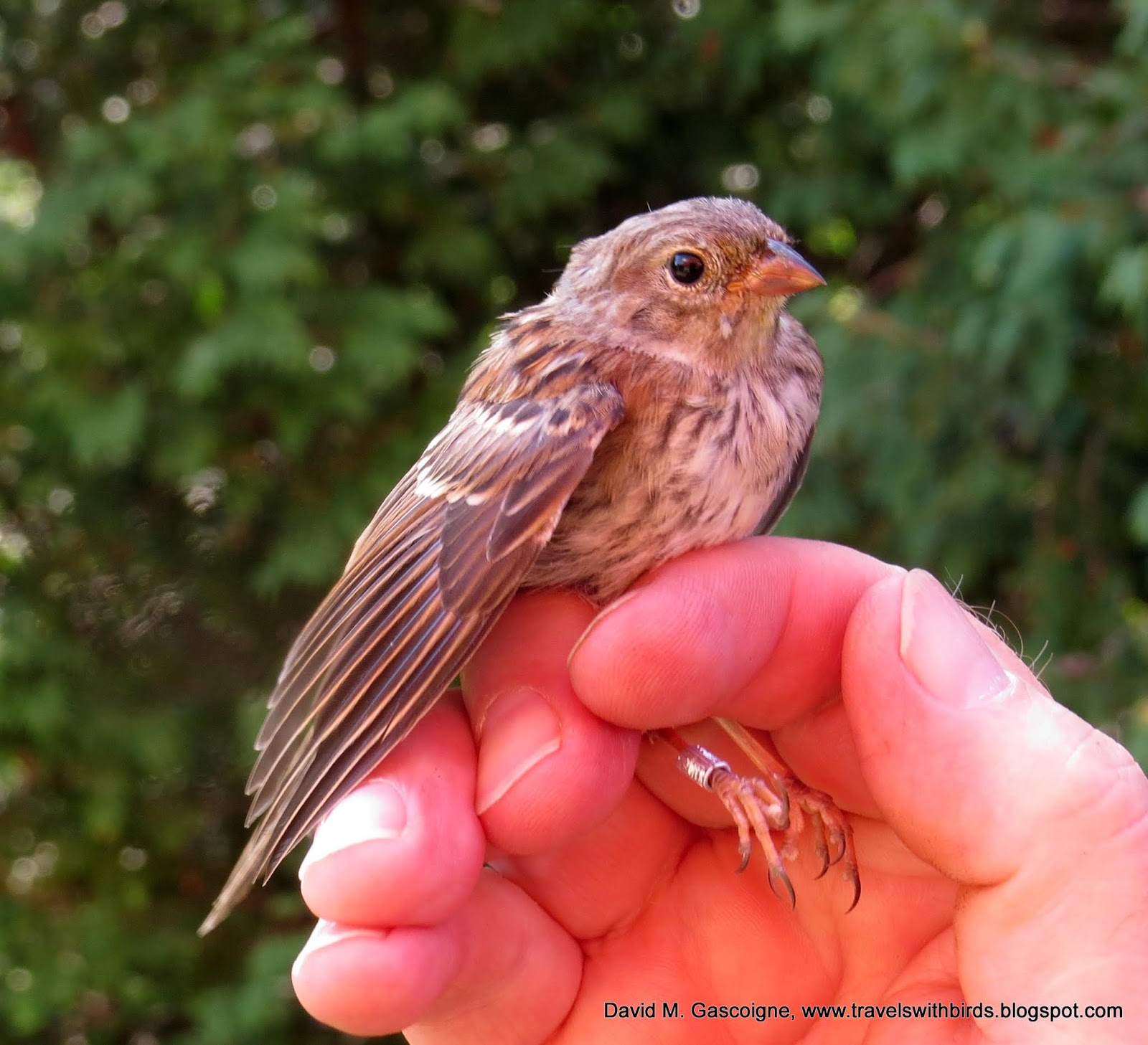
     It is relatively infrequently that we trap Field Sparrows (Spizella pusilla) so we considered ourselves exceptionally fortunate to capture two juveniles of this species.


     A Nashville Warbler (Leiothlypis ruficapilla) is somewhat more predictable, however.


     Song Sparrow (Melospiza melodia) is the most common new world sparrow in our area, so the only surprise was that we caught but one.


     House Wrens (Troglodytes aedon) have had a prolific breeding season this year, with several successful nests at SpruceHaven, and this young bird will soon be making its first migratory journey.


All birds banded 24 August: House Wren (1), Grey Catbird (1), Field Sparrow (2), Song Sparrow (1), Nashville Warbler (1), Common Yellowthroat (4)  Total: 10 individuals of 6 species.

25 August 2019

     It was our great pleasure to host a group of people under the aegis of Wild Birds Unlimited (wbukitchenerwaterloo@gmail.com) who were interested in all that goes on at Sprucehaven. It was a small but enthusiastic group, and it was my great pleasure to try to impart some of the magic of SpruceHaven to them. I was especially delighted to see children present.


     I do not have all the names of the people above but I will give the ones I know and I would be happy to add the the others if people would contact me. Along the back row, working from the left, unknown, Sharon Dillon-Martin, Tammy ?, Cathy Hale (Owner, Wild Birds Unlimited). In front are Darwin (great name!) and his sister, Joy. Tammy is their mom and is to be congratulated for bringing out her children to enjoy the wonders of nature.
     Kevin was unable to band with us this morning, but Ross came out to help and Heather was happy to make her first appearance of the season. Judy and Lorraine came out later.
     It was with a good deal of pleasure that we caught our first empidonax flycatcher, the morphology and biometrics of which narrowed it down to Least Flycatcher (Empidonax minimus).


      It was while processing this bird that a fly in the family Hippoboscidae, an obligate parasite of birds and mammals, dropped out of the feathers. (Picture courtesy of Ross Dickson)


     These flies are commonly referred to as flat flies and can compress their body and easily insert themselves into the feather tract of their avian host, being able to move sideways to sidle through the feathers. At least we did the bird the service of removing this bothersome intruder!
      A Black-capped Chickadee (Poecile atricapillus) is a resident species, and this individual that flew into our mist net was banded along with the migrants.


     The highlight of our banding session was a Mourning Warbler (Geothlypis philadelphia), a species we do not often capture, and in fact a species infrequently encountered in the field.


     A young male Rose-breasted Grosbeak (Pheucticus ludovicianus) let Heather know that he was not at all sanguine about being handled.


     It is not so bad when they seize your whole finger as above, but if they clamp down on the skin between your thumb and forefinger it is painful!
     A Warbling Vireo (Vireo gilvus) was our first capture of the season.


     Chipping Sparrows (Spizella passerina) breed locally so it is quite possible that this juvenile bird may have been born right at SpruceHaven. 


     Our final bird banded was a juvenile male American Goldfinch (Spinus tristis), a resident species. I expect we will trap a few more goldfinches before the season is done.


     It was a great weekend of banding, aided in no small measure by good weather, and the wonderful fellowship of bird enthusiasts, and a visit from Cathy and friends. 
     Ross will be back at it on Tuesday!

All birds banded 25 August: Least Flycatcher (1), Warbling Vireo (2), Black-capped Chickadee (1), Grey Catbird (1), American Goldfinch (1), Chipping Sparrow (1), Song Sparrow (9), Mourning Warbler (1), Common Yellowthroat (1), Rose-breasted Grosbeak (1). Total: 19 individuals of 10 species.


Sunday, May 27, 2018

Final weekend of spring bird banding at Sprucehaven

26/27 May 2018
SpruceHaven, St. Agatha, ON

26 May 2018

     We seem to have just started banding for the spring session and it is already over. Kevin was unable to come one weekend due to family commitments and we got rained out on another so the activity has been shortened a little.
     For the first time this spring Debbie Hernandez was able to make it out to the nets and we were delighted to see her again.


     Since we last saw her Debbie has graduated from Wilfrid Laurier University with an Honours BSc. in biology and is now contemplating her future. Whatever it holds we hope that she will continue to come and help out at SpruceHaven.
     We banded a few new species for the season including this Mourning Warbler (Geothlypis philadelphia), a bird previously only recorded in the fall.


     It is interesting to look at the following photograph of the same bird taken from a slightly different angle. You will see that the grey throat has a much paler aspect, and in a couple of other photographs which were blurred unfortunately, it looked even whiter.


     I simply provide this comparison to illustrate the fact that a photograph can at times be misleading. Different light can portray a bird in tones quite unlike its true colours.
     This male Brown-headed Cowbird (Molothrus ater)was one of two caught in the same net.


     A Lincoln's Sparrow (Melospiza lincolnii) is a delicately marked little bird, one which is often misidentified in the field by inexperienced birders, but there was no mistaking this bird in the hand.
     Heather carefully processed the bird and she and Kevin conferred on some finer points of aging and sexing.


     Kevin's tee shirt says, "I'm not normal," and I leave it up to you to judge how true this statement is! Suffice it to say, that Kevin would have been right at home as a member of Monty Python's Flying Circus, or perhaps a star performer on The Goon Show!
     Here are a couple more pictures of Lincoln's Sparrow before release.


     It is not often that we capture a Common Starling (Sturnus vulgaris). Perhaps this species is generally too wily to be caught in a mist net.


     Without a shadow of a doubt Cedar Waxwing (Bombycilla cedrorum) is one of our most beautiful birds.


     Here you see the detail of the waxy tips on the wings from which the bird derives its name.


     It would be pretty hard to tire of waxwings.


     Curiously several of our Barn Swallow (Hirundo rustica) nests held a single nut (walnut?). How these nuts got there is a matter of conjecture but perhaps they represent some kind winter storage for squirrels.


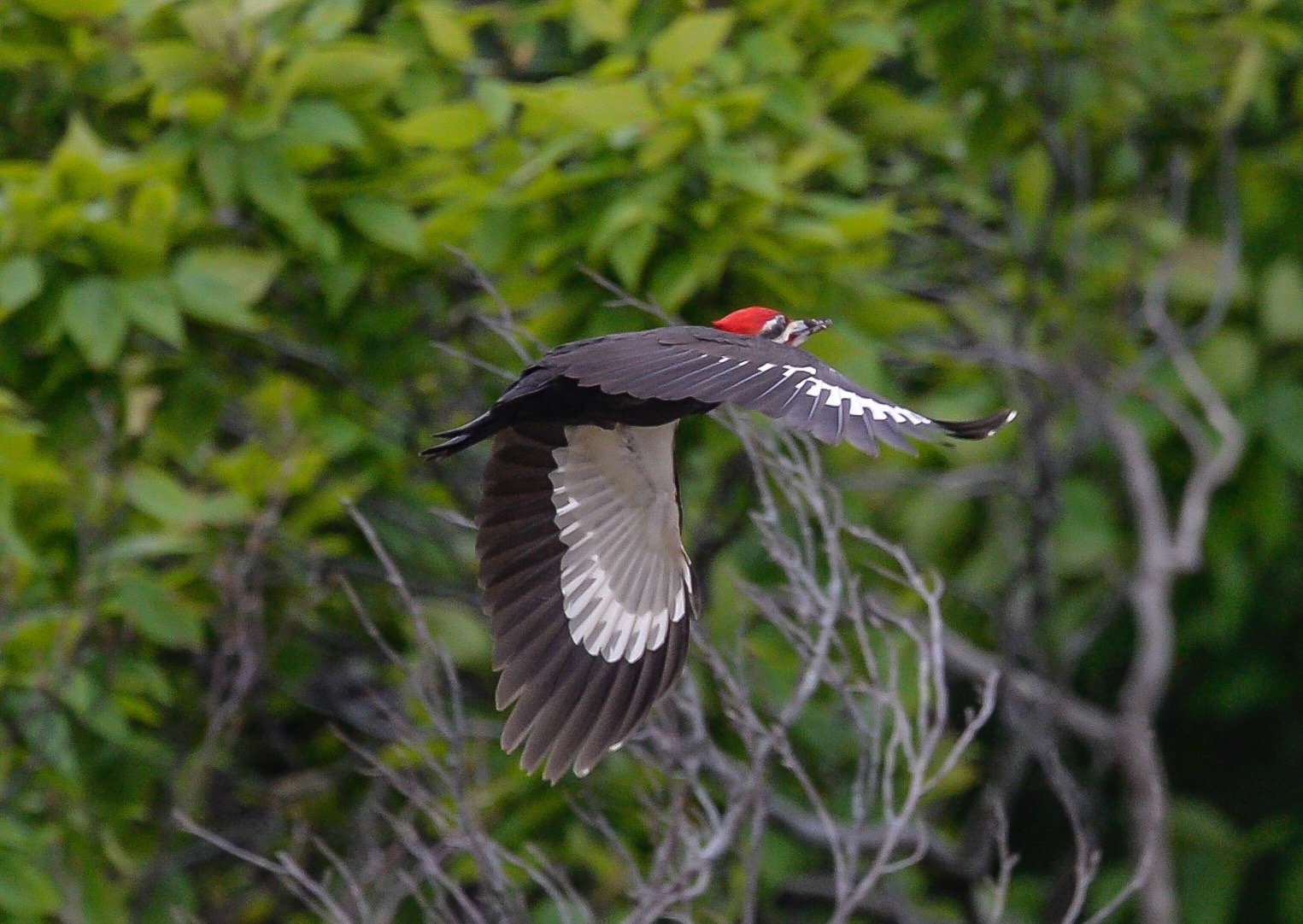
     Pileated Woodpecker (Dyocopus pileatus) is a species we have seen infrequently at SpruceHaven and Kevin's friend, John Pringle, visiting from England, managed this flight shot.


All species banded 26 May: Cedar Waxwing (1), Common Starling (1), American Goldfinch (1), Common Yellowthroat (1), Mourning Warbler (1), Brown-headed Cowbird (2), Common Grackle (2), Song Sparrow (2), Lincoln's Sparrow (1). Total: 9 species, 12 birds.

27 May 2018

     It was a slow day at the nets, fittingly perhaps on our final day of banding for the spring.
     Significantly, however, we trapped two more Mourning Warblers for a total of three in two days. Since most warblers have already moved north, and this species has bred locally in past years, it leads me to believe that perhaps they are breeding at SpruceHaven.
     A Barn Swallow in our nets was the first bona fide capture, other birds having been netted in/at the barn to establish which birds had returned to their natal site. This bird had not been previously banded and was not one of the nestlings banded last year.


     A male Red-winged Blackbird (Agelaius phoeniceus) is not a momentous capture, given the sheer number of this species at SpruceHaven, but this male was especially handsome and robust. This is a polygynous species and it is likely that this male has a harem of females.


     Just before we wrapped it all up, Vashti Latchman and her young son, bird devotee, Roddie, arrived for their first visit of the season.


     It was good to see them both and it was too bad that we had but a single Song Sparrow (Melospiza melodia) to show them. We will look forward to a return visit in the fall when we hope to have many interesting birds to fuel Roddie's already burgeoning interest in all things ornithological.

All species banded 27 May: Traill's Flycatcher (1), Barn Swallow (1), Mourning Warbler (2),  Red-winged Blackbird (2), Song Sparrow (1), Northern Cardinal (1).  Total: 6 species, 8 birds.

Gotta love this one.


Sunday, May 21, 2017

Another Banding Operation at SpruceHaven

20 May 2017

     The wind was relatively calm when we arrived before 06:00 but the augury was for the velocity to increase as the morning progressed. The forecast turned out to be accurate and we were compelled to close the nets early. So we did not have an especially auspicious day in terms of numbers and variety of birds; we did, however, enjoy each other's company and benefitted from being together.
     It is rewarding to see how Heather and Daina have become part of our team and have quietly assumed more and more responsibility. Here Heather is set to process a male American Goldfinch Spinus tristis while the maestro Kevin Grundy is content to let these young people become ever more involved.


     Heather is gently blowing on the bird to determine whether there is any deposition of fat. As might be expected on a non-migratory species, there was not.


     Having completed the other measurements she is ready to install the band.


     Her dexterity and confidence grow with each bird she handles.
     Our "bird of the day" was a Mourning Warbler Geothlypis philadelphia, our first ever for SpruceHaven. It is quite incredible how much we have learned of the avian population at SpruceHaven from our banding activities and we did not even start until last fall, and even then only one day each weekend.


     Baltimore Orioles Icterus galbula are pretty common but it is still an amazing sight to see this brilliant bird up close.


     Brown-headed Cowbirds Molothrus ater are ubiquitous at times and it will be informative if we can detect the species which they are parasitizing. 


     We captured this female Rose-breasted Grosbeak Pheucticus ludovicianus and I think that Heather's fingers may still be bruised from the experience! It was pretty calm, however, when Kevin held it for a photograph.


     We had expected to be back at it again today, but it has rained quite heavily for most of the morning, so we had to abandon any thoughts of unfurling our nets.
     We will look forward to resuming again next weekend.

All species 20 May: Common Starling (1), American Goldfinch (2), Mourning Warbler (1), Baltimore Oriole (1), Brown-headed Cowbird (1), Red-winged Blackbird (2), Song Sparrow (1), Rose-breasted Grosbeak (1).  Total: 10.

Land Acknowledgement

We acknowledge that the land on which we are situated are the lands traditionally used by the Haudenosaunee, Anishinaabe, and Neutral People. We also acknowledge the enduring presence and deep traditional knowledge, laws, and philosophies of the Indigenous Peoples with whom we share this land today. We are all treaty people with a responsibility to honour all our relations.

Followers