Showing posts with label Least Flycatcher. Show all posts

Saturday, May 22, 2021

More Local Highlights

16 May 2021

Lakeside Park, Kitchener, ON


     We heard a tremendous racket from a group of American Crows (Corvus brachyrynchos) and searched to see whether they were perhaps routing a Great Horned Owl (Bubo virginianus). 


     At one point there were about twenty individuals occupying two or three trees, but we never did ascertain the reason for their noisy performance. They departed as quickly as they had arrived, shrieking and yelling all the while.
     A Baltimore Oriole (Icterus galbula) was far more restrained and serenaded us delightfully.


     It was interesting to see the channels created by a kind of wood-boring insect in this log.


     It is both sobering and distressing to contemplate the varieties of trees that are now endangered by invasive pests, often introduced from outside North America in shipments of fruit, or via wooden pallets that are already heavily infested.
     One is never out of earshot of Red-winged Blackbirds (Agelaius phoeniceus) at Lakeside Park, and we spotted a female busily constructing a nest.


     An American Red Squirrel (Tamiasciurus hudsonicus) seems to have found a meal sufficient for lunch and dinner!


Benjamin Park Trail, Waterloo, ON

     May-apple (Podophyllum peltatum) is carpeting woodlands everywhere, and there was much of it to be seen on the Benjamin Park Trail.


     Yellow Archangel (Lamium galeobdolon) is a widespread invasive, often originating in gardens; quite beautiful, but quickly swamping native species.


     Bristly Buttercup (Ranunculus hispidus) is appearing everywhere.


     There is no shortage of yellow flowers!
     Taxonomy is ever fluid it seems, and the genus Celastrina is the subject of much discussion and review. At least for now, the following species is Northern Spring Azure, also known as Lucia Azure (Celastrina lucia).


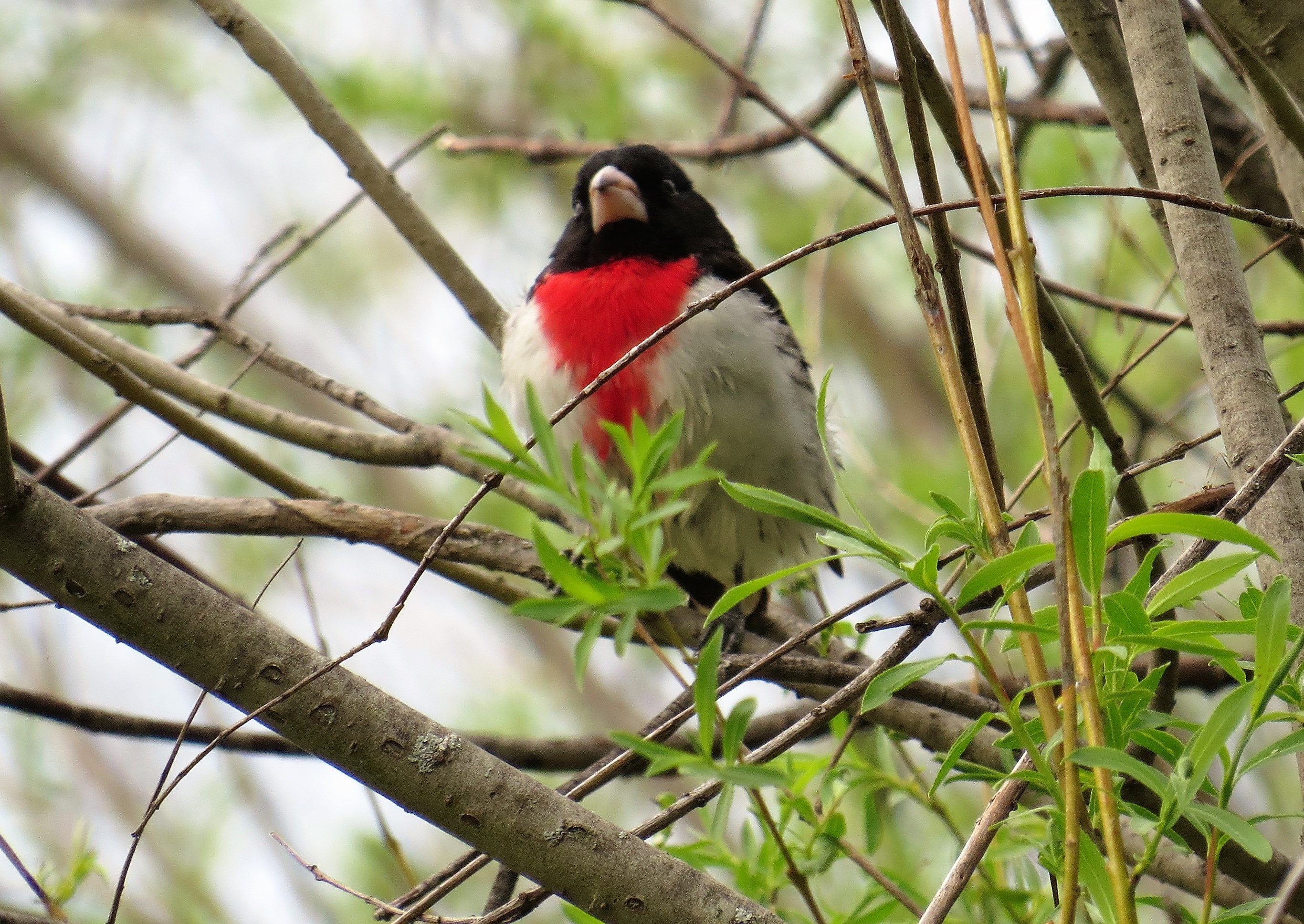
     Rose-breasted Grosbeak (Pheucticus ludovicianus) is probably no more abundant than in previous years, but I have been running into them frequently.


     It is an impressive species and it is always a great pleasure to share a few moments with them.


19 May 2021

Our Backyard, Waterloo, ON

     Ruby-throated Hummingbird (Archilocus colubris) has been a regular visitor to our backyard for as long as we have lived here, but this year visits have been few and far between.
     We were happy, therefore, when we looked out the window and saw a female at the feeder.


     The pictures are not fantastic but they were taken through the glass and are the best we could do. Perhaps even from these less-than-perfect images you will sense our joy at seeing the bird. 

RIM Park, Waterloo, ON

     There is a field opposite the parking area that has harboured Eastern Meadowlarks (Sturnella magna) over the past few years, and it didn't take us long to find one singing from the grass.


     Shortly a second bird was spotted on a cable and the two joined forces and flew off together.


     I suspect that starting a family was top of mind for them.
     The spruces (Genus Picea) seem to universally sport a good cone crop already this year. No doubt squirrels are gleeful!


     There are numerous little wet channels at RIM Park, all looking especially bucolic and tranquil in spring.


     A male Baltimore Oriole is very handsome, especially when highlighted by bright sunshine.


     A good part of the day is spent capturing food and soon there will be additional mouths to feed.


     This is a species that adds a bright splash of colour to a spring landscape, and unlike warblers and other tiny birds is quite easily seen.


     It so delights the average walker in the park that it is the single most pointed-out species, by people who see our binoculars. 


      "Did you see the oriole?" is a commonly posed question.
     For part of the trail the Grey Silo Golf course runs alongside it, and I am sure that the owners are anxiously awaiting the lifting of COVID restrictions, so that greens can reverberate with the cheerful chatters of golfers and the thwacking of balls.


      We are quite happy that we don't have to keep a watchful eye for the golf carts occupying their half of the trail.
      Wild Geraniums (Geranium maculatum) are starting to bloom, a delightful addition to any walk.


     Ground Ivy (Glechoma hereracea) is probably considered a pest in the wrong location, but for a peripatetic naturalist it gives great pleasure.


     One of the dominant features of RIM Park, the most dominant in fact, is the Grand River.


     It meanders alongside for a good part of the way, and supports a variety of birds - ospreys, eagles, terns, gulls, swallows, shorebirds - and not a few mammals. American Beavers (Castor canadensis) make their presence known and White-tailed Deer (Odocoileus virginianus) come down to river to drink.


     We enjoyed great views of a male American Redstart (Setophaga ruticilla) and when it remained still for a few seconds, Miriam obtained a couple of pictures.


     We watched transfixed as it sang to us!


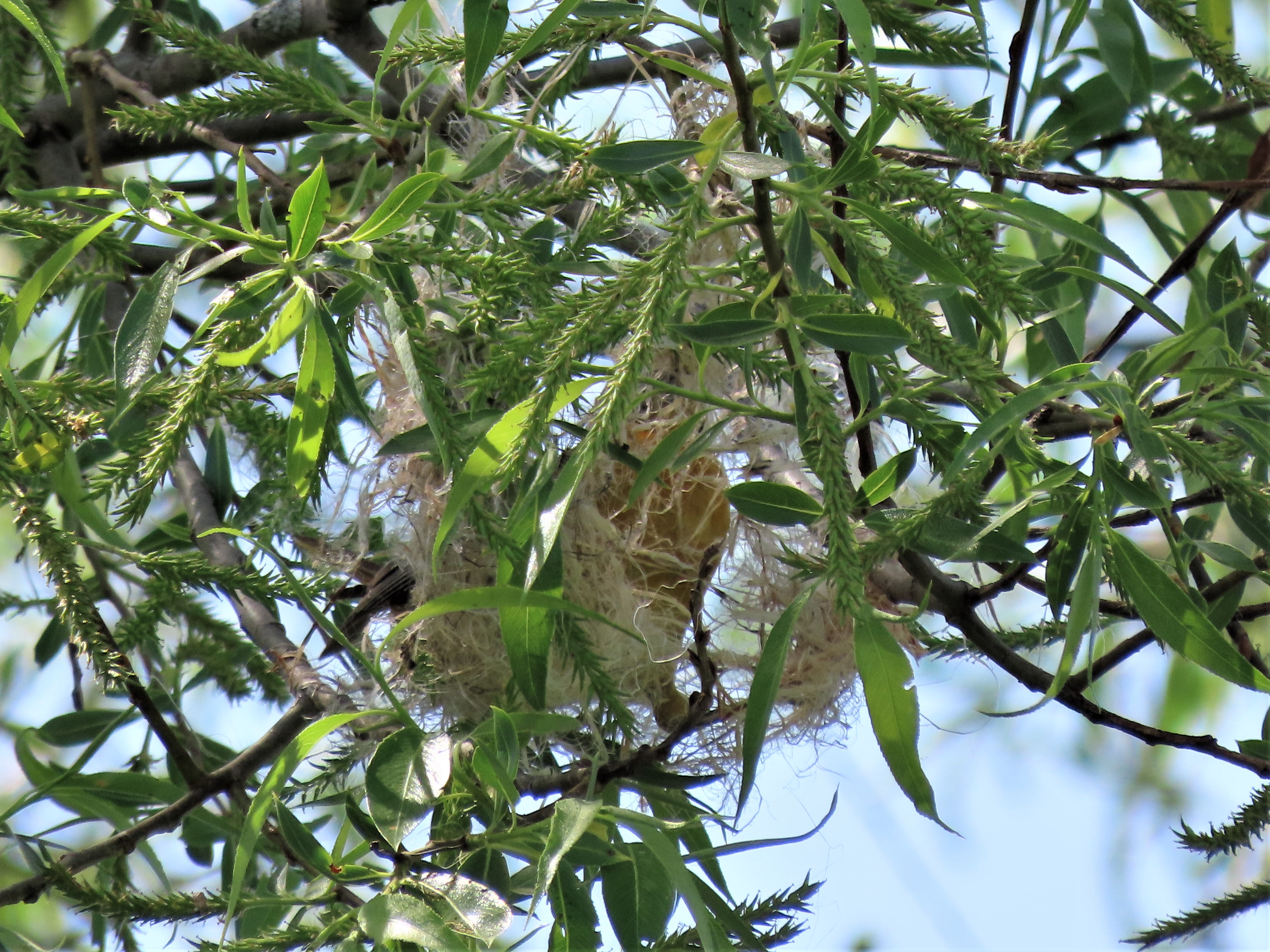
     Having had several terrific looks at a male Baltimore Oriole, additional pleasure was gained by observing a female in the early stages of nest construction.

     We see more American Yellow Warblers (Setophaga aestiva) at RIM Park than at any other location where we bird regularly.


     A Willow Flycatcher (Empidonax traillii) was a very agreeable addition to our birds for the day, but it played hide-and-seek with us.


     We spotted a Least Flycatcher (Empidonax minimus) and heard its distinctive call.


     And within moments we watched a flurry of activity and discovered out first ever nest under construction for this species.

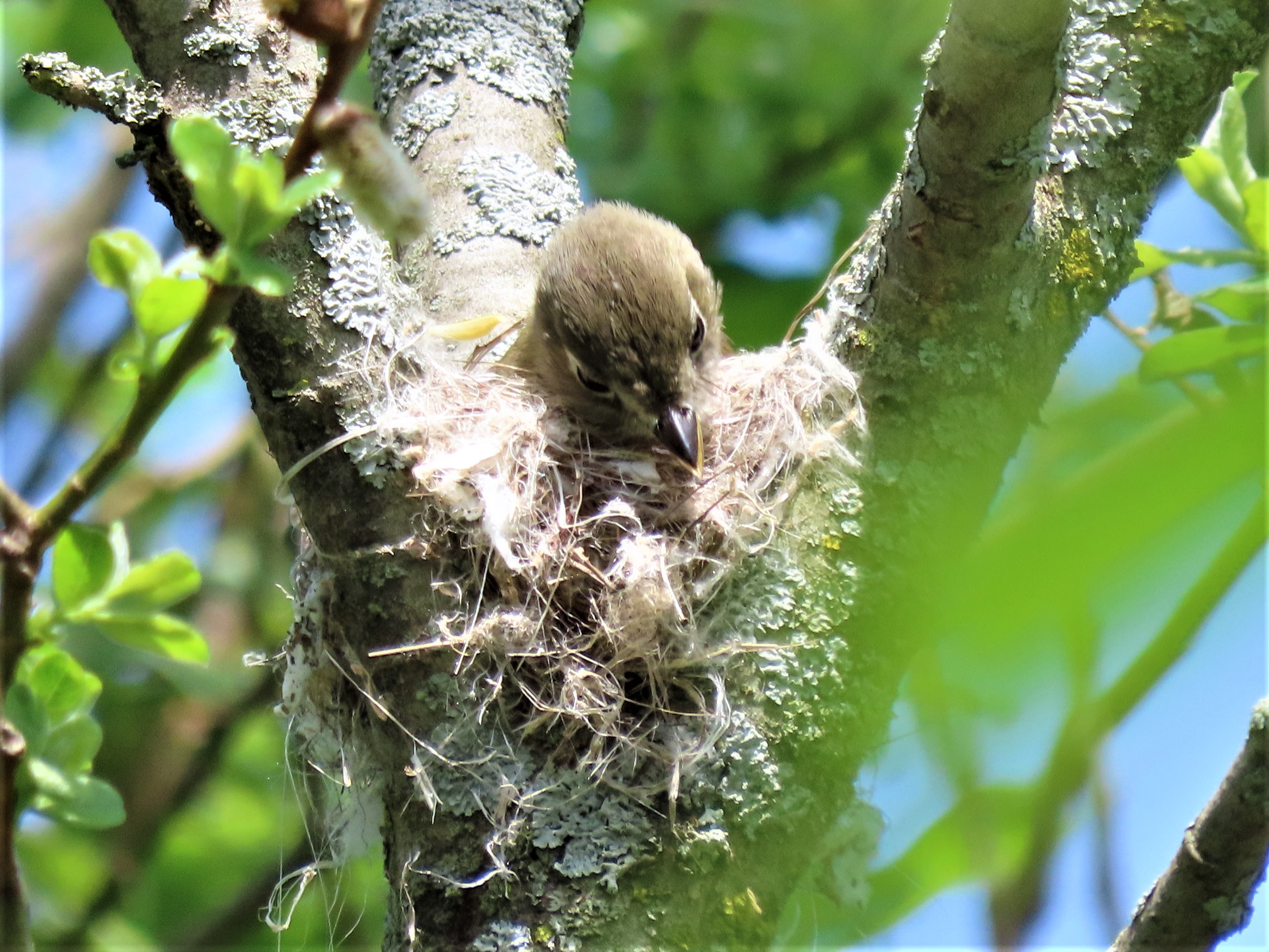

     For many I am sure this would not be a big deal, but for anyone involved with birds, it is a moment of high excitement.


     For a moment we thought we had come across a mixed species flock, until we realized that a Grey Catbird (Dumetella carolinensis) was mimicking the songs of several other birds.


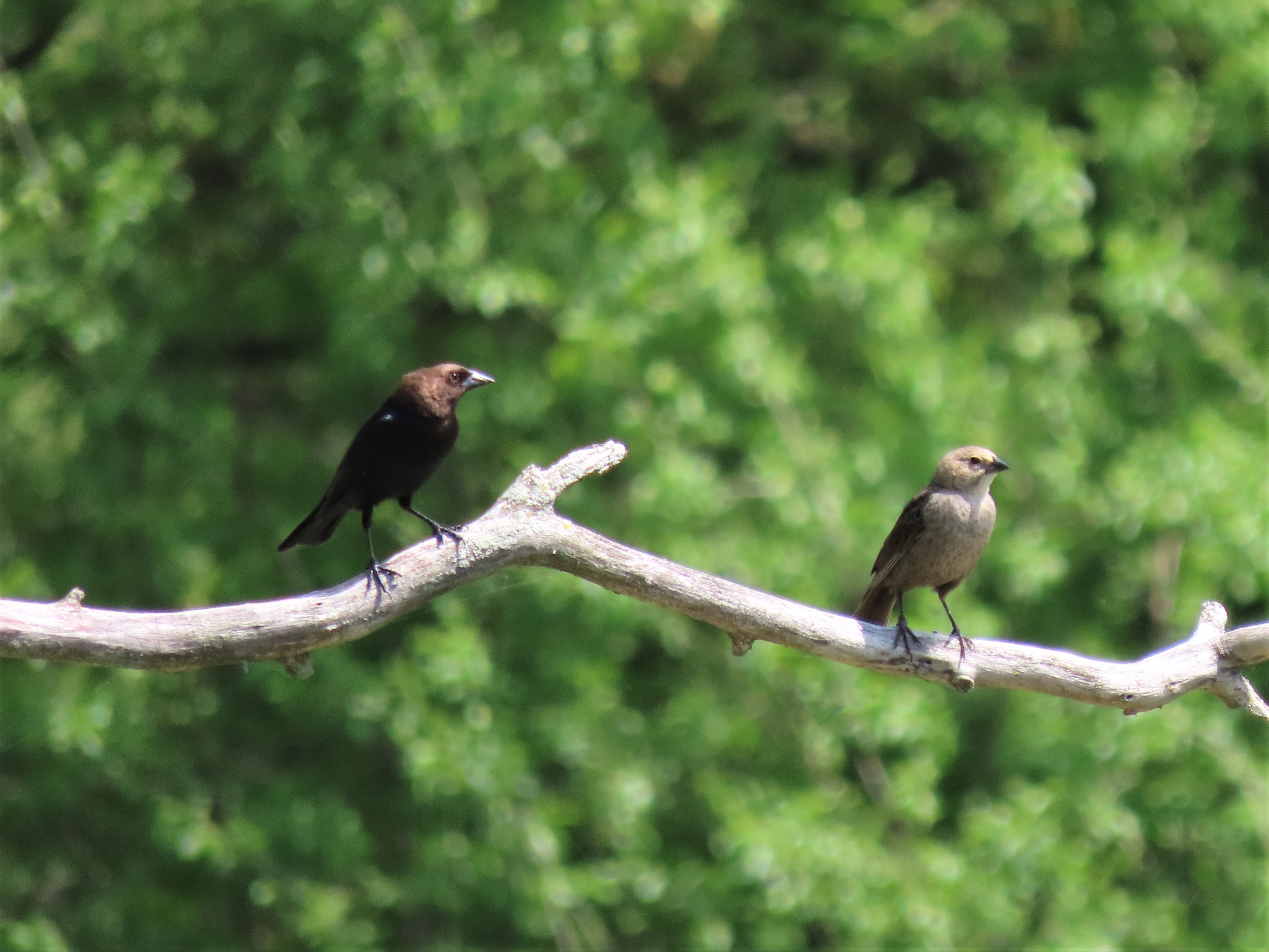
     A pair of Brown-headed Cowbirds (Molothrus ater) is an ominous sight for many small songbirds whose nests are targets for brood parasitism.

     Cheery Song Sparrows (Melopspiza melodia) never fail to delight us.


     In several spots we heard the familiar wichety-wichety call of Common Yellowthroat (Geothlypis trichas) but seldom saw the chorister, and managed but one picture of indifferent quality.


     There is one small, swampy area that we pass each time we visit RIM Park that we always think should harbour birds, amphibians and who knows what else. But it never does.


     It is perfect habitat for a pair of Northern Waterthrushes (Parkesia noveboracensis) and I remain hopeful that one day they will be there.
     There are glimmers of hope that the Province of Ontario may be on the road to loosening some of the COVID restrictions that have dominated our lives for so long. It can't come soon enough for us and perhaps before too long we can bring you reports of visits farther afield.

Sunday, May 20, 2018

Bird Banding at SpruceHaven, St. Agatha, ON Episode No. 3

20 May 2018

     The weather has not been kind to us this weekend and our banding activity has been fairly dismal. Yesterday, without checking the weather, I went outside a little after 05h:30 only to find it raining, so I went back into the house.
     This morning I was a little later getting going having spent a wonderful evening with Francine and Jim and Franc and Carol and getting to bed later than normal. At least it was not raining.
     When I arrived at SpruceHaven Kevin, Heather and Daina were already there, having completed the first round of the nets in fact. My friend Khurram Janjua was also there with his young son Zacariya who is passionate about birds; their first visit to SpruceHaven and their first experience at a banding operation.
     It was wet underfoot, with cloudy conditions and a little cool, but we had high hopes for a series of migrant species. And we were not disappointed in the variety of species, but the numbers were low.
     We were excited to capture a Blackpoll Warbler (Setophaga striata), a species only trapped previously in the fall. 


     It is a constant source of amazement to me that so many birds are black-and-white yet they are all distinctive in so many ways, and this species is handsome indeed, and its autumn migration is the stuff of legend.
     Flycatchers are moving north to their breeding territories and we were very pleased to capture this Least Flycatcher (Empidonax minimus).


     Willow Flycatcher (Empidonax traillii) and Alder Flycatcher (Empidonax alnorum) are indistinguishable in the field unless they are singing. In fact they were formerly considered to be one species, Traill's Flycatcher. Even in the hand, other than for a very narrow range where the wing length differentiates one species from the other, it is well nigh impossible for a bander to establish the species with confidence. Thus, most birds are still recorded as Traill's Flycatcher - and this is the procedure we followed for this bird.


     Most warblers have now migrated north, but as evidence that a few are still moving through here we captured this female Blackburnian Warbler (Setphaga fusca). 


     We hope that she will find a mate and produce a fine clutch of healthy youngsters to journey to their home in South America.
     Judy Wyatt came out to help and Daina brought her boyfriend, Rob, a splendid young man, and very agreeable company. Daina also has a friend visiting from Copenhagen and she and her significant other also paid us a visit. It was a highly sociable morning and as always it was good to share our banding experience with others.
     I will leave you with this picture of Heather, our dedicated volunteer, who contributes so much to our success, and who delights me every time I see her.


     I had intended to take a picture of Daina too, our other biologist par excellence, but I neglected to do so, so here is a picture from my files.


     I cannot emphasize too much what these young women have meant to us, and how much they have contributed to the success of SpruceHaven banding and Barn Swallow (Hirundo rustica) monitoring. 
     And they are truly delightful to be around. I must confess that as I get older I am ever more aware that we need to pass the torch onto younger generations. In Daina and Heather we are handing off to the very finest. It is a happy experience in every way for me to be associated with them.
     Thank you Heather and Daina!

All species banded 20 May:  Traill's Flycatcher, Least Flycatcher, Grey Catbird, Common Yellowthroat, American Yellow Warbler, Blackburnian Warbler, Blackpoll Warbler, Red-winged Blackbird, White-crowned Sparrow.  Total: 9 species, 9 birds.

Monday, August 28, 2017

A weekend of bird banding at SpruceHaven

26 and 27 August 2017

26 August

     Our nets went up a couple of weeks ago, but for one reason or another there has been no report here about our activity. Time to rectify that!
     The morning started badly on Saturday for Kevin, who forgot his waterproof boots, and did the rounds of the nets with soaking wet feet. Temperatures at the crack of dawn were hovering around 8°C so his feet were not only wet, but cold. Bird banders are hardy souls, however, and he persevered despite the discomfort, with nary a word of complaint coming out of his mouth. My feet were toasty warm and dry in my long rubber boots, (wellies as they are known in England), so perhaps there was an air of smugness about me - I hope not!
     One of the captures we made on the first circuit  was a Savannah Sparrow (Passerculus sandwichensis), a species which we see infrequently at SpruceHaven since there is not (yet) suitable habitat for them, so we seem to have prima facie evidence that we are situated on their migratory pathway.


     We recovered three House Wrens (Troglodytes aedon) from the same net, located close to the edge of the woodlot where they are known to breed, so it appears that they are initiating migration already.


     Wood warblers are certainly on the move now and we were not surprised to find this Common Yellowthroat (Geothlypis tricha) in the net.


     A Nashville Warbler (Leiothlypis ruficapilla) provided further evidence of the early stages of warbler migration.


     In a family noted for its scintillating beauty I find Wilson's Warbler (Cardellina pusilla) exceptionally attractive, even though it is not as spectacular as some of its congeners.


     One of the most appealing features about our bird banding operation is to use it as an educational opportunity for the numerous visitors who come to observe the process and see birds they had not even known existed. Many are simply astounded at the migratory feats of these tiny gems. Everyone goes away with a new appreciation of the avian world, and not a few are motivated to support conservation measures when the opportunity arises. Sometimes it as simple as a commitment to enhance their gardens with bird-friendly native plants.
     One of our star pupils, almost since we banded our first nestling Barn Swallow (Hirundo rustica) has been Sandy's granddaughter, Annabelle. This bright young nine-year old has not only an insatiable curiosity she also helps us in many ways, not hesitating to do the rounds of the nets with us and carry back the birds in their bags. 


     Every bird banded affords us an opportunity to talk to Annabelle about it and she absorbs information like a sponge. It is always a special treat for her to have a bird placed in her hand for release, and she relishes this intimate contact with a tiny wild creature with whom she has gained an affinity.


     Perhaps we have one of the next generation of biologists or conservation giants right here at our modest little banding station. Regardless, I am always happy to see her.
     Willow Flycatcher (Empidonax traillii) and Alder Flycatcher (Empidonax alnorum) are impossible to distinguish in the field unless they are heard. Even in the hand of a bird bander one cannot be differentiated from another and they are recorded as Traill's Flycatcher.


     Least Flycatcher (Empidonax minimus) can be identified by wing measurement, however, and we were happy to have the opportunity to band one. Had we simply seen this bird flitting in the trees searching for food we would have been hard pressed to record it as anything other than Empidonax, sp.


     It was a day for tyrant flycatchers, with Eastern Phoebe (Sayornis phoebe) being next on our list.


     This handsome male Northern Cardinal (Cardinalis cardinalis) let Kevin know in no uncertain terms that it was not happy about being handled, and latched onto his hand. Those beaks are designed to crack open nuts and really hurt when sunk into human flesh.


     So not only did he have wet feet, he had a sore finger!
     We trapped numerous Song Sparrows (Melospiza melodia), one of which was a bird we banded on 2 October 2016 (Band number 2581 87982) so we know that this bird migrated and returned to the same area this year.

All species banded 26 August: Eastern Phoebe (1), Traill's Flycatcher (1), Least Flycatcher (1), Cedar Waxwing (2), Black-capped Chickadee (3), House Wren (3), American Goldfinch (4), Nashville Warbler (1), Common Yellowthroat (1), Wilson's Warbler (1), Song Sparrow (3), Savannah Sparrow (2), Northern Cardinal (1).  Total:  24.

27 August

     Having learned his lesson yesterday, Kevin arrived with waterproof footwear, newly treated with silicone, and a warm fleece to start the day. I am sure he wiggled his toes with glee!
     Following a clear night with no wind, it was quiet, as we had expected.
     Another migrating warbler surrendered itself for a band, however; a female American Redstart ( Setophaga ruticilla), this time.


     This bird was followed in short order by Cedar Waxwing (Bombycilla cedrorum), one of several trapped over the weekend, but this individual obligingly fanned his tail to reveal the yellow terminal feathers and the waxy red tips on the wing, from which the bird gets its name. 


     A Red-eyed Vireo (Vireo olivaceus) was our first capture of this species in the fall.


     Roger Tory Peterson stated many years ago that this species was probably the most abundant species in eastern deciduous woodlands, but it is certainly no longer anywhere near as common as it used to be.
     A Common Yellowthroat was the only other warbler we banded today.


     Ever faithful, Annabelle came out to help and we enjoyed chatting with her, and tried to answer her hundred and one questions. She has been staying with her grandparents but she will be back home next weekend, so we probably won't see her. We'll just have to manage without her!

All species banded 27 August: Traill's Flycatcher (1), Red-eyed Vireo (1), Cedar Waxwing (1), House Wren (2), American Goldfinch (1), Common Yellowthroat (1), American Redstart (1), Song Sparrow (3).  Total: 11.
     

Land Acknowledgement

We acknowledge that the land on which we are situated are the lands traditionally used by the Haudenosaunee, Anishinaabe, and Neutral People. We also acknowledge the enduring presence and deep traditional knowledge, laws, and philosophies of the Indigenous Peoples with whom we share this land today. We are all treaty people with a responsibility to honour all our relations.

Followers