Showing posts with label Eastern Cottontail. Show all posts

Tuesday, July 20, 2021

Bunnies, Dust Bowls and Roddie

      We are on the cusp of venturing a little farther afield, but for the moment most of what we do is local.

16 July 2021

Our Front Yard

     Anyone who reads this blog regularly will know that Miriam is frustrated with Eastern Cottontails (Sylvilagus floridanus) due to their habit of regularly dining on the choicest items in her garden. Weeds they leave alone, hostas and coneflowers are always on the menu. It is exasperating for her, as you can understand, to invest money, time and effort into a floral display only to have her efforts thwarted.  
     From time to time I have heard her expostulate in ways that might make a drunken sailor blush! 
     Despite this, however, I am ready to expose her as an impostor! Little baby rabbits will do it every time!


     She was as thrilled as anyone to see these tiny bundles of delight exploring the front yard. They must have just left the safety of their burrow for they are so tiny they would easily fit onto my hand.


     Who can maintain a hard heart when confronted with this enchanting renewal of life? Not Miriam!


     She may become extremely annoyed with the rabbits, and chase them from her flowers, but in truth she would not wish them harm even for a moment.


     It is in fact a pleasure to have them share their lives with us.
     Right by our front porch, birds, especially House Sparrows (Passer domesticus) regularly drop by for a dust bath, to cleanse their feathers of ectoparasites. The result is that two bowls have become established and they are well used.


     Sooner or later we may be able to get a shot of the birds performing their vigorous toilette when the dust flies in all directions! I'll be sure to post it if we do.

Hood Century Farm

     Roddie, a ten-year old dynamo, has been a fan of birds ever since I have known him, about five years now, and he has acquired a substantial repertoire of knowledge about all matters ornithological. He and his mom, Vashti, and sometimes his little sister, Raya, would come to SpruceHaven to observe our bird banding operation, and generally get involved with everything we were doing.
     I had not seen Roddie since before the beginning of the COVID scourge, so I was delighted to receive an email from Vashti, asking whether I could find Bobolinks (Dolichonyx orizivorus) for Roddie, the latest species in his quest to add to his life list. 
     I knew of just the place to go.

Picture courtesy of Roddie

      The visit turned out to be a family affair and I was happy to welcome everyone to join in on our quest for Roddy's quarry for the day.

Vashti, Raya, Roddie, Kyle (in green jacket at the rear), James

     We spotted Bobolinks almost immediately, with some males still in breeding plumage. We were unable to get closeup shots, but Roddie, wielding the camera like a National Geographic professional, managed this shot of a pair in flight.


     Others were perched in trees, many being hatch-year birds preparing for their first migration to the grasslands of South America.


     Roddie took this nice shot of a female or juvenile Bobolink at the top of the tree, and a male American Goldfinch (Spinus tristis) down below.


     Barn Swallows (Hirundo rustica) have had a good breeding season and we saw many fledglings still being fed by their parents. Roddie the Recorder memorialized it for posterity.


     As it turned out one of the highlights for the day was not a bird, but a butterfly, and it landed on Vashti's jacket.
     The first picture below is mine and the second one is Roddie's. Neither are especially brilliant, but between the two all the salient details are present to identify the butterfly as a Banded Hairstreak (Satyrium calanus) a species that I had not seen before. 


     It was delightful to spend time together and I am sure it will not be as long before I see Roddie again.

Tuesday, July 07, 2020

Midsummer Happenings

         It has been miserably hot of late, with the daily temperature routinely getting up into the thirties, not conducive to long walks, unfortunately. As a consequence this post will be a bit of a mixed bag of sightings around the backyard, in the house, and a few items from farther afield.
     Eastern Cottontail (Sylvilagus floridanus), the arch invader of the garden, is both a delight and a menace, and is extremely common. These creatures, whose life span seldom exceeds six to eight months, rarely one year, are susceptible to all manner of diseases, and harbour a full suite of endo and ecto parasites, and in addition face a formidable array of predators, both terrestrial and aerial.
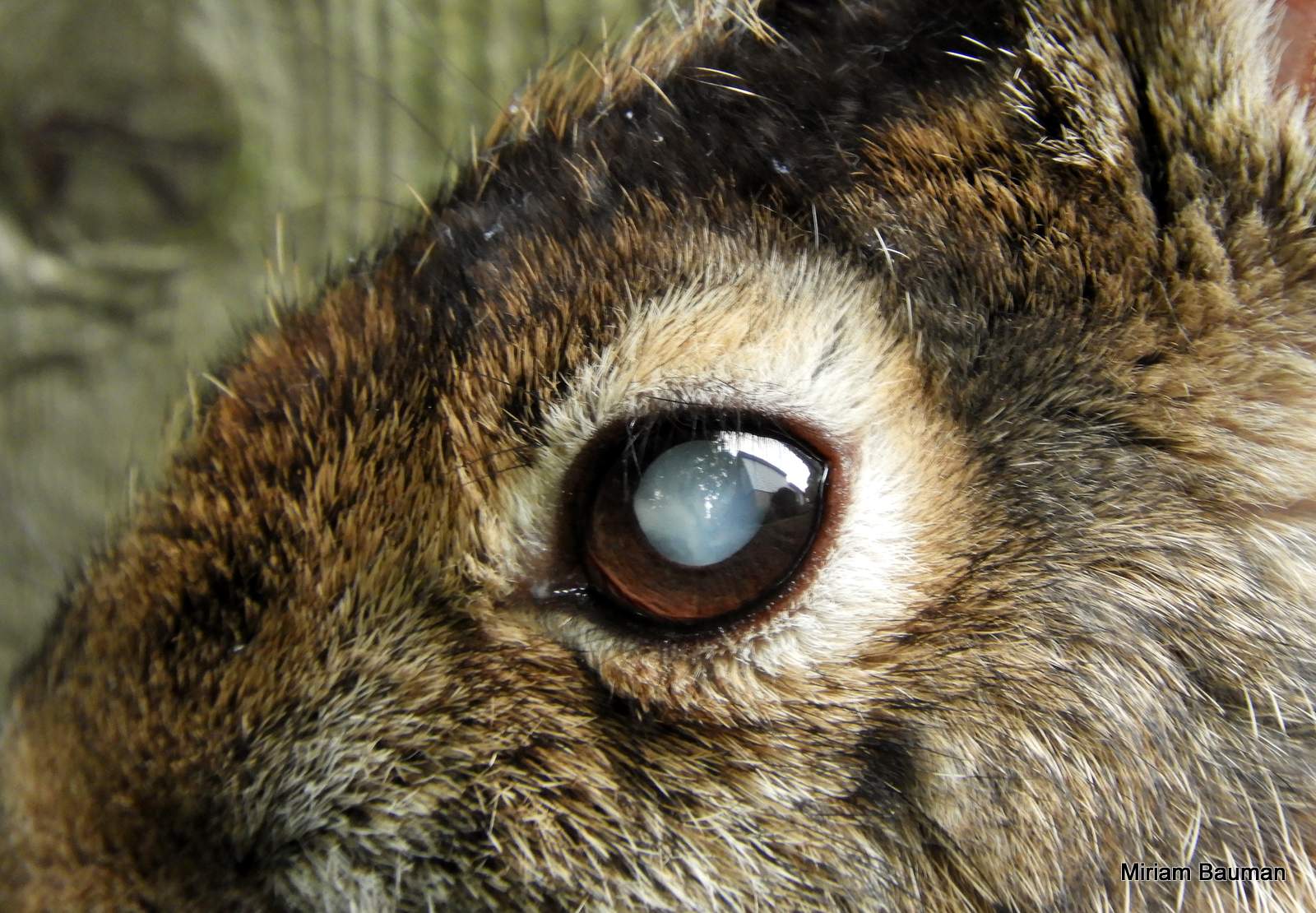
     Cottontails contract a range of occular surface diseases, and this individual, a regular visitor, appears to have a cataract in one eye.


     It does not seem to have affected its ability to forage and even with one operative eye it unerringly finds the plants Miriam would least like it to chew upon.


     Woe betide it, however, when a cunning fox comes up on its blind side!
     For several years now we have raised butterflies inside the house, with an undiminished fascination for observing the transformation from egg to caterpillar, to chrysalis, and finally a beautiful butterfly.
     Here are two companions, both feeding on Rue (Ruta graveolens), safe from the elements, and more significantly from winged predators of many types. Black Swallowtail (Papilio polyxenes) is at the left, nose-to-nose, so to speak, with Giant Swallowtail (Papilio cresphontes) at the right.


     Miriam and I were outside looking at another half dozen caterpillars or so on the Rue, debating whether we should bring them into the safety of the house, all the while recognizing that these larvae are an important food source for birds and other insects. Our minds were made up for us, in short order, as several European Paper Wasps (Polistes dominula) swarmed the plant, and immobilized the caterpillars with their sting, and feasted on them.


     Most caterpillars do not survive, of course, and songbirds would be unable to raise their young without this spring flush of protein.


     Less desirable are Gypsy Moth (Lymantria dispar) caterpillars, which have appeared in profusion this year, and are capable of inflicting serious damage to a range of native deciduous trees.


     Foolishly, this species was deliberately introduced into North America in 1868-69 and threatens our forests. Many have found their way into our yard, where we destroy them.


     Their spiny body makes them unappealing to most birds and other potential enemies.
     A male Cabbage White (Pieris rapae) nectaring on Salvia is not threatening at all.


     There was a bumper crop of Paeonies (Paeoniceae) this year and Miriam brought the final few into the house. 


     Several juvenile American Robins (Turdus migratorius) have appeared in the backyard as they leave the nest, sometimes accompanied by an adult but more frequently alone as they embark on an independent life.
     It was apparent that one young bird was in trouble. It panted frequently, its wings drooped and it had a noticeable tremor. I do not know whether some form of pathogen affected this bird or whether it was carrying a lethal load of parasites, but it succumbed overnight and was found dead the next morning.


     It is always sad to see a young bird not live to fulfill its potential, but life in the wild is neither easy nor predictable.


     The Mourning Dove (Zenaida macroura) below seemed to be engaged in some kind of feather maintenance activity, either anting or soaking up UV rays.


     Our Butterfly Milkweed (Asclepias tuberosa) has done exceptionally well this year, and provides a burst of colour at the front of the house.


      Despite its name, we have never seen a butterfly on it, although it does not lack for other pollinators.


     It is by any measure a beautiful plant and has fortunately escaped the attention of the rabbits.
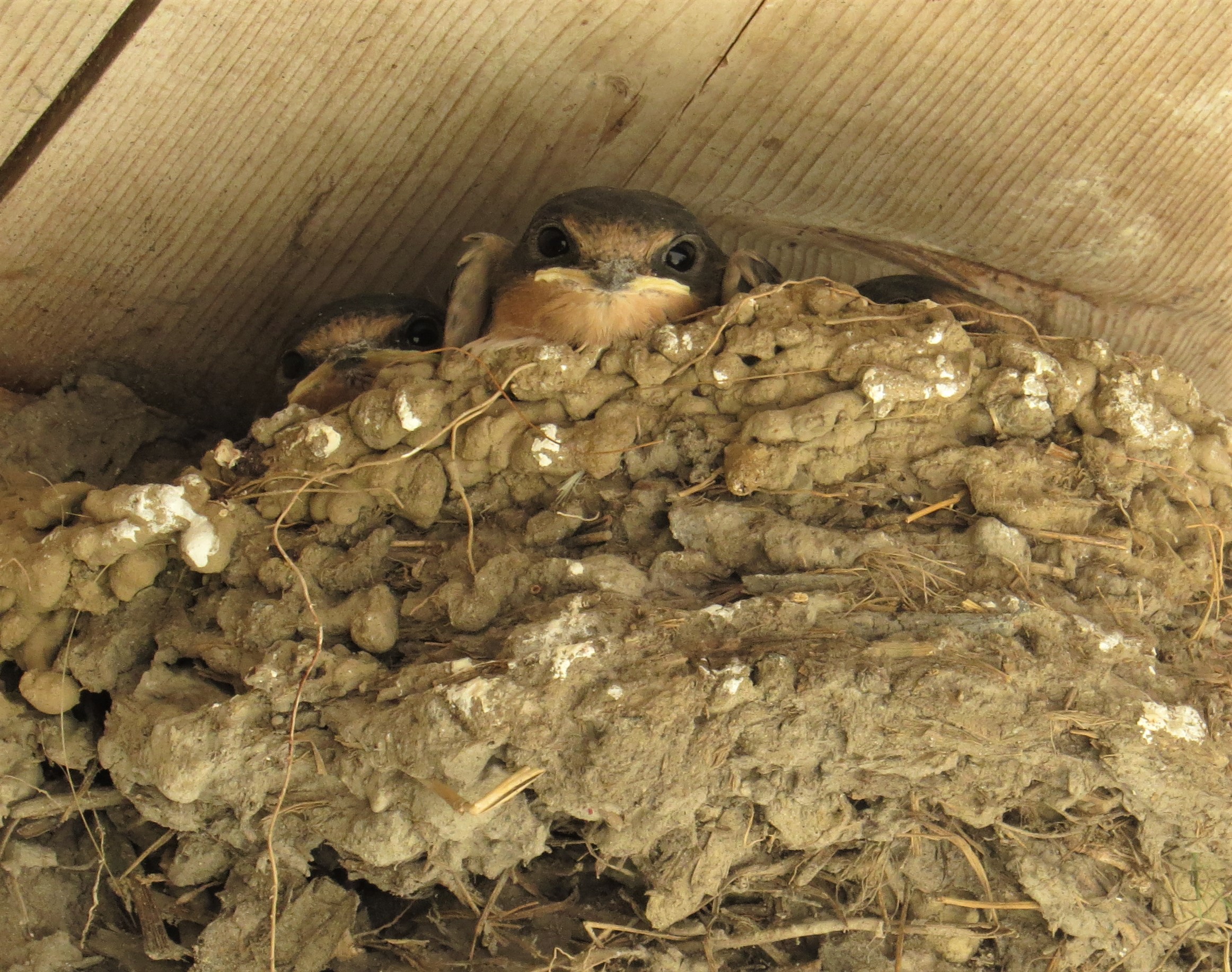
     At SpruceHaven this year we have not been able to do any serious monitoring of the Barn Swallows (Hirundo rustica) as the Coronavirus put an end to team work and cooperative effort, but the colony appears to be prospering.


     Fairly early in their development the nestlings learn to orient their rear ends to excrete over the lip of the nest, so an easy way to know which nests have active young is to follow the piles of poop building up beneath them.


     Many species of butterfly are active now; witness this Tawny-edged Skipper (Polites themistocles) on Bird's Foot Trefoil (Lotus corniculata).


     Several Pearl Crescents (Phyciodes tharos) were flitting around; finally one came to rest and we were able to get a picture.


     This period has also been marked by upgrading from Windows 7 to Windows 10 on a brand new computer. Nothing has the capacity to make me nervous more than computer issues and we owe a great debt of gratitude to Jeremy Faulkner of Nerds on Site for making the transition seamless and worry-free.
     We had always used Picasa for our photo editing and were very familiar with its ease of operation. It was at the apex of user-friendliness. However, it was discontinued some years ago and is no longer available for download, so on Jeremy's advice we switched to digiKam. After some initial consternation, and a great deal of perseverance from Miriam, we (insert "she") navigated our way through it, and are becoming more comfortable with repeated use.
     Adding a watermark to a photograph seems inordinately complicated, however, and we will eschew this feature for now. I am not quite sure why amateurs like us need a watermark anyway.

Wednesday, June 17, 2020

Backyard, Countryside and City

     The Backyard

     Our backyard is always a tiny oasis of calm, comfort and delight for us, and I suspect that its role in that regard has been even greater than usual during the pandemic.


     It was here that Miriam "broke" the isolation curse by inviting three good friends over for lunch last week.
     A Giant Swallowtail (Papilio cresphontes) was there to welcome everyone.


     Grey Squirrels (Sciurus carolinensis) are a part of urban life in Canada and for people who feed birds they can be a cause of substantial irritation, and a challenge too. They are in fact charming little creatures and as long as they stay off my bird feeders we get along well together.


     The black morph of this animal is only found in the northern part of its range, principally in Canada, leading to speculation that the black colour gene carries some unknown adaptation. 


     It is equally welcome, however, free of discrimination, and with no knee on the throat, figurative or otherwise.
     An Eastern Cottontail (Sylvilagus floridanus) could easily be the poster child for the oft used expression "cute as a bunny." 


     Miriam might be reluctant to agree with that assessment, however! It is the bane of her garden and seems to chew off whatever plant looks best. It is not only a catholic diner, it seems to enjoy sampling flowers not to its taste, nibbling them down to the ground and leaving them uneaten.


     It does well to hide from her wrath!


     This squirrel was seen chewing on the stump of a branch that was broken off, for what purpose we are not quite sure. Perhaps sweet sap oozes into the wound on the tree; whatever the inducement it attracted the attention of the squirrel for several minutes.


     Ruby-throated Hummingbird (Archilocus colubris) has been a visitor to the garden this year, but nowhere near as frequently as in previous years. Miriam was lucky to photograph this female perched on a branch.


     One of our most predictable visitors, flashy, gaudy in the best possible way, bold and determined, and a sonorous musician is Northern Cardinal (Cardinalis cardinalis). One was singing this morning to enliven first light, a maestro of sostenuto.


     And this is the object of his ardour.


The City

     Peregrine Falcons (Falco peregrinus) have become permanent residents in the City of Kitchener, and this year again four young have been fledged from their urban nest.
     When I visited them recently the male had just delivered food and you can see the female tearing it apart in the picture below, with one of the fledged young perched out on a spar of the tower where the nest is located.


The Countryside
     
     England has long been identified as a "green and pleasant land" and I tried to find a source for the expression, without success. It seems to have been used as far back as antiquity, and justifiably so.
    I would contend, however, that the Great Lakes country of southern Ontario could lay equal claim to such an appellation. The area close to our home is evidence of this.


     Surely you must agree! 
     A female Mallard (Anas platyrynchos) ambled along the side of a country road, seemingly without a care in the world.


     Perhaps she too contemplated her green and pleasant home, where cows rested contentedly.


     I have introduced you before to the Western Osprey (Pandion haliaetus) that nests alongside the Conestogo River on the way to Hawkesville, and I have no doubt that I will be featuring more pictures of this accessible nest. Here the female is feeding on a fish delivered earlier by the male.


     Savannah Sparrow (Passerculus sandwichensis) is a familiar grassland species from spring through fall and an ardent male may often be seen singing from atop a fence post.


     And, just another example of our green and pleasant land!


     At SpruceHaven our success continues apace, and of the six next boxes that I check weekly on behalf of WRN Teens, five are occupied, and having cleaned out the sixth a couple of days ago, who knows what surprises might be in store next week?
     Tree Swallow (Tachycineta bicolor) young are growing strong, due to the diligence of devoted parents who spend most of their waking hours feeding them.


         A pair of Black-capped Chickadees (Poecile atricapillus) has claimed possession of another box and if you look carefully you can see the female staring out at me from inside the nest box.


     A quick check inside revealed six eggs.


     On the way home I saw three different male Indigo Buntings (Passerina cyanea) all in full voice.


     The first cut of hay is exceptionally early in recent years and this portends the end of any possibility of a successful breeding season for ground-nesting species.


     I do not have statistics on the impact on species such as Northern Harrier (Circus hudsonius), Bobolink (Dolichonyx oryzivorus), Eastern Meadowlark (Sturnella magna), and others, but it must be substantial.
     Classic products of our area are Maple Syrup and Apple Butter, and signs are frequently posted at the end of the driveway to a farm - in this case rendered as one word in each instance!


     I can attest that both products are delicious!
     Quite frequently one sees signs extolling the virtues of Canadian milk, which is purer and contains less chemical additives than imported milk.


     And I can't resist one more shot of the Osprey on the nest.


Back at home

     We started off in the backyard so let's finish off there. 
     This young American Robin (Turdus migratorius), recently out of the nest and quite capable of taking care of itself, nevertheless continued to beg from its parents. 


     A free meal is always a good thing I suppose.
     And finally, this morning we found eggs of Giant Swallowtail on our Common Rue (Ruta graveolens). We located two eggs but I suspect there are more.


     We will keep an eye out for the first caterpillars and perhaps bring them inside to raise them indoors free from the threat of predation.
     We will see!

Land Acknowledgement

We acknowledge that the land on which we are situated are the lands traditionally used by the Haudenosaunee, Anishinaabe, and Neutral People. We also acknowledge the enduring presence and deep traditional knowledge, laws, and philosophies of the Indigenous Peoples with whom we share this land today. We are all treaty people with a responsibility to honour all our relations.

Followers