05 August, 2023
Lakeside Park, Kitchener, ON

Jerusalem Artichoke (Helianthus tuberosa) is blooming in August; what a glorious flower it is!

Its tubers are eaten by some, raw, pickled or roasted, but as far as I know I have never had the pleasure.
Stickseeds (genus Hackelia) are interesting plants, several of which were growing at Lakeside Park.

I confess to being very fond of Chicory (Cichorium intybus) - not the extract used as a coffee substitute - but the glorious blue flower that dots the landscape of southern Ontario at this time of the year.


Wild Bergamot (Monarda fistulosa) has a bit of a "ragged" look about it, but is greatly favoured by pollinators of various kinds.


its common name derives from its pleasant fragrance, reminiscent of the Bergamot Orange grown in Italy.
Riverbank Grape (Vitis riparia) was used by early settlers to make jelly, but I suspect few people do this today.

It attracts a variety of birds, however, including Cedar Waxwing (Bombycilla cedrorum), Northern Flicker (Colaptes auratus) and even Pileated Woodpecker (Dyrycopus pileatus).
Greater Burdock (Arctium lappa) is the tallest representative of a group of plants that were the inspiration for Velcro.

Anyone who has ever been covered with burs at the end of a walk knows only too well how difficult they are to remove. Sadly, small birds (e.g. Golden-crowned Kinglet (Regulus satrapa)) are sometimes ensnared on the plant and die there.
One might be forgiven for concluding that Common Red Soldier Beetles (Rhagonyncha fulva) lead a life of orgiastic excess, since they seem always to be seen copulating, but this individual is taking a break from its hedonistic pursuits.

Wild Carrot (Daucus carota), otherwise known as Queen Anne's Lace, seems to be the host plant of choice for this species and the locus of their bacchanal.
Common Jewelweed (Impatiens capensis) sits ready to deliver copious volumes of nectar to hungry hummingbirds taking on fuel for migration.

July and August are the proverbial dog days for birders. Most species are busy with young, males have stopped singing, the foliage is at its densest and many species are undergoing moult.
Male Mallards (Anas platyrynchos) have been transformed by eclipse moult when they divest themselves of all their flight feathers at the same time, and are confined to the water for safety, and look for all the world like females.

Some, by now, are beginning to re-acquire their masculine splendour and various intermediate stages are on display.

And young Canada Geese (Branta canadensis) are almost as big as their parents.

It really did seem, though, that Mallards were all over the lake, on the shore.....

..... and little squadrons on the water.
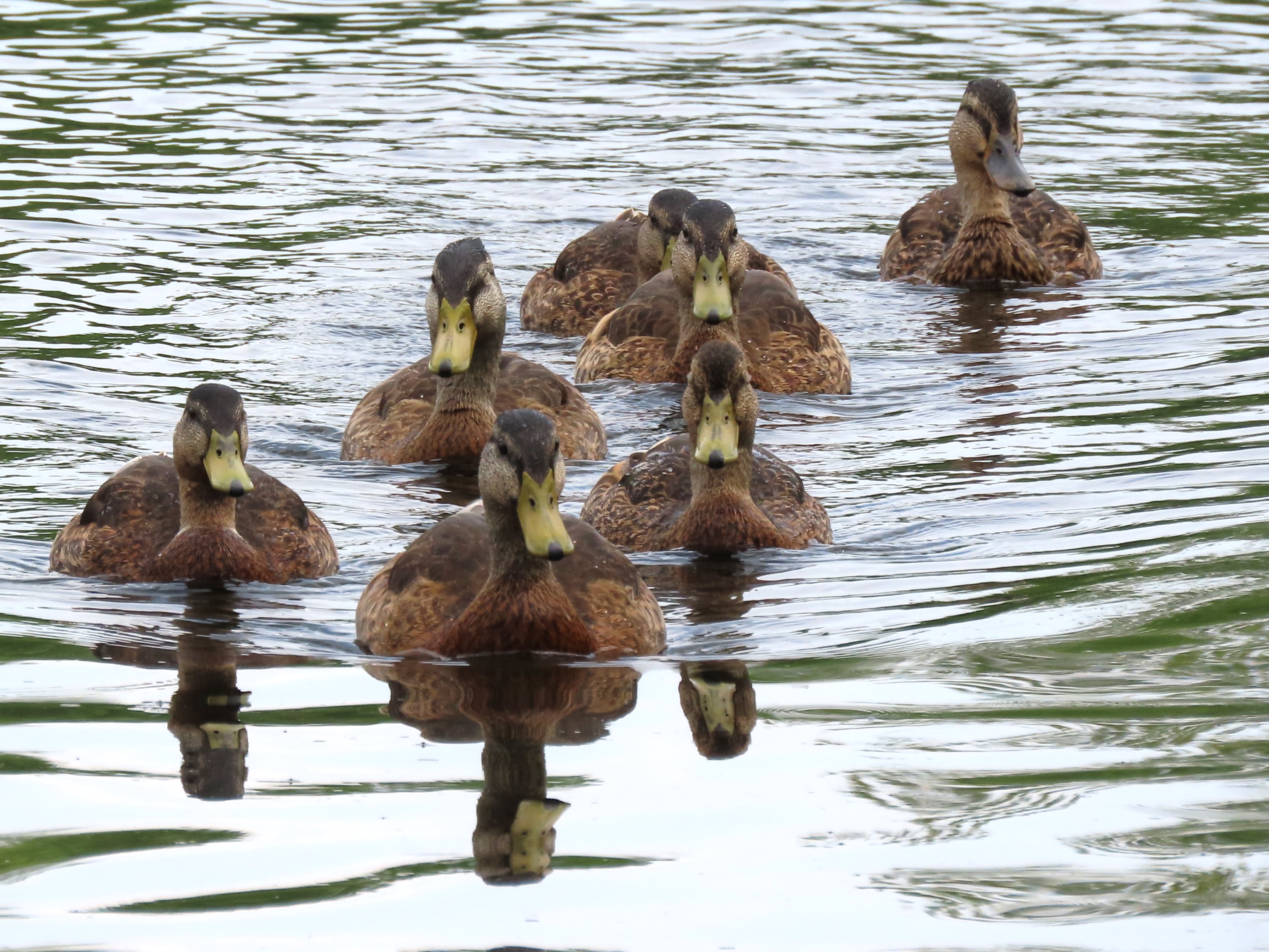
Sometimes they even joined forces and drifted off together harmoniously.

I was impressed by the delicate beauty of the leaves of Staghorn Sumac (Rhus typhina), a familiar plant that rewards close inspection.

Common European Greenbottle Fly (Lucilia sericata) has had no trouble adjusting to life in southern Ontario.

Nor has the European Paper Wasp (Polistes dominula) that joined it here.

I am sure that everyone is familiar with a paper wasp's nest (Polistes is Greek for 'city founder'), where the adults feed their young chewed up insects, especially larvae. They often patrol our backyard searching for caterpillars.
Hedge Parsley (genus Torilis) is very attractive.

This charming little bee is a Modest Masked Bee (Hylaeus modestus), a species that I had not seen before.

It is a twig-nesting species, preferring dead stems over other materials.
Wild Carrot sometimes takes on a pinkish hue.

Common Whitetail (Plathemis lydia) is one species of dragonfly that alights frequently and often close.

One must be thankful for small mercies!
There were other species flying around that day, some quite big, but they never came within camera range or landed for even a second, so we have no pictures to share, nor do we know what we saw.
A Common Eastern Bumble Bee (Bombus impatiens) was contentedly nectaring on Wild Bergamot.

Perennial Sow Thistle (Sonchus arvensis) hosted pollinators too.

It was good to see native Narrow-leaved Cattail (Typha angustifolia) holding its own in the marshes, against the relentless onslaught of Common Reed (Phragmites australis).

Common Aerial Yellowjackets (Dolichovespula arenaria) had descended on Wild Carrot en masse.


Some of the Wild Carrot flowers are starting to form their familiar bird's nest shape, in many cases soon to be home to the larva of a Carrot Seed Moth (Sitochroa palealis), a site of both food and hibernation.

Common Boneset (Eupatorium perfoliatum) tends to be found in the same areas as Wild Carrot.

The following plant is a type of Mint (genus Mentha) but I didn't detect the characteristic odour.

A Meadow Spittlebug (Philaenus spumarius) is responsible for the frothy foam seen on grasses, often referred to as Cuckoo Spit.

The nymphs actually live in, and are protected by, this substance.
A Common Eastern Bumblebee was gathering pollen and nectar on Goldenrod (genus Solidago).

Flowers on the Elders (genus Sambucus) are giving way to fruit.

A Mock Strawberry (Potentilla indica) resembled the sort of protein spike we became accustomed to seeing on our TV screens during the height of COVID.

Snowberries (genus Symphoricarpos) are simply lovely.

Don't you wish you had a little island of diversity like Lakeside Park near you?
06 August, 2023
At Home, Waterloo, ON
Just as I was leaving to run some errands, a Monarch (Danaus plexippus) landed on the coneflowers at the front of the house.
In a flash, Miriam was there with her camera.

She did well, I think you'll agree.

This is perhaps the most iconic butterfly in all the world.


My young friend, Roddie, a self-confident boy (he is 12 years old) with naturalist blood running through his veins, has started his own blog. There are some great pictures there, so if you have a chance please drop by and take a look: https://rhornbyphotography.wixsite.com/the-waterloo-warbler
If you are able to leave a comment, I have no doubt he would appreciate a few words of encouragement.