Showing posts with label Brown Creeper. Show all posts

Monday, November 30, 2020

Catching up.....

     A while ago, I came across a delightful word, one that I had never heard before. The word is gruntled and it indicates the opposite sentiment of the familiar expression, disgruntled. Makes perfect sense, doesn't it? And it has a nice ring to it, so I am gruntled to wander through a few highlights of the past few days, with a glance back at Lily (I can hear the applause) a couple of weeks ago!

Lily, Friday 13 November 2020


 I could add a few words to these pictures, but your own reactions will suffice I am sure.
     On 20 November, when we would normally have met Heather and Lily for our regular Friday morning walk, they were away at the family cottage, so we skipped a week.

Friday 27 November 2020

     The Mill Race was our chosen spot and it looked very inviting as we began our walk.


     I cannot even estimate how many times Miriam and I have meandered along the Mill Race, but even Lily has done it a few times now. It is a pity, in a way, that she will not remember any of it, but we will doubtless be bringing her here for years to come.


     Brown Creeper (Certhia americana) is not an unusual bird, but it is not always easy to spot, and most have migrated south by now. A few remain and tough out the winter with us.

     Actually, given the weather of late, with bright sunshine day after day and temperatures well above freezing, we are in danger of forgetting what winter is like!
     Trees denuded of leaves often present quite a stark image and this mass of branches caught our attention.


     Muskrat (Ondatra zibethicus) can generally be easily found along the Mill Race and this individual was snacking on corn.


     American Beavers (Castor canadensis) seem to have been exceptionally busy this year, and they are nothing if not ambitious!
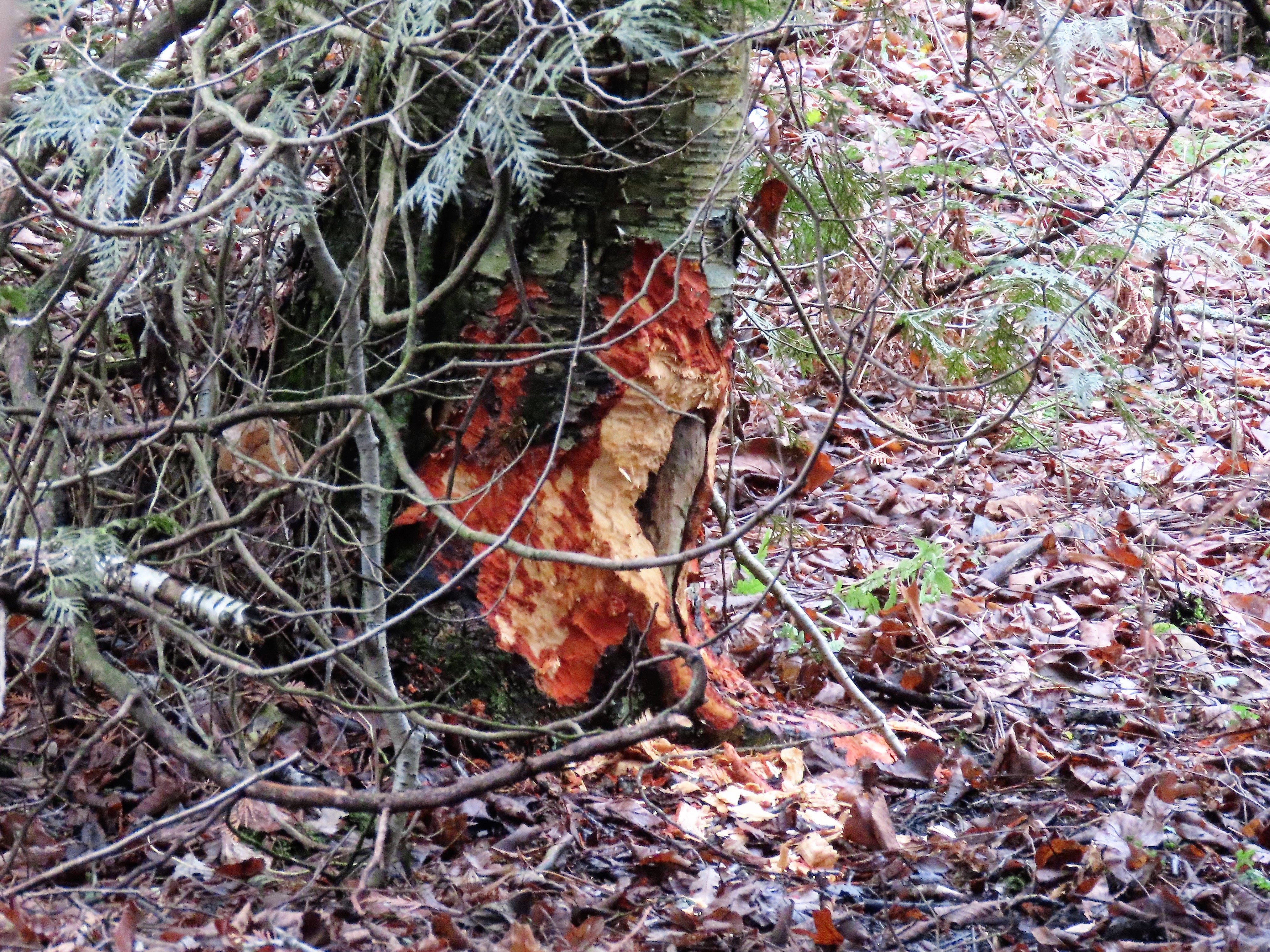

     They have built up their lodge, and laid in a winter food storage, in the process taking over half the path, and possession is ninth tenths of the law as we well know.


     Lily was totally unimpressed with it all and decided to have a snooze.


     A Blue Jay (Cyanocitta cristata) was puffed out, not to keep warm I might add, for it was several degrees above freezing. Perhaps it was impressed by its own importance!


     Mallards (Anas platyrynchos) swam along beside us most of the time, and we remarked to each other that they are truly handsome ducks.


     A few leaves still clung to their branches, imparting a splash of brightness to a bare and largely colourless woodland.


     European Buckthorn (Rhamnus cathartica) can be found at different points along the trail and this patch seems to attract Northern Cardinal (Cardinalis cardinalis) in great numbers, sometimes as many as a dozen feeding on the berries, taking advantage of easy pickings.


     A female was resting up, digesting the last engorgement, waiting to feast again. Buckthorn berries pass rapidly through the bird's digestive tract, so the wait will not be a long one.


    Lily's eyes followed all the action - a year from now we will perhaps have taught her the names of the birds and she will be calling them out to us.


     She is a biologist in waiting!

Saturday 28 November 2020

     For the first time in many weeks I decided to venture a little farther afield, and made off towards Lake Ontario to areas I knew would present no difficulty in maintaining the social distancing required during the pandemic. The change of scenery felt good.
     Harlequin Duck (Histrionicus histrionicus) is a rare winter visitor to southern Ontario, and I was delighted to see a pair at Lakefront Promenade in Mississauga. I had great looks at the birds through my telescope but they were a little far out for good photographs, at least with my basic equipment.

Harlequin Duck ♂

Harlequin Duck ♀

     Flotillas of Canada Geese (Branta canadensis) sailed by, looking quite splendid in diffused November sunlight, which at times cast a subtle glow upon the water.


     A stop at Bronte Harbour in Oakville yielded unusually few birds, but a couple of female Common Mergansers (Mergus merganser) were keeping company with each other.


     Mute Swan (Cygnus olor) is a resident species at Bronte, adding a bit of a regal presence to the harbour, now emptied of boats that have been stored on land for the winter. 


     Given the balmy weather, no doubt many weekend mariners wished their craft were still available for a last excursion on the lake. It is much easier to take advantage of good weather for a final round of golf than to contemplate putting a sailboat back in the water.
     While I was out for the morning, Miriam was visited by a Cooper's Hawk (Accipiter cooperii) which no doubt caused great consternation among the songbirds. She was unable to get a good picture, but this one memorializes the visit.


     Given the chance, I am sure that the hawk would have breakfasted on Downy Woodpecker (Dryobates pubescens).


     And a Mourning Dove (Zenaida macroura) would have made a substantial lunch.


Sunday 29 November 2020

     Always a regular in our yard, Mourning Doves of late have become particularly abundant, and for the past few days fifteen of them have congregated together. They are scattered throughout with some in trees, a few along the fence and others on the ground, so it is impossible to encompass them all in one shot, but this will give you an idea.

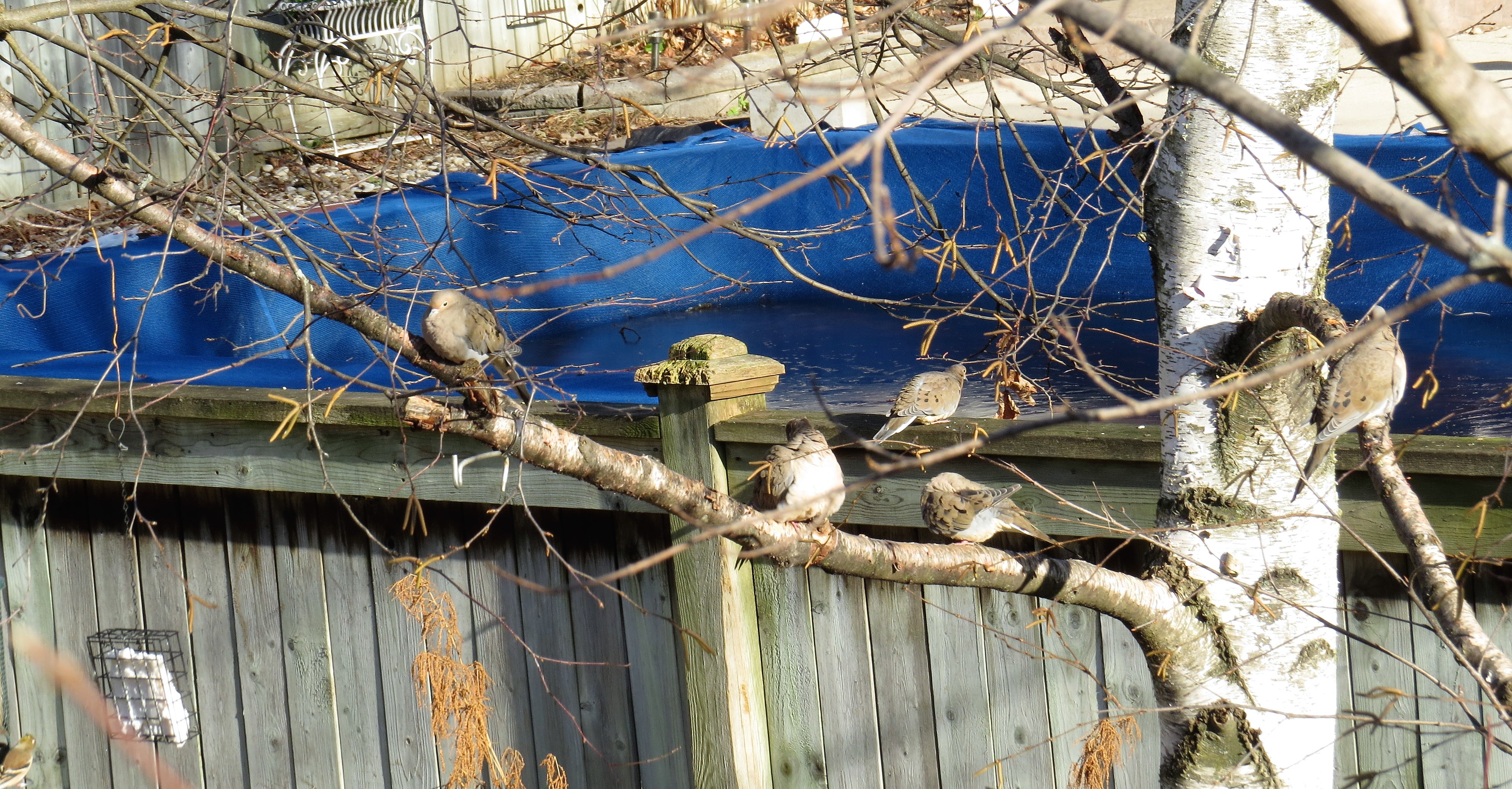

     One individual found a sunny spot to catch the warm rays of the sun and do a little feather maintenance.


     A House Finch (Haemorhous mexicanus) and an American Goldfinch (Spinus tristis) were content to feed side-by-side on the feeders. 
     

     Sunflower hearts are always good! 


Wednesday, November 27, 2019

Some Days You Get Lucky

26 November 2019
An Outing to Long Point, ON

     Recently, our group of eight has been intact as we go on our outings, adding to the pleasure of the day. Today was such a day; Mary and Judy rode with Miriam and me, Franc and Carol picked up Jim and Francine at their house.
     November, in its infancy, presented us with cold weather and snow. We all groaned and complained about an early start to winter, but of late inclemency has morphed into benign and pleasant conditions, and we looked forward to a day of sunshine and a temperature climbing to 10° C. And we were not disappointed! Furthermore, a day at Long Point is always made all the more enjoyable by the fact that we are permitted to use Carol's sister, Betty's house to have our lunch, including fresh coffee which Carol always makes for us. It is never less than very agreeable, but on a cold day it verges on heavenly.
     Just to the north of Port Rowan we glanced off to the side and saw hundreds upon hundreds of Sandhill Cranes (Antigone canadensis) in a ploughed field. This is one of the signature attractions of the Long Point area in the fall and the spectacle we were to witness would exceed all our expectations.


     Everywhere we looked there were cranes, adults and juveniles, birds landing, birds on the ground, spectres high in the sky and others coming in to land in that magical fashion of cranes of every species throughout the world.  Never had we seen so many in Ontario.


     In the evocative words from Paul Johnsgard's little book Those of the Grey Wind: The Sandhill Cranes - "The long, wavering grey line of cranes was like a giant aerial armada, weaving and advancing in wave after wave of birds stretching as far as the eye could see - and beyond."
     And so it was for eight awestruck observers, humbled by the grandeur of it all.
     The voice of these magnificent birds evokes wonder, joy, contentment, tranquility and a link to the primeval and vital quality of nature. It is at once a burble, a booming, a bugling, a glorious chorus in celebration of life, a choir of the great outdoors, a symphony borne on the wind, a trumpet of joy to sooth the most troubled breast. 


      The cranes were not the only spectacle, however. Fall on the north shore of
Lake Erie is equally renowned for the arrival of Tundra Swans (Cygnus columbianus) fresh from their breeding grounds above the Arctic Circle. The skies were filled with swans. Swans vied with cranes to capture our attention. The chorus of the cranes was reinforced by the melody of the swans. We were delighted to see so many young birds, clear evidence of a successful breeding season.


     Upon landing the swans lined up in regimental fashion, all facing the same way, as though on a parade ground with a sergeant-major putting them through a drill.


     Swan or crane? Where did one look first?


     As we meandered along slowly, stopping all the while to feast anew on the spectacle, we saw more and more birds of both species, but the Sandhill Cranes had the edge in numbers. It was truly a remarkable show.


     The sky just kept on delivering cranes, and even provided a hint of celestial  colour as a fitting backdrop.


      In Europe many have seen spectacular concentrations of Common Starling (Sturnus vulgaris) and while we do see large flocks in North America, they pale by comparison to the European spectacles. This was about as large a flock as we have seen and they wheeled around in unison, maintaining a tight formation, and thrilling us with their aerial exploits.


     Normally we all meet at the harbour in Port Rowan, but we had been occupied with the cranes and swans and were distracted from our regular pattern, but we decided to visit the harbour before lunch to check out the waterfowl. 
     The fish huts looked serene in the bright autumn sunshine.


     What few ducks were present were way out on the water. It is duck hunting season in Ontario, so perhaps they were wisely seeking safe haven in the middle of the bay.


     Most of the ducks in the image below were Canvasbacks (Aythya valsinaria).
Doubtless there were a few other species but we could not be sure of their identification.


     A Red-tailed Hawk (Buteo jamaicensis) was surveying the area, seeking prey no doubt, from atop one of the fish huts.


     At nearby Bird Studies Canada headquarters a Cooper's Hawk (Accipiter cooperii put on a bit of a show for us.


     A couple of stops along the causeway produced very little in the way of birds. But some of the trees still retained their leaves and looked quite splendid in the sunlight of this fine day.


     After lunch we went down to the area known as Old Cut, where Mary insisted on a group picture of some of us at least.

David, Mary, Carol, Franc
     There were many House Sparrows (Passer domesticus) around the feeders near to the banding station, and this picture reveals just what an attractive little bird this much maligned species is.


     We saw a couple of Brown Creepers (Certhia americana) in the woodlot and Francine managed not a bad picture.


     And not to be outdone she snapped her own group shot too.

Judy, Miriam, Jim, Mary, David
     It had been a fabulous day, highlighted by the Sandhill Cranes and the Tundra Swans, a day we will not soon forget. It was great that the whole group was able to enjoy it together.


Land Acknowledgement

We acknowledge that the land on which we are situated are the lands traditionally used by the Haudenosaunee, Anishinaabe, and Neutral People. We also acknowledge the enduring presence and deep traditional knowledge, laws, and philosophies of the Indigenous Peoples with whom we share this land today. We are all treaty people with a responsibility to honour all our relations.

Followers