Showing posts with label Northern Cardinal. Show all posts

Sunday, January 01, 2023

Northern Cardinal (Cardinal rouge)

      A couple of days ago I was looking out at my bird feeders and a male Northern Cardinal (Cardinalis cardinalis) was feeding on the ground on seed knocked down by other species who seem to scatter four seeds for every one they eat.

Northern Cardinal ♂

     It got me thinking about our good fortune in sharing our winter with these birds, and about the various adaptations they need to survive in all seasons, but especially during a Canadian winter that at times can be especially harsh.

Northern Cardinal ♀

     Bird feeders certainly help; birds quickly know where they can reliably find food, and it is particularly important when ice storms and extended periods of freezing rain render natural sources of food (hard enough to find in winter at any time) inaccessible.


     We know that the digestive efficiency of cardinals varies with temperature, with efficiency an average of 16% higher at 25 degrees Celcius than at zero degrees. More food is required at low temperatures merely to maintain core body temperature. Digestive efficiency also varies with the type of food consumed and oil type sunflower seeds are markedly superior at bird feeders.
     Northern Cardinals consume a range of animal matter too with the caterpillars of moths and butterflies being especially favoured during the period of their emergence.


     They will also consume beetles, grasshoppers, ants and a range of other insects, but this rich source of fat and protein is denied them in the winter.
     Cardinals are generally agreeable based on my observations, but if a male has its crest raised it may be signalling aggression or is making overtures to a female.


     One of the highlights of my year occurs when male cardinals start to sing in late February, high atop the bare branches of a tree. Spring may not have arrived according to the calendar, but Northern Cardinals responding to lengthening hours of daylight and the changes that occur in their bodies know better! It is surely one of the most joyful sounds in all of nature and I thrill to it anew every year.


     Females pay attention when serenaded by males, but they are fickle and take their time to select a mate.


     He has to be robust, have vivid red plumage, especially on the breast, and a fine song. The female is anxious to choose a partner who displays all the signs that he will be an attentive partner and a suitable father to her young.


     There is obviously more - much more - to know about these wonderful birds, but it is not my intention to go on at length here. 
     This post was triggered by a simple observation outside my family room window at the peak of the recent blizzard, so let me conclude with a couple more pictures of birds in winter.


    Someone has left black oil sunflower seeds along the rail at Riverside Park in Cambridge, and the male looks in the peak of good health with bright body plumage and a crisp black mask.
     And the female is willing to share with others.


     There are many other species to evoke delight in the winter and we appreciate them all. Thank goodness I learned to love birds - what would my life be like without them?


Sunday, December 12, 2021

Waterloo Region Nature Outings, Columbia Lake, Waterloo, ON

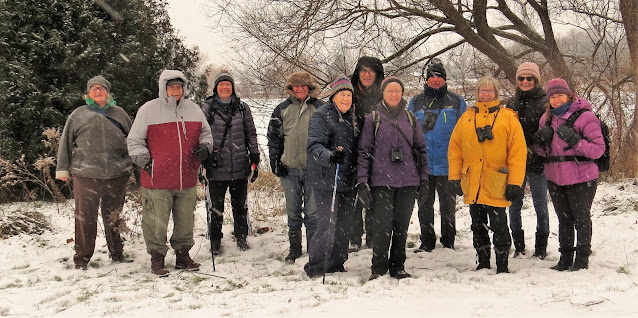
     The latest in the series of outings I have been conducting for WRN recently saw us visit Columbia Lake. As always, there was a mid week venture for people who do not have the daily grind of a job to occupy their time, and a weekend jaunt for the benighted souls who do.

 08 December 2021

Leader: David M. Gascoigne

Members: Lynn Conway, Pauline Copleston, Lisa Den Besten, Bob Fraser, Beth Hobson, Graham Macdonald, Marg Macdonald, Geoff Moore, Rog Suffling, Judy Watson, Kathy Waybrant

Lynn, Graham, Lisa, Geoff, Marg, Rog, Pauline, Bob, Beth, Judy, Kathy

      It was a crisp minus seven degrees as our hardy group of winter warriors set out to see what birds wished to join us on our snowy promenade.

Monday, November 01, 2021

Two Outings to RIM Park for Waterloo Regional Nature

      COVID, while still a spectre hanging over our heads, seems to influence our daily activities less than it has done since the very beginning of the pandemic and I was happy to be able to offer a couple of outings to RIM Park, Waterloo, for keen members and friends.

27 October 2021
RIM Park, Waterloo, ON

Leader: David Gascoigne

Members: Miriam Bauman, Lynn Conway, Lisa DenBesten, Anna Harper, Karl Malhotra, Mary Ann Vanden Elzen, Curtiss MacDonald, Zach Summerhayes.

Guest: Lucille Bordman

Zach, Lynn, Mary Ann, Karl, Curtiss, David. Lisa, Anna, Lucille

     It was a very pleasant late October day, and while the birds were a little sparse, it was quite wonderful to be outside together, enjoying each other's company, with nary a mask in sight!


     Miriam was unable to take many pictures, so I will draw from my archives for some of them, making sure as far as possible that they are from RIM Park at the same time of year.
     There were large numbers of American Robins (Turdus migratorius) gorging on buckthorn berries; some migratory, but many no doubt part of the contingent that elects to stay here all winter, in ever greater numbers it seems.


     Flocks of Red-winged Blackbirds (Agelaius phoeniceus) were also travelling through the area, but like the robins, more of them are toughing out the winters and eschewing migration.


     It was a distinct pleasure to see a Pileated Woodpecker (Dryocopus pileatus) fly over, and only a couple of weeks earlier we had photographed this species at RIM Park.


     Fungi, for the most part, have passed their prime, often being little more than squishy masses by now, but a couple of interesting types were still pristine.


     This stash of cones was a bit of a puzzle.


     It is obviously not random and we wondered who might be responsible for it. Perhaps it is the work of American Red Squirrel (Tamiasciurus hudsonicus); from The Mammals of Canada, A.W.F. Banfield (1987) - "The squirrel may cut anywhere from ten to a hundred cones, before it descends to carry the cones to its cache."
     As might be expected, a few Blue Jays (Cyanocitta cristata) joined us from time to time.


     All of the Northern Cardinals (Cardinalis cardinalis) we saw, to the best of my recollection, were females.


     There were remarkably few sparrows. We had a fleeting glimpse at a Song Sparrow (Melopsiza melodia) and a couple of Dark-eyed Juncos (Junco hyemalis) zoomed into the undergrowth, flashing their white outer tail feathers.


     In times past, Hermit Thrush (Catharus guttatus) has not been shy in the undergrowth seen below, but today there was nary a one.


     Thanks to everyone who joined me on this walk. I thought that Curtiss put it well, "Every bird is a bonus, but simply to be out enjoying the fresh air with like-minded people is satisfaction enough."

31 October 2021
RIM Park, Waterloo, ON and Bechtel Park, Waterloo, ON

Leader: David Gascoigne

Members: Miriam Bauman, Lyndsey Butcher, Victoria Ho, Jenny Lorette, Tara Natter, Tracey Rainer, Selwyn Tomkun

Guests: André Bastel, Elaine Gallant

Jenny, Tracey, Victoria, Selwyn, Elaine, David, Lindsey, Tara, André

     It is always a delight to welcome guests on our walks, but there is added satisfaction when it is someone from out-of-province. Elaine Gallant from New Brunswick is visiting her daughter, Lindsey; she is a keen and proficient birder and made a great addition to our group.
     Victoria always cuts a striking figure, but when she brings out her Halloween spider for its annual encounter with the world, the result is stunning.


     Autumn leaves were the order of the day.


     If anything, birds were even harder to find than on the 27th, but we did have a few pockets of activity.
     This Red-bellied Woodpecker (Melanerpes carolinensis) kept returning to the same area, obviously finding food there, and flying off to add to its winter cache.


     Several Blue Jays, alert to the same source of food, alternated with each other and with the woodpecker in adding to their stash.


     Tracey was especially thrilled when a Golden-crowned Kinglet (Regulus satrapa) deigned to boldly flash its colours.


     Some kinglets migrate but, incredibly, many of these tiny birds, barely bigger than a hummingbird, will spend the winter here.
     Does a tree in fall not look splendid?


Bechtel Park, Waterloo, ON

     Tracey mentioned that she had searched long and hard in Bechtel Park to find an Eastern Screech Owl (Megascops asio) but without sucess.
     Since we were not far away, Miriam and I offered to accompany them over there to show them where we had located "our" owl.
     Selwyn and Victoria indicated that they wished to come too; then Lindsey said to her mom, "Do you want to go?", so other than Tara and André, we all went to Bechtel woods.


Success was our reward!


     This diminutive little owl was at the lip of its hole for all to see.
     Elaine was especially ecstatic, and Tracey and Jenny no less, since it was a lifer for all of them. I am not quite sure whether it was a first for Selwyn and Victoria, but they were thrilled in any event.
     A couple of Hairy Woodpeckers (Leuconotopicus villosus) plied their trade, but it's hard to compete with an owl, and I think they were paid scant attention!


     Another great outing with wonderful people came to a close.
     In a couple of weeks time we'll do it all again.     

Monday, September 06, 2021

Recent Activity in the Backyard - Mostly Hummingbirds

     We like to think of our backyard as a little urban oasis, and we feel that our claim has been validated of late.
     The excessive heat of summer is unkind to man and beast alike and Eastern Grey Squirrels (Sciurus carolinensis) find ways to stay cool.


     A fur coat is perhaps a disadvantage at times!
     Mourning Doves (Zenaida macroura) are fixtures in our yard, and their numbers build up into the winter when it is not unusual to see twenty or more, attracted by the food we provide, of course.


     They seek shade in the foliage and drink regularly from the bird bath.
     It would be wise for this Common Carpet Moth (Epirrhoe alternata) to seek a little more cover, lest it become a quick snack for an opportunistic bird.


     Northern Cardinals (Cardinalis cardinalis) are deep into their moult cycle, and some can look pretty ragged at this time of year.


     For most of the year Ruby-throated Hummingbird (Archilocus colubris) has been an irregular visitor at best, but that has all changed recently.


     Whenever we sit out on the patio it is mere minutes before a hummingbird appears and recently there have been two individuals that arrive together, with a minimum of squabbling, rare for a species that seems to have pugnacity and aggression built into its DNA.
     We have been wondering whether these are two fledglings from the same nest who are still learning to face the world together and have not yet parted ways.
There is no way we can prove this, and the literature seems to contain nothing to corroborate our supposition, but for whatever reason they seem to get along.


     I am guessing that the bird above, with distinct streaking on the neck with a hint of suffuse red, is a young male.
     The bird below may well be his sister.


     These young birds are probably already entering a hyperphagic state and are laying down extra fat to fuel their imminent migration.


     The perils that these tiny birds, weighing barely more than the dime in your pocket, will face on this peril-laded hegira, defy comprehension. They will need all the skills that are hard-wired in their brain and more than a little luck to make it to their wintering quarters in Mexico and Central America.
     The adult female shown below is resting after drinking her fill from our sugar water feeder.


     If you too have hummingbird feeders in your garden to attract these little gems, please be sure to keep them clean and regularly replace the syrup so that it does not become rancid or get filled with ants seeking the sugary prize and drowning for their efforts.
     There is something about a hummingbird that appeals to everyone. Perhaps it is their size that conveys vulnerability, but gram for gram they are amongst the toughest competitors in the world.


     I could not begin to put a price on the pleasure they have given us and we wish them well on their journey.


     May they return to see us next spring and stay to raise their own young. 
     And let us do all we can to help them. We owe them no less.

Thursday, August 19, 2021

At Home and a Morning at SpruceHaven

09 August 2021
Our backyard, Waterloo, ON

     Northern Cardinals (Cardinalis cardinalis) are daily visitors to our backyard, and this handsome male makes a statement!


     You could be forgiven for thinking that he looks a little grumpy, but a couple of minutes later he was singing his head off!     
     A male House Finch (Haemorhous mexicanus) is a smart looking bird too.


     A female Cabbage White (Pieris rapae) would find it hard to compete with the cardinal or the finch in the good-looks department, but she is a welcome visitor nonetheless.


     I have tried as best I can to identify this arachnid, without success. If you know what it is, feel free to leave a comment.


13 August 2021
Our backyard, Waterloo, ON

     Chipping Sparrow (Spizella passerina) is a frequent victim of cowbird parasitism and in years past we have seen these tiny birds feeding gargantuan cowbirds. This year, however, we have on several occasions observed adults feeding their own young, so perhaps they are developing effective strategies to combat the cowbird cheats.
     These two are gazing skyward for some reason.


     They did not appear alarmed and we saw no predator in the sky above them, so what they were looking at will forever remain a mystery.
     A third individual was perched nearby.


    The following American Robin (Turdus migratorius) is probably a female, based on the muted colouration.


     Females are generally duller overall with browner black on the head, but I have never found this to be entirely reliable, and somewhat subjective. For all practical purposes males and females look the same.
     An Eastern Carpenter Bee (Xylocopa virginica) was industrious - as bees are supposed to be.


     You may recall from my last post that a Northern Cardinal was seen feeding a fledgling Brown-headed Cowbird (Molothrush ater). Here we see a male cardinal with his own young.


     As is the case with human children, food is usually top of mind.


     Give me more!


     There seems to be every indication that he will grow up to be as handsome as his father.


14 August 2021
Berlett's Road, Wilmot Township, ON

     On the way to SpruceHaven we generally travel along Berlett's Road, which at times can be pleasingly birdy. 
     We often see Wild Turkeys (Melegris gallopavo) and this flock seems to have become particularly tame around one of the houses that borders on a forested area.


     I have no doubt that they had consumed all the seed that had spilled from one of the bird feeders and were relaxing in the warm sunshine of an August morning.


     We parked at the side of the road quite close to them and they seemed not the slightest bit perturbed.


     Wild Turkeys buck the trend of species in decline; they have done spectacularly well in recent years and are now a common sight.


     A little farther along four juvenile Eastern Bluebirds (Sialia sialis) were perched on a wire; three left as soon as we spotted them, but one remained behind for a picture.


     In wet areas near the ditches Spotted Jewelweed (Imaptiens capensis), so important for hummingbirds fuelling up for migration, lined the verges.


     Usually it is difficult to get anywhere close to American Crow (Corvus brachyrynchos), but on this occasion, using the car as a blind, Miriam managed some quite decent shots.


14 August 2021
SpruceHaven, St. Agatha, ON

     Wild Bergamot (Monarda fistulosa) is a wonderful native plant that attracts bees, hummingbirds and other pollinators. 


     I am always happy to see it and it is established in several locations at SpruceHaven.
      Common Eastern Bumblebees (Bombus impaties) could be found all over it.


     To identify grasshoppers down to the species level is a bit daunting for any but an entomologist specializing in the taxon. The best I can do with the following species is to assign it to the large genus melanoplus.


     The grasshoppers were so numerous that many exploded in front of us as we walked, conjuring images of plague numbers that must defy belief.
     Many species of Echinacea populate prairie ecosystems, both moist and dry, and it is very exciting to see the number of species that have taken root in our emergent temperate grassland biome.
     Purple Coneflower (Echinacea purpurea) is exceptionally striking to my eyes.


     Sow Thistle (Sonchus oleraceus) is not quite so entrancing.


     As already mentioned identifying grasshoppers as to species is not easy, and I am certainly reaching the boundaries of my knowledge when I attempt it, but it is challenge to try, and the process of learning is always enjoyable.
     There is more than one genus of Smooth-horned Grasshoppers; I am pretty sure this is one of them, but I am not sure which!


     Goldenrod Soldier Beetle (Chauliognathus pensylvanica) is obviously not restricted to goldenrods.


     Ambush bugs, in the subfamily Phymatinae are superbly camouflaged as they lie in wait for their prey. We spotted Pennsylvania Ambush Bug (Phymata pennsylvanica) several times.


     You will note by looking carefully there are two bugs here, in copula.


     Camouflage seems not to be a major concern in the ecstasy of the moment!
     Grey-headed Coneflower (Ratibida pinnata) is one of the prairie species that has become established in the grassland; wonderful to behold.


     Appropriately enough, one of its alternate common names is Prairie Coneflower.
     Many areas are awash with gold, with False Sunflower (Heliopsis helianthoides) nodding in gentle breezes or bending to the power of stronger winds.


     It is impossible not to be moved by the beauty of it all.....


     ..... and to wonder what it will all look like a few short years from now.


     A Great Spangled Fritillary (Speraria cybele) found everything to its liking.


     Common Eastern Bumblebee (Bombus impatiens) foraged at will.


     Western Honey Bee (Apis melifera) was no less dedicated in its quest for nectar and pollen.


     A male Indigo Bunting Passerina cyanea) was perched on top of a conifer across the road from SpruceHaven.


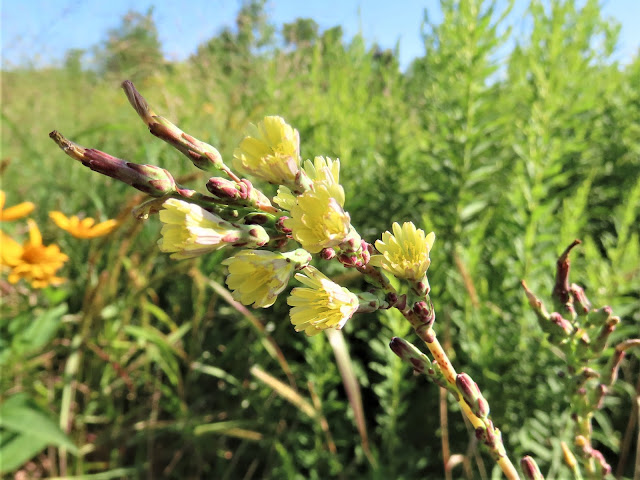
     Wild Lettuce (Lactuca canadensis) is sometimes referred to as Indian Lettuce, in reference to the fact that its leaves were boiled by First Nations people to make a kind of tea, albeit quite bitter.


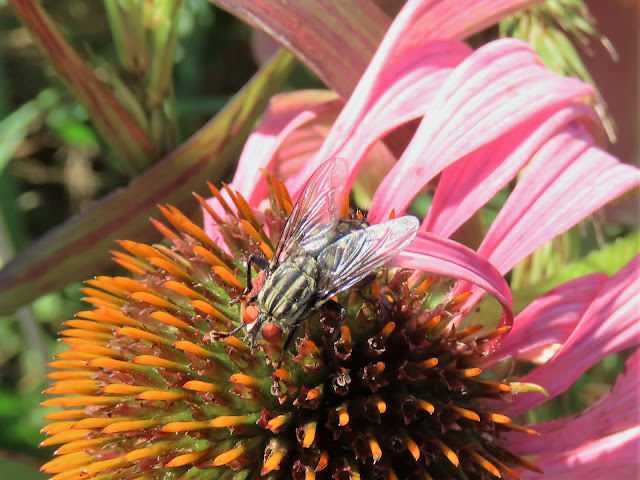
     Stable Fly (Stomoxys calcitrans) is an impressive insect. Don't get bitten by one, however - it hurts!


     Their preferred hosts are cattle and horses, but they display little hesitation in turning their unwelcome attention to dogs and humans.
     The following larva has eluded all my attempts to identify it.


     The fly below is found in the genus Poecilanthrax.


     Daisy-like Annual Fleabane (Erigeron annuus) was quite common throughout.


     This Western Honey Bee appears to have had a successful bout of foraging judging from the load in its pollen baskets.


     Canada Wild Rye (Elymus canadensis) is known to establish easily so it was no great surprise, yet no less of a pleasure to come across it, a recent component of the grassland.


     Various species of thistle (Genus Cirsium) are equally adept at propogating themselves, and though their seeds provide an important food source for birds such as American Goldfinch (Spinus tristis) they are aggressively invasive, and we may have to devise ways of removing them.


     A Black Blister Beetle (Epicauta pensylvanica) is known to favour yellow plants, as seen here.


     The web of Argiope spiders are wonders of architecture, and in the fall when early morning dew is a daily feature, meadows glisten with them.


     A Black Swallowtail (Papilio polyxenes) found foraging to its liking.....


     ..... as did a Northern Corn Rootworm (Diabrotica barberi).....


     ..... and a Clouded Sulphur (Colias philodice)


     Pinkweed (Persicaria pensylvanica) is an attractive plant and a target of pollinator insects.


     Unfortunately it has the potential to swamp entire areas, as has happened at the spot we refer to as Teen Hollow.


     We will have to put our heads together to see whether some form of remediation is possible.
     Common Eastern Bumblebees are nothing if not industrious.


     A hyper-abundance of Pinkweed is probably to their liking, if not to ours!
     It was difficult to slog through the Pinkweed down to the ponds which are reduced in size due to relentless summer heat, but a Twelve-spotted Skimmer (Libellula pulchella) justified the effort.


     A friendly Northern Leopard Frog (Lithobates pipiens) was unperturbed by our presence.


     Carolina Grasshopper (Dissosteira carolina) is numerous and the easiest  grasshopper to identify.


     We saw Common Ringlet (Coenonympha california) fluttering daintily above the grasses, alighting now and then.


     False Milkweed Bug (Lygaeus turcicus) is a very attractive little animal.


     Cabbage White was very common, and this male perched nicely for us.

 
     The sighting of a One-spotted Stink Bug (Euschistus variolarius) was a first - always exciting.


   Barn Swallows have had a successful year and many youngsters were waiting for long-suffering adults to come and feed them.


     Finally, I offer you a Tarnished Plant Bug (Lygus lineolaris), a serious pest of fruits such as strawberries, peaches and apricots. 


     We enjoyed discovering the bug, but we don't have to deal with its destructive consequences.
     It will be plain to all who read this account that our restored grassland, which just three summers ago hosted a soybean crop, has become a veritable centre of biodiversity.
     I am giddy just imagining what is still to come.  


Land Acknowledgement

We acknowledge that the land on which we are situated are the lands traditionally used by the Haudenosaunee, Anishinaabe, and Neutral People. We also acknowledge the enduring presence and deep traditional knowledge, laws, and philosophies of the Indigenous Peoples with whom we share this land today. We are all treaty people with a responsibility to honour all our relations.

Followers