Showing posts with label American Crow. Show all posts

Tuesday, November 26, 2024

Miriam's Crows

     Some of you may recall that I have blogged in the past about the American crows (Corvus brachyrynchos) that come to visit us. We feed them, having saved all manner of juicy morsels for them, and they have "made friends" with Miriam more than with me since she feeds them most frequently. Hence the name, Miriam's Crows.


     They generally appear less frequently in the spring and early summer when they are busy with the serious business of raising young, but reappear with their usual regularity when the young fledge, sometimes bringing the kids to visit.
     

     This year, however, for a couple of moths they abandoned us completely, and we are at a loss to explain why. They had reached the point where they showed no fear of us and knew that there would be food laid out.
     Over the past few weeks crows have returned, but we are not quite sure whether they are "our" crows. They are much more wary, feed cautiously and fly off at the slightest provocation.


     Traditionally, five crows came to visit a couple of times a day, but now only two, at times three, are seen in the yard. Are these new birds? What happened to the original five? It seems incomprehensible that all of them could have met a bad end somehow, but I can't think of another reason why they abandoned a guaranteed source of food, available without danger.


     We are delighted to enjoy the regular company of these handsome intelligent birds, and wish they could let us know what happened.


     We'll just continue to enjoy them, however; of that you may be sure.

Recommended reading list for Corvids (Crows, Ravens, Magpies and Jays)

The Magpies, T.R. Birkhead, T & A.D. Poyser Ltd (1991)
Ravens in Winter, Bernd Heinrich, Vintage Books (1991)
Mind of the Raven, Bernd Heinrich, HarperCollins (1999)
Crows and Jays, Steve Madge and Hilary Burn, Houghton Mifflin Company (1994)
In the Company of Crows and Ravens, John M. Marzluff and Tony Angell, Yale University (2005)
Gifts of the Crow, John Marzluff and Tony Angell, Atria Paperback, a Division of Simon and Schuster, Inc. (2012)
Crows, Candace Savage, Greystone Books (2005)
The Raven, Derek Ratcliffe, T & A.D. Poyser Ltd (1997)

Monday, April 03, 2023

Miriam's Crows

      "Pay attention, be astonished and tell about it."
Mary Oliver

     It has been a while since I have reported on the five American Crows (Corvus brachyrynchus) that regularly visit our backyard, and appear to be particularly bonded to Miriam. 
     Whenever she tosses out food for them, juicy bits of fat and other delectables, she calls to them and then talks to them while they descend on the yard and gather up the food. John Marzluff and Tony Angell in their wonderful book Gifts of the Crow, referring to a crow named Macaw that Tony had befriended, state, "When Macaw heard Tony greet him each day, that sound rippled from his ear up his eighth cranial nerve and into his forebrain, and eventually became a memory."


     I have no doubt that this is what has happened with "our" crows and that they not only recognize Miriam auditorily, but also visually, and they have concluded that she is their friend.
     When we first embarked on this adventure with these wary corvids, they would not come down in the yard if they could so much as see us through the window. Gradually they have overcome their inhibitions and we (but especially Miriam) have won their trust.


     When they arrive they call to her and wait patiently until she appears at the window and provides food. They seem genuinely delighted to see her and switch to a rattle call followed by soft, gurgly vocalization, quite distinct from the normal caws familiar to everyone. While much of this gentle sound is directed at each other, I have not the slightest doubt that some of it is meant for Miriam.


     It seems to have an overall calming effect and when the birds come to ground to get the food, they do not fight over it, and while a couple of individuals (dominant birds, I assume) seem to take more than others, they all gain a share of the feast.


     It is tempting to anthropomorphize about this situation, and I confess that the temptation is too great for me to resist. There has been a sea change in recent years about animals' emotions and their ability to experience joy and sorrow, mourning, play and other states formerly thought exclusively the preserve of humans. It is hard not to conclude that a specific connection has been established between Miriam and the birds, important to them in ways surpassing the provision of food.


     We have been enriched by the experience and look forward to meeting their children later in the year. We'll have food for them too.
     In the meantime, enjoy a few more pictures of these handsome friends.


     I hope you too will one day be able to forge a realtionship with crows. You will be thrilled at the extent to which it will enrich your life. 

Sunday, January 29, 2023

Winter at Home

     Winter has been real winter since our return from Ottawa, with lots of snow (I shovelled the sidewalk and my driveway four days in a row), so we have not been rambling too much. This post, therefore will consist of a few highlights from home, some dating back a couple of weeks before white became the dominant colour of the landscape.

09 January, 2023

     Hairy Woodpecker (Leucontopicus villosus) is not always easy to find so we consider ourselves especially fortunate that a male comes to our yard regularly to feed on suet packed with seed and nuts.


     Not only does it arrive with predictable frequency, it stays for as long as it takes to become satiated before flying off. A rare privilege, we think.

10 January, 2023

     An American Linden (Tilia americana) in front of our house had died and the municipality dispatched an army of chainsaw warriors to take it down. I was actually hoping that they would leave it for a while, since I think it was in no danger of imminently toppling, and the bark had separated so beautifully to provide nest space for a Brown Creeper (Certhia americana). Realistically, however, I knew that chances of that happening were slim to none.


     We were sitting in the house enjoying mid morning coffee when we finally clued in to what was happening. By then the mighty tree was an ignominious corpse, shattered and broken, lying on asphalt.


     It is incredible the size of branches they can feed into the maw of the wood chipper.


     We were very happy when finally the sylvan destroyers moved on and silence was restored.
     One day in spring, I am sure another crew will come along to plant a sapling in the linden's place. It had better be a native species or I will be having a chat with the city!

17 January, 2023

     We continue with our efforts to encourage American Crows (Corvus brachyrynchos) to become part of our circle of friends, although I suspect we have lost some of our gains by being away for four days.


    Today (29 January, as I type this), however, five individuals paid a visit and responded to Miriam's voice when she called them in, and fed on the scraps of fat and cheese we tossed out for them.


     They go to their familiar perches and permit us minutes on end to gaze upon their sleek and glossy beauty. You can barely imagine our excitement and sheer pleasure at sharing our world with these lordly birds.
    I made a peanut butter sandwich for them, cut it up and tossed it out, but wily squirrels beat them to the feast.


17 January, 2023

     While squirrels have the capacity at times to incite mental anguish in frustrated human feeders of birds, one is bound to admit that they are endearing and appealing.


     A Red-breasted Nuthatch (Sitta canadensis), on the other hand, elicits only whoops of joy.


28 January, 2023

     One can never have too many types of food on offer for our feathered friends, so I invested in some fat balls (grins and smirks permitted). 


     As you can see, they are a great success. It took a Downy Woodpecker (Dryobates pubescens) no time at all to find them.


     I expect that the next post will contain a little more variety, but I am hopeful that these few pictures will entertain you and keep you on tenterhooks waiting for more of the World of Wonders from Waterloo!

Iam linking to Wild Bird Wednesday

Thursday, August 19, 2021

At Home and a Morning at SpruceHaven

09 August 2021
Our backyard, Waterloo, ON

     Northern Cardinals (Cardinalis cardinalis) are daily visitors to our backyard, and this handsome male makes a statement!


     You could be forgiven for thinking that he looks a little grumpy, but a couple of minutes later he was singing his head off!     
     A male House Finch (Haemorhous mexicanus) is a smart looking bird too.


     A female Cabbage White (Pieris rapae) would find it hard to compete with the cardinal or the finch in the good-looks department, but she is a welcome visitor nonetheless.


     I have tried as best I can to identify this arachnid, without success. If you know what it is, feel free to leave a comment.


13 August 2021
Our backyard, Waterloo, ON

     Chipping Sparrow (Spizella passerina) is a frequent victim of cowbird parasitism and in years past we have seen these tiny birds feeding gargantuan cowbirds. This year, however, we have on several occasions observed adults feeding their own young, so perhaps they are developing effective strategies to combat the cowbird cheats.
     These two are gazing skyward for some reason.


     They did not appear alarmed and we saw no predator in the sky above them, so what they were looking at will forever remain a mystery.
     A third individual was perched nearby.


    The following American Robin (Turdus migratorius) is probably a female, based on the muted colouration.


     Females are generally duller overall with browner black on the head, but I have never found this to be entirely reliable, and somewhat subjective. For all practical purposes males and females look the same.
     An Eastern Carpenter Bee (Xylocopa virginica) was industrious - as bees are supposed to be.


     You may recall from my last post that a Northern Cardinal was seen feeding a fledgling Brown-headed Cowbird (Molothrush ater). Here we see a male cardinal with his own young.


     As is the case with human children, food is usually top of mind.


     Give me more!


     There seems to be every indication that he will grow up to be as handsome as his father.


14 August 2021
Berlett's Road, Wilmot Township, ON

     On the way to SpruceHaven we generally travel along Berlett's Road, which at times can be pleasingly birdy. 
     We often see Wild Turkeys (Melegris gallopavo) and this flock seems to have become particularly tame around one of the houses that borders on a forested area.


     I have no doubt that they had consumed all the seed that had spilled from one of the bird feeders and were relaxing in the warm sunshine of an August morning.


     We parked at the side of the road quite close to them and they seemed not the slightest bit perturbed.


     Wild Turkeys buck the trend of species in decline; they have done spectacularly well in recent years and are now a common sight.


     A little farther along four juvenile Eastern Bluebirds (Sialia sialis) were perched on a wire; three left as soon as we spotted them, but one remained behind for a picture.


     In wet areas near the ditches Spotted Jewelweed (Imaptiens capensis), so important for hummingbirds fuelling up for migration, lined the verges.


     Usually it is difficult to get anywhere close to American Crow (Corvus brachyrynchos), but on this occasion, using the car as a blind, Miriam managed some quite decent shots.


14 August 2021
SpruceHaven, St. Agatha, ON

     Wild Bergamot (Monarda fistulosa) is a wonderful native plant that attracts bees, hummingbirds and other pollinators. 


     I am always happy to see it and it is established in several locations at SpruceHaven.
      Common Eastern Bumblebees (Bombus impaties) could be found all over it.


     To identify grasshoppers down to the species level is a bit daunting for any but an entomologist specializing in the taxon. The best I can do with the following species is to assign it to the large genus melanoplus.


     The grasshoppers were so numerous that many exploded in front of us as we walked, conjuring images of plague numbers that must defy belief.
     Many species of Echinacea populate prairie ecosystems, both moist and dry, and it is very exciting to see the number of species that have taken root in our emergent temperate grassland biome.
     Purple Coneflower (Echinacea purpurea) is exceptionally striking to my eyes.


     Sow Thistle (Sonchus oleraceus) is not quite so entrancing.


     As already mentioned identifying grasshoppers as to species is not easy, and I am certainly reaching the boundaries of my knowledge when I attempt it, but it is challenge to try, and the process of learning is always enjoyable.
     There is more than one genus of Smooth-horned Grasshoppers; I am pretty sure this is one of them, but I am not sure which!


     Goldenrod Soldier Beetle (Chauliognathus pensylvanica) is obviously not restricted to goldenrods.


     Ambush bugs, in the subfamily Phymatinae are superbly camouflaged as they lie in wait for their prey. We spotted Pennsylvania Ambush Bug (Phymata pennsylvanica) several times.


     You will note by looking carefully there are two bugs here, in copula.


     Camouflage seems not to be a major concern in the ecstasy of the moment!
     Grey-headed Coneflower (Ratibida pinnata) is one of the prairie species that has become established in the grassland; wonderful to behold.


     Appropriately enough, one of its alternate common names is Prairie Coneflower.
     Many areas are awash with gold, with False Sunflower (Heliopsis helianthoides) nodding in gentle breezes or bending to the power of stronger winds.


     It is impossible not to be moved by the beauty of it all.....


     ..... and to wonder what it will all look like a few short years from now.


     A Great Spangled Fritillary (Speraria cybele) found everything to its liking.


     Common Eastern Bumblebee (Bombus impatiens) foraged at will.


     Western Honey Bee (Apis melifera) was no less dedicated in its quest for nectar and pollen.


     A male Indigo Bunting Passerina cyanea) was perched on top of a conifer across the road from SpruceHaven.


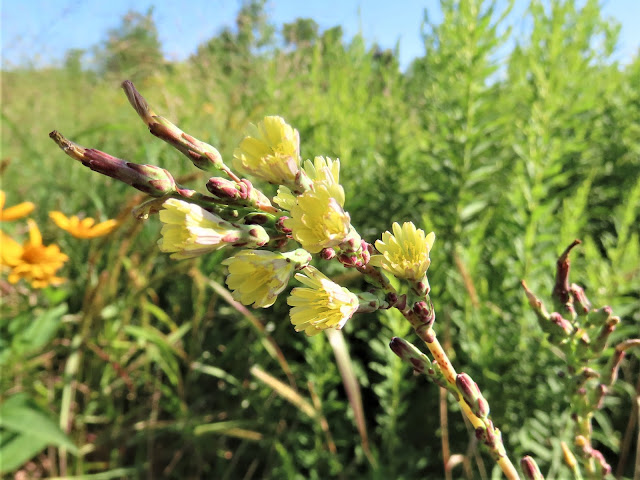
     Wild Lettuce (Lactuca canadensis) is sometimes referred to as Indian Lettuce, in reference to the fact that its leaves were boiled by First Nations people to make a kind of tea, albeit quite bitter.


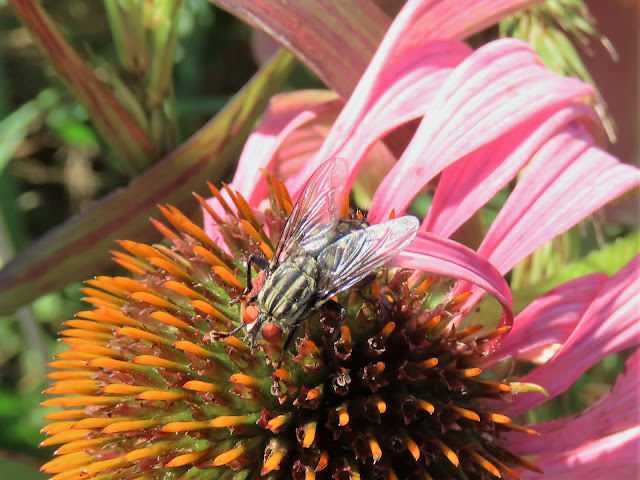
     Stable Fly (Stomoxys calcitrans) is an impressive insect. Don't get bitten by one, however - it hurts!


     Their preferred hosts are cattle and horses, but they display little hesitation in turning their unwelcome attention to dogs and humans.
     The following larva has eluded all my attempts to identify it.


     The fly below is found in the genus Poecilanthrax.


     Daisy-like Annual Fleabane (Erigeron annuus) was quite common throughout.


     This Western Honey Bee appears to have had a successful bout of foraging judging from the load in its pollen baskets.


     Canada Wild Rye (Elymus canadensis) is known to establish easily so it was no great surprise, yet no less of a pleasure to come across it, a recent component of the grassland.


     Various species of thistle (Genus Cirsium) are equally adept at propogating themselves, and though their seeds provide an important food source for birds such as American Goldfinch (Spinus tristis) they are aggressively invasive, and we may have to devise ways of removing them.


     A Black Blister Beetle (Epicauta pensylvanica) is known to favour yellow plants, as seen here.


     The web of Argiope spiders are wonders of architecture, and in the fall when early morning dew is a daily feature, meadows glisten with them.


     A Black Swallowtail (Papilio polyxenes) found foraging to its liking.....


     ..... as did a Northern Corn Rootworm (Diabrotica barberi).....


     ..... and a Clouded Sulphur (Colias philodice)


     Pinkweed (Persicaria pensylvanica) is an attractive plant and a target of pollinator insects.


     Unfortunately it has the potential to swamp entire areas, as has happened at the spot we refer to as Teen Hollow.


     We will have to put our heads together to see whether some form of remediation is possible.
     Common Eastern Bumblebees are nothing if not industrious.


     A hyper-abundance of Pinkweed is probably to their liking, if not to ours!
     It was difficult to slog through the Pinkweed down to the ponds which are reduced in size due to relentless summer heat, but a Twelve-spotted Skimmer (Libellula pulchella) justified the effort.


     A friendly Northern Leopard Frog (Lithobates pipiens) was unperturbed by our presence.


     Carolina Grasshopper (Dissosteira carolina) is numerous and the easiest  grasshopper to identify.


     We saw Common Ringlet (Coenonympha california) fluttering daintily above the grasses, alighting now and then.


     False Milkweed Bug (Lygaeus turcicus) is a very attractive little animal.


     Cabbage White was very common, and this male perched nicely for us.

 
     The sighting of a One-spotted Stink Bug (Euschistus variolarius) was a first - always exciting.


   Barn Swallows have had a successful year and many youngsters were waiting for long-suffering adults to come and feed them.


     Finally, I offer you a Tarnished Plant Bug (Lygus lineolaris), a serious pest of fruits such as strawberries, peaches and apricots. 


     We enjoyed discovering the bug, but we don't have to deal with its destructive consequences.
     It will be plain to all who read this account that our restored grassland, which just three summers ago hosted a soybean crop, has become a veritable centre of biodiversity.
     I am giddy just imagining what is still to come.  


Land Acknowledgement

We acknowledge that the land on which we are situated are the lands traditionally used by the Haudenosaunee, Anishinaabe, and Neutral People. We also acknowledge the enduring presence and deep traditional knowledge, laws, and philosophies of the Indigenous Peoples with whom we share this land today. We are all treaty people with a responsibility to honour all our relations.

Followers