Showing posts with label Mill Race Trail. Show all posts

Sunday, December 08, 2024

A Walk along the Mill Race

 25 November, 2024

     For one reason or another we had not seen Lisa for a while, so we were happy to get together for an afternoon stroll along the Mill Race.


     It was not long before Downy Woodpeckers (Dryobates pubescens) were seen climbing trunks and spiralling around branches. A female probed the base of a tree looking for food in every crevice.


          White-breasted Nuthatch (Sitta carolinensis) forms the second part of a trio of birds we often encounter together; we heard them - and voilĂ , there they were.


     Lisa spared no effort to lure them onto her hand.


     Often people walking along the trail bring food for the birds and it is not unusual to find a stump laden with seed. A female Northern Cardinal (Cardinalis cardinalis) took full advantage of the buffet.


     A male Downy Woodpecker displayed his vibrant red crown.


     Dark-eyed Juncos (Junco hyemalis) have been here for several weeks now, having arrived from their northerly breeding area, and they enlivened our walk in a very pleasing manner.


     This really was the day of the woodpecker. In the shot below you can see the nictitating membrane drawn across the eye to serve as protection against flying wood chips.


     Lisa and I were ready with food for any diner that deigned to visit.


     In no time at all we were surrounded by Black-capped Chickadees (Poecile atricapillus), the third member of the trio I mentioned earlier. Our patience was rewarded.


     This stump was favoured by several species; no doubt seed had lodged in every seam and crevice.


     White-breasted Nuthatch was almost as ubiquitous as Downy Woodpecker; they approached closely and you could be forgiven for concluding that they were talking to us.


     Jaunty chickadees were all around.


     As long as there is open water Mallards (Anas platyrynchos) are habitual residents. They too have become accustomed to humans delivering food and swam to us in anticipation of a snack. 


     Japanese Barberry (Berberis thunbergii) is an aggressive invasive plant and it would be better if it were not established, yet it is undeniably attractive.


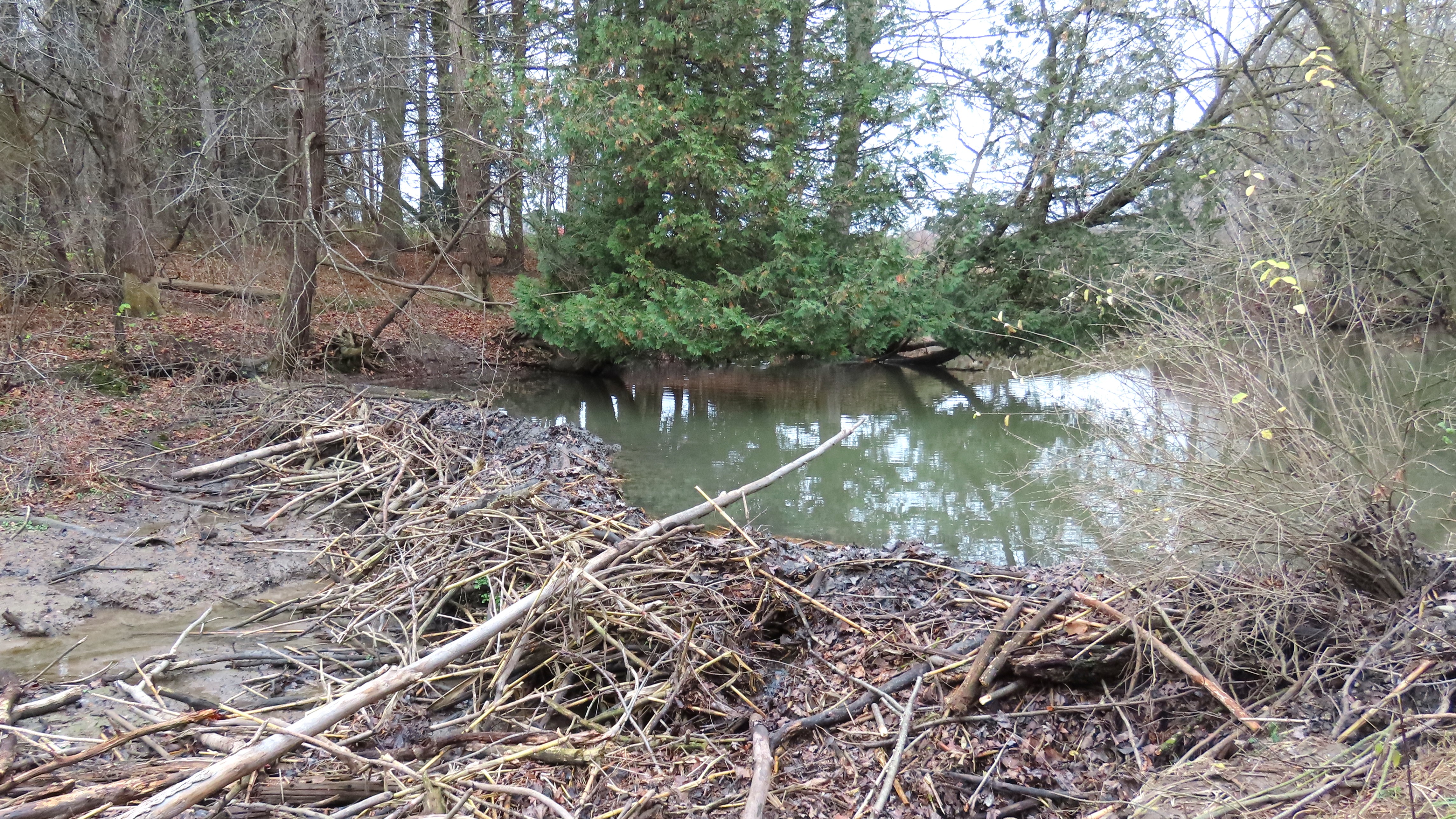
     The impressive beaver dam has so far remained intact. Perhaps the township has developed a more tolerant attitude towards wild nature. We can only hope!

     We came across a homeless man, straining to pull his worldy possessions behind him, making his way along the trail.


     It is a sad commentary on modern society that billions are invested in weapons designed to kill more efficiently, and in space exploration, bribes are offered to buy votes, thirty percent of the food we buy is wasted, yet we are unable (or unwilling) to find a solution to this terrible scourge that afflicts all advanced western democracies.
     This tree was afflicted by a form of blight, but what it precisely is I don't know.


     A Wooly Bear Caterpillar, the larva of Isabella Tiger Moth (Pyrrharctia isabella) was seeking a protected niche in which to spend the winter.


     I don't know how often I have made the observation that a drake Mallard is exceptionally handsome, lacking appreciation due to familiarity, yet it warrants a second look every time.


     Lichens, comprised of a mycobiont (fungal partner) and a photobiont (photosynthesizing partner) fascinate me. Recently I acquired an excellent field guide to the macrolichens of the Great Lakes Region, and I was happy to be able to identify Hooded Sunburst Lichen (Xanthomendoza fallax).


     Someone had made a bird feeder and installed it - and I assume is replenishing the seed. 


     These small acts of kindness, caring and generosity in a world where war, death, destruction and callous indifference are the staple fare of the daily news, are very welcome.
     At the end of our walk Miriam walked down to the river for a final picture, and discovered the bedding- down place of the homeless fellow.


     The river was tranquil. 


     We hoped that his night would be too.


Sunday, October 27, 2024

Waterloo Region Nature Outing to the Mill Race, St. Jacobs, ON

 26 October, 2024

Leader: David M. Gascoigne

Members: Miriam Bauman, Y-T Chen, Beverly Church, Bob Fraser, Brenda Gyorffy, Steve Gyorffy, Lorne Harding, Beth Hobson, Dale Ingrey, Nina Ingrey, Alice Lee, John Lee, Leon Linseman, Sandy Linseman, Curtiss MacDonald, Pam Sadler, Andrea Smith, Don Voisin

Guests: Mary Ann Cassidy, Dave McCaughan, Ruth McCaughan


     Following an extended period of unseasonably warm weather, we had a typical late October morning to enjoy a stroll along the Mill Race
     Lest it escape my attention later, let me thank Bob Fraser for picking up Mary Ann Cassidy. I appreciated his kindness very much, and I know she did too.


     Almost as soon as we set foot on the trail a Northern Cardinal (Cardinalis cardinalis) was chipping, and even though it remained close we did not see it.
     An Eastern Chipmunk (Tamias striatus) by contrast was anxious to let us know his whereabouts, in the hope of cadging a little food.


     Of all the rodents in the world this little creature must surely rank very highly on the cuteness index.
     Black-capped Chickadees (Poecile atricapillus) and White-breasted Nuthatch (Sitta carolinensis) were quick to visit. Unusually, it was a nuthatch who first descended to a friendly hand bearing food.


     They were calling to us constantly, in that wonderful nasal way they have - instantly recognizable and very appealing.
     Blue Jays (Cyanocitta cristata) were heard more than seen, and none came really close.


     It is a stunningly handsome bird, and even partly hidden is a show-stopper.
     Eastern Grey Squirrel (Sciurus carolinensis) was ubiquitous, as might be expected, and even though they can push our limits of tolerance when around bird feeders, they are in fact quite adorable, and a welcome part of the ecosystem.


     The melanistic phase, found only in the northern part of its range, is common here but extremely rare or not present farther south.


     Along certain sections of the trail the trees were filled with American Robins (Turdus migratorius). They were vocal, and gathered in feeding parties on invasive buckthorn berries.


     In years past it would have been a safe bet to conclude that we witnessed a migratory flock, fattening up for the journey ahead, but so many American Robins now overwinter with us that's no longer a certainty.
     Red-winged Blackbirds (Agelaius phoeniceus) were equally vocal and seemed to be travelling with the robins.


     A female Wood Duck (Aix sponsa) was the source of universal admiration.


     Bob harangued me to find him a male, but I was unable to oblige! Don't you know a good looking female is hard to beat, Bob?
     Muskrat (Ondatra zibethicus) seems to find the Mill Race exactly to its liking and we were delighted to see one.


     Nuthatches were first to feed from the hand, but Black-capped Chickadees wasted no time in catching up!


     Nuthatches were never far away, however.


     I am always happy to see the various components of a healthy woodland ecosystem fulfilling their roles as nature intended. Decay and decomposition are essential.


       An Asian Lady Beetle (Harmonia axyridis) was doubtless seeking a sheltered spot to spend the winter.    


     This invasive insect has adapted so well to our environment that it is the most common lady beetle in Ontario. It is rapidly displacing native species.
     Human folly is on display once again.
     Beavers have been dining on corn dragged in from adjacent fields, and Mallards (Anas paltyrynchos) are no doubt greatly appreciative of the smorgasbord delivered to them.


     Beavers are not referred to as nature's engineers for nothing, and their dam is impressive.


     Nature's jewelry is nowhere more apparent than raindrops on fallen leaves.


     Is it not gorgeous?
     

     Winged Euonymus or Burning Bush (Euonymus alatus) is yet another invasive species, originally native to N. China, Japan and Korea. 


     A Great Blue Heron (Ardea herodias) was having great success securing mid morning snacks along the Conestogo River - all of the fishy variety!


     Isn't fall grand?


     One of the great attractions of a walk along the Mill Race is to drop into the Eco CafĂ© at the half way point, for coffee, scones, muffins - whatever takes your fancy - and warm, clean washrooms.


     Looks like they are ready for Halloween.


     I learned that this was Andrea's last outing with us, as she prepares to move to St. Thomas. We will miss her and hope that our paths may cross again.
     As always, I am very grateful to all who came out to enjoy this outing and bestow upon me the pleasure of their company. 
     You may rest assured we'll do it again soon. In the meantime, please take care of Nature. 

Land Acknowledgement

We acknowledge that the land on which we are situated are the lands traditionally used by the Haudenosaunee, Anishinaabe, and Neutral People. We also acknowledge the enduring presence and deep traditional knowledge, laws, and philosophies of the Indigenous Peoples with whom we share this land today. We are all treaty people with a responsibility to honour all our relations.

Followers