Showing posts with label Sandhill Crane. Show all posts

Wednesday, January 12, 2022

Waterloo Region Nature Outing to Long Point, Norfolk County, ON

      It is getting hard to remember a time when COVID didn't affect almost every decision we make. In the wake of the rapid spread of the Omicron variant new provincial restrictions on assembly have been imposed on a weary populace, and there is now a limit of ten people on an outdoor gathering.
     At the last moment one participant's family contracted COVID and another had difficulty getting a caregiver for a younger family member, so we were eight that made a visit to the the Long Point area, along the northern shore of lake Erie.
     It was a cold day, but suitably dressed, we sallied forth in high spirits and with great expectations. 


     Once again, we proved the point that you can clothe yourself properly and deal with cold, yet oppressive heat is impossible to escape, especially when accompanied by high humidity.
     And by midday the temperature soared to a heady minus 9.5 degrees! No one had to worry about the mayo on a sandwich curdling in the hot sun!
     
Leader: David M. Gascoigne

Members: Miriam Bauman, Lisa Den Besten, Tina Den Besten, Bob Fraser, Angie Koch, Wendy Shaw, Zach Summerhayes.

Angie, Bob, David, Tina, Lisa, Wendy, Zach

Friday, December 17, 2021

Odds and Ends

      Winter has been a strange affair so far, with snow and relatively cold temperatures one day, followed by above freezing conditions day after day thereafter, with precipitation in the form of rain. The regular species  have been active at the feeders, including a very welcome Red-bellied Woodpecker (Melanerpes carolinus). 


     More often than not a male has graced us with his presence, so we were especially happy to see this female.

Tuesday, May 18, 2021

Staying Local is Not So Bad After All

      We continue to explore the riches of our local area, bound as we are by COVID restrictions, but life is far from dull.

10 May 2021
Waterloo, ON

     At least some of you will recall that I told of a Canada Goose (Branta canadensis) that made its nest in a busy commercial plaza.
     I am happy to report that the outcome was successful.


     People had obviously warmed to this goose and some well-intentioned person left a tray of fresh vegetables, keen to ensure the goose ate a balanced diet, I suppose!


     One gosling did not even make it out of the nest, but death in young birds is a reality and if the others made it to safety this family did well.


Martin Creek Road, Woolwich Township, Waterloo, ON

     I have never quite understood how the Common Dandelion (Taraxacum officinale) became so universally despised. The flower is beautiful, requires no care, and the leaves make a tasty salad.
     Perhaps the next time you are ready to foam at the mouth over dandelions, keep the following image in mind.


     It is nature's beauty writ large.

St. Jacobs, ON

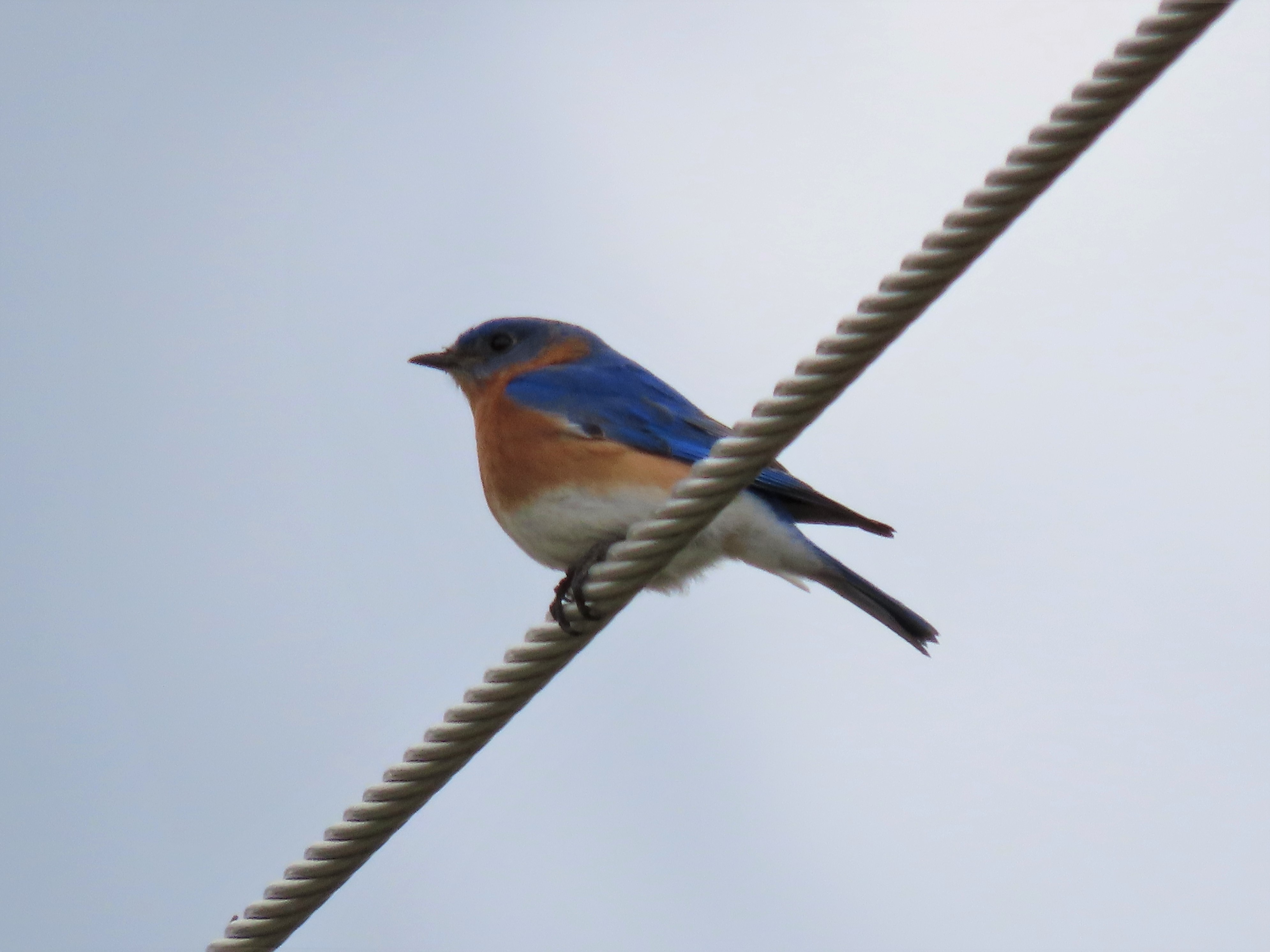
     A male Eastern Bluebird (Sialia sialis) waited for us in the graveyard of a church where we often see this species.


     We noticed a Red-tailed Hawk (Buteo jamaicensis) foolishly (or so it seemed to us), tangling with a couple of Bald Eagles (Haliaeetus leucocephalus).


     It was impossible to get all three birds in the same frame, but here are the two eagles.


     The red-tail had a couple of gaps in its primary feathers so its maneuverability was compromised perhaps, and wisely it broke away from the tussle.
     
14 May 2021
The Mill Race Trail, St. Jacobs, ON

     I was attempting to calculate how many times we have walked this trail and I came up with an estimate in the order of four hundred times. But it still holds secrets that we have not uncovered, and we stand little chance of knowing more than a small fraction of the wonders of nature occurring there in every season. 
     It remains one of our favourite spots.


     A Downy Woodpecker (Dryobates pubescens) is predictable and it is rare that we do not see at least one individual and most frequently several. This male is probing for insects and their larvae in the dead wood and hollows of this rotting trunk.


     It was Miriam who first spotted a large concentration of what we initially assumed were Water Striders (Gerridae) but a closer examination revealed a mass of Whirligig Beetles (Gyrinidae), in the genus Dineutus if I am not mistaken.


     Whirligig Beetles are interesting from many angles, not the least of which is that their swimming legs have been modified into unidirectional paddles. These beetles are actually in the water, not on it.


     We were excited to find them.
     Three male Brown-headed Cowbirds (Molothrus ater) were perched high above us. 


     Not for them the rigours of parenting. Their sole purpose in life is to provide sperm for the female; once that deed is done, the warm, balmy breezes of summer are to be enjoyed. One might be inclined to recall George Gershwin's immortal words, "Summertime and the livin is easy"!
     A female Red-winged Blackbird (Agelaius phoeniceus) will never rival the male for ostentation, but she is certainly lovely.


     I am quite sure that you will agree.


      Baltimore Oriole (Icterus galbula) surely ranks as of one of nature's great troubadours, clad in finery to match his golden voice.


     It is a not uncommon bird in spring and summer, but it is a joyous event whenever one is seen.


     And it could sing to me without end and I would still find it enjoyable.


     Two-leaved Toothwort (Cardamine diphylla) has attracted its share of insects.


     A species of maple (Acer) is about to burst into full leaf, but at this stage I am not sure of the species.


     Mourning Cloak (Nymphalis antiopa) can still be found fluttering through the woodlands, often alighting with wings outspread.


     Eastern Comma (Polygonia comma) was equally cooperative.


     We saw a couple of Palm Warblers (Setophaga palmarum), but never in the open, and difficult to photograph.


15 May 2021
Grass Lake and Area, Cambridge, ON

     Much of the wetland component of the area known as Grass Lake, ancestrally known as the Paris Cranberry Bog, has been invaded by Common Reed Grass (Phragmites australis) and is unfortunately slowly filling in. 


     Nonetheless, it remains a spot to see species not easily viewed elsewhere in the region.
     Savannah Sparrow (Passerculus sandwichensis) is guaranteed to be there, with males seeking fenceposts and bushes as vantage points to sing in proclamation of territory, and to lure females to join in a tryst to assure the survival of the species.


     Bobolink (Dolichonyx oryzivorus) is a classic grassland species, and the expanse of uncut meadow provides perfect habitat for this visitor from the pampas of South America.


     Horned Lark (Eremophila alpestris) is an easy species to find in winter, but far more difficult once breeding is initiated. It is a safe bet that this individual gathering grit from the road, is a member of a breeding pair.


     Tree Swallows (Tachycineta bicolor) still nest in natural cavities when they can find them, but most breeding now takes places in nest boxes provided by humans.


     Skunk Cabbage (Symplocarpus foetidus) is an interesting plant, thriving in cold, wet meadows and swamps.


     Heat generated by Skunk Cabbage can melt  surrounding snow and may help to release the foul smell of decaying flesh that helps it to attract pollinators.


     If you would like some to plant in a wet spot in your garden, be sure to let me know and I will ship it immediately!
     Trumpeter Swans (Cygnus buccinator) are  majestic  birds, and have been reintroduced to Ontario, (with great difficulty I might add), having been extirpated many years ago. And their population is expanding.
     Last year we found a pair nesting locally and were ecstatic to find them in the same spot again this year.


     Pure euphoria overcame us when we saw them.


     Yet it was about to get better.
     Miriam was busy photographing the swans, having scampered across a busy road I might add, when I saw a pair of Sandhill Cranes (Antigone canadensis) with a chick, on the far shore of the wetland.


     It's hard to jump for joy strapped into a car seat at the side of a busy road, but mentally that's what I was doing.


     It was so encouraging to see this, to say nothing of inspirational, and gob-smackingly entrancing.


     The combination of the swan sitting on eggs, with a pair of Sandhill Cranes with a young baby, is probably going to remain the highlight of the year.


      It's hard to beat exultation like this. To hell with COVID, I say. Pandemic or not, scenes such as this are eternal.
     There is more, but I think we will save that for the next post. Until then stay safe, and be thankful for nature in your life. Nothing beats it!

Sunday, March 14, 2021

A Squirrel, Snow, Swans, Sandhills - and Lily.

      We are still not into full mobility and sociability levels due to COVID restrictions, so this post is an amalgam of odds and ends over the past week or so.

06 March 2021

     During the depths of winter, water left in the bird bath froze, and it was my practice to scatter a little cracked corn on it, so that the birds could get to it but it was out of reach of the rabbits that invade our yard nightly and hoover up everything on the ground.
     During a recent period of thaw, a circle of ice was floating in water and I pushed it off so that the birds could drink. Corn was embedded in the ice, and an enterprising squirrel was quick to discover it.


     Food in its own personal fridge!


     The upright model too.


07 March 2021

     We went for a short drive through the countryside looking for signs of spring, but these Mennonite ladies trudging through snowy fields reminded us that winter is not quite done with us yet.


     Red-tailed Hawks (Buteo jamaicensis) are paired off now and anticipating the breeding season ahead.


     Horned Larks (Eremophila alpestris) are also getting ready for nuptial arrangements and the challenging task of raising young.


09 March 2021
A Visit to Long Point, ON

     This was a day marked by excellent birding, with no less than thirteen new species for the year, but photographic opportunities were generally absent. Most of the waterfowl was far out; we had wonderful views through our scope, but the distance to the birds precluded picture-taking.
     On the way down to Long Point, near Walsingham, ON, we came upon a small group of Eastern Bluebirds (Sialia sialis), freshly returned from the south no doubt, and ready to begin work on the next generation. Several nesting boxes were waiting for them, doubtless cleaned out and ready for occupancy - no deposit required and residency is rent-free!


     Red-tailed Hawk was ubiquitous, as expected, but their familiarity makes them no less desirable.


     When we arrived at Port Rowan, there was open water offshore, but the shoreline was still locked in ice.


     There were so many Redheads (Ayhtya americana) that any attempt at a count ended in mere conjecture, but certainly there were thousands.


     A male House Sparrow (Passer domesticus) announced to others of his kind that he had already claimed this nest box.


     It was nothing short of uplifting to see a Song Sparrow (Melospiza melodia) putting his all into defending a territory and inveigling a female to join him there.


     Bird Studies Canada has been renamed simply Birds Canada, but its headquarters remain a beacon of inspiration for all who care for birds.


     Many Sandhill Cranes (Antigone canadensis) were migrating high over our heads, their haunting, spine-tingling call saturating the morning air, but we found only two individuals on the ground, well beyond photographic range unfortunately.


     The same situation was replicated with Tundra Swans (Cygnus columbianus); hundreds passed over us and landed on the bay, some as far as a kilometre away.


     The inability to take pictures did not detract one iota from the magnificent experience of witnessing  these birds "coming home." The serene beauty of flights of swans and cranes never fails to register awe, no matter how many times one has viewed the spectacle of migration.
     A Common Starling (Sturnus vulgaris) showed that it is also ready for spring and affairs of the heart!


     Turkey Vulture (Cathartes aura) is a species that seems to return to Ontario earlier each year; in fact a few have even been recorded on Christmas Bird Counts, indicating that small numbers may remain here throughout the winter.
     It is a bird that one sees most frequently in the air, circling in search of carrion, so an individual obligingly perched is a bonus.


     Turkey Vultures roost in trees overnight and are equipped with the conventional anisodactyl foot configuration of perching birds (three toes forward, one back).


     It has been said that beauty is in the eye of the beholder, and I will leave it your judgement whether this bird is beautiful.


     Once airborne it is a study in grace and symmetry; here it flexes its wings in preparation for launch!


     By now, I am quite certain, you have decided that it is indeed beautiful, so I will let a few extra portraits speak for themselves.


     You have Miriam's permission to enlarge and frame any of these images for placement at your dining room table. Be sure to send pictures.
     Just before stopping for lunch a few Tundra Swans were close enough to get at least an acceptable shot.


     Eastern Chipmunks (Tamias striatus) have emerged from hibernation and were busily scurrying hither and yon, chattering noisily to all who cared to listen, and even those who didn't.


     American Tree Sparrows (Spizelloides arborea) have kept us company all winter, and will soon be departing for their breeding grounds amid the dwarf birches and willows of the Arctic tundra.


     On our way along the causeway as we made our way home, we stopped at a couple of vantage points to scan the water, and discovered huge rafts of Canvasbacks (Aythya valisineria).


     Following a tranquil winter, undisturbed by mobs of summer vacationers and day trippers, Long Point is slowly awakening from its winter repose.


     No doubt business owners are hoping that they will be able to open up and make a little money following the pecuniary evisceration brought about by COVID lockdowns.


     We wish them well, but to tell the truth, the lack of crowds has been wonderful. I am quite certain that the birds agree.

Lily

     This precious little girl gets livelier, more aware, and without a doubt more beautiful each day. No further words are needed; feel free to make your own captions!


     "See you all again soon," says Lily.

Land Acknowledgement

We acknowledge that the land on which we are situated are the lands traditionally used by the Haudenosaunee, Anishinaabe, and Neutral People. We also acknowledge the enduring presence and deep traditional knowledge, laws, and philosophies of the Indigenous Peoples with whom we share this land today. We are all treaty people with a responsibility to honour all our relations.

Followers