Tuesday, August 21, 2018

Special Visitors to SpruceHaven

19 August 2018

     Regular readers of my blog will know that I do a weekly avian survey, spring and fall, at the University of Waterloo, for Professor Michael Drescher. In fact, I am now into my fourth year of this work.
     As we have chatted over the time I have been associated with Michael he has shared tidbits about his family, with an overwhelming sense of pride in his children, about whom he speaks in the doting tones one would expect from a dedicated father.
     Michael had told me earlier this spring that he was looking forward to a visit from his mother who lives in Germany and his sister from Australia. We both agreed that a visit to our banding operation at SpruceHaven would be interesting for everyone.
     Thus it was with great pleasure that we welcomed Michael and his family to SpruceHaven on Sunday morning.


     Going from left to right in the above picture are Andrea, (Michael's sister), Pippa, Michael, Allie, Anna and Marlies, (Michael's mother). In the foreground are Ross Dickson and Heather Polan, members of our crew.
     There was not a whole lot of activity at the nets, but the enthusiasm of our guests was not diminished and even though I had forgotten to advise them to wear rubber boots, they had no hesitation in risking wet feet to tour the nets with us.


     As you can see Pippa was entrusted with the important task of carrying one of the birds back to our banding table, and she performed like a true professional. She was very careful not to swing the bag at all and delivered her precious charge in a tranquil state. I think we have an ornithologist in the making!
     Heather, as always, was engaging and involved everyone in what she was doing, young and old alike. Ross, ever the teacher, described every organism we encountered!


     You can see the fascination on the faces of Pippa and Allie as Heather shows them the finer points of a hatch-year Northern Cardinal (Cardinalis cardinalis).
     Adults peered in too, all witnessing bird banding for the first time.


     All of the members of the Drescher family were the stars of the day, with Pippa and Allie attaining superstar status. But in the interests of illustrating why we get up long before the sun rises in the sky, here are a few pictures of some of the birds we banded.

Tennessee Warbler (Leiothlypis peregrina)


House Wren (Troglodytes aedon)
Chestnut-sided Warbler (Setophaga pensylvanica)
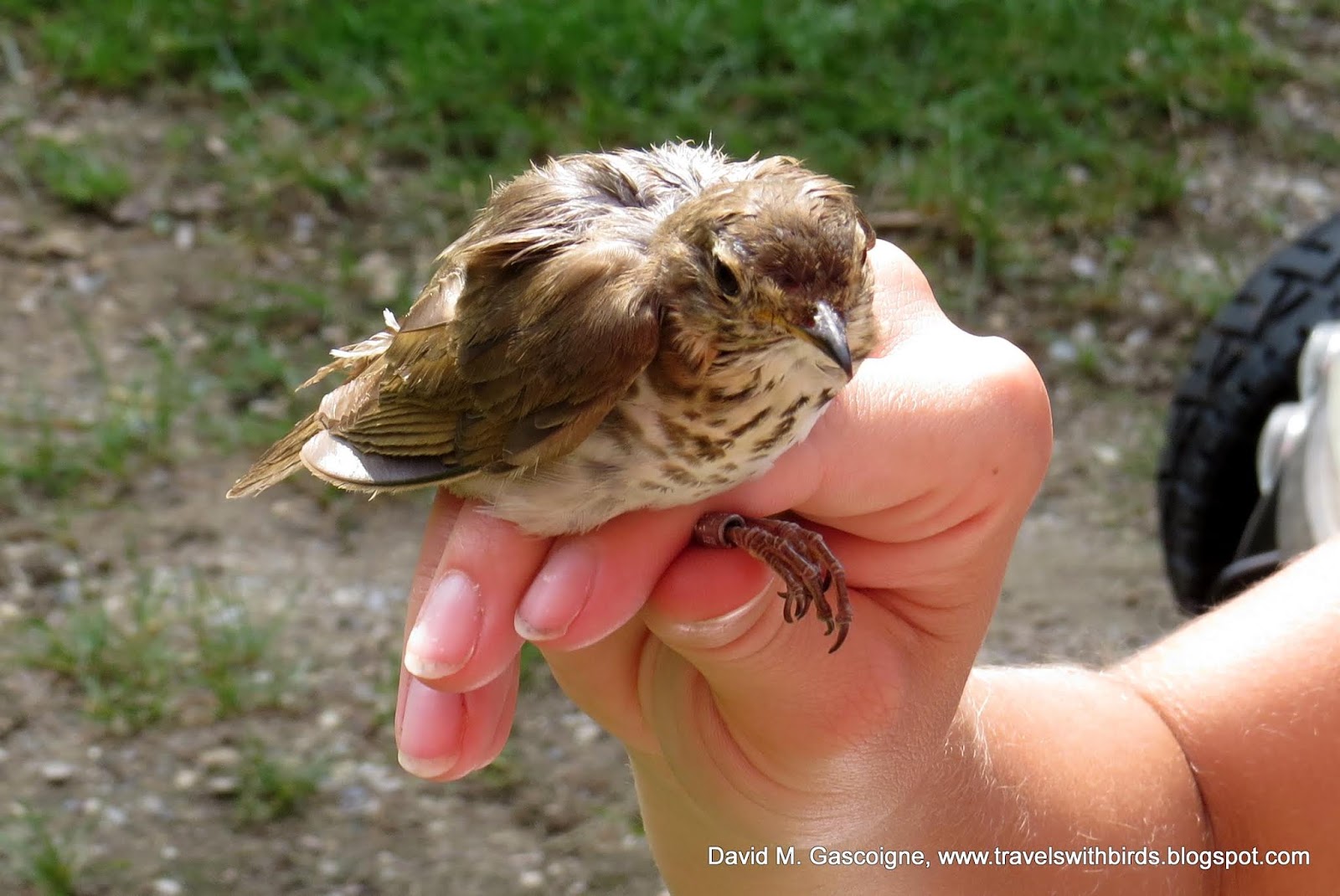
Swainson's Thrush (Catharus ustulatus)
 
     It was also interesting to be able to show our guests the caterpillar of a Milkweed Tussock Moth (Euchaetes egle), bristly and threatening like a creature from the underworld.


     This large moth was on the silo and we believe it to be a Bride Underwing (Catocala neogama), sometime referred to as simply The Bride, but we are awaiting confirmation on this identification - not always easy with moths!


     Michael and Anna, Pippa and Allie, Marlies and Andrea, what a pleasure it was to have you visit. Please come back any time. The welcome mat at SpruceHaven will always be spread out for you.

All birds banded 19 August: House Wren (2), Grey Catbird (1 new, 1 retrap), Swainson's Thrush (1), Americn Goldfinch (1), Tennessee Warbler (1), Common Yellowthroat (1 new, 1 retrap), Chestnut-sided Warbler (1), Song Sparrow (2), Northern Cardinal (1).  Total: 13 birds of 9 species.

Saturday, August 18, 2018

Northern Gannet (Fou de bassan) Colony on Île Bonaventure, Québec

     We returned last night from a short trip to Québec (justifiably called La Belle Province) where our main quest was to witness the grand spectacle of the colony of Northern Gannets (Morus bassanus) located on ÃŽle Bonaventure just offshore from the easternmost regions of La Gaspésie.


     This bird, surely one of the marquee species of all seabirds, is nothing short of magnificent, and the colony one of nature's awe-inspiring events. The sights, sounds, and yes the smell, are unforgettable. For a bird lover this is an exercise in sensory overload!
     Miriam and I were joined on our trip by Franc, Carol and Judy, and as usual we are counting on Franc for the best selection of pictures, and doubtless Miriam will have many fine images too; in the meantime I hope you will enjoy a few from my less than perfect results. A full report of this trip will be posted within a few days.
     The range of behaviours displayed by Northern Gannets is quite remarkable; from vicious attacks on intruders, to tenderness between pairs. This couple solicitously preened each other with loving care. It is not hard to anthropomorphize about these birds.


     This youngster was alone in a grassy area, perhaps having strayed from its nest. It is certainly not a good idea to roam in so dense a colony, rendering it difficult for devoted parents to locate their young when returning with food.


     In the same manner that adult birds engage in allopreening, great attention is also paid to the young. Whether this is a comfort mechanism or a sanitation practice I am not sure.


     Birds are very densely packed together but as long as each pair keeps to its own small space tranquility reigns.  Any bird straying into the territory of another risks prolonged and serious attack from its owners. 
     This individual has decided that a log is a fine place to perch.


     Conditions in such a crowded colony must at times be difficult and an individual here has somehow collided with a branch, or has in other fashion become entrapped, hanging there in mute reminder that life is sometimes brutish and short.


     As soon as one lifted one's eyes from the immediate concentration of birds practically at one's feet, the size of the colony was once again revealed.


      Headland after headland contained countless thousands of birds from mature adults to recently hatched chicks, and everything in between. In fact one bird was still sitting on an egg. In the picture below you can see a bird on a nest to the right of the bird with its head pointed skyward.


     Below, if you looks carefully, you can actually see the egg, as the sitting adult raised up to turn it.


     This pair seemed bonded by ties as strong as any human attachment.


     Whenever I decided that I had taken enough pictures I set about taking a few more!  Who can resist?


     I do not have a great deal of experience with Northern Gannets, but I am fairly sure this is a third year bird, with strongly marked upper wings and a yellow suffusion starting to appear on the nape.


     Franc, our consummate photographer, will have many fine shots of birds plunge diving into the water, and flying in formation across the waves, taken from the boat as we crossed from the mainland to the island, and I will look forward to sharing those with you, in addition to many other details about our trip.
     Ã€ bientôt!

Sunday, August 05, 2018

Radio Tagging Barn Swallows (Hirondelles rustiques) at SpruceHaven and Blaze Farm

31 July 2018

     The highlight of our Barn Swallow (Hirundo rustica) year is when we get to attach radio tags to some of our birds so that we are able track them when they leave the barns where they have spent the summer and follow them as they move around. In this way we can learn about foraging practices, the area of dispersal within the province and the migratory path of the swallows into Central and South America, where they will spend the austral summer.
     As always, we are deeply indebted to Dave Westfall, for facilitating this operation; indeed for all he does in the service of conservation and wildlife protection. It is an ongoing pleasure to be associated with Dave, and his sister, Sandy, and brother-in-law, Jamie, who provide support and encouragement in so many ways.
     Heather, dedicated as always, had taken a day off work to help us, and we were very happy to see her arrive.


     This baby Barn Swallow, still in the nest (but about to leave), looked down on the activity below with less than keen interest.


     Greg Mitchell, Research Scientist, Environment and Climate Change Canada, came to SpruceHaven for the second year in a row to attach the tags, and it was a distinct pleasure to see him again. I know that Dave, Heather and I all looked forward to his arrival. 
     This year we had the added delight of having Mike Cadman, Songbird Biologist, Canadian Wildlife Service, come along to help. Mike is principally known for his work on the last two Ontario Breeding Bird Atlases and has a long and fruitful relationship with the Ontario ornithological community. 
     Our conversations that day were all about birds in one way or another, with discussions of latest research trends, Greg's work with Song Sparrows (Melospiza melodia), and other avian topics. I can't think of a better way to spend the day!
     Before the tags can be attached the birds obviously have to be caught. Here is Greg, ably assisted by Judy Wyatt, setting up a mist net in the barn at SpruceHaven.


     We were tagging twenty birds in total, ten at each farm, and it did not take long to trap the birds at SpruceHaven. 
     Greg quickly got busy in order to process the birds as speedily as possible while Heather recorded all the pertinent data.


    Greg had carefully checked his equipment and activated the tags.


     In addition to attaching the radio tags, any bird not already banded is fitted with a standard leg band. Greg has a bird in the hand ready to be processed.


     Among other measurements we check for fat.


     We measure the tail length (instructive in determining sex).


     Each bird is weighed.


     And, with delicacy, finesse and precision, Greg quickly attaches the radio tag.


     The bird is now ready to venture forth and provide us with all manner of information that should help us to protect the species.


     Judy had brought her friend, Janet Bryson, to observe our operation and Greg entrusted her with the release of one of the birds.


     Never having had this kind of contact with a wild creature, Janet was thrilled to be afforded the opportunity.
     Even more thrilled perhaps was Janet's grandson, Aidan, visiting from Vancouver, who was keen to observe, help and learn.


     This fine young man had an experience that he will not soon forget and one that was doubtless not enjoyed by any of his friends and classmates. He will have bragging rights about summer activity when he gets back home.
     Heather and I had a couple of nests to band and we squeezed these in when our activity did not interfere with Greg's.


     At the Blaze Farm the whole process was repeated, but first of all we had to make sure that the two horses stayed outside the barn for about fifteen minutes so that they did not walk into our net and destroy it.


     I think that they were mildly indignant that they were not permitted to come inside and receive their due share of affection and attention!
     As anyone can plainly see Mike was holding up his end!


     Heather was kept busy extracting swallows from the net, a task that she performs with admirable skill and speed.


     Aidan was anxious to help and not just be a supernumerary and he took the bagged birds back to Greg and Mike for processing.


     At the end of it all Greg commented to Mike that he was very happy with the entire operation and the speed with which everything had been accomplished. Heather and I have proprietary feelings about these swallows and it gave us a great sense of satisfaction to see this operation completed.
     We were a happy quartet!


Greg, Mike, David, Heather

     Same time next year everyone!

Note of appreciation: As she so often does, Miriam took all the photographs when I am occupied with other things and unable to do it (and she does a better job anyway). Without her efforts we would not have this fine photographic record of the day. Thank you Miriam!

Friday, August 03, 2018

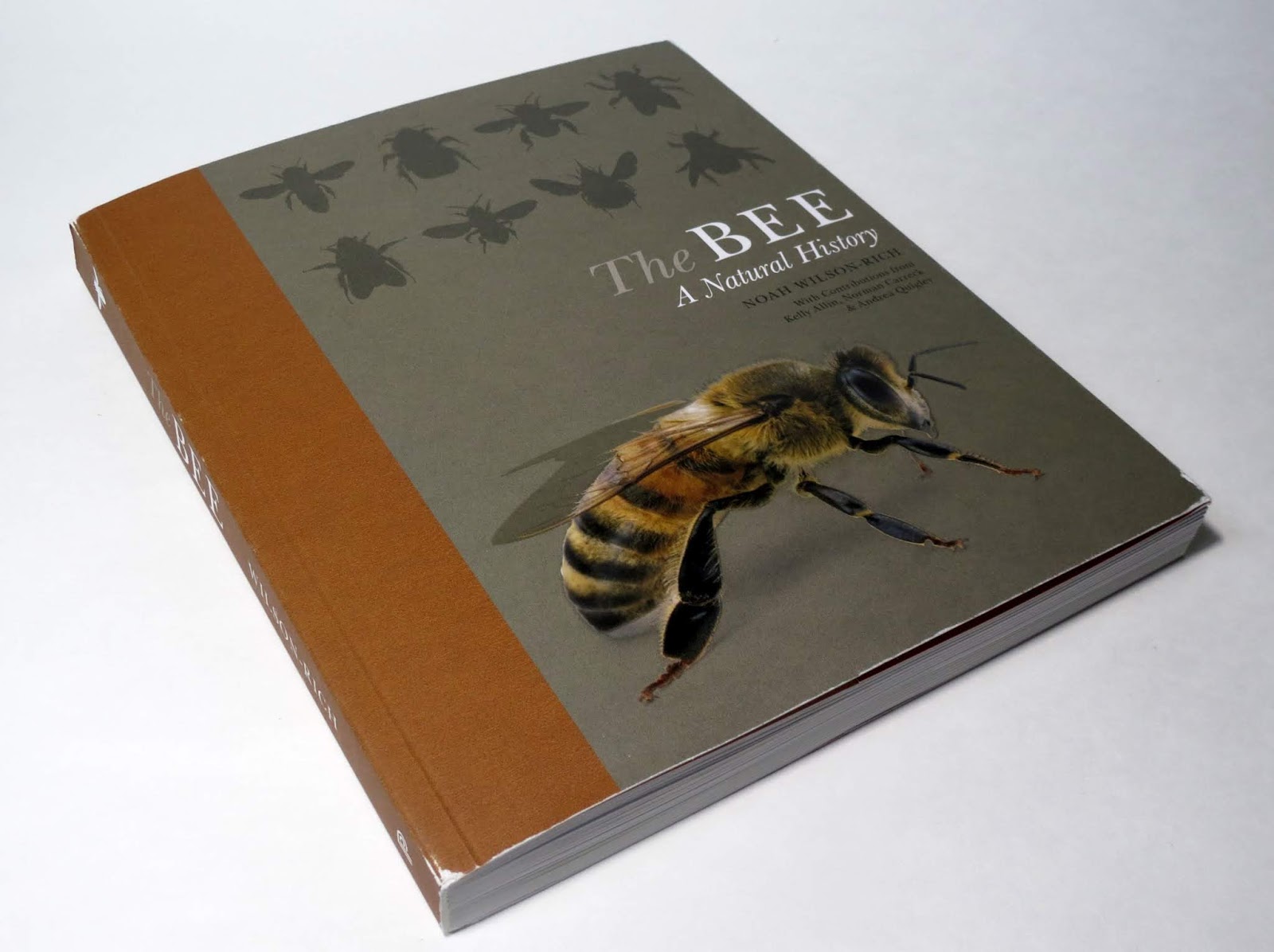
Book Review - The Bee - A Natural History, Princeton University Press

     As a lifelong birder I never gave bees much thought beyond the fact that they were an important food source for Bee-eaters (family Meopidae) and that their honey led to the fascinating behaviour of Honeyguides (family Indicatoridae). 
     All of that changed with the introduction of neonicotinoid pesticides and the catastrophic declines in bees and other pollinators, all absolutely vital to a healthy and productive ecosystem, not only for animals but critical for humans too. Many food crops require pollination and in parts of China bee populations have plummeted so drastically that farmers are already pollinating by hand. It is hard to believe that we could have come to this. Human stupidity knows no bounds.
     The introduction of this fine work by Noah Wilson-Rich is timely indeed.


     It covers every aspect of the life of the bee and provides a comprehensive understanding of bee ecology from start to finish. Witness the chapter titles:


Chapter 1 Evolution and Development 
Chapter 2 Anatomy and Biology
Chapter 3 Society and Behaviour
Chapter 4 Bees and Humans
Chapter 5 Beekeeping
Chapter 6 A Directory of Bees
Chapter 7 The Challenges Faced by Bees

     The chapters are followed by a lengthy bibliography for those wishing to research the subject further - count me among them!
     Each chapter is broken down into subsets with discussions of various facets of the main topic of the chapter. The book is superlatively illustrated throughout.


     Furthermore, it is written in easily understood prose. One does not need training in biology to derive full value from the text; the end of one chapter leaves one anxious to get on to the next.


     I suspect that many people are unaware of the incredible diversity of bees, familiar only with a local hive or the friendly bumblebee in their garden. There is a staggering array of species with different habitat requirements and life styles. Contrary to common misconception most species do not sting, and there is little to fear from bees.


     Upon completion of the book one is left with the feeling that we can all do more to protect these vital insects, often with little effort or expense. Moreover, we can become politically active in letting our politicians know that we want noxious, insidious and dangerous chemicals banned. It is instructive to remember the noble fight waged by Rachel Carson against DDT. No just cause is championed without commitment, no victory is won without sacrifice.
    I wholeheartedly recommend this book to all who are concerned with what the future holds for our children. Share its content with your friends and family; become an advocate for pollinators everywhere.

The Bee: A Natural History
Noah Wilson-Rich
Paperback?$17.95/224 pages/7 1/4 x 9 1/4
Publication date: 24 July 2018
      

Land Acknowledgement

We acknowledge that the land on which we are situated are the lands traditionally used by the Haudenosaunee, Anishinaabe, and Neutral People. We also acknowledge the enduring presence and deep traditional knowledge, laws, and philosophies of the Indigenous Peoples with whom we share this land today. We are all treaty people with a responsibility to honour all our relations.

Followers