Showing posts with label Bees. Show all posts

Thursday, June 01, 2023

Book Review - Common Bees of Western North America - Princeton Field Guides


      For two years I have been using the excellent (and by now well-thumbed) Carril and Wilson guide, Common Bees of Eastern North America, so I was delighted to note that a companion volume had been published covering the bees of Western North America. I am planning a visit to Vancouver Island in September and this guide will get its first serious workout then. In the meantime hours of pleasant study await.
     There are over 3,000 species in western North America, and it is impractical to feature all of them, but more than 200 species are covered, representing those taxa most likely to be found in the appropriate habitat. 
     Bee identification is often difficult, even for a scientist with specialized training and sophisticated equipment, so for the casual naturalist it is frequently impossible to narrow down the ID to the species level. Pages 25 to 33 provide a very useful guide to help in refining the possibilities - "Bees that are completely red," "Bees that are extremely large (bigger than the top joint of the pinky," "Bees that are miniscule" - and so on.
     What then follows is a taxonomic list of bee families with genera found within that family, with clear and detailed photographs to accompany each account. The text is excellent and will facilitate identification in most cases; range maps are key to defining the geographic range.  At the very least, it should be possible to assign a bee to the correct family, often to the genus and sometimes right down to species.
     I am quite sure that like most naturalists my aim is to experience the bee as it goes about its life, and not to capture it for close examination or pinning. A photograph will often be very helpful in identifying the bee, and with today's sophisticated digital cameras, even those on cell phones, everyone has the ability to get a good shot.
     An excellent glossary is provided and an extensive list for further reading.
     I am delighted to add this book to my ever expanding library on bees; it is bound to become a treasured reference.

Common Bees of Western North America - Princeton Field Guides
Olivia Messinger Carril and Joseph S. Wilson
Paperback - US$35.00 - ISBN: 9780691175508
416 pages - 5.5 x 8.5 inches (13.75 x 21.25 cm)
582 Colour photographs, 198 black-and-white silhouettes
Publication Date: 23 May, 2023


Friday, August 05, 2022

Book Review - The Mind of a Bee - Princeton University Press


     When one views the historical record, it is astonishing to note how animals were viewed as little more than automata, to be exploited by humans (who were created in God's image, of course) to do with as they wished. Lacking any sense of pain, joy, regret or other emotions considered the exclusive preserve of Homo sapiens, even vivisection was fair game if it pleased humans. Animals were deemed to operate only by "instinct" with no ability to rationalize or modify behaviour. Thank goodness these notions have been dispelled and Lars Chittka contributes in a major way to revealing that the intelligence of bees rivals human intelligence in so many ways, and in certain areas surpasses it.
     A whole series of exquisite experiments aided by advances in technology, delivers insight into the way bees see (in a spectrum beyond human capability) and how that faculty aids them to select flowers that promise nectar.  Additional experiments reveal how bees navigate to and from food sources with unerring accuracy and find their way back to the hive, where the waggle dance announces to others the location and distance of the stash. The waggle dance is deconstructed to reveal how it serves to identify the precise location of the area where foraging will repay the effort.


     A flower is not merely a flower - only the precise kind of flower will do and we learn how a bee identifies the species it is seeking. This minimizes the time spent foraging and confers maximum efficiency to the bee's activity.


     Charles Darwin examined bees that were benefitting from observing congeners and learning from them, and postulated that we should not be surprised that insects might be able to acquire knowledge in the same way as mammals. In a series of elegant experiments Chittka's graduate students offer proof of this phenomenon. Incredibly, bees could be taught to use tools, an ability that not so long ago dumbfounded animal behaviourists when it was proven that chimpanzees and Caledonian Crows could do so. Ideas of what makes a human "human" fall quickly.
     It comes as no surprise to pet owners that animals have distinctive personalities and display traits that differ little from human emotions. It may come as a shock to many, however, that bees too have "personalities."
     Bees experience physical pain if injured in similar fashion to other higher animals and this will not be a revelation to anyone who has seen a worm writhing on a fish hook. Furthermore, bees are susceptible to trauma associated with an encounter with a predator, and they manifest other facets of consciousness. 
     Bees are resilient creatures, but there is a limit.
When change happens too quickly, not only bees, but other organisms do not have time to adapt.


     Chittka states it very well, "Imagine humanity was faced with the challenge of losing over 90 percent of our living space over a few generations. Yes, some of us might survive, but not necessarily because of superior intelligence - more likely because of guns and money."
     If we really care about bees, and by extension the welfare of the planet, we can all do our part. Convert your home garden to native plants, eliminate lawns, permit wildflowers to flourish, eschew pesticides, herbicides and other lethal chemicals, give up or seriously reduce your consumption of red meat, provide habitat for wild creatures, stop using plastic, don't litter,  and make conscious decisions with the welfare of your grandchildren in mind, even those you don't yet have!
     This is an amazing book. I give it my highest recommendation. I find fault in only one trivial aspect - the typeface is too small. But even my aging eyes learned to cope - and I am sure yours will too!

The Mind of a Bee - Princeton University Press
Lars Chittka
Hardcover - US$29.95 - ISBN 9780691180472
272 pages - 6.125 x 9.25 inches (15.31 x 23.125 cm)
57 colour illustrations
Publication date: 26 July, 2022

Friday, August 03, 2018

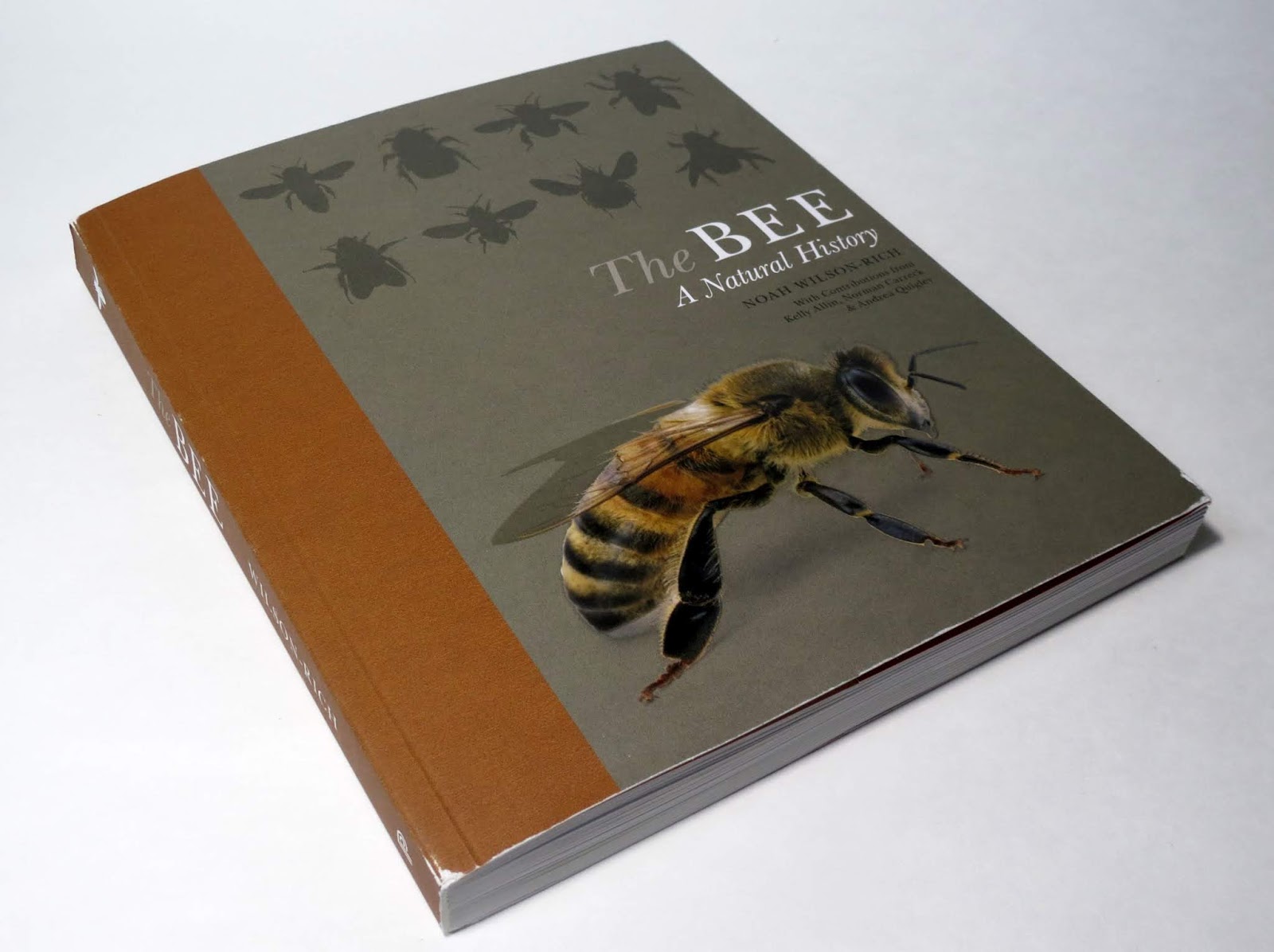
Book Review - The Bee - A Natural History, Princeton University Press

     As a lifelong birder I never gave bees much thought beyond the fact that they were an important food source for Bee-eaters (family Meopidae) and that their honey led to the fascinating behaviour of Honeyguides (family Indicatoridae). 
     All of that changed with the introduction of neonicotinoid pesticides and the catastrophic declines in bees and other pollinators, all absolutely vital to a healthy and productive ecosystem, not only for animals but critical for humans too. Many food crops require pollination and in parts of China bee populations have plummeted so drastically that farmers are already pollinating by hand. It is hard to believe that we could have come to this. Human stupidity knows no bounds.
     The introduction of this fine work by Noah Wilson-Rich is timely indeed.


     It covers every aspect of the life of the bee and provides a comprehensive understanding of bee ecology from start to finish. Witness the chapter titles:


Chapter 1 Evolution and Development 
Chapter 2 Anatomy and Biology
Chapter 3 Society and Behaviour
Chapter 4 Bees and Humans
Chapter 5 Beekeeping
Chapter 6 A Directory of Bees
Chapter 7 The Challenges Faced by Bees

     The chapters are followed by a lengthy bibliography for those wishing to research the subject further - count me among them!
     Each chapter is broken down into subsets with discussions of various facets of the main topic of the chapter. The book is superlatively illustrated throughout.


     Furthermore, it is written in easily understood prose. One does not need training in biology to derive full value from the text; the end of one chapter leaves one anxious to get on to the next.


     I suspect that many people are unaware of the incredible diversity of bees, familiar only with a local hive or the friendly bumblebee in their garden. There is a staggering array of species with different habitat requirements and life styles. Contrary to common misconception most species do not sting, and there is little to fear from bees.


     Upon completion of the book one is left with the feeling that we can all do more to protect these vital insects, often with little effort or expense. Moreover, we can become politically active in letting our politicians know that we want noxious, insidious and dangerous chemicals banned. It is instructive to remember the noble fight waged by Rachel Carson against DDT. No just cause is championed without commitment, no victory is won without sacrifice.
    I wholeheartedly recommend this book to all who are concerned with what the future holds for our children. Share its content with your friends and family; become an advocate for pollinators everywhere.

The Bee: A Natural History
Noah Wilson-Rich
Paperback?$17.95/224 pages/7 1/4 x 9 1/4
Publication date: 24 July 2018
      

Land Acknowledgement

We acknowledge that the land on which we are situated are the lands traditionally used by the Haudenosaunee, Anishinaabe, and Neutral People. We also acknowledge the enduring presence and deep traditional knowledge, laws, and philosophies of the Indigenous Peoples with whom we share this land today. We are all treaty people with a responsibility to honour all our relations.

Followers