Showing posts with label Red Admiral. Show all posts

Thursday, May 21, 2020

Birds, Buns and Butterflies

     We have not been far enough afield to merit a complete post (although that might change when Miriam downloads her pictures from yesterday, albeit from a local morning walk), so once again this segment will be a composite of a few days activity.

16 May 2020
Hillside Park, Waterloo, ON


     This local park, mere minutes from our home, has become a bit of a favourite in recent times, especially during the Coronavirus. Sometimes the bird life is plentiful, at others not, but it is always a pleasant walk regardless.
     On this day it was very active and migrant wood warblers were present in good numbers. Seeing them, enjoying them, revelling in them, is entirely different from taking a picture, however.
     Myrtle Warbler (Setophaga coronota) was the most common species but this is the only picture we could get.


     Myrtle Warbler was formerly combined with Audubon's Warbler (Setophaga auduboni) as a single species (and still is by some taxonomists) as Yellow-rumped Warbler and the picture shows the reason for this name. I have heard it referred to as Yump, or, (with great affection no doubt), Butter-butt. I suspect it would be a sage and diplomatic decision to never refer to your spouse or special other in such a way! Otherwise hot tongue and cold shoulder might be your daily diet for a while to come!
     Grey Catbird (Dumetella carolinensis) is a wonderful bird to encounter. Its own song is varied and melodious but it is an accomplished mimic and many is the time I have searched for several species only to realize that a catbird is playing with me!


     The Mallards (Anas platyrynchos) we saw were all males, lazing away their time while the females go about the serious business of incubating their eggs.
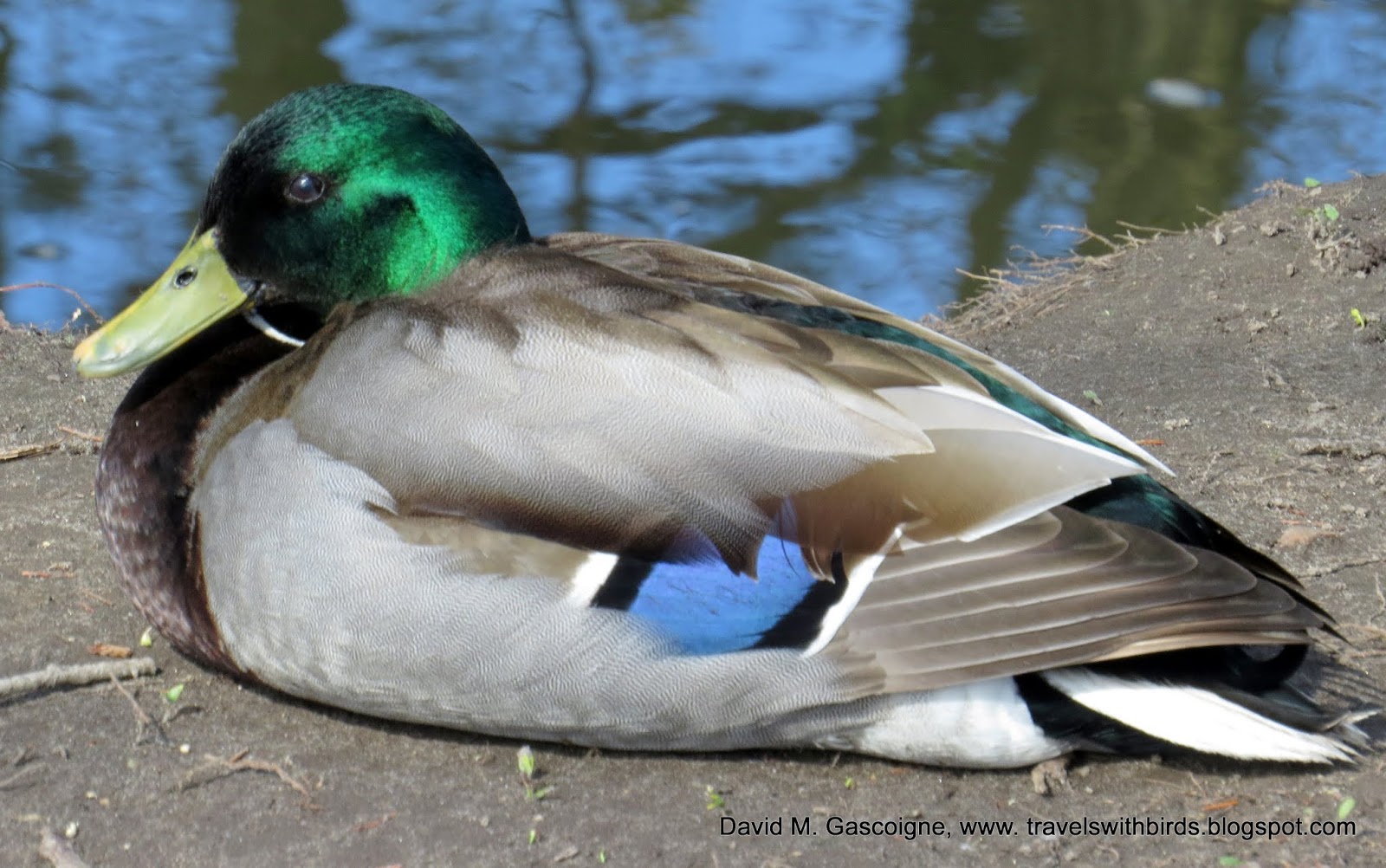

     Miriam's close up of the head should cause you to take a critical look at this dandy next time you see one. Did you ever look so good?


     She also had the presence of mind to capture the speculum in glorious detail.


     The speculum is that bright patch of colour seen on the secondary feathers of waterfowl, with a distinct border surrounding the main colour. Interestingly this feature is different for each species, and careful examination enables one to identify the species by the speculum alone. I am sure you will all wish to embark on a study of this character in several species!
     Red-winged Blackbird (Agelaius phoeniceus) is one of our most common birds and can be heard almost constantly. It is a splendid component of our avifauna and very handsome too.


     Butterflies were not plentiful, except for Cabbage White (Pieris rapae) and this male obligingly lit on a beautiful golden Dandelion (Taraxacum officinale).


     A Red Admiral (Vanessa atalanta) was also very considerate and posed with wings outspread.


17 May 2020
In our house and in our yard

     Miriam and I both like to cook, but she is the only baker of the two of us and has been doing quite a bit of it during our Covid-19 confinement.
     One of the items she has made are buns for sandwiches for lunch. They are large, quite flat (something like baps in Britain), coated with red onion and cheddar cheese, and they take their place on the Elysian Fields of culinary out-of-worldliness. If Michelin were to have a category for home cooking, these petits pains would have the highest rating. (Take note, Rick, in Michigan, you have serious competition!)


     Miriam has declared that next time she makes them she also plans to add sliced olives, so the very best will get even better. 
     I wonder if the House Finches (Haemorhous mexicanus) on the backyard feeders were looking in and contemplating a change in diet?


     The American Goldfinches (Spinus tristis) seemed utterly content with sunflower hearts. 


       Baltimore Orioles (Icterus galbula) were happy to gorge on oranges sliced and put out for them to enjoy.


17 May 2020
Lakeside Park, Kitchener, ON

     This location seems to have acquired a bit of a reputation as a warbler hot spot during migration; it has never been so for us, however. In fact, for birding in general, it has by and large been a dead zone.
     

     The highlight of the visit was that we ran into Jim and Francine, also similarly deprived of avian companionship at the park. We kept our social distance, but chatted for a while and got caught up a little. 
     Canada Geese (Branta canadensis) and their young were the undisputed stars in the park, and barely a person walked by them without an admiring glance. I think that "ooh" and "aah" were the two most used words that day!


     And there are more to come.


      This Mallard was determined not to be outdone and posed for all the world to see.

    
18 May 2020
Three Bridges Road, St. Jacobs, ON

     It was a bit of a dreary day, and at times there was quite a bit of rain, but I had a great suite of birds despite the conditions.
     Who can fail to ignore the weather when male and female Northern Cardinals (Cardinalis cardinalis) take the time to say hello?


     And a couple of noisy Blue Jays (Cyanocitta cristata) did their share to enliven the day too.


     A little bird seed, judiciously distributed, is guaranteed to bring in a variety of species.
     This female Brown-headed Cowbird (Molothrus ater) was chased out of the trees by a Common Grackle (Quiscalus quiscula) where perhaps she had intentions of depositing her egg in the grackle's nest.


     A couple of White-breasted Nuthatches (Sitta carolinensis) navigated the trunk of a tree in their customary head first fashion.


     The little male Downy Woodpecker (Dryobates pubescens) hopped onto the cable for the briefest of moments but my camera was primed and ready.


     The local Eastern Bluebirds (Sialia sialis) were dealing with the rain as best they could.


     And a Red-winged Blackbird seemed resigned to a good drenching too.


     So there you have it - a little glimpse into our lives during the Covid-19 pandemic. I suspect that we will all look back on this event and have stories to tell. The one consistent for us is that life has not radically changed, and the certain benefit of being captivated by nature is that it is always there to enjoy, pandemic be damned!


Wednesday, November 09, 2016

Rondeau Provincial Park

7 November 2016

     Last year my scope was inadvertently knocked over and one of the legs on the tripod broke. It has been fixed three times since then and when it again fell apart recently I decided it was time to break down and buy a new one.
     There is a store just outside Point Pelee National Park in southwestern Ontario, called Pelee Wings, which specializes in sales of all items related to outdoor activities, and is a favourite spot for birders to purchase equipment. The staff there is nothing short of superb and expert sales assistants spend time explaining every facet of the equipment you are about to purchase. It truly is worth the time it takes to drive down there to get the technical guidance required when buying optics and related items.
     It was an incredibly warm November day (by mid afternoon the temperature was in the low twenties) and Miriam and I decided to combine a tripod-buying expedition with a visit to Rondeau Provincial Park.
     This part of the province has a long historical association with oil extraction and there are still plenty of oil rigs "nodding" away. One of the local towns is even called Petrolia.


     These images depicting an ancient technology are in stark contrast with the ubiquitous wind farms that now mar the landscape.


     I confess that I really dislike these blights upon the land, but I am torn between my personal abhorrence of them and my equally strong desire to have clean energy. They certainly are responsible for substantial bird deaths, and bats suffer equally when they fly into a pressure vortex on the back side of the blades and suffer a pulmonary embolism. We have screwed the planet so much in one fashion or another that even our solutions bring their own set of environmental issues.
     This flock of Wild Turkeys Meleagris gallopavo was totally unfazed by the windmills as they foraged in a field.


     Just inside the entrance area at Rondeau there is access to Lake Erie and a small boat launch. We had brought a picnic lunch from home and enjoyed it sitting by the water's edge.


     Rondeau Provinicial Park is a veritable magnet for neotropical migrants in the spring, but as might well be expected, activity in the fall is considerably more muted.
     Late butterflies were in evidence and we saw several Eastern Comma Polygonia comma.  


     Red Admiral Vanessa atalanta, another species known to occur into November, was not to be outdone. The following individual had suffered a fair amount of wing damage, but seemed not to be hindered by its loss.


     I have been unable to identify the following species. If anyone can help out with this I would be happy to hear from you.


     Our target species at Rondeau was Red-headed Woodpecker Melanerpes erythrocephalus, the woodpecker in Ontario most associated with the Carolinian forests found in the southwest, but we were unsuccessful in our quest. 
     We scoured the South Point Trail, a reliable spot on past visits, but came up empty.


     We hardly considered this White-breasted Nuthatch Sitta carolinensis adequate compensation, since this species makes daily visits to our feeder at home. It is by any standards, however, a very handsome bird.


     Cedar Waxwing Bombycilkla cedrorum has obviously had a successful breeding season in the park and we saw numerous juveniles feeding on the plentiful berries.


     We relaxed for a while on the beach before heading back to our car.


     Before leaving for home we checked at the Visitor Centre, now closed until next spring, but having seed in the birds feeders nevertheless, for one last try for the Red-headed Woodpecker, for we have seen them there in the past. There was no woodpecker but the following Blue Jays Cyanocitta cristata were a welcome sight.


     An American Goldfinch Spoinus tristis was no less delightful.


     My eyes are heavy this morning, and so is my heart. I stayed up far too late watching the US election unfold and was dismayed beyond belief by the results. There are so many issues with Trump we could discuss, but most serious of all the environment on this continent is screwed. He has promised to reopen coal mines in Appalachia, strip the EPA of any powers to regulate emissions, tear up the Paris climate agreement, and he believes that global warming is a hoax created by the Chinese to gain trade superiority over the United States.
     It is a sad, sad chapter for the United States when they can, by a substantial margin, elect a demagogue who can barely compose a cogent sentence in English, but who has clearly fascist overtones to his rhetoric, and has shown himself willing to ignore societal norms, and roll back social progress hard won over many years of principled political struggles. The whole world should take note.

Land Acknowledgement

We acknowledge that the land on which we are situated are the lands traditionally used by the Haudenosaunee, Anishinaabe, and Neutral People. We also acknowledge the enduring presence and deep traditional knowledge, laws, and philosophies of the Indigenous Peoples with whom we share this land today. We are all treaty people with a responsibility to honour all our relations.

Followers