15 November 2016
This account of the most recent Tuesday ramble around local areas is later than normal, because the day after the outing took place we all left for Cuba.
Franc, who supplied most of the pictures did not have the time to edit them until after our return on 23 November and I doubt I would have had the time to create the post even if he had.
Our usual group, minus Mary, who had other things on her mind, met at my house and we went over to Laurel Creek together - a mere five minutes away. The area is closed to vehicular traffic after Thanksgiving but we were able to park outside and walk in.
Laurel Creek contains a variety of habitat types and depending on the time of the year a wide variety of birds.


The Tamaracks Larax laricina are especially attractive in the fall as their foliage turns to gold.

The cones of this tree are a favourite food of crossbills (loxia sp.) and during irruption years are a reliable site to locate these interesting birds.
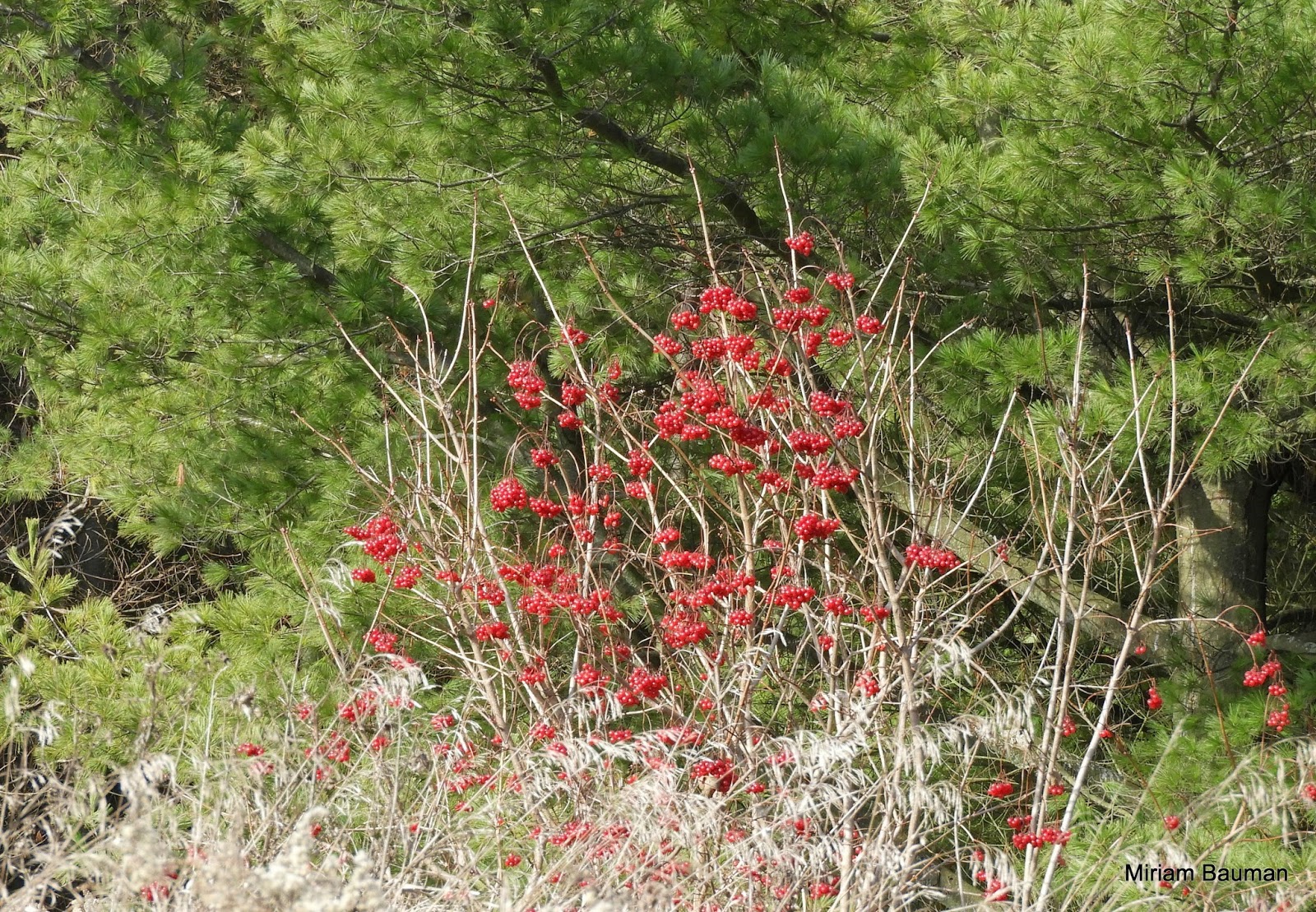
There was ample High Bush Cranberry Viburnum acerifolium to provide food for American Robin Turdus migratorius and the fruit will no doubt support flocks of Cedar Waxwings Bombycilla cedrorum during the winter.


Black-capped Chickadees Poecile atricapillus are very common indeed and chattering flocks followed us throughout. People routinely bring their children to Laurel Creek so that they can enjoy hand-feeding the birds. We had brought sunflower hearts with us to enable us to revisit our inner child.


Northern Cardinal Cardinalis cardinalis was seen quite frequently too, although seldom in a position where good pictures could be taken. Franc captured the male and Miriam the female.


The reservoir has been drained for the winter, with only small patches of water remaining in depressions. Mallard Anas platyrynchos and Canada Goose Branta canadensis were the pre-eminent species, but these handsome male Green-winged Teal Anas carolinensis were also present.

Downy Woodpecker Picoides pubescens is the "default" picid here, a beautiful, hardy little bird that ably survives the harshest conditions that winter serves up. No doubt these two are busy caching seeds to be retrieved later when other food is hard to find.


These tiny crab apples harbour fat, juicy grubs and will be exploited by a number of species.

Most Golden-crowned Kinglets Regulus satrapa migrate through our area, but some populations remain and survive our winter. This species is nearly always recorded on Christmas Bird Counts. Whether these two are residents or passing through it is impossible to know.


We were all very happy to see a couple of Brown Creepers Certhia americana. This is another species with both a migratory and a resident cohort. Brown Creeper is quite common but is often overlooked due to its ability to camouflage itself against the bark of a tree, which comprises its entire world. It depends totally on tree trunks and branches for food and nest sites; it knows no other habitat.


Dark-eyed Junco Junco hyemalis and American Tree Sparrow Spizella arborea are two species that arrive in late fall and spend the winter and early spring with us.


Miriam captured this picture of some of us walking back to the park gate.
This family of arachnids was introduced from Europe and is now fairly widespread. I am not familiar with its life cycle but I assume that it will soon enter hibernation for the winter.
As always it was a great walk with great friends. The day after we all went to Cuba together, accompanied by a few others. The next Tuesday morning ramble would be in a different location indeed!
Franc, who supplied most of the pictures did not have the time to edit them until after our return on 23 November and I doubt I would have had the time to create the post even if he had.
Our usual group, minus Mary, who had other things on her mind, met at my house and we went over to Laurel Creek together - a mere five minutes away. The area is closed to vehicular traffic after Thanksgiving but we were able to park outside and walk in.
Laurel Creek contains a variety of habitat types and depending on the time of the year a wide variety of birds.


The Tamaracks Larax laricina are especially attractive in the fall as their foliage turns to gold.

The cones of this tree are a favourite food of crossbills (loxia sp.) and during irruption years are a reliable site to locate these interesting birds.
There was ample High Bush Cranberry Viburnum acerifolium to provide food for American Robin Turdus migratorius and the fruit will no doubt support flocks of Cedar Waxwings Bombycilla cedrorum during the winter.

Black-capped Chickadees Poecile atricapillus are very common indeed and chattering flocks followed us throughout. People routinely bring their children to Laurel Creek so that they can enjoy hand-feeding the birds. We had brought sunflower hearts with us to enable us to revisit our inner child.


Northern Cardinal Cardinalis cardinalis was seen quite frequently too, although seldom in a position where good pictures could be taken. Franc captured the male and Miriam the female.


The reservoir has been drained for the winter, with only small patches of water remaining in depressions. Mallard Anas platyrynchos and Canada Goose Branta canadensis were the pre-eminent species, but these handsome male Green-winged Teal Anas carolinensis were also present.

Downy Woodpecker Picoides pubescens is the "default" picid here, a beautiful, hardy little bird that ably survives the harshest conditions that winter serves up. No doubt these two are busy caching seeds to be retrieved later when other food is hard to find.


These tiny crab apples harbour fat, juicy grubs and will be exploited by a number of species.

Most Golden-crowned Kinglets Regulus satrapa migrate through our area, but some populations remain and survive our winter. This species is nearly always recorded on Christmas Bird Counts. Whether these two are residents or passing through it is impossible to know.


We were all very happy to see a couple of Brown Creepers Certhia americana. This is another species with both a migratory and a resident cohort. Brown Creeper is quite common but is often overlooked due to its ability to camouflage itself against the bark of a tree, which comprises its entire world. It depends totally on tree trunks and branches for food and nest sites; it knows no other habitat.


Dark-eyed Junco Junco hyemalis and American Tree Sparrow Spizella arborea are two species that arrive in late fall and spend the winter and early spring with us.


Miriam captured this picture of some of us walking back to the park gate.
 |
| Franc, Judy, David, Carol
This Garden Cross Spider Araneus diadematus was not to be outdone as it ambled across our path.
 |
As always it was a great walk with great friends. The day after we all went to Cuba together, accompanied by a few others. The next Tuesday morning ramble would be in a different location indeed!