Showing posts with label Ontario. Show all posts

Sunday, February 25, 2018

Snowy Owl (Harfang des neiges)

25 February 2018

     I was advised yesterday evening by our good friend, Anne Morgan, that she and her husband Alan, along with Virgil and Beth Martin had been hunting for Snowy Owls (Bubo scandiacus) and had met with resounding success. Even though we had a busy day ahead of us Miriam and I decided that we could spare a couple of hours to search for these northern birds who will soon be leaving our area. It was sunny and the temperature was 8°C, unusually warm for this time of year. 
     We had not gone far when we saw several Red-tailed Hawks (Buteo jamaicensis) gambolling in the sky, ostensibly involved in courtship flights. The spectacle they put on is quite amazing, twisting and turning, tumbling like circus acrobats. We were able to photograph this individual before it left its perch to join in the fun.


     The Region of Waterloo is the epicentre of Mennonite residency in Ontario, and being Sunday morning, the meeting houses were full. The horses, all lined up at the hitching rails waiting for their owners to return, presented quite a sight, as did the conveyances, each with a "Slow Moving Vehicle" sign emblazoned on the back.


     The fact that it has been so mild of late (and is predicted to continue warmer than usual) means that the sap has started to flow in the Sugar Maples (Acer saccharum), much earlier than is normal, and many trees bore telltale sap-collecting pails. Plastic has pretty much taken over now, but the old metal pails still in use not many years ago were certainly better suited to a rural landscape, and seemed a natural part of the annual cycle.


     In fact, many large operations no longer use pails at all and have a network of plastic pipes connecting the trees to a central collection area.
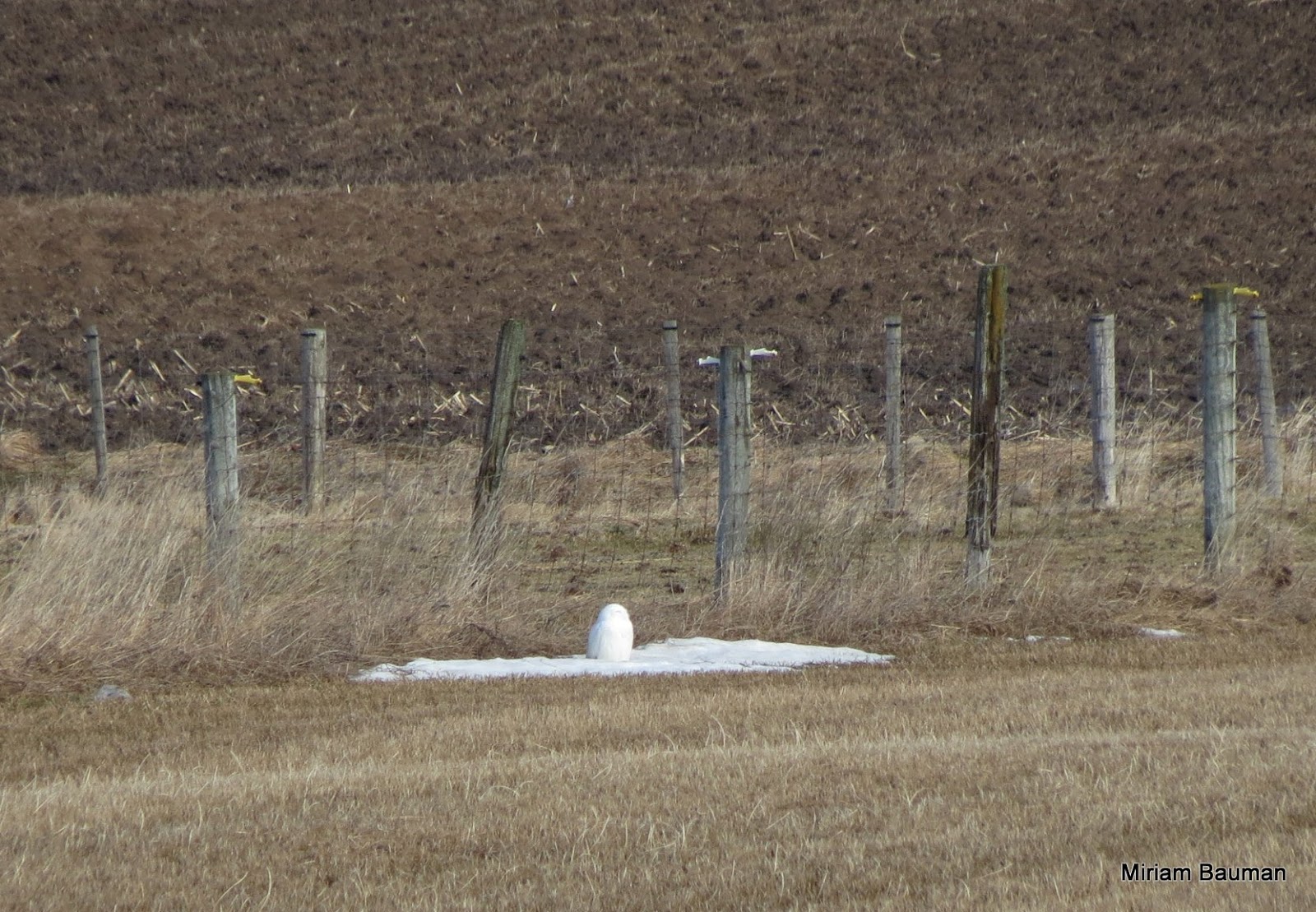
     Our first Snowy Owl was a male, quite far off and sitting on the last patch of snow in the field.

     We drove along keeping a keen eye peeled for others and finally our efforts were handsomely rewarded. A female was located hunkered down behind a stump, sheltering from the wind. And it was very close to the road. By using the car as a blind, and basically letting the car roll very slowly, with intermittent stops,  we were able to get a series of photographs.


     This truly is a magnificent creature and it matters not how many times I have seen one, a sense of awe and reverence takes over. It is akin to being in the presence of greatness.


     Tomorrow looks fairly open with only a few discretionary chores to take care of, so I think we might embark on a search again. After all the Snowies will soon be leaving us and we will have to wait another nine months or so until we see them return. We wish them good hunting on the tundra, with plentiful prey. May they raise large families to send south to fill our hearts with joy next winter.

Addendum to this post 26 February 2018: We went out again today and discovered another seven Snowy Owls. Remarkable!

Also - Only in America: https://www.youtube.com/watch?v=fB7MwvqCtlk

Friday, December 29, 2017

Red-bellied Woodpecker (Pic à ventre roux) on our feeder

28 December 2017

     Recently all of North America has been experiencing a monumental cold snap, the like of which has seldom been seen before. Overnight from 27 December to 28 December in the Region of Waterloo we broke a record which had stood for a hundred years when the mercury plunged to minus 24.2°C, and taking into account wind chill, minus 31°C.
     Resident birds have to survive in these conditions at a time when we are barely past the winter solstice, the shortest day of the year, and they still have minimal hours in which to forage.
     We feed birds primarily for the pleasure they bring us it must be said, but under these conditions our feathered friends really do need a helping hand.
     As far as I can recall we have only seen Red-bellied Woodpecker (Melanerpes carolinus) twice before in our backyard, and then only as a casual visitor. We had not previously witnessed it feeding.
     Imagine our delight, therefore, when we looked out to see a female feeding on one of our suet feeders.


     You can even see the feint smudge of a red belly from which this species gets its name.
     This was not a casual visit to the feeder, the bird stayed there for quite a while and bolted down as much food as it could pry from the frozen block of suet.


     Not only did it feed voraciously the first time around, about an hour later we observed it back at the feeder gorging again. We can only hope that this intake of fat will buffer the bird against the cold and help it to survive the long, dark, bitterly cold night.
     Today we were occupied with the Linwood Christmas Bird Count so we were not at home to see whether the bird returned, but we hope it did, and we further hope that it will make our yard a regular stop, even when these dire conditions have ended.
     Tomorrow, one or the other of us will be home most of the day, so we will keep a close eye on the feeders to see whether the bird returns to take advantage of the food we have on offer. Today I installed an additional suet feeder so perhaps it will bring a friend!


Wednesday, June 28, 2017

Dickcissels (Dickcissels d'Amérique) in Ontario

    Dickcissel Spiza americana is the only member of its genus in the family Cardinalidae. The scientific name translates straightforwardly to American finch.


     This species, resembling a miniature meadowlark, is common to abundant throughout its range across the midsection of North America, where it inhabits native grassland, and readily adapts to agricultural uses, where it voraciously feeds on seeds, much to the chagrin and annoyance of farmers.
     I first saw this species in Ontario about twenty-five years ago in a part of Richmond Hill which has now been totally converted to tract after tract of residential development. At that time a fellow birder located a male and in searching together in the days following his discovery we found a female also, giving at the least the possibility of breeding. We were never able to confirm whether nesting occurred or not.
     At that time a Dickcissel in southern Ontario was a mega-rarity, such that when I ended my term as Chairman of the the Board of a well-known Canadian charity, a picture of the species was painted and presented to me in honour of our rare sighting.


    Since that time, up until the present, I have seen this species only once more in Ontario.
    This is in stark contrast to this year, when Dickcissels seem to be everywhere throughout the Province of Ontario, with multiple sightings, even here in Waterloo.


      Several other species are colonizing Ontario as climate change seems to herald a northward movement in their range, and I wonder whether Dickcissel is the next species to exemplify this trend.
     Franc Gorenc, ever ebullient, wanted to take pictures of what was a new bird for him, and he and Carol, on a very windy day, visited its known location with us. We were not disappointed, seeing two males and a female. The conditions for photography were less than ideal, with very strong winds blowing the birds around as they perched, and constantly blowing grass in front of the lens to distort the focus. Despite this, a persistent Franc managed a couple of shots.


     Having enjoyed seeing this enchanting little bird this year, we are left to wonder whether it will return again in 2018 to cement its status as a breeding bird in Ontario. Perhaps in years to come it will be a standard feature of our grassland ecosystem, taking its place alongside other common residents. It will be very welcome!

Friday, May 19, 2017

Blue Jays (Geais bleus) in our backyard

     For some reason Blue Jays Cyanocitta cristata seem to be especially abundant this year and we are fortunate to regularly have three or four of this very handsome bird in our backyard.


     Even when sitting outside on the patio they display little fear and will readily come into close proximity. 
     We have a bird feeder dispensing peanuts, designed to exclude squirrels (it is not always effective) and the jays look winsomely at the food inside, unable to get to it. 


     If we are outside we can toss down food for them but in other circumstances any food available to the birds is quickly gobbled up by squirrels. These little critters appear to have become totally urbanized and they exploit every source of anthropogenic food supply available. Friends with rural properties seem not have nearly the same "problems" we have with squirrels in our suburban backyard. Sometimes five at a time are scampering around; their appetites are voracious and their ingenuity knows no bounds.


     In any event, we are very happy to have our Blue Jay companions spend time with us and look forward to many hours of pleasure derived from a close association with these intelligent birds.


Wednesday, May 03, 2017

Unusual Common Yellowthroat (Paruline masquée) in our backyard

01 May 2017

     Miriam called to me, "Come quickly!
     Looking out the window from the family room she had seen an odd looking bird, which she recognized as a Common Yellowthroat Geothlypis trichas, but it had a very visible white crown. We both tried to get a picture, she from the downstairs window and I from the bedroom, but the bird flitted about nervously and was in and out of vegetation and we were unsuccessful. Finally the bird flew off.
     I decided to have a nap on the sofa and while I was asleep the bird returned and Miriam was able to capture a few shots.


     I have never seen a bird like this before and I can only conclude that leucism is responsible for this condition. As you can see there are white patches in its characteristic black mask in addition to the extensive white crown.
     Males (and this bird is a male) normally have a pale whitish band separating the mask from the olive rear crown and neck, as shown in the pictures below taken from my archives.


     Common Yellowthroats have recently returned from their winter quarters in Central America or the West Indies, and it was serendipitous that our first sighting this spring would be of this anomalous bird.
     Surely this all proves why birding is an eternal source of enjoyment and fascination. Perhaps it also serves to point out that it's good to have a wife who doesn't take an afternoon nap!

Wednesday, March 22, 2017

Canadian National Wildfowl Carving Championship

19 March 2017


     Miriam and I were very happy to attend the above event again this year, where we could marvel at the truly outstanding work done by these carvers. Their output is art in every sense of the word and merits the serious attention of collectors. 
     We were very happy for Tom Weiler, a member of a local club, who had submitted three items and won a ribbon, or honourable mention, for all three, I joked to Tom that I would have to exhibit them in my home to really appreciate their beauty and he rejoined that there were times when he was carving and painting them he would gladly have given them to me!


      Congratulations Tom on a job well done and the appreciation it garnered, not only from the judges but from the discerning public who came to the show.
       As was the case last year, I was stunned by the lack of attention to the basic requirements of spelling. Surely in a NATIONAL championship it is not unreasonable to expect that someone would proof read the cards to ensure that the names of the birds are spelled correctly. To the right of Tom's Belted Kingfisher above you see the card saying Red Headed Woodpecker and not Red-headed Woodpecker. The difference is profound and the incorrect nomenclature effectively changes the bird to a different and non-existent species.
      A wide variety of waterfowl was on display, beautifully rendered to be sure.


       Here are two admirable carvings of a Rose-breasted Grosbeak and a Red-winged Blackbird.


     Again, both names are spelled incorrectly. I might ask rhetorically if no one checks anything, but the answer is obviously no.
    The Chipping Sparrow below is a gorgeous rendition of this familiar species and here the spelling is just plain sloppy (Spparow instead of Sparrow). It is not even a misrepresentation of the bird's name.


     It truly is a shame that Linda would not check her card a little more closely, or perhaps she has no influence over it.
     This Baltimore Oriole had us all filled with appreciation. Every component has to be carved and we wondered at the fine detail of the leaves and speculated as to how many might have been broken before perfection was achieved.


     A Cuban Tody brought back memories for us of this gorgeous little bird seen so frequently on our last two visits to Cuba.


     A Grey Catbird always delights us and we are looking forward to its return. And we will be sure to spell its name correctly whenever we refer to it. It is a Grey Catbird and not simply Catbird.


     Furthermore, the artist is designated as being from Dartmouth, Nova instead of Dartmouth, Nova Scotia. Is it really so hard to get the right information on these tags?
     A Blue Jay, a familiar species to us all, was rendered beautifully.


     How about this Golden-crowned Kinglet? Captured to a tee don't you think?


     Once again the named is misspelled. A Golden Crowned Kinglet would be quite a different bird from a Golden-crowned Kinglet.
      This Gyrfalcon was so lifelike, you almost expected it to move when viewed from certain angles.


     The same could be said of this Peregrine Falcon.


     My good friend, Bill Wilson, a distinguished birder and a carver of great merit exhibited an American Three-toed Woodpecker. This species is well known for its proclivity to forage 


in freshly burned areas and I think that Bill has captured this behaviour wonderfully.
     This show represents an amazing opportunity for carvers to enter their works into competition and to have the general public appreciate their fine work. It is too bad that the peripheral aspects of it lend this Mickey Mouse quality to it.
     I bet that the next time you visit the Louvre you won't see signs directing you to the Mona Liza, or a visit to the McMichael Gallery won't reveal the works of the Group of Sevven, or urge you to examine a canvas by A.Y. Jackksn. 
     If anyone reading this wishes to take me up on this, I would happy to proof read the cards next year before they are printed. It can only benefit the show and the dedicated artists who put so much effort into it.


Land Acknowledgement

We acknowledge that the land on which we are situated are the lands traditionally used by the Haudenosaunee, Anishinaabe, and Neutral People. We also acknowledge the enduring presence and deep traditional knowledge, laws, and philosophies of the Indigenous Peoples with whom we share this land today. We are all treaty people with a responsibility to honour all our relations.

Followers