Showing posts with label Kayla Simms. Show all posts

Friday, August 12, 2022

Odds and Ends

 At home

02 July, 2022

     A Sharp-lined Yellow (Sicya macularia) decided to pay us a visit, and we were happy to welcome it to the backyard.
     

04 July, 2022

     No less welcome was a Large Yellow Underwing (Noctua pronuba) in the porch when we opened the front door. 


     It appears headless in the picture, but I can assure you it was not!

09 July, 2022

     The patch of Butterfly Milkweed (Asclepias tuberosa) we planted a few years ago, has bloomed in profusion each year and presents a very striking image at the side of our driveway. 


     A Monarch (Danaus plexippus) was seen nectaring on it, flitting from flower to flower.
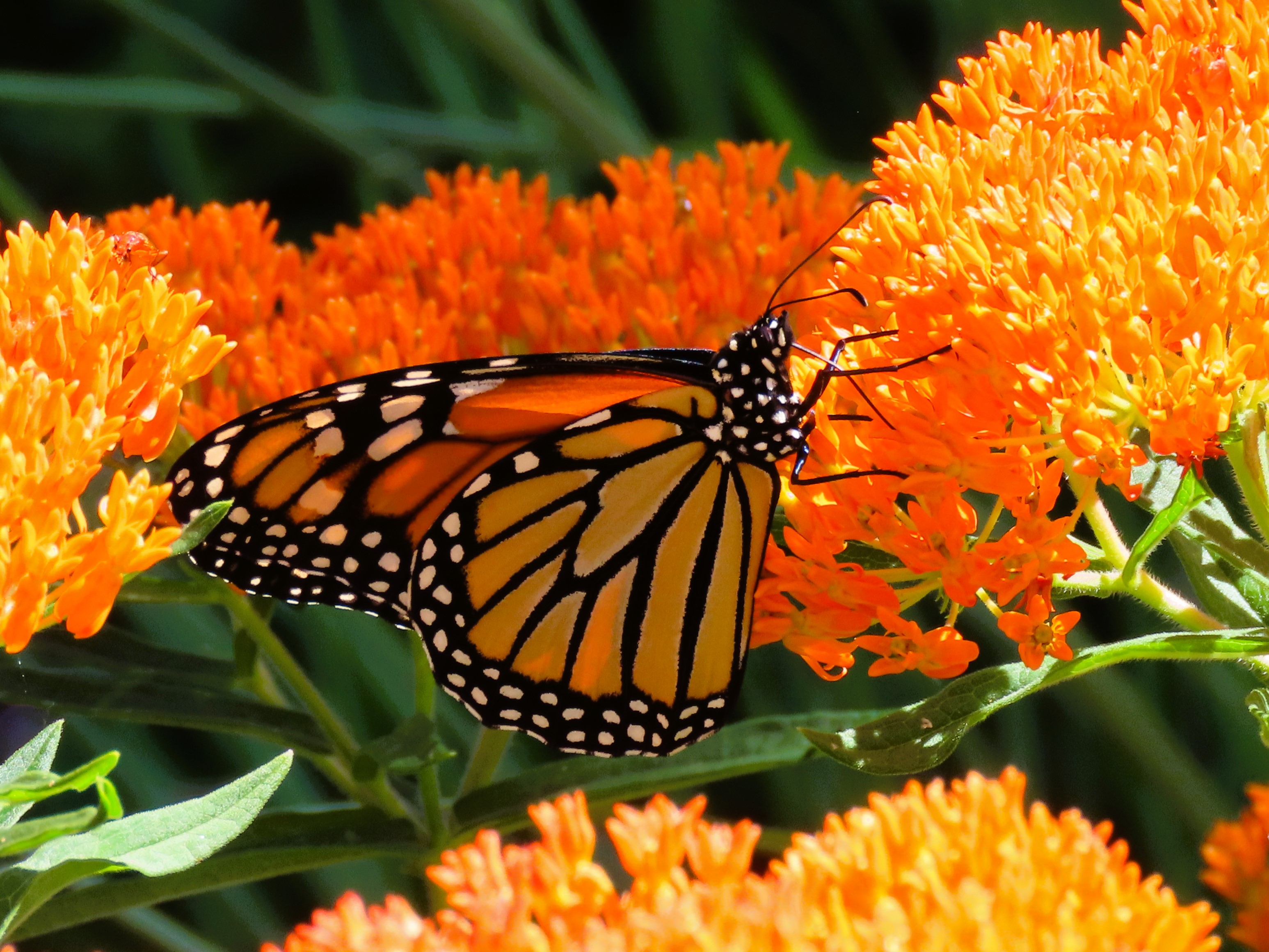

     Many is the time I have seen a dozen or more Western Honey Bees (Apis mellifera) exploiting its sweetness.


12 August, 2022

     Miriam was working in the garden under the bay window at the front of the house and noticed this Northern Dog-day Cicada (Neotibicen canicularis), an impressive insect to say the least.


18 June, 2022
Hillside Park, Waterloo, ON

     We joined Jonah and Kayla to meet little Shai, the newest member of their family, but sleeping in the stroller was more to his liking than chatting about birds!


     There were many Ebony Jewelwings (Calopteryx maculata) going about the business of their short lives.


     The following fly has me totally baffled. It is perhaps a type of Snipe Fly, but I am far from sure of that.


     It is undeniably attractive.

08 July, 2022
SpruceHaven, St. Agatha

     Kayla had long expressed an interest in a visit to SpruceHaven, which was made even more interesting by the accompaniment of Jonah's parents, Jack and Yaffa, who were visiting from Ottawa, a delightful couple if ever I met one.
     Who can fail to be enchanted by baby Barn Swallows (Hirundo rustica)?


     An American Cliff Swallow (Petrochelidon pyrrhonota) (see below) was busy at its nest.


     Shai finally agreed to put it an appearance, photo-bombed by Grandpa Jack in the right hand corner.


23 July, 2022
RIM Park, Waterloo, ON

     There was great excitement in the local birding community when a Black-bellied Whistling Duck (Dendrocygna autumnalis), far outside its normal range, decided to pay us a visit.
     I saw Mallards (Anas platyrynchos).....


     ..... and a preening Killdeer (Charadrius vociferus).....


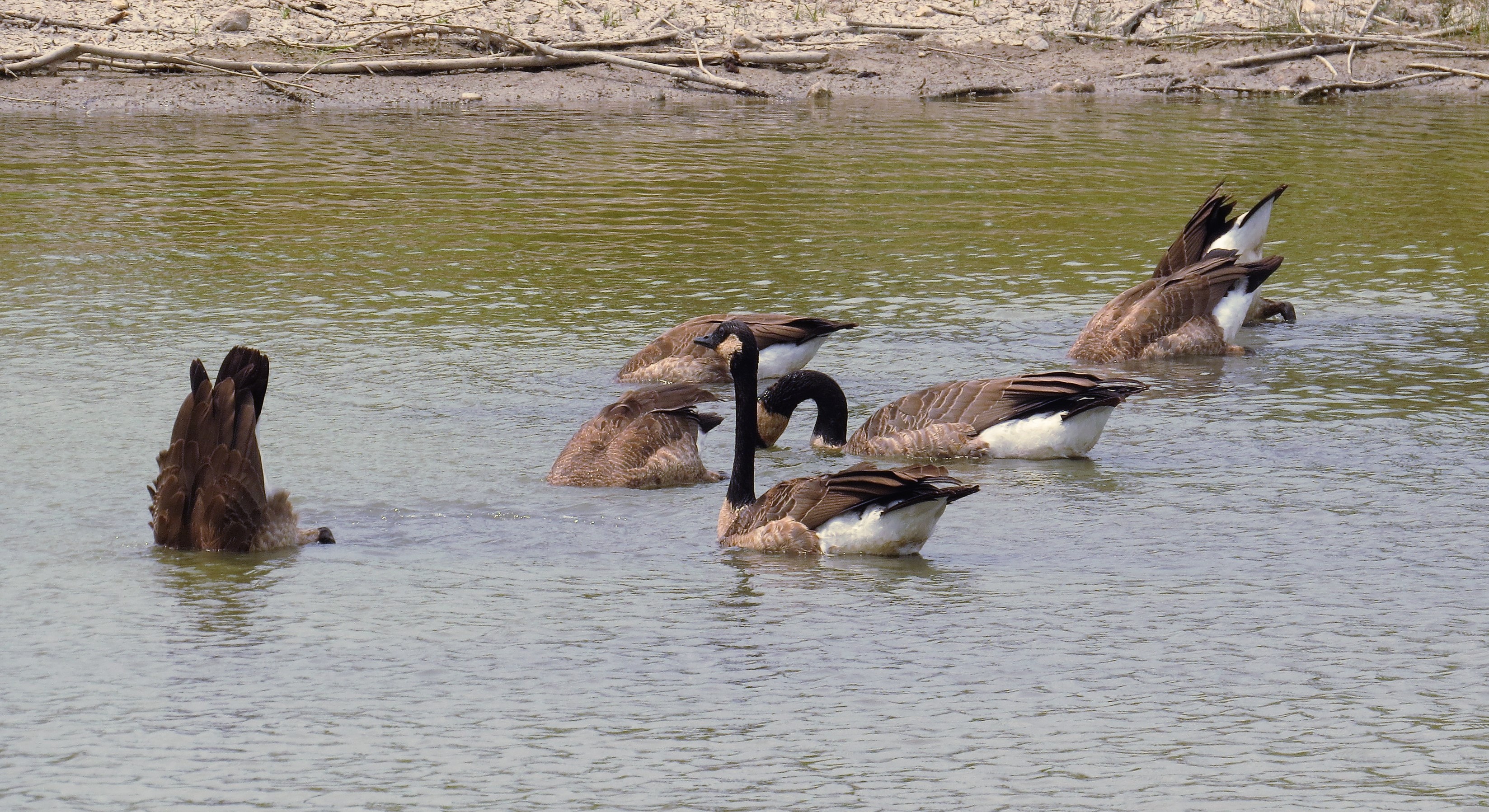
     ..... and Canada Geese (Branta canadensis).....

     ..... and finally the star of the show!


     It had no idea what a celebrity it had become.

31 July, 2022
SpruceHaven, St. Agatha, ON

     The barn at SpruceHaven contains around seventy-five Barn Swallow nests in an active colony that has been present there for decades. The farm has been in the Westfall family for almost fifty years with continuous occupancy since their arrival. In fact, it was the idyllic scene of swallows dipping over the pond and feeding above it that sufficiently enchanted Dave's parents to buy the property.
      Thirty to thirty-five nests are in use each year, or at least have been during the six years we have monitored them.
     In July 2020, a pair of American Cliff Swallows built a nest in the barn and successfully raised young. It seemed quite remarkable to me at the time, never having experienced a mixed colony of Barn Swallows and Cliff Swallows.  What is even more noteworthy now, is that we have five Cliff Swallow nests, some of which are Barn Swallow structures usurped and modified by the Cliff Swallows.


     The fourth picture from the top is the first Cliff Swallow nest built in the barn, a structure entirely typical of the species. The others, originally Barn Swallow nests, have been modified in odd ways, yet some were used successfully this year.
     A Cliff Swallow colony inside a barn is highly unusual and my experience with this species has always been of colonies under bridges, culverts and on buildings. I have never found nests in a building and there is scant reference to it in the literature. Angela Turner comments that occasionally Cliff Swallows will nest inside buildings, but there is no indication they do so in the presence of other species. I should add that I never observed any inter-specific conflict, nor intra-specific conflict for that matter, although Cliff Swallows are notoriously aggressive in large colonies of their own species.
     A Green Heron (Butorides virens) approached very close while we were concealed by the hide at the edge of the pond.


     We have a very poor picture of a Blue Dasher (Pachydiplax longipennis).


     This species is quite rare in this area, in fact nowhere common. It is extremely wary and difficult to approach, hence its common name "dasher". The one thing in our favour was that it tends to return to the same perch and by the exercise of dogged patience Miriam was able to obtain this image, overcoming the combined obstacles of it not being particularly close and shooting into the sun.
     There are more odds and ends, but I'll save those for another time.


Monday, December 23, 2019

Jonah Feeds a Chickadee

22 December 2019

     On a fine winter's day we met up with Kayla and Jonah to do a little birding along the Mill Race Trail in St. Jacobs.
     Kayla is originally from the Toronto area and Jonah from Ottawa, and neither one had ever seen the assembly of Mennonite horses and buggies at a church, so we took them first to the meeting house on Three Bridges Road in order that they might witness this remarkable sight.


     The horses waited patiently at the hitching rails while the service continued inside. And we waited too until a few of the conveyances left so that Kayla and Jonah could take in the whole scene, following which we returned to the start of the Mill Race Trail to begin our walk.
     I have to tell you that Jonah is a beer chemist, a fellow engaged in fermenting, brewing, fusing molecules, alchemy almost, a sophisticated creator of the unique tastes associated with micro breweries - but he has never fed a Black-capped Chickadee (Poecile atricapillus) from the hand. Ergo, his education was clearly incomplete.  Furthermore, when Kayla raised the possibility he scoffed at the very idea. Scoffed, mind you, dismissed the notion as a foolish flight of fancy. Obviously this grave misapprehension had to be rectified and we had brought bird seed along with exactly that aim in mind.
     Chickadees on the Mill Race Trail have been habituated to friendly humans for years and recognize every two-legged creature as a potential source of food.
     It did not take long for Jonah to experience the unique joy of contact with a wild creature. The sheer elation on his face speaks volumes as he follows a bird that had just left his hand with a seed in its bill.


          Once is never enough, of course.


     Kayla was in on the secret all along and knew with certainty what Jonah's reaction would be.


     Some days happiness is a little bird on your hand.
     It was unlikely that this American Crow (Corvus brachyrynchos) would be following the lead of the chickadee!


     The Mill Race looked quite splendid clad in its winter coat.


     At one point a train went over the old trestle bridge, slowly, and almost elegantly it seemed.


     Kayla and Jonah were happy to watch it go by.


     I am sure that this female Downy Woodpecker (Dryobates pubescens) had other activities to occupy her daylight hours, not the least of which was securing food.


          It was very seldom that several chickadees did not travel with us on the trail, joined by others along the way. Each one represented sheer delight for us.


     The sun was shining, the temperature was mild, there was snow on the ground, the green of conifers all around - it was good to be out and about.


     No stroll along the Mill Race Trail would be complete without a visit to the Eco Café at the St. Jacobs end of the walk. I think that for Jonah it was almost in the nature of a victory celebration. He even got a cookie with his coffee!


     Every year a few Belted Kingfishers (Megacerlye alcyon) tough out the winter and remain on territory rather than migrate. It has always been my theory that males remain behind, accepting the trade-off of cold weather versus migration in order to have a territory established for when the females return in the spring. The birds I have seen in the winter have always been males. Today there were two Belted Kingfishers on the Conestogo River and as the picture below clearly shows one is a female.


     I am inclined to believe that this has something to do with climate change. The temperature was around 4.5° C, whereas the expected value for this period in December is minus 4.1° C. It now appears that mated pairs will, at least sometimes, remain to face the winter together.
     There were expanses of open water on the river, and Kayla had mentioned that she had only ever seen kingfishers in flight and had never seen them perched. Our obliging female dived into the river, caught a fish, went to a perch and swallowed it. The whole performance was staged for Kayla, I have no doubt.
     Chickadees were our companions on the return journey as they had been on the outward leg, and Kayla and I could not resist feeding them again.


     We saw numerous species, but Black-capped Chickadee was the unchallenged star of the day.


     I suspect that Jonah learned a brand new formula today, and it looks like this.....


SJ + BCCH = HAPP²

     ..... where SC = Scoffer Jonah, BCCH = Black-capped Chickadee, resulting in Happiness squared.

     You many not be able to brew beer with it but it is guaranteed to bring a smile to your face on a snowy winter's day.


Monday, September 02, 2019

A Day's Birding with Kayla

01 September 2019

     The first day of September always represents the beginning of fall for me, regardless of the the fact that the autumn solstice is yet three weeks away, so it was a pleasure to initiate fall birding for 2019 with Kayla Simms.
     Kayla had contacted me to advise that she was a novice birder and would like me to take her birding to help improve her skills a little and I was happy to oblige. 


     I am wholeheartedly glad that I consented to do so, for she turned out to be the most agreeable companion one could possibly imagine and quite aside from a great day of birding I enjoyed my time with her immensely, and a new and rewarding friendship was struck.
     I took few photographs, and what I have are of indifferent quality, but I will include a few taken at the DesJardins Canal. The range of species here was not dramatic, but there were lifers for Kayla, and she was keen to learn as much as possible about their lifestyle, so adult and juvenile Black-crowned Night Herons (Nycticorax nycticorax) gave her great pleasure.


     This juvenile Green Heron (Butorides virescens) was no less pleasing for Kayla and we saw a couple of adults also.


     Great Egret (Ardea alba) is a species whose range has expanded dramatically in southern Ontario in recent years, and it is no longer unusual to encounter concentrations of twenty or thirty of these birds. A lone individual was present at the canal, but I suspect that had we explored farther along Coote's Paradise we might well have found more.


     As is usually the case, even in winter, Double-crested Cormorants (Phalacrocorax phalacrocorax) are a fixture at the DesJardins Canal, and Kayla was very interested to observe them swimming, often almost totally submerged, fishing, and drying their wings.


     Our next stop was at Grindstone Creek where there was a good deal of activity, with Western Ospreys (Pandion haliaetus) and Caspian Terns (Hydroprogne caspia) putting on impressive displays of aerial maneuverability and fish-catching prowess.
     A Great Blue Heron (Ardea herodias) had captured a quite large fish and was bashing it thoroughly in the way that herons do. I had left my camera in the car (I am probably so used to relying on Miriam to take the pictures), but I went back for it. Alas, when I arrived anew at the scene the heron had already swallowed the fish.
     All was not lost, however, for Joel Marshall, a real photographer with real equipment, had been chatting to us in the most friendly and agreeable way, and he undertook to send me some of his images. They are included below and I am sure you will agree that they are as dramatic as one could ever hope to witness. I am very grateful indeed to Joel for his kindness; no less for his promptness in forwarding the pictures.


     Kayla and I said goodbye to Joel, and proceeded to La Salle Park and Marina in Burlington, followed by visits to Paletta Park and Bronte Harbour in Oakville. Each location held its special attractions, including a lively movement of migratory warblers at Paletta Park. For Kayla there were numerous lifers and the excitement of seeing fall migration in full swing.
     I had one lifer too, a rare but highly desirable species, known only to a small discerning audience. Its scientific name is Kayla iucunda. The great thing about this species is that once discovered it is easy to find again, and never ceases to amuse, charm and reveal new characters. Now, what could be better than that? 

Land Acknowledgement

We acknowledge that the land on which we are situated are the lands traditionally used by the Haudenosaunee, Anishinaabe, and Neutral People. We also acknowledge the enduring presence and deep traditional knowledge, laws, and philosophies of the Indigenous Peoples with whom we share this land today. We are all treaty people with a responsibility to honour all our relations.

Followers