Showing posts with label DesJardins Canal. Show all posts

Wednesday, January 08, 2025

LaSalle Park and the DesJardins Canal

      During the recent strike by Canada Post workers (still unresolved) Miriam was entrusting her ETSY shipments to Chit Chat, and we journeyed down to Burlington each week to deliver her packages. It always made sense to combine the practical reason for the journey with a little birding.


04 December, 2024
LaSalle Park and Marina, Burlington, ON


     LaSalle is a place that never disappoints. As soon as we had parked the car, while enjoying hot coffee and a muffin, Gadwalls (Mareca strepera) and a Common Goldeneye (Bucephala clangula) streamed by, forsaking the shelter of the inner harbour for more productive feeding opportunities on Lake Ontario.


     Common Goldeneye is a bird that really proclaims its name.


     American Black Duck (Anas rubipres), a species not always easy to find, is reliable at LaSalle. 


     These two, keeping company with a Mallard (Anas platyrynchos), are rotund and healthy. Friendly humans bringing food no doubt contribute to this state of affairs.
     There does not seem to have been a general arrival of winter ducks, so we were happy to see a lone female Greater Scaup (Aythya marila).


    A raft of Mallards enjoyed a spell on the water.


     Canvasback (Aythya valsinaria) is one species that seems to have already taken up residence in their usual numbers. A female looked exceptionally lovely, I thought.


     Not to be outdone a handsome male cruised into view.


     Bufflehead (Bucephala albeola) is an exceptionally appealing little duck, the male looking quite different from the female.

Bufflehead ♂

Bufflehead ♀

     I am very fond of gulls, and am sometimes dismayed when they are overlooked at best, or reviled at worst. Ring-billed Gull (Larus delawarensis) is beautiful, common and worthy of our study and respect.


     For those anxious to learn more about moult, there is no better subject, and in a given flock it is possible to observe every phase the bird passes through.
     We have days to celebrate just about everything, so I think it's well past time for Gull Appreciation Day!
     As long as there is open water a few American Coots (Fulica americana) can generally be found at LaSalle.


     Actually in recent years open water has become the default condition; finding ice is the problem.
     This very attractive duck is a Mallard hybrid, although I remain uncertain as to the other side of its parentage.


    It has associated with its wild congeners for four or five years now and is affectionately called Coco by some.
     Rock Doves (Columba livia) waste no time in letting you know that they are anxious to keep you company - as long as you bring food!


     Okay, you made your point!


     A female Mallard looked content bobbing gently on the waves.


     One can never undervalue the elegance of a Trumpeter Swan (Cygnus buccinator).


     Another female Mallard was quietly minding her own business.


     Until she received a visit from one of her domestic relatives, that is.


     I am not sure whether she left in a huff or whether they decided to take a walk together.


      These days, rain often comes sporadically, but often in deluges, and erosion occurs quickly. 


    Some trees, exposed to strong winds or more downpours, may be in danger of toppling.


11 December, 2024
DesJardins Canal, Dundas, ON

     Initially we went to LaSalle Park and Marina, and sat in the car to have our coffee and muffin, but it was raining steadily and we decided to move over to the DesJardins Canal where we hoped better weather would prevail
     It was a good decision; although it was overcast and a little gloomy the rain held off.


     It was not long before we saw a female Hooded Merganser (Lophodytes cucullatus) and scanned for her male companion without success - for the moment.


    A pair of Mallards, by contrast, with pair bond  firmly established shared a perch together.


     A sparkling male Common Merganser (Mergus merganser) completed a trio of waterfowl before we had barely moved from the car.


     Given that there was no snow on the ground, there were splashes of colour here and there.

Genus Buddleja

Genus Barbula

Genus Lobularia

Genus Sedum

     It's always delightful to see Common Snowberry (Symphoricarpos albus).


     Beavers have been active!


     It was merganser day on the canal!


     Most Pied-billed Grebes (Podilymbus podiceps) have long since migrated, but this individual decided that staying around was advantageous.


It was lunch time and we made our way back to the car, accompanied by a male Northern Cardinal (Cardinalis cardinalis), perhaps wondering if we had seed for him.


     Several American Tree Sparrows (Spizelloides arborea) hovered around too.


     A Red-bellied Woodpecker (Melanerpes carolinus) flew in from the opposite bank of the canal, but left again almost as soon as it arrived.


     Another vehicle pulled into the parking area and the driver began tossing out whole slices of white bread.


     It looked like the gulls and the mallards were as addicted to junk food as are humans!


     I am sure that our lunch was far healthier - and we weren't quite as messy either!

Saturday, September 28, 2024

WRN Outing to North Shore of Lake Ontario - 21 September, 2024

 Leader: David M. Gascoigne

Members: Miriam Bauman, Dave Collins, Mary Collins, Lisa Den Besten, Heather DeYoe, Helen Fowler, Steve Gyorffy, Leon Linseman, Curtiss MacDonald, Kuldip Malhotra, Melinda Metzger, Geoff Moore, Ruthann Moore, Pamela Sadler

Guests: Ellen Klein


DesJardins Canal, Dundas, ON

     It was a little dull when we set out, and we had brief periods of rain, but we were not to be deterred. Conditions for photography were less than ideal; it is an old truism, however, that you can't change the weather, so we pressed on.
     The target bird at this location in September is Black-crowned Night Heron (Nycticorax nycticorax) and in no time at all we found a juvenile.


     There were several novice birders on this outing, so this species was a "lifer" for many of them. That always adds an extra degree of satisfaction for the leader.
     As might be expected, Mallards (Anas platyrynchos) were ubiquitous, but no less lovely for their familiarity.


     Despite the gloomy overcast, there was sufficient light for pleasant reflections in the water.


     You may see how everyone was keenly looking for birds and pointing out sightings to others.


     To listen to a group of birders give directions to each other is sometimes a lesson in hilarity. "It's over there," one will say. "Where?," asks another. "In that tree." "No not that one, the one next to it." "High up in the lower brown dead stuff." "Where?" "On the branch!" One way or another we always make sure that everyone sees the bird.
     Having located at least two juvenile Black-crowned Night Herons we then found an adult.


     I think it was in "that tree!"
     It was a morning for herons. Down in the corner, hard by Olympic Drive, we caught sight of a Great Blue Heron (Ardea herodias). 


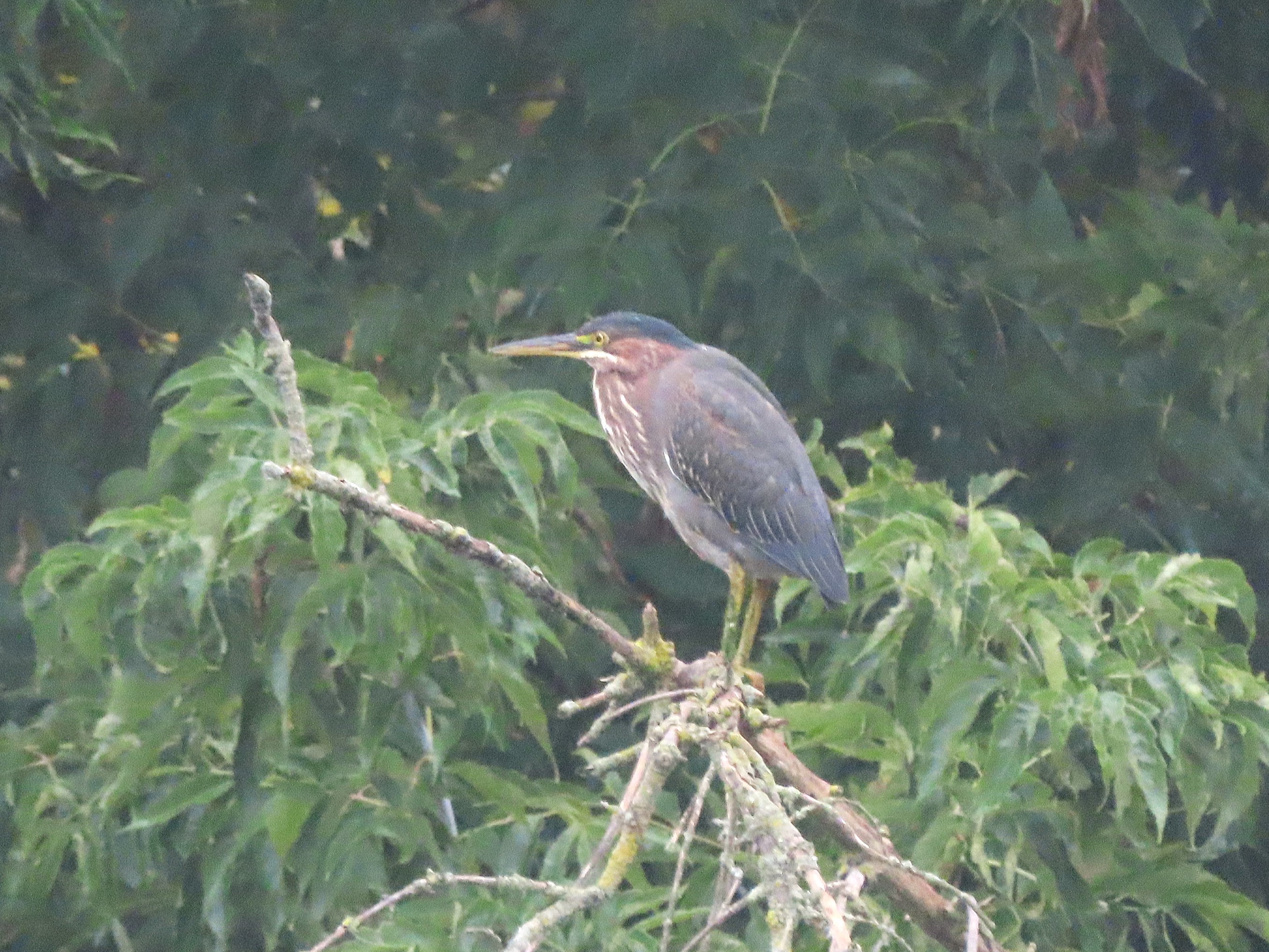
    Today Hermes was doubtless smiling on us, for in mere moments we added Green Heron (Butorides virescens) to complete a trifecta.


     Later in the day we would add yet a fourth, but you'll have to read on to see that one.
     Goldenrod (genus Solidago) looked splendid.


     Every time I come here I am reminded just what a lovely spot it is.


     Mallards take full advantage of floating platforms strategically located along the canal.


     A Pied-billed Grebe (Podilymbus podiceps) put on a show for us nearby.

Photo credit: Dave Collins

     We all heard the characteristic rattle of a Belted Kingfisher (Megaceryle alcyon) as it flew by us at high speed, but very obligingly it perched in a convenient spot.

Photo credit: Dave Collins

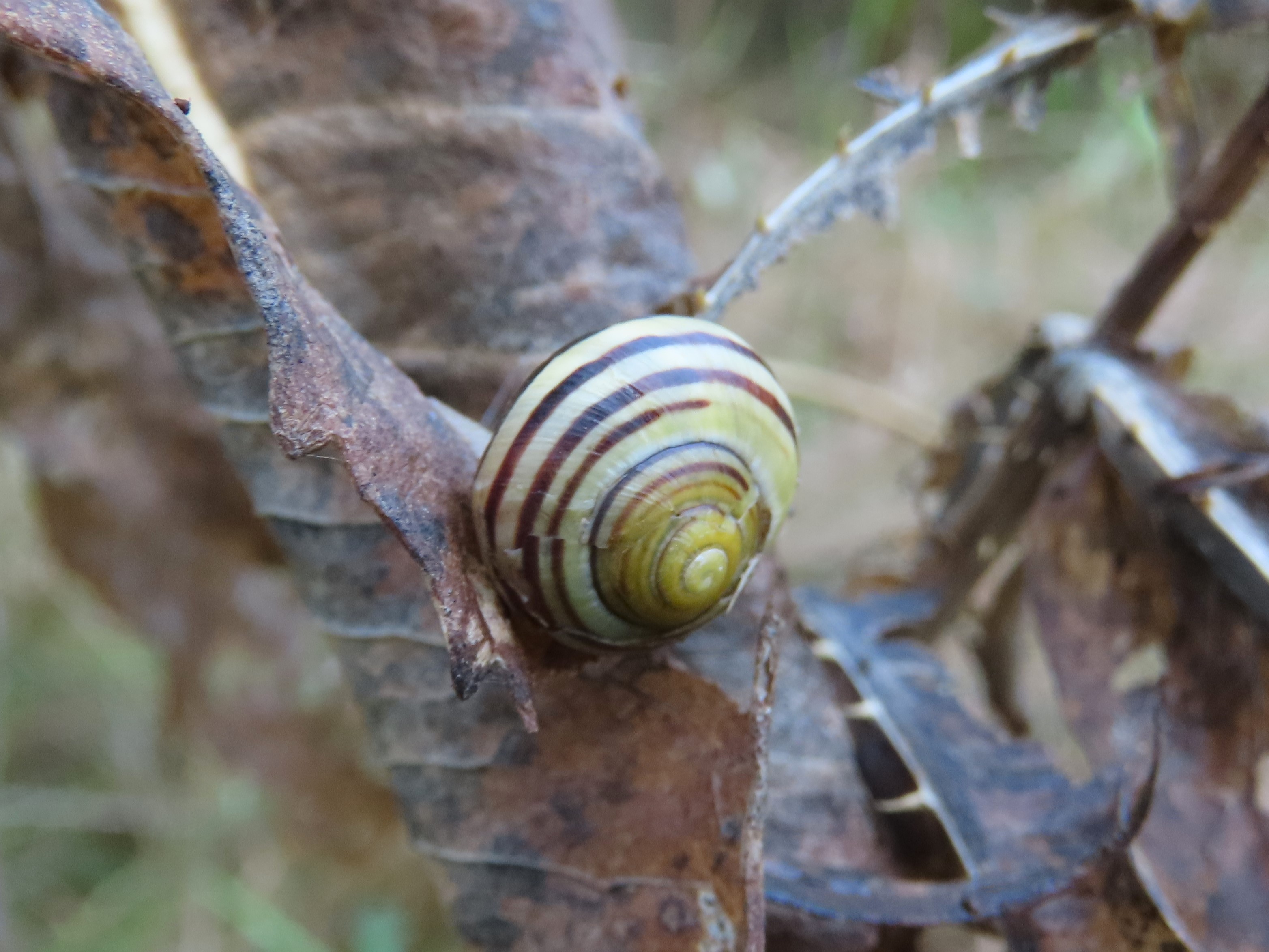
     Land snails in the genus Cepaea were abundant.


     These are either Brown-lipped or White-lipped Snail, but I'm damned if I can ever tell the difference!
     It was Tina's sharp eyes that picked up yet another Green Heron.


     I think we all deserve heron patches to sew on our clothing or backpacks, and I am quite sure Lisa will be organizing this without delay!
      
Urquart Butterfly Gardens, Dundas, ON

     The butterfly gardens were a riot of colour - sensory overload of the very best kind.


     The people responsible for these gardens deserve a good deal of praise, and I am especially happy to see Fred Urquart, a true Canadian hero, memorialized in this way.


     Kuldip had his camera primed and ready.


     On the way back to the car we saw many more snails.


     It will be a happy gang of Cedar Waxwings (Bombycilla cedrorum) who first happen on this Guelder-Rose (Viburnum opulus) - unless American Robins (Turdus migratorius) beat them to the punch that is!


Grindstone Creek, Hamilton, ON


     We were greeted by a tree full of Turkey Vultures (Cathartes aura) enjoying the sun that was now breaking through.


     The marsh is adjacent to a very large cemetery and the presence of congregations of vultures always adds a sense of the macabre.
     A Great Egret (Ardea alba) - our fourth heron species - seemed to be having a chat with a Double-crested Cormorant (Nannopterum auritum).


     Perhaps a spat is about to break out, with piercing cries and slashing bills. 
      Ring-billed Gulls (Larus delawarensis) were loafing peacefully as only gulls can.


     Many Killdeer (Charadrius vociferus) scampered up and down the marsh.


     A Caspian Tern (Hydroprogne caspia) was patrolling the water in search of lunch.


     Several Great Egrets were present, dotted around the shore mostly.

Photo credit: Dave Collins

     A Green-winged Teal (Anas carolinensis) is an exceptionally appealing little duck. Several were spotted quite far out, but this individual was close by and cooperative.

Photo credit: Dave Collins

     A local commuter train went by, perhaps with a load of those people who still have to work. What a shame!


     Retirement is highly recommended!
     A couple of Trumpeter Swans (Cygnus buccinator) preened and primped and never really gave us a great look.


     Sometimes you have to take what you can get!
     A Mallard and a Green-winged Teal were happy to hang out together.


     This Green Heron posed very nicely for us.


     In recent years Great Egrets have become more and more common, and there were several in different parts of the marsh. No doubt a high perch confers an advantage - or so this individual seems to think!


     It will not be long before Ospreys (Pandion haliaeetus) will all have departed for their winter quarters in the south, but this individual still patrolled the water searching for a meal.


     A Grey Catbird (Dumetella carolinensis) remained mostly hidden but revealed itself briefly before disappearing again.


     Mute Swans (Cygnus olor) meandered up and down in all their regal splendour.

Photo credit: Dave Collins

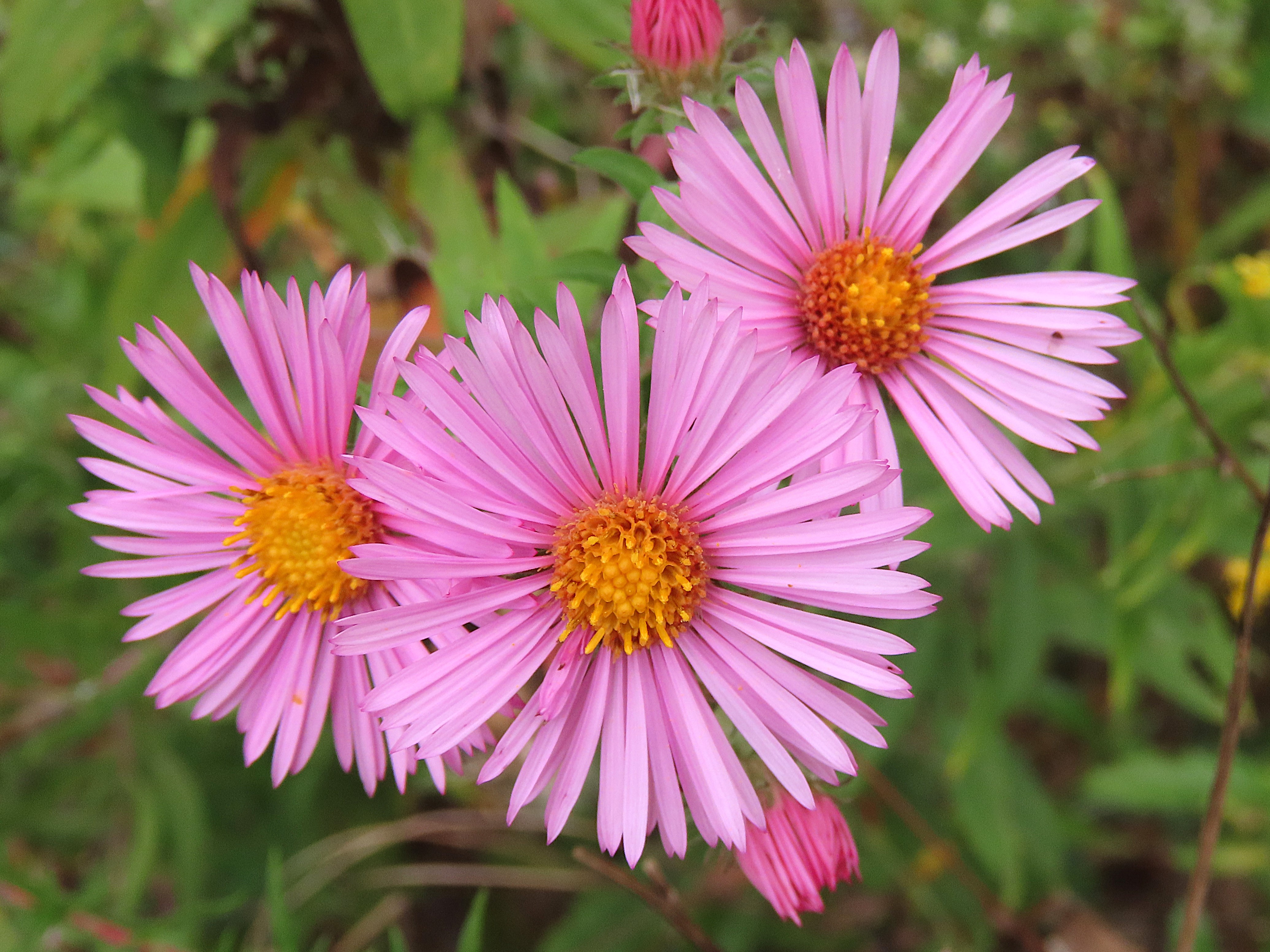
     New England Asters (Symphyotrichum novae-angliae) are just one of the reasons why Ontario is a very special place.


     This Common Eastern Bumble Bee (Bombus impatiens) was in full agreement.


     And so was a Western Honey Bee (Apis mellifera).


     The fishing was good, evidenced by the large number of fish-eating species present together.


LaSalle Park and Marina, Burlington, ON


     Dave and Mary strode purposefully ahead, pausing to scan the lake.


     There were not many birds out on the water, so this Double-crested Cormorant received extra attention.


     This infestation of Wooly Alder Aphid (Prociphilus tessellatus) was quite visible to the naked eye, even at some distance.


     Interestingly, we spotted an Oblique Streaktail (Allograpta obliqua) right afterwards, an insect known to feed on aphids.


     You don't see much of this well-hidden spider, but I believe that it is a Lattice Orbweaver (Araneus thaddeus).


      I was interested to see this unit, recently installed, to encourage fisherfolk to responsibly dispose of unwanted fishing line, the scourge of birds and small mammals.


     I hope that it is used well.
     A pure white form of a Mallard that has been selectively bred by humans is very attractive. It is generally known as a Pekin Duck.


     A Common Raccoon (Procyon lotor) was contentedly snoozing high in a tree.


     Cross Orbweaver (Araneus diadematus) is one of our most common spiders.


     Surprisingly, we did not see any Trumpeter Swans at LaSalle but Mute Swans were quite numerous.


     The larva of an Asian Ladybeetle (Harmonia axyridis) decided to hitch a ride with Miriam.


     Lady beetles we accept with pleasure; ticks not so much!
      Eastern Chipmunks (Tamias striatus) were ubiquitous, always on the hunt for a human laden with peanuts or other tasty treats.


     Here is a dedicated group of birders chatting, discussing, identifying and scanning.


     A lone male Ruddy Duck (Oxyura jamaicensis) was a very agreeable discovery - and another lifer for several members of the group.

Photo credit: Dave Collins

     And to round out the walk as we strolled back to the car, a Typical Funnel Weaver (family Agelenidae).


Paletta Park, Burlington, ON

     Like other locations, the passage of migratory songbirds was virtually non-existent at Paletta, and there does seem to be a general reduction in numbers this fall. This is, of course, in line with the alarming declines of bird populations overall, a universal phenomenon.
     A Double-crested Cormorant perched delightfully, in full sun, on a high branch.


     Common Eastern Bumblebee once again exploited goldenrod.


     A Song Sparrow (Melospiza melodia) was having a vigorous bath, and we all enjoyed seeing the sheer ebullience with which it went about its task.


     Cepaea snails were easily seen.


     Stands of Tall Blue Lettuce (Lactua biennis) look quite bizarre and triffid-like.


     Right at the end of the trail a Downy Woodpecker (Dryobates pubescens) put in a brief appearance.


Bronte Harbour, Oakville, ON

     We were greeted by a very handsome Ring-billed Gull.


     The aim of our quest at Bronte was Red-necked Grebe (Podiceps gisegena) and we were royally rewarded, as an adult and a well-developed youngster put on quite a show for us.


     A Great Blue Heron was not the centre of attraction while the grebes were in play.


     A small squadron of Canada Geese (Branta canadensis) looked very grand as they sailed by.


     Carolina Grasshoppers (Dissosteira carolina) were hopping all over the rocks, no doubt providing nutritious food for the gulls.


     Bittersweet Nightshade (Solanum dulcamara) is very beautiful.


     Adult grebes are known to provide feathers to their young to be swallowed as a stomach lining, to protect against penetration by sharp fish bones. We were elated to see this exchange taking place.


     A Ring-billed Gull loafed on the grass.


     People install decoy owls around their boats in the harbour and they are quite useless. I think it takes the gulls an hour at most to figure out that the owl is not real and they waste no time in perching next to it.


     Mostly the gulls were ringbills but several American Herring Gulls (Larus smithsonianus) stood out.


     It is a big bird!
     This was our final stop on what had overall been a very fine day, with many highlights, not least of which was the sheer enjoyment of being with like-minded people. 
      Let's do it again soon!

Land Acknowledgement

We acknowledge that the land on which we are situated are the lands traditionally used by the Haudenosaunee, Anishinaabe, and Neutral People. We also acknowledge the enduring presence and deep traditional knowledge, laws, and philosophies of the Indigenous Peoples with whom we share this land today. We are all treaty people with a responsibility to honour all our relations.

Followers