Showing posts with label Ethiopia. Show all posts

Sunday, December 13, 2020

Marabou Stork (Marabout d'Afrique)

      It is perhaps better that you have lunch before continuing with this account of what might be, by any reasonable standard, one of the ugliest birds in the world!
     I give you the Marabou Stork (Leptoptilos crumeniferus).


     It has been referred to by several authors as 'a gaunt-looking object at the best of times', 'the world's ugliest bird', 'entirely lacking any charm', 'stiff-jointed and dried up as though it had lived for a thousand years', or, 'a dirty old man with a skin disease of the scalp.'
     Ironically, it was when watching a couple of particularly loathsome politicians on television a few nights ago, that my thoughts turned to my encounters with this species in Ethiopia in 2014.


     The pair above might be deemed salutary by the standards of the current batch of political ne'er-do-wells, male and female alike.
     Unlike politicians, however, they are not usually first at the trough, and often wait for other scavengers to do the tough work of tearing into a carcass, daintily gathering whatever morsels they can glean. 
     They may often be found foraging with African Sacred Ibis (Threkiornis aethiopicus), and can pick off insects in the most delicate fashion, despite their huge bill.


       This female is perhaps searching for whole vertebrate food to feed her nestlings. Studies have shown that only in this manner can the developing young get enough calcium to successfully reach adulthood. 


     Adults also regurgitate water for their young to ward off dehydration.
     As you may gather, they are dedicated parents.
     When I saw Marabous, they were often in association with Great White Pelicans (Pelecanus onocrotalus).


     Both species, as well as Sacred Ibis and Hamerkop (Scopus umbretta) showed no hesitation to congregate with people wherever the opportunity for food scraps presented itself.


Hamerkop

     The people cleaning the fish appeared totally indifferent to the hundreds of birds milling around them, squabbling over the food scraps tossed their way. They have probably gathered together in this manner for hundreds of years.
     Some females foraged at the water's edge, doubtless seeking whole fish to feed to their young. A sudden snap of the bill announced success.


     However ungainly Marabous may appear on the ground, they have complete mastery of the air, soaring effortlessly on the thermals generated by the convection currents rising from the hot African soil


     Marabou Storks both construct their nests, and roost high in trees, sometimes in sizable colonies.


     It is not the prettiest bird in the world, and is never going to initiate the ooh and ah reaction that songbirds do, but give a kind thought to them anyway.


     Like all of us they are just trying to maintain a home and raise the kids. Surely that merits our admiration - or at the very least our understanding and sympathy. Long live the Maribou Stork!

Tuesday, May 06, 2014

Wire-tailed Swallow

Wire-tailed Swallow Hirundo smithii
Melka Gebdu, Ethiopia
29 January 2014

    This was my penultimate day in Ethiopia and we were heading back to Addis Ababa for our flights home the following day. We stopped for lunch in a secluded spot along a river gorge where we appreciated the minimal amount of cool breeze the river afforded us, for the temperature registered 44 degrees.
    The area was filled with birds, not the least of which was this Wire-tailed Swallow, of which we had fine views as it perched under a rocky overhang. We had encountered this species a couple of times previously, but in flight the chestnut head and fine streamers are not easy to detect. This was clearly a grand opportunity to see the bird well.


Lichtenstein's Sandgrouse

Lichtenstein's Sandgrouse Pterocles lichtensteinii
On the road to Weliso, Ethiopia
26 January 2014

    We had just two encounters with this enigmatic species, which, despite its colourful apperance is able to conceal itself very well. I have seen several species of sandgrouse but I think that this one surely ranks as the most interesting.I consider myself fortunate to have seen it.


Thursday, April 17, 2014

White-headed Buffalo Weaver

White-headed Buffalo Weaver Dinemellia dinemelli
Bilen, Ehtiopia
23 January 2015

    We saw this handsome species on numerous occasions during our journey through Ethiopia and it was never shy around human settlement. It forages on the ground for insects, especially beetles and butterflies. Breeding pairs are monogamous and build their nest together.


Monday, April 14, 2014

Northern Carmine Bee-eater

Northern Carmine Bee-eater Merops nubicus
Awash Falls National Park, Ethiopia
23 January 2014

    Surely one of the most beautiful birds in all the world, I found Carmine Bee-eater to be one of the most memorable species I have ever seen. Gregarious and confiding, they seemed not to be at all affected by our presence and we were thrilled at the large numbers we saw. I think I would have been quite happy to have simply watched them all day!


Awash Falls National Park

Awash Falls National Park, Ethiopia
23 January 2014

    There were huge numbers of Abdim's Stork Ciconia abdimii in appropriate habitat at Awash Falls National Park, often in close association with African Sacred Ibis Threskiornis aethiopicus and Egyptian Goose Alopochen aegyptiaca.
   They were prone to flush at the slightest provocation, usually undetected by us.

Abdim's Storks in flight

Abdim's Storks in flight

African Sacred Ibis with Egyptian Goose
   
Abdim's Stork with Africa Sacred Ibis
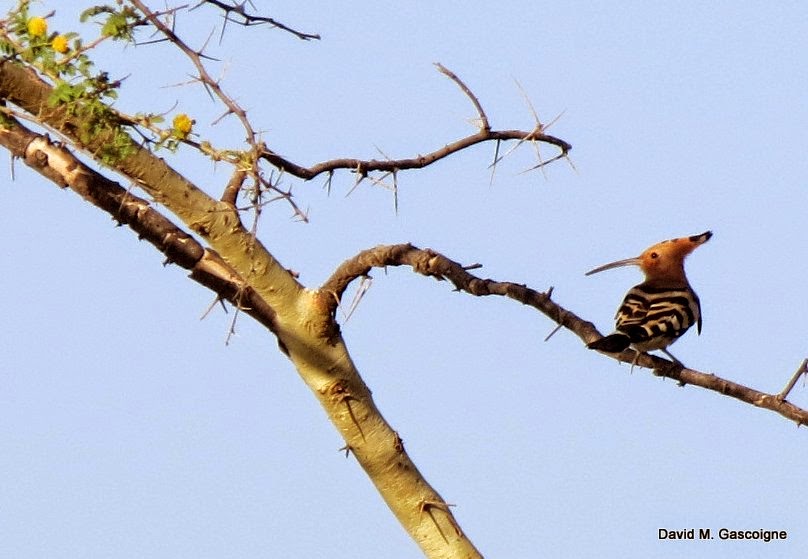
    We saw Eurasian Hoopoe Upupa epops quite frequently although rarely in a position for a decent photograph.


Wednesday, April 09, 2014

Abyssinian Roller

Abyssinian Roller Coracias abyssinicus
Awash Falls National Park, Ethiopia
23 January 2014

        Rollers as a group are nothing short of spectacular, but I am inclined to think that the Abyssinian Roller is perhaps the most stunning of all. Whenever I saw one with the sun glistening off its plumage it simply took my breath away. In this area they were reasonably common so we had lots of opportunities to revel in their beauty. 
      Their usual habitat is dry woodland with well spaced trees, but they take readily to human settlements and are not particularly shy. They will nest on buildings and tolerate pets, humans and vehicles.


Sunday, April 06, 2014

Lake Abijata, Ethiopia

Lake Abijata, Ethiopia
22 January 2014

   The extensive shoreline of Lake Abijata, a shallow lake situated in the Rift Valley, had a great variety of avifauna and we spent a very productive half day there. 
    Grey Heron Ardea cinerea was quite common and seemed to find an abundance of prey at the water's edge.


    A Speckled Mousebird Colius striatus was tugging away at this hawser and appeared to be gleaning strands of the rope for nest building I assumed.


    Egyptian Goose Alopochen aegyptiaca was a very common species, seen throughout the country. Here it is seen with with Greater Flamingos Phoenicopterus roseus.


    At times it seemed that wherever one looked there were Western Yellow Wagtails Motacilla flava, but it was frustratingly difficult to photograph one for it seemed they never stayed still for a moment.


    The local African Fish Eagles Haliaeetus vocifer have developed a taste for flamingos and seemed to have a good deal of success in capturing them. This is all that was left of a recent kill. No doubt whatever the eagle might have left was rapidly cleaned up by Marabou Storks Leptoptilos crumenifer.


    As we were leaving we were delighted to see these two Somali Ostriches Struthio molybdophanes moving across the grassland. 


Thursday, April 03, 2014

Greater Flamingo

Greater Flamingo Phoenicopterus roseus
Lake Langano, Ethiopia
22 January 2014

    A spectacular bird unto itself, large flocks of Greater Flamingo are a true spectacle of nature. When massed together they seem to be a sea of pink, undulating in the shallows as they move in unison to feed. Their bills sweep back and forth at the surface as they sieve small invertebrates from the water. They are also capable of upending like ducks in deeper water and despite their long, thin legs are competent swimmers when they need to be.
    Whenever we saw flamingos, Marabou Storks Leptoptilos crumenifer patrolled the edges of the lake, feeding on carcasses of dead flamingos, and waiting on every opportunity to seize and kill an injured bird.


Tuesday, April 01, 2014

Red-breasted Wheatear

Red-breasted Wheatear Oenanthe  bottae
Bale Mountain National Park, Ethiopia
14 January 2014

    I have been posting the birds of my Ethiopian odyssey in chronological sequence, but somehow I missed this one from the 14th January. The Red-breasted Wheatear is a bird of high altitude grasslands so it was clearly at home on the high plateau of the Bale Mountain National Park. In its restricted habitat we saw it quite commonly, but once we descended to lower altitudes sightings of this species ceased.

Checking left.

Checking right.

Monday, March 31, 2014

Broad-billed Roller

Broad-billed Roller Eurystomus glaucurus
Bishangari, Ethiopia
21 January 2014

    This was our only sighting of this small, compact roller. A pair was perched near the top of a solitary tall tree, a behaviour typical of this species. In Ethiopia they tend to frequent thick savannah woodland and open plains with scattered trees. 

Male

Male left, female right

Preening

Sunday, March 30, 2014

Black-headed Oriole

Black-headed Oriole Oriolus larvatus
Dilla, Ethiopia
20 January 2014

    This species frequents dry forest, especially acacia and broadleaf woodlands, and dense shrubby areas. Despite its striking colour it is more often seen than heard, camouflaging well in the foliage where it gleans insects and their larvae. This single bird represented the only reasonable photographic opportunity we had, but it did not perch for long and one had to be content with a few quick shots.


Saturday, March 29, 2014

Shikra

Shikra Accipiter badius
Bure Hora, Ethiopia
20 January 2014

    Shikra is a small accipiter (25 - 30cm) found in parts of Asia and over a good deal of Africa. Its preferred habitat is dry, open woodland, with trees, riverine forest, even orchards or similar areas of cultivation. Unlike other accipiters its principal diet is comprised of small lizards and insects, although in true accipiter fashion it will take small birds, and even raids nests.
    It uses a perch in dense foliage from which to make a rapid dash to seize its prey, although in areas of human habitation it will perch more openly and rush onto a building to grab a lizard from the wall.


Red-bellied Parrot

Red-bellied Parrot Poicephalus rufiventris
Bure Hora, Ethiopia
20 January 2014

    The principal range of Red-bellied Parrot is in the Horn of Africa, but it also occurs in NE Tanzania, E and N Kenya. It favours dry bush and wooded country and it was exactly in this kind of habitat that we located it. This was the only day on our trip that we were able to see this species.


    The following picture has little merit photographically, but it does show the green on the lower belly and undertail.


Thursday, March 27, 2014

Nubian Woodpecker

Nubian Woodpecker Campethera nubica
Yabello Area, Ethiopia
19 January 2014

    Nubian Woodpecker was quite common in some of the areas we visited in Ethiopia. It is a small woodpecker of drier bushland and riverine woods. The bird shown in the following pictures is a female.


Land Acknowledgement

We acknowledge that the land on which we are situated are the lands traditionally used by the Haudenosaunee, Anishinaabe, and Neutral People. We also acknowledge the enduring presence and deep traditional knowledge, laws, and philosophies of the Indigenous Peoples with whom we share this land today. We are all treaty people with a responsibility to honour all our relations.

Followers