As travel continues to be severely restricted in the Province of Ontario, I am presenting once again tidbits from several local excursions.
11 April 2021, Benjamin Park Trail, Waterloo, ON
As I have mentioned before, this trail is directly behind our house, and we have walked it scores of times over the years, in all its seasons.
We came across this female Downy Woodpecker (Dryobates pubescens) asleep on a branch, head tucked into its scapulars.
We observed it for a few minutes until it awoke from its slumber and moved upwards ever so slightly.
Perhaps a nearby male had something to do with it, perched on a stout branch with its stiffened tail feathers acting as a prop.
This closeup of the zygodactyl configuration of a typical woodpecker foot (toes 2 and 3 forward, 1 and 4 backwards) is not the clearest illustration I might have hoped for, but it will serve the purpose.
13 April 2021, Benjamin Park Trail, Waterloo, ON
It is rarely that we walk along this trail without seeing and/or hearing several Northern Cardinals (Cardinalis cardinalis). This male was doing his best to impress a female, but at the time we observed she was having none of it.
Eastern Garter Snakes (Thamnophis sirtalis sirtalis) have recently emerged from their hibernacula where they have spent the winter months below the ground, and we were very happy to see our first individual of the spring.
These delightful snakes are harmless and should be left alone to go about their business, occupying their role in a healthy ecosystem.
We were careful not to startle it with any sudden movement and it remained in position for several minutes, finally entering the narrow creek and swimming across to the opposite bank where it disappeared into the undergrowth.
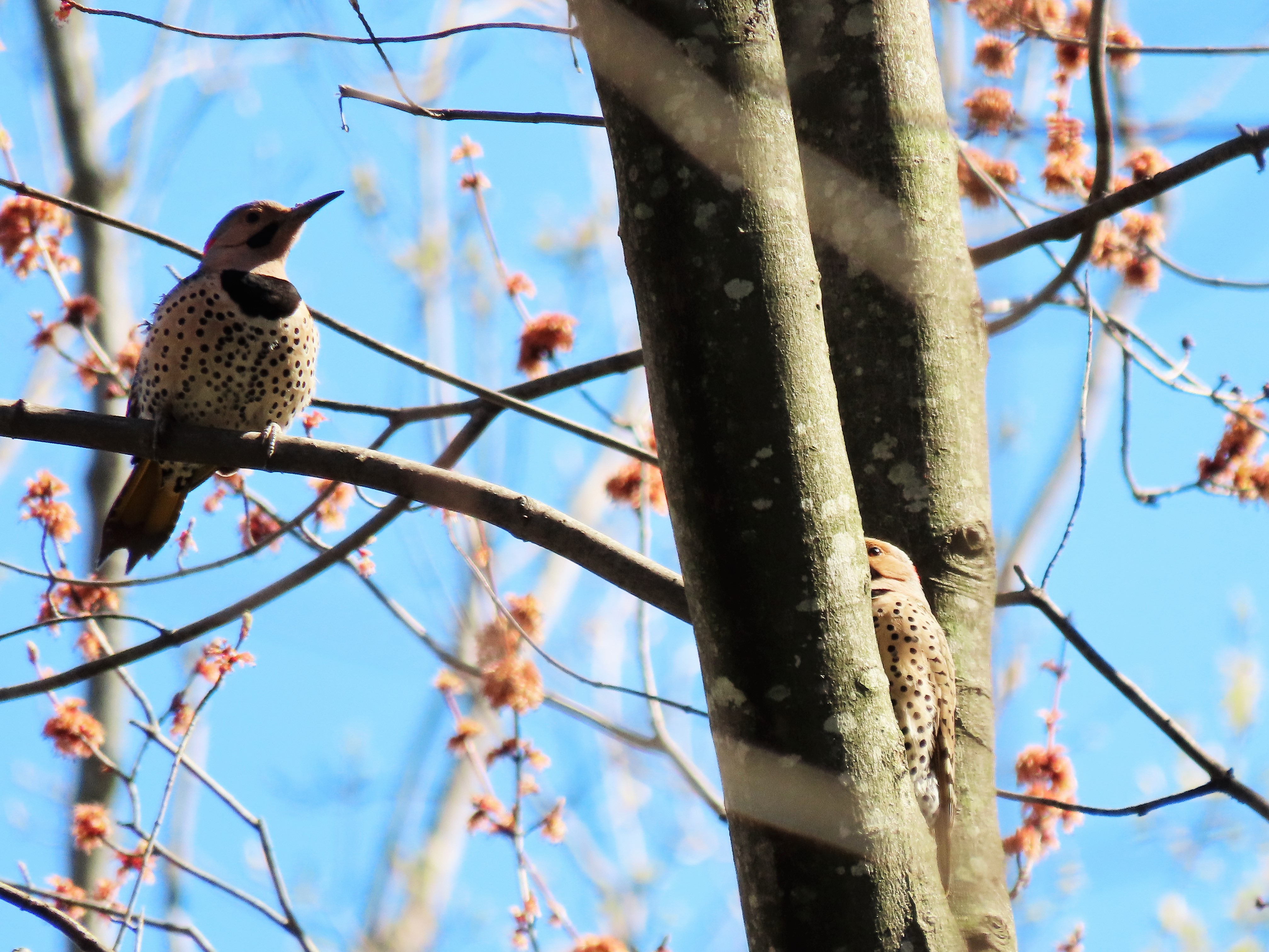
There were Northern Flickers (Colaptes auratus) aplenty, including this handsome male.
But the flickers that put on a show for us were two males, that we initially thought were a male and a female engaged in courtship displays.
There was much head bobbing and ritualized shaking of the body and thrusting motions, with tail fanned.
You can see the second bird, which we had concluded was the female, wedged in the fork of the tree. The individual on the left always seemed to initiate the movements, followed by an almost identical response from the other.
Gradually the bird at the right emerged from its protected position, clearly revealing itself to be a male, and the posturing continued, but we never saw actual contact.
Abruptly one bird flew off, and we observed what appears to be the cause for the dispute between two males.
We are not sure whether possession is nine tenths of the law, or whether at some point one male acknowledged defeat in some manner lost to us, but no challenge was mounted once one male claimed the nest cavity.
We watched this activity for close to fifteen minutes and were fascinated to witness behaviours we had not previously been privilege to, having seen hundreds of flickers over the years. Between the Garter Snake and the flickers our day was capped with the seal of excellence.
Our first Purple Finch (Haemorhous purpurea) of the year, a handsome wine-dipped male, was the olive in the martini, so to speak.
A Star Magnolia (Magnolia stellata) is an early bloomer and we were treated to a magnificent display.
14 April 2021, Lakeside Park, Kitchener, ON
Today found us at Lakeside Park in Kitchener. We have two good friends whose homes back onto the park and under normal circumstances we could have dropped by for a visit, but COVID kills those opportunities. Damn this pandemic!
A Ruby-crowned Kinglet (Regulus calendula) was not concerned about COVID but nevertheless showed a great reluctance to show itself well and get close to us!
A pair of Pied-billed Grebes (Podilymbus podiceps) was courting out on the lake, but we were never quick enough with the camera to capture them together.
Red-bellied Woodpecker (Melanerpes carolinus) was the dominant picid and I don't think we were ever out of earshot and we saw several.
It was very agreeable to see our first Midland Painted Turtle (Chrysemys picta marginata) hauled out on a log to catch the warming rays of the spring sun.
The subject of urban tree cover and the range of species in a city is the subject of great debate in recent times, and the City of Kitchener is aggressively attempting to restore natural balance to the areas under its jurisdiction, an action to be greatly applauded.
This Big-toothed Maple (Acer saccharum grandidentatum) looked like a monster tree that surges menacingly through the forest in an animated film for children.
It has awakened from its winter slumber and is welcoming spring as it always does, and I suspect it will not be trundling anywhere!
There were many pleasant side trails that invited exploration.
Common Starling (Sturnus vulgaris) is a handsome bird that evokes the ire of many.
It is not native to North America, but it was deliberately introduced by nostalgic immigrants and has thrived in ways that no one might have imagined. Unfortunately, it is an aggressive species and fights tenaciously for nesting cavities and is adept at supplanting native species.
Cavities are in short supply, and once a pair of starlings has successfully taken up occupancy they are impossible to remove. We witnessed a ferocious tussle going on between a pair of starlings and a pair of Red-bellied Woodpeckers over a cavity which the woodpeckers had excavated.
There was no clear victor at the time we left, but neither side appeared ready to concede defeat.
There are starling haters who despise them with a passion so intense it is hard to accept. I am not one of them, but I freely confess that I hope the woodpeckers maintained the home they had worked so hard to create. House Sparrow (Passer domesticus) is another species introduced into North America by early acclimatization societies, and it too has become ubiquitous across much of the continent. It is equally proficient at displacing native species and represents a serious threat to Tree Swallows (Tachycineta bicolor) and Eastern Bluebird (Sialia sialis) among others.
A pair has claimed this nest box. I know you are all waiting for my next example of avian feet - so wait no more!
Here is the palmate configuration of a male Mallard (Anas platyrynchos), with toes 2, 3 and 4 fully webbed, with 1 (the hallux) facing backwards.
And to enhance your pleasure even more, I present the foot of a female, and you also have a wonderful view of the speculum.
I think that the drake had had enough of this voyeurism and sat down to conceal his feet from my prying eyes!
14 April 2021, Waterloo, ON
Less than ten minutes from our home, behind the local library, a pair of Western Ospreys (Pandion haliaetus) has successfully raised young for years.
One might be forgiven when driving by to conclude that they have returned this year, but a close examination reveals that it is a Red-tailed Hawk (Buteo jamaicensis) that has been frequently seen.
Ospreys have been reported from several locations but there has been no sign of them here, and I am wondering whether we are going to enjoy their presence this year. I am sure that a pair of ospreys would have no difficulty driving off a Red-tailed Hawk.
17 April 2021, Benjamin Park Trail, Waterloo, ON
The trail was exceptionally quiet today, but just before actually entering it, we were happy to first hear, and then locate, our first Chipping Sparrow (Spizella passerina) of the year.
We expect them soon to be a fixture in our backyard. To miss an American Robin (Turdus migratorius) at this time of year I think you would have to walk blindfolded with your ears plugged!
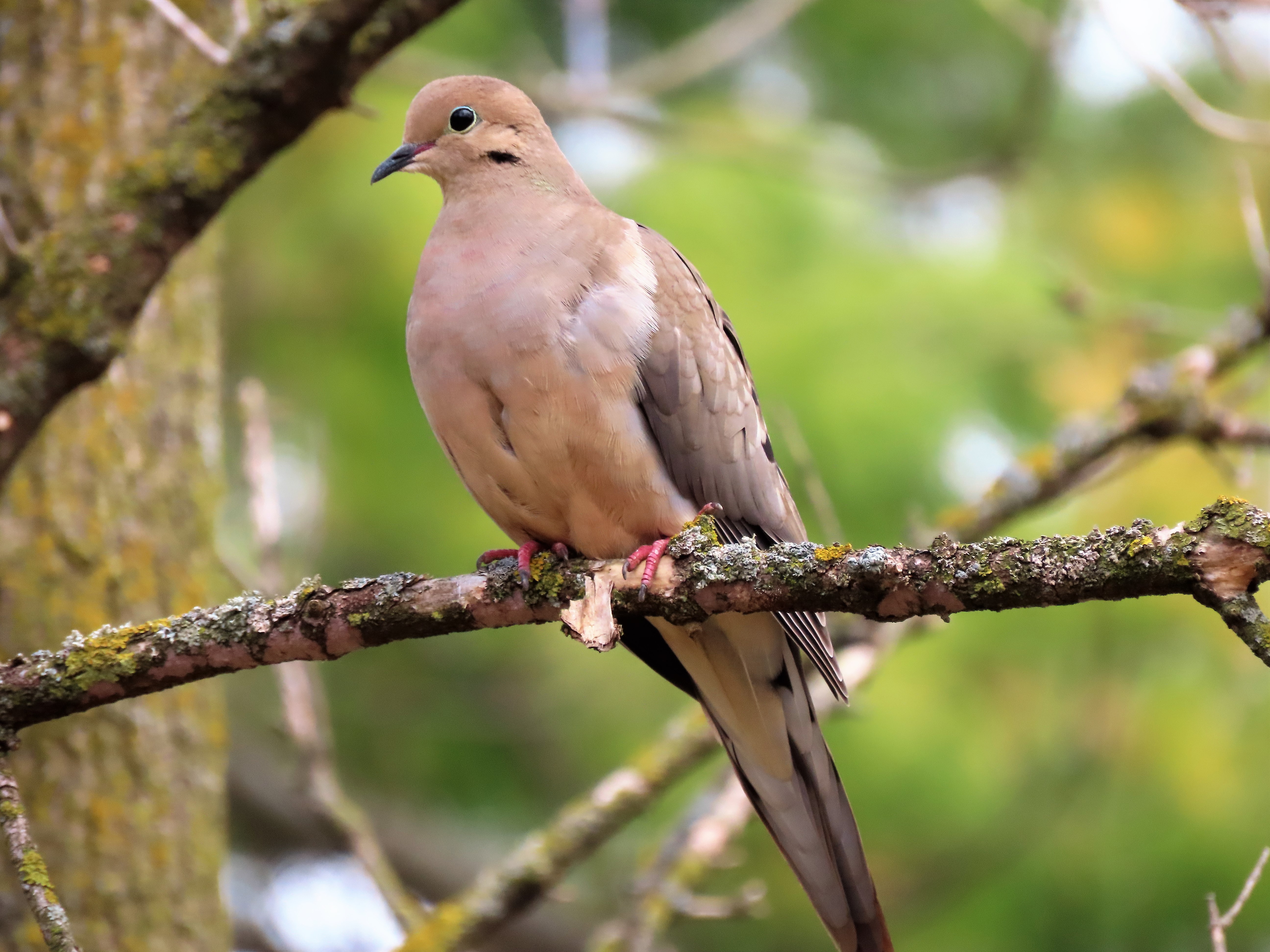
Mourning Dove (Zenaida macroura) is always stately and beautiful.
19 April 2021, St. Jacobs, ON
We decided to drive into the country a short ways and have our coffee and muffins there.
A Savannah Sparrow (Passerculus sandwichensis) doubtless approved of our choice and sang to us for a while.
A Red-tailed Hawk meantime, scanned the terrain to see what might be on the menu for its mid-morning snack.
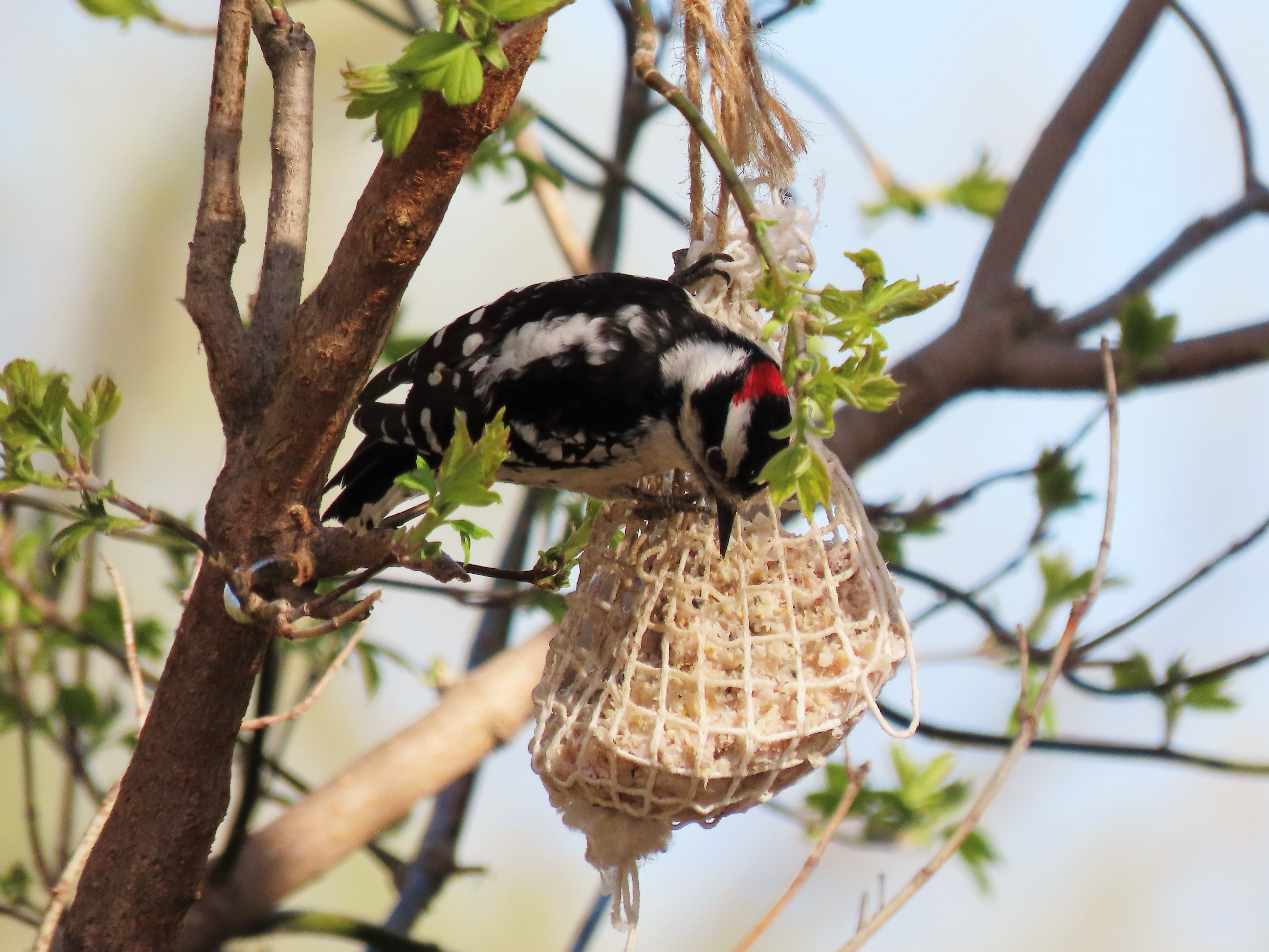
A kind bird lover had hung a ball of suet on a tree and a Downy Woodpecker was taking full advantage of it.
A Red Fox (Vulpes vulpes) had also found food to its liking.
A couple of farms along Three Bridges Road have erected substantial structures to attract Purple Martins (Progne subis) and I have no doubt that the owner of this condominium was happy to see a pair checking out the accommodation.
Ironically the focus of our attention for a good part of the time we were out was the presence of two church services that were total contrasts in social and civic responsibility. The local Mennonite community, that rejects the trappings of what we would refer to as civilization, does not have the option to conduct on-line religious observance, so worship has of necessity to be actual.
The elders of the Old Order Mennonites have been in consultation with the local health department and have come to an arrangement to conduct open air services in a safe manner.
Families are required to stay together and they may sit in their buggies and participate in worship in the same manner as they would indoors.
We noticed that even when the Mennonites hitched their horses, they were led singly, and spacing was maintained so that members of different families did not come into close contact with each other. This behaviour was in total contrast with Trinity Bible Chapel, a local bastion of right-wing Christian extremism, that has defied COVID restrictions on assembly from the very beginning.
The church has already been fined many thousands of dollars, yet continues to conduct services in total defiance of provincial regulations. The Attorney General of the Province of Ontario sought to have the doors barred, but this request was denied by a local judge, pending further clarification, and the case is due back in court.
As you may see, there is no shortage of parishioners willing to flout the law and join with their pastor in this act of civil disobedience, and utter disregard for the health and well-being of the community.
When the congregation left the church there was not a mask in sight.
All of these people have been exposed to each other and are now going out into the community to potentially infect innocent citizens who are doing their best to ensure the safety of themselves and their neighbours. If the conduct of this group is not the very definition of a super-spreader, I am not quite sure what is. It is beyond my level of comprehension that people who are perhaps rational in other aspects of their lives will participate in conduct that is clearly reckless, not only to themselves but to the community at large.
What we witnessed was the end of the first service, the second was about to take place. It is sheer madness, and I hope the authorities can shut down them down soon. Believe whatever you want, but don't inflict the folly of your stupidity on your fellow Canadians. Your conduct is nothing short of obscene.