03 April, 2023
At Home, Waterloo, ON
Miriam's crows still regard her as their own personal St. Francesca of Assissi and call to her persistently until she responds with food, not neglecting to chat for a while, however.

What handsome, intelligent birds they are.

We have been unable to identify one individual from another, seeing no marks that would permit this, but some still display great wariness when approaching the food, often sidling up to it, so perhaps a new bird is permitted to join the regulars from time to time.

In case you are wondering what this food is, it is chicken fat skimmed from the top of the broth when we make chicken soup. Then it is frozen and cut into cubes and all indications are that it is their favourite item. If it is offered along with other morsels the chicken fat is snatched up and eaten first.
We often remind ourselves how incredibly blessed we are to share our lives with crows.
08 April, 2023
At home, Waterloo, ON
Song Sparrow (Melopsiza melodia) is a frequent visitor to our backyard, always very welcome, of course.

Squirrels can do serious damage to a wooden fence, and often they prove the point, for no other reason it seems than they can.

22 April, 2023
At home, Waterloo, ON
Some robust White-throated Sparrows (Zonotrichia albicollis) spend the winter here, but most move farther south and return in the Spring.

As soon as the first one puts in an appearance in the yard, they are joined by others in short order, and one day we had six at the same time.

An American Robin (Turdus migratorius) displays no hostility towards them and they are happy to forage side by side.

15 April, 2023
The Linear Trail, Cambridge, ON
Barely had we entered the trail than we saw our first Red Admiral (Vanessa atalanta) of the spring.

It actually led Miriam on quite a merry chase, stopping for only the briefest moment, until finally it decided that this bark was where it wanted to rest for a minute or two.
An American Herring Gull (Larus smithsonianus) was, by comparison, a model of cooperation.

Several Buffleheads (Bucephala albeola) cruised up and down the water, including these very smart males.

Hermit Thrush (Catharus guttatus) is always the first of the Catharus thrushes to arrive back in southern Ontario, and we were charmed by our first sighting of 2023.

A group of Canada Geese (Branta canadensis) was the very image of riverine tranquility.

Would that I were an artist to render such a scene in delicate watercolours.
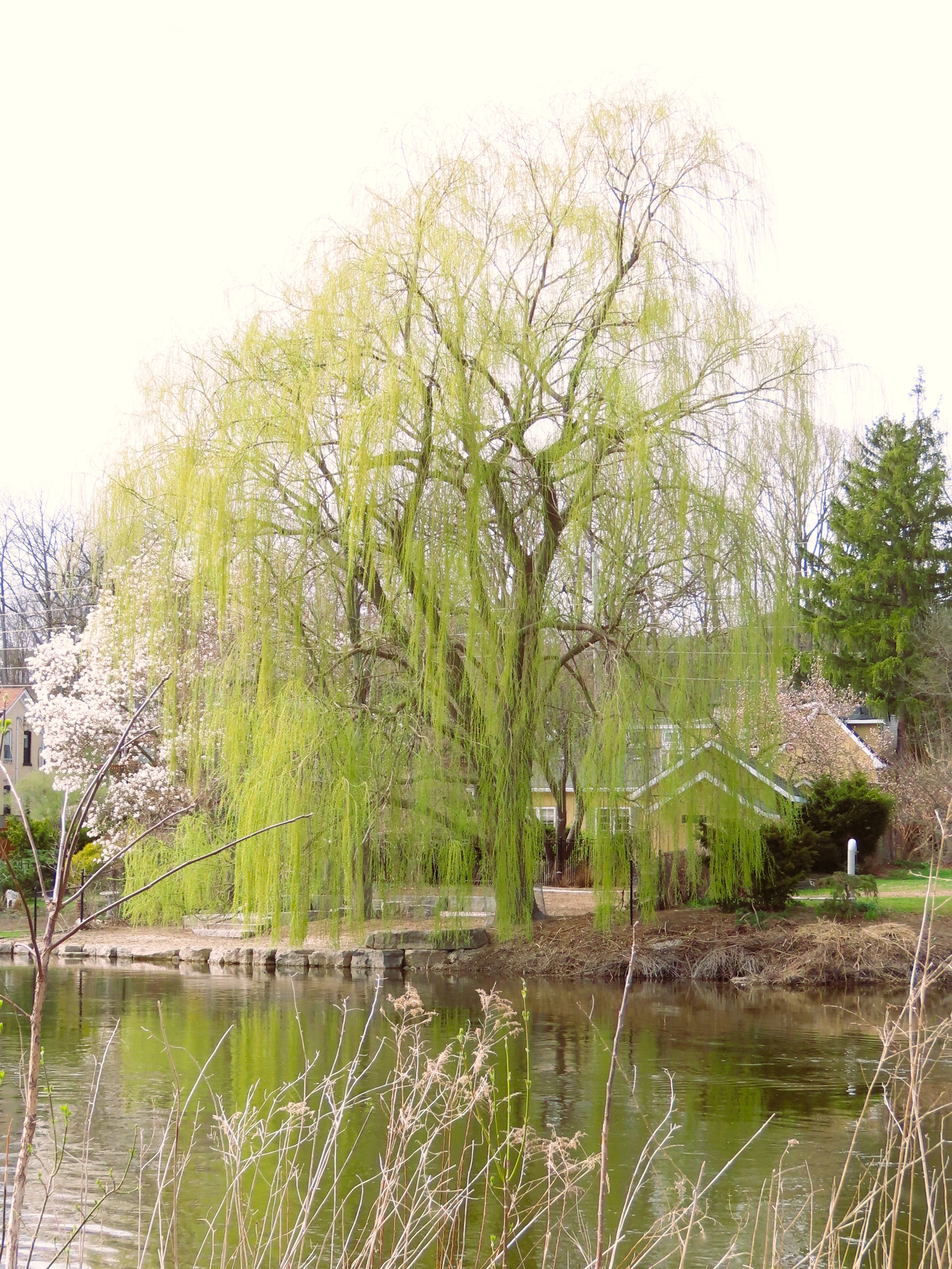
Weeping Willows (Salix babylonica) leaf out earlier than most trees and look so grand and stately.
A Belted Kingfisher (Megaceryle alcyon) had captured a good-sized fish, and was about to have a sushi lunch!

The expansive pallette of nature's art is always on display, and this fallen tree make a very attractive tableau.

Box Elders (Acer negundo) are bursting forth and they are nothing short of magnificent.

I doubt that a tree can become complacent, but better stand on guard in any event. Box Elder Bugs (Boisea trivittata) are poised to wage war on them.

Actually these insects do little damage to the tree, but they do cause deformities and discolouration in fruit.
Who does not love a Common Dandelion (Taraxacum officinale)?

Far too many, unfortunately. The way that the poor dandelion has been attacked, uprooted, poisoned, and in every other way possible subjected to hostility and aggression, would rank as bigotry and persecution of the most heinous kind in human relationships.
Bloodroot (Sanguinaria canadensis) is consistently one of the first of the spring ephemerals to burst into bloom, and for that reason alone (quite apart from its singular beauty) is greatly loved by everyone.

16 April, 2023
Benjamin Park Rail, Waterloo, ON
The trail looks quite bare so early in the Spring, but hints of green are announcing the season.

A Two-spotted Bumble Bee (Bombus bimaculatus) was wasting no time, nectaring on the early blooms.

Siberian Squill (Scilla siberica) is a very attractive flower, found early and found often.


One is never out of earshot, and seldom out of sight of an American Robin - or two or three.

Daffodils (genus Narcissus) show themselves so brightly and boldly in the woodlands, courtesy of squirrel gardeners in all probability.

Magnolias (genus Magnolia) have also migrated by one means or another from suburban garden to wild woodlot.

17 April, 2023
Martin Creek Road, Woolwich Township, Region of Waterloo. ON
In contrast to most woodpeckers, Northern Flicker (Colaptes auratus) feeds on the ground, often searching for ants, but not rejecting other arthropod morsels that might cross its path.

17 April, 2023
Mill Race Trail, St. Jacobs, ON
American Beaver (Castor canadensis) specializes in landscape reconfiguration and no attractive bit of food or ornamentation escapes its attention!

In this case most of the edible bark has been stripped and consumed and it looks as though the branch was destined for use in the dam, but the beaver got distracted twice.
Honeysuckles (genus Lonicera) are emerging.

Male Northern Cardinal (Cardinalis cardinalis) are charged with spring lust and are everywhere competing for the attention of willing females.

The female below seems to have been occupied with other matters and had little time for our Lotharios - at least for now.

A White-breasted Nuthatch (Sitta carolinensis) is infrequently seen on the ground, but if food is to be had there better go and get it.

Here it is seen in a more usual posture, exploring every nook and cranny of the bark of a tree.

There are other outings to report on, but this post is quite long enough so I will save them for the next episode. In the meantime, enjoy nature to the fullest while protecting and nurturing it. It needs all the help we can give it.