Showing posts with label Alan Morgan. Show all posts

Monday, October 17, 2022

The Waterloo Geo Time Trail

      Miriam and I have known of the existence of the Waterloo Geo Time Trail for some time, but inexplicably had never visited it until recently. It is in fact a lovely trail, in a loop slightly under 5km and we have now done it twice, the first occasion just the two of us and a second time with our good friend, Judy Wyatt.

04 October, 2022


     Almost immediately on entering the trail there is a fairly extensive pond.


     The colours of fall were showing nicely, but I doubt that the mixed flock of Mallards (Anas platyrynchos) and Canada Geese (Branta canadensis) were impressed.


     It was not long before cheery Black-capped Chickadees (Poecile atricapillus) came to greet us.


     White-throated Sparrows (Zonotrichia albicollis) migrate south through southern Ontario in October and they were hard to miss as they foraged at the edge of the paths, darting in and out of cover.


     There is a glorious forested section with huge trees towering above the ground.


     Intermediate Wood Fern (Dryopteris intermedia) was prolific - and graceful too I might add.


     Take another look at the forest and bask in its magnificence. 


     Who would not wish to walk through there and imbibe all the therapeutic benefits a forest delivers, both mental and physical? In recent years much has been made of the ancient Japanese practice of "forest bathing" and other quasi-metaphysical approaches to trees, but I think that those of us who have spent our lives in woodland habitat knew instinctively that it was life-affirming, without ceremony or alleged spiritual connection. 
     Surprisingly I saw very little fungi, although this may be the result of not looking carefully enough. I believe the following example is in the genus Hericium, a member of the Tooth Fungi.


     The sharp "peek" of a Hairy Woodpecker (Leuconotopicus villosus) alerted us to its presence, followed by furious excavating on a dead tree, no doubt full of juicy insect larvae.


     Our distinguished friend, Alan Morgan, was involved with this trail from conception to completion, and the result is spectacular.
     Let me shout the praises of Alan for a moment.
Professor Emeritus, Quaternary Geology and Paleontology

Alan Morgan.Alan Morgan was an international expert in Quarternary geology, mapping and studying past permafrost structures in Britain and Canada. He also specialized in Quarternary entomology, the study of fossilised beetles as a way to reconstruct past climate conditions.

Over his nearly 40 year career, he and his students and family collected over 60,000 specimens of Arctic, sub-Arctic and Boreal Coleoptera, including some new species, that served to provide basic zoogeographic and ecological information for interpreting fossil insect assemblages in various parts of North America and Europe.


     Alan provided the information for the interpretive signs along the trail and I will show you a few of them throughout this post.


     The inexorable spread of new housing is encroaching right up to the very perimeter of the trail, leading to the fear that "use" of the trail will become "abuse" of the trail, especially if dog owners do not respect the dogs on leash rules.


     Is there ever a chance that we will one day control growth, finally realizing that it cannot continue unchecked forever, and that all resources are finite? I am not filled with optimism!
     Milkweed pods are ready to burst.....


          .....and the sumac is splendid.


     Enjoy a couple more of Alan's signs.


     The path meandered along, and you may see how pleasant it is.


     Panicled Aster (Symphyotrichum lanceolatum) is a lovely late-blooming plant.
 
     Song Sparrows (Melospiza melodia) tend to be skulkers once the breeding season is over.


     A female Northern Cardinal (Cardinalis cardinalis) seemed bent on imitating the sparrow's behaviour.

     A male Downy Woodpecker (Dryobates pubescens) was foraging for insects and their larvae.

     Just one more of Alan's signs.


     I am not quite sure why, but Field Horsetail (Equisetum arvensis) always seems especially appealing to me.


     An Eastern Yellowjacket (Vespula maculifrons) was crawling over a metal sign, perhaps attracted by the warm surface.


     Dark-eyed Juncos (Junco hyemalis) have moved in for the winter and their jaunty presence is very welcome.


     Several juvenile White-throated Sparrows were searching diligently for seeds in the grassy verges as we neared the end of the trail.


     The Geo Time Trail had already become a firm favourite and we were happy to have finally walked this inviting tract.


     We will be back!

11 October, 2022

     Judy was anxious to join us for a walk and since she had not experienced the Geo Time Trail we decided to do it again. At the end of it all she was as enthused as we were about this lovely and educational journey through the geological history of our region.
     The pond looked tranquil, bathed in the soft sunlight of a fine October morning.


     Wooly Bear caterpillars, the larvae of the Isabella Tiger Moth (Pyrrharctia isabella) are on the move, seeking a suitable place to shelter, under leaf litter or boards, to spend the winter.


     I am not quite sure of the origins of Siberian Crabapple (Malus baccata) in Ontario, but they have become quite widely distributed in natural landscapes.


     The fruit is highly favoured in the winter by Cedar Waxwings (Bombycilla cedrorum) when the sugars have concentrated. Maybe there is an opportunity for apple ice wine here!
     White-throated Sparrows, not singing at this time of year, seemed to be uttering a kind of soft mewing refrain.


     Red Raspberries (Rubus idaeus) are still ripening it appears.


     Several of the houses that abut the path have bird feeders and this male House Finch (Haemorhous mexicanus) was happy to take advantage of a free meal.


     An Eastern Grey Squirrel (Sciurus carolinensis), black morph, gathered up the seed spilled onto the ground below the feeders.


     Miriam discovered this particularly colourful gall of the Goldenrod Gall Fly (Eurosta solidaginis).


     Mourning Doves (Zenaida macroura) always look sedate, and seem somehow aristocratic.


     The natural world is filled with beauty, on and on, at every turn, but is anything more lovely than a New England Aster (Symphytrichum novae-angliae) on a fall morning in Ontario?


     One clearing at the edge of the woods was especially active, with several White-breasted Nuthatches (Sitta carolinensis) working the trees.


     A Red-bellied Woodpecker (Melanerpes carolinus) was equally diligent about probing the bark for juicy morsels.


     American Goldfinches (Spinus tristis) are no doubt happy to be done with breeding for another year.


     We were delighted to be able to show Judy the Geo Time Trail and I am quite sure we will be back to explore it again together.


Sunday, August 16, 2020

Marg, Lily and Other Stuff

     In life one has friends and acquaintances, people who pass through with more or less impact, sometimes hardly at all, and then one is fortunate to have to have true, true friends, who can be counted on, who entertain, who delight, to whom one is irresistibly drawn.

     Margaret Lewis-Macdonald is such a person.

     She recently celebrated her eightieth birthday, and such an auspicious event could not be allowed to pass without celebration, even under the dire circumstances imposed by COVID-19. 


     The whole event was organized outside by her stalwart husband, Graham, and went off without a hitch. 

     As you may note, Marg took it all very seriously.

     She had insisted that she wanted no sappy cards and that all greetings should be humorous or naughty! That describes Marg down to a tee!

     As it happened, other friends had birthdays at the same time, so it was a joint celebration for three birthday beauties.

Marg Wendland (80), Marg Macdonald (80), Lynda Buck (75)

     What a pleasure it was to celebrate with these  gorgeous ladies. Good friends, good food, good wine - what more could one ask for?

     Well, you could ask for Lily too!


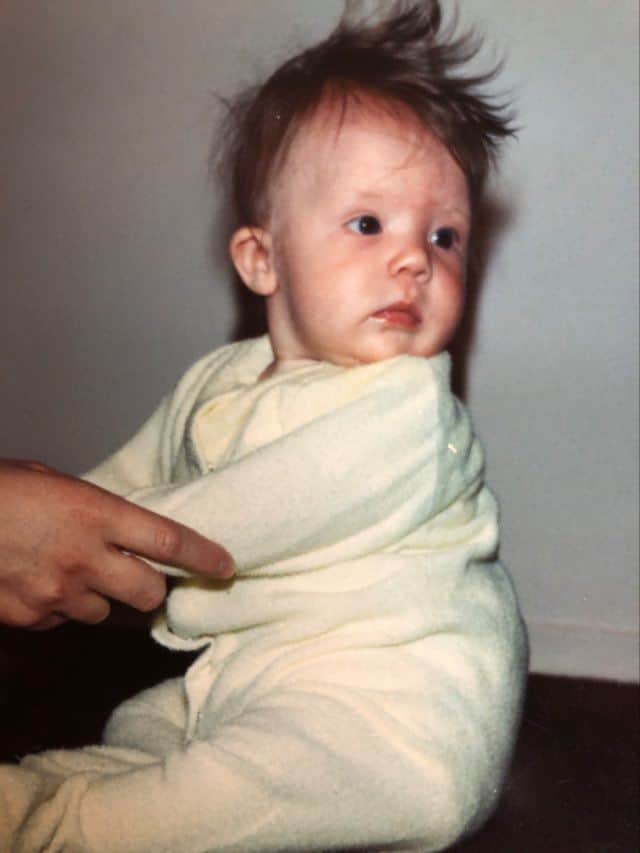
     Before going any further, permit me to show you a couple of pictures of Heather as a baby, and note the stunning resemblance to Lily. It could be the same person! Down to the hair almost!


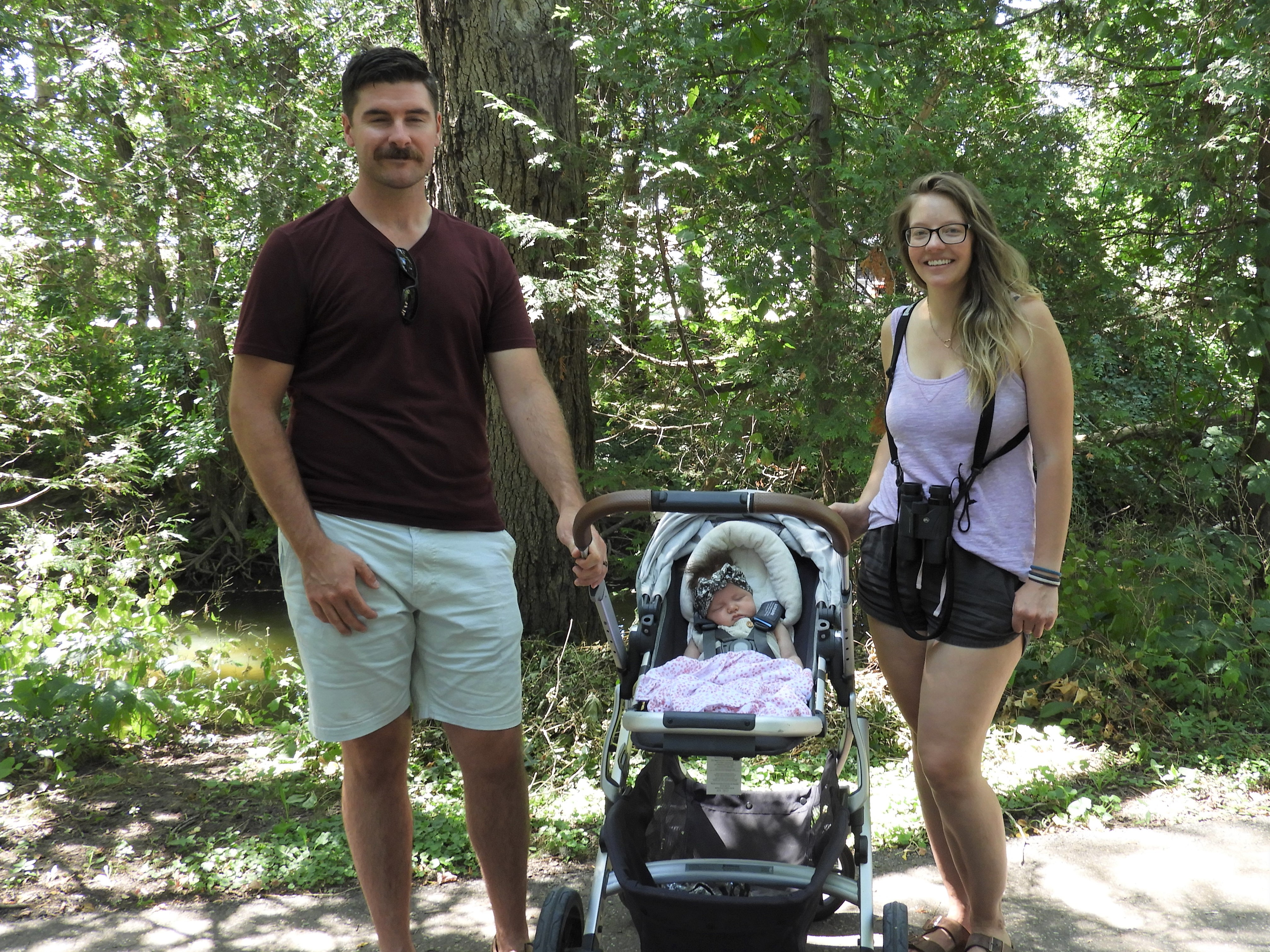
     We were joined on our walk this week by Shane, Lily's daddy, having recently shaved his beard and looking like an erstwhile Tom Selleck! 

     I am utterly convinced that as we continue these nature walks with Lily she will start to absorb the smells, sights and sounds around her, and that her character will be formed in part by these early encounters with nature.

     A girl has to have a sleep now and then.

     So that she can wake up lively and ready to look around.

     And what is life all about if you can't blow bubbles?


     On other fronts, we have a robust population of juvenile Barn Swallows (Hirundo rustica) at SpruceHaven. Many of them are content to perch on a wire and wait for devoted parents to zoom by, stuffing food in their mouths on the way past.

     I mentioned in an earlier post that Northern Flickers (Colaptes auratus) appear to have had a successful breeding season, and this recently independent bird was seen at Forwell Park.


     We pass through a tunnel on our way from Forwell Park to Hillside Park, and it is unfortunate that some of our less enlightened citizens cannot resist defacing the walls with their graffiti. Wouldn't it be wonderful if one of them could, even once, come up with something creative?

      The view above is looking back and I have spared you the pathetic nature of their crude daubing. You will be happy to know, however, that they can spell at least one word correctly, and it has four letters.

     If this American Crow (Corvus brachrynchos) perched high above considered himself superior he was right.

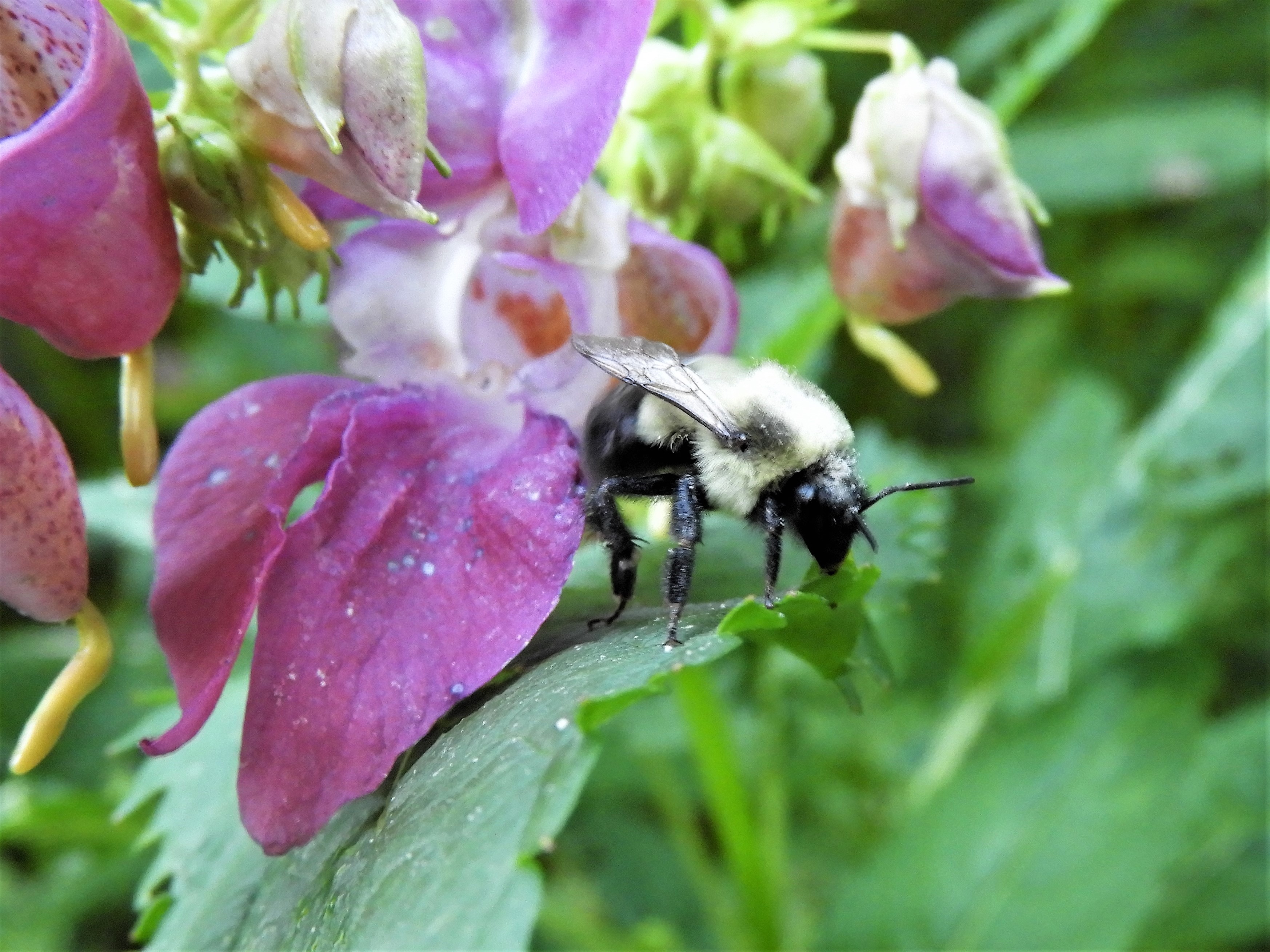
     If I am not mistaken, this insect is a Common Eastern Bumblebee (Bombus impatiens) and it was fascinating to watch as it got right into the corolla of the flower on which it was feeding.

     On a visit to SpruceHaven with the Morgans, Alan took these two wonderful shots.

Green Heron (Butorides virescens)

Clouded Sulphur (Colias philodice) on coneflower

     We had arranged to meet Andrew and Lorraine Wesolowski at RiverSong to tour around and stay for lunch, and just as we arrived a White-tailed Deer (Odocoileus virginianus) ambled slowly across the river.


     It was a wonderful welcome to a beautiful spot.


     Several Midland Painted Turtles (Chrysemys picta marginata) were basking in the warm sun.


     Sometimes you have to make room for a friend.


     Lorraine is an accomplished photographer and managed this superb shot of an Osprey (Pandion haliaeetus) flying along the Conestogo River.


     A Spotted Sandpiper (Actitis macularius) was perched a little out of range for a really good picture, but I think that what Lorraine achieved is delightful.


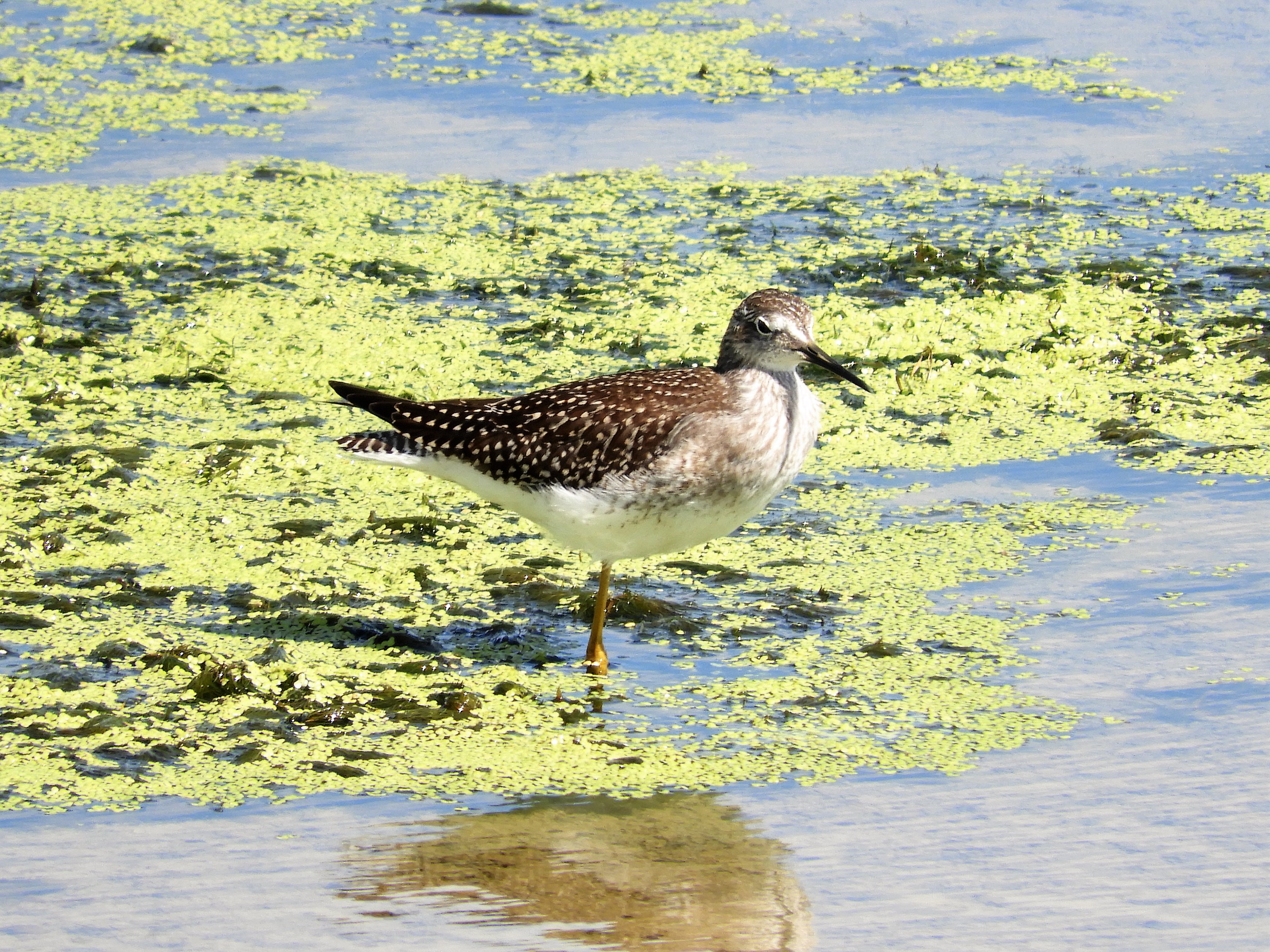
     Miriam and I made our first visit to the sewage ponds at Milverton, where Lesser Yellowlegs (Tringa flavipes) was far and away the most common species.


     For those not  familiar with the esoteric niceties of birding, sewage farms are highly prized habitat for waterfowl, shorebirds, herons, egrets and others, and by default therefore, equally cherished locations for birders. Eau de sewage is a powerful attractant, verging on pheromone for a dedicated birder!
     The highlight of this visit was to locate a Long-billed Dowitcher (Limnodromus scolopaceus), quite rare in these parts.

     Killdeer (Charadrius vociferus) were present, but not in the numbers one would normally expect at this time of the year.

     Many young Red-winged Blackbirds (Agelaius phoeniceus) were enjoying (or not) their first flush of freedom from the nest.

     Eastern Kingbirds (Tyrannus tyrannus) were no less common.

     As you can see, COVID-19 has not really slowed us down one bit!   


Land Acknowledgement

We acknowledge that the land on which we are situated are the lands traditionally used by the Haudenosaunee, Anishinaabe, and Neutral People. We also acknowledge the enduring presence and deep traditional knowledge, laws, and philosophies of the Indigenous Peoples with whom we share this land today. We are all treaty people with a responsibility to honour all our relations.
Followers