I have never kept track of those birds which are in greatest demand for visiting birders I have helped, but Northern Cardinal (Cardinalis cardinalis) is high on the list. It is a stunning bird, possessed of a beautiful loud song which carries far, it is not reluctant to approach humans and is present all year.
Let us first deal with the male.
Imagine that you had never seen one. How could you not be bowled over by this jaunty pirate with his black mask? Based on daily encounters with cardinals I feel confident in saying that you never become indifferent to "His Holiness" no matter how often you see him.
Puffed out against the bitter chill of wintry blasts, feet tucked under its feathers, it looks comfortable; fully at home in its environment, tough enough to handle whatever conditions nature delivers.
To look into a woodlot and see a burst of crimson is always a thrill. It never gets old, believe me.
Cardinals are principally seed eaters, as their powerful bill denotes, but they are not averse to eating caterpillars and arthropods, and they especially seek such prey when they have young in the nest; hungry mouths anxious for protein to stimulate healthy growth. This unfortunate victim was battered into submission along our fence rail a couple of summers ago.
Short months later the same bird perhaps, was on the ground beneath the feeders searching for sunflower seeds in the snow.
Shakespeare immortalized the words of Richard III who offered his kingdom for a horse. Perhaps that is only because he had never seen a cardinal!
There are only a couple of spots we know of where Northern Cardinals routinely congregate to feed with other species in the winter, Riverside Park in Cambridge, being one of them. In the picture below, to the left and behind the cardinal you can see an American Tree Sparrow (Spizelloides arborea).
And now let us turn to the female of the species.
Not as vivid as the male, but equally attractive in a muted way, with a subtle blending of beiges and browns, with hints of grey, all assembled in a way that only nature can achieve, indisputably a Northern Cardinal at first glance.
They grace our garden in equal measure as the males.
On all our local walks we are likely to see cardinals. Here on the Benjamin Park Trail right behind our house......
...... and along the Mill Race Trail in St. Jacobs.
At Riverside Park a female perches in a tree......
......but wastes no time in dropping down to enjoy the smorgasbord laid out by friendly humans, in the company of other species, as mentioned above. Here the female is feeding alongside an American Tree Sparrow and a White-throated Sparrow (Zonotrichia albicollis).
In fact, the assemblage of birds at this location is often nothing short of remarkable.
In the picture above are Northern Cardinals, male and female, American Tree Sparrows, and Dark-eyed Juncos (Junco hyemalis). They are often joined by Mourning Doves (Zenaida macroura), House Sparrows (Passer domesticus), Downy Woodpeckers (Dryobates pubescens), Red-winged Blackbirds (Agelaius phoeniceus), White-breasted Nuthatches (Sitta carolinensis), Black-capped Chickadees (Poecile atricapillus) and others. Most of the time there seems to be little squabbling, and perhaps the demands of winter survival stimulate the birds to concentrate on the important task of securing food.
It is always encouraging to see humans involved with nature in this way, and I have little doubt that many people, old and young alike, get their first close encounter with wild birds along the boardwalk at Riverside Park.
And the Northern Cardinal may be the biggest draw of them all.
Thursday, November 07, 2019
Monday, November 04, 2019
Nature everywhere speaks to man in a voice that is familiar to his soul.
Alexander von Humboldt
I have followed birds all my life, my love affair with them goes back as far as my conscious memory permits. I suppose that at different times I might have had "favourites," but I think that if I did it was a transitory sentiment, for all species are special in their own way.
There can be little doubt, however, that birds that align with our sense of what is beautiful, inevitably crowd out others from time to time, and Cedar Waxwing (Bombycilla cedrorum) indubitably falls into this category.
It is a show stopper by any standards.
And we are very fortunate that this bird is not uncommon, and moves around in flocks seeking fruiting trees and shrubs. It is not unusual to come across flocks of twenty or thirty feeding on berry-bearing bushes. It is a resident species and deals with our harsh winters well. I am always somewhat taken aback when I see them swallowing frozen berries, which must seem like little balls of ice entering their digestive tract.
They are known to consume berries that are toxic to humans in doses that would be lethal, having the ability to detoxify these fruits.
Miriam and I were once birding along a local trail when a friend of hers approached us, and we let her see Cedar Waxwings through our binoculars. She was quite bowled over and excited, never having known that birds of such distinct and stunning beauty exist here. I suspect she is not the first to have this reaction.
Juveniles do not have quite the splendour of adults (true of most species), but they have a certain charm nonetheless; with their prominent black mask they look like young avian buccaneers.
They tend to flock together once they have gained independence.
There is safety in numbers and probably an enhanced ability to find food.
I am sure that over the next few days I will spot Cedar Waxwings here and there, and that each sighting will evoke the same measure of delight as it has always done. I hope they you too may come across them. Your whole day will be enhanced, maybe even your entire week.
Thursday, October 31, 2019
30 October 2019
Every member of our regular "gang of eight" was available, and up for a drive into Toronto to sample the avian life at some of our favourite spots. Franc, Carol, Jim and Francine left together from Kitchener, and Mary and Judy joined Miriam and me at our house, and we set off in good humour with high expectations for a fine day of birding. It was not long into the journey before the reasons for not venturing eastwards to Canada's largest city, manifested themselves. Expressways become slow lanes, parkways become parking lots, speed limits seem like a fanciful and unrelieved bad dream. Based on the distance to be travelled it was a trip of about an hour and fifteen minutes; we struggled along for twice that time to get to our first destination, Humber Bay Park.
The fog was of the consistency of pea soup; thick, murky pea soup even. Visibility was pitiable. But "the sun will soon be up and it will burn off" we all said. Hope springs eternal in the breasts of eight intrepid (some might say delusional) ornithophiles!
Miriam, quite amazingly it seems, succeeded in obtaining pictures that showed the conditions in an appealing way; not merely dull as one might expect, but creative in their gloomy realization.
Along the shore an obscene array of high-rise condominiums has been erected, far beyond the financial reach of ordinary folk, with vistas across Lake Ontario. Not this morning, however. The upper floors were not visible from the ground. There would be no coffee on the balcony, with biscotti or fig newtons perhaps, gazing across the tranquil waters.
Miriam, quite amazingly it seems, succeeded in obtaining pictures that showed the conditions in an appealing way; not merely dull as one might expect, but creative in their gloomy realization.
Along the shore an obscene array of high-rise condominiums has been erected, far beyond the financial reach of ordinary folk, with vistas across Lake Ontario. Not this morning, however. The upper floors were not visible from the ground. There would be no coffee on the balcony, with biscotti or fig newtons perhaps, gazing across the tranquil waters.
And Miriam still found beauty and captured it well.
It was all just another day for this Mute Swan (Cygnus olor), busily engaged in rearranging and sleeking down its feathers.
A Ring-billed Gull (Larus delawarensis) took everything in stride, perhaps disdaining its human gawkers. And it probably could have flown from Waterloo faster than we had taken to drive!
There were not many birds to keep us company initially so we all paid attention to a male Mallard (Anas platyrynchos), giving it the admiration which is certainly its due, but to paraphrase what that old comedian Rodney Dangerfield used to say "It don't get no respect!"
The pictures look remarkably clear given the conditions - and the gloom persisted - but the images below have the appearance of a creation from an artist's palette.
There were few birds to be seen, but a Muskrat (Ondatra zibethicus) enjoyed the water.
And an American Mink (Mustela vison) patrolled the perimeter of one of cells in the harbour, no doubt looking for unsuspecting prey.
A Great Blue Heron (Ardea herodias) looked like a spectre in the mist at the edge of a small island out in the lake, its reflection nevertheless shimmering below it.
A short walk through an area of grassland, and scattered trees and shrubbery, yielded a Northern Mockingbird (Mimus polyglottos). How Miriam managed so clear a picture I don't know.
This is a species that has become more common in recent years, but nowhere reliable, except for Humber Bay Park. In my experience this has been the most predictable location for this species over many years.
We also observed a late Swainson's Thrush (Catharus ustulatus). I suspect that migration dates for many species are now undergoing revision.
A Song Sparrow (Melospiza melodia) probed the grass for juicy morsels along with a White-throated Sparrow (Zonotrichia albicollis).
A Field Sparrow (Spizella pusilla) was not shy either.
Mute Swans, Mallards and Ring-billed Gulls seemed content to perch together.
And there were a few Ruby-crowned Kinglets (Regulus calendula), barely stopping for even a second, as they gleaned leaves and branches in search of food.
The time on our parking tags was about to expire so we decided to go to Colonel Samuel Smith Park, where we would sit in the car and have our lunch, and then do some exploring.
Joy of joys, the mist started to clear a little; the sun broke through for brief intervals and it felt glorious. Our spirits soared!
Gadwalls (Mareca strepera) were numerous, and we agreed one and all that this is a very attractive little duck.
A lone Redhead (Aythya americana) was the only one of its kind that we saw, although I expect that this species will move onto the lake in great numbers very soon.
There were a few Common Mergansers (Mergus merganser) and this female was close enough to permit an identifiable photograph.
A quick scan reminded us all that this is a splendid park in the middle of a sea of urban development; an oasis of tranquility.
For the second time today we noted that a Mallard is a bird not to be dismissed lightly.
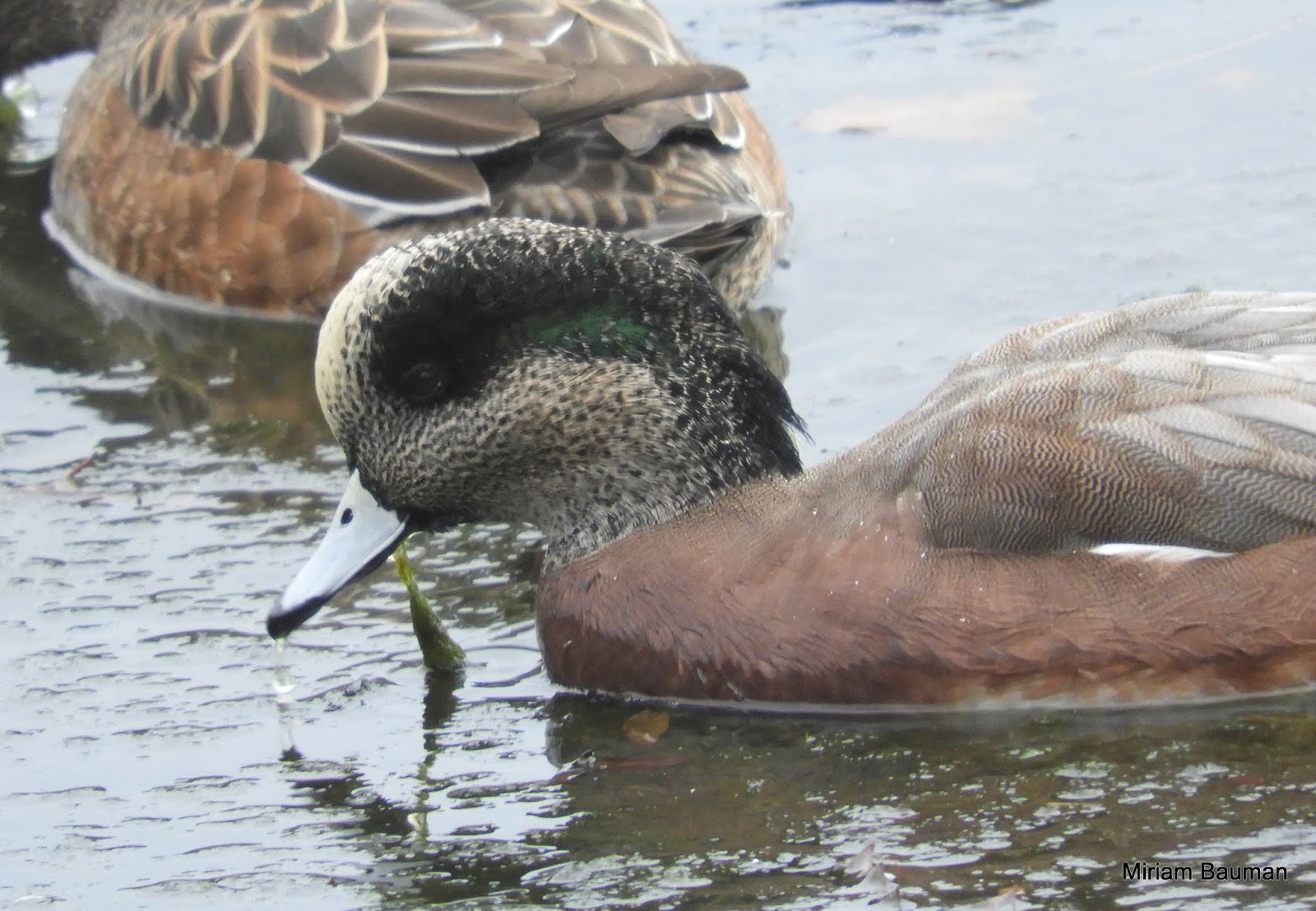
American Wigeon (Mareca americana) is another handsome duck that was easy to find in the large flocks ensconced in a small bay.
Mixed flocks were noisy and sometimes argumentative, but for the most part the ducks all coexisted without incident.
Within weeks, or even days, Bufflehead (Bucephala albeola) will become very common on Lake Ontario, but today we saw only three individuals, a male accompanied by two females.
It is a tiny duck and very attractive.
A solitary Pied-billed Grebe (Podiceps auritus) was seen practicing its flight capability in preparation for migration, after which it rested under some overhanging branches.
Our final stop was at Long Branch Park, but there was very little on the water, other than ubiquitous Mallards and Ring-billed Gulls, with an amazing total of 49 Mute Swans, mostly far off, however. Two were close by and posed nicely for a picture or two.
Since the birding was slow, what does a person of a certain age do? Why soar skywards on the children's swings, of course.
Miriam can still pump her legs with the best of them!
I would be remiss if I did not pay tribute to Mary at this location. We saw a woman feeding the gulls and Mallards, following which she tossed her plastic bag on the ground. Mary confronted her, pointing out oh so sweetly, "You dropped something, ma'am." The woman scowled, no doubt uttered a few curses under her breath, denied she had done so, and strode off. Mary picked up the trash. It is incredible to witness this kind of blatant disregard for even the most basic of environmental concerns, but perhaps Mary's action will cause this slob to think twice next time. Bravo, Mary!
We took a vote as to whether we wished to continue birding, but given the dire experience of the morning's drive, everyone elected to head for home to beat the afternoon rush hour.
Despite the weather, despite the dreadful journey, we had a very enjoyable day together and concluded one and all that we would not have missed it for the world.
Subscribe to:
Posts (Atom)
Land Acknowledgement
We acknowledge that the land on which we are situated are the lands traditionally used by the Haudenosaunee, Anishinaabe, and Neutral People. We also acknowledge the enduring presence and deep traditional knowledge, laws, and philosophies of the Indigenous Peoples with whom we share this land today. We are all treaty people with a responsibility to honour all our relations.
Followers
Welcome
My name is David. I'm a lifelong birder, fiercely committed to all of nature, however. Married to Miriam Bauman. I love to travel. I Enjoy a good book and a good glass of wine. To read more about me, click my ABOUT page.