30 October 2019
Every member of our regular "gang of eight" was available, and up for a drive into Toronto to sample the avian life at some of our favourite spots. Franc, Carol, Jim and Francine left together from Kitchener, and Mary and Judy joined Miriam and me at our house, and we set off in good humour with high expectations for a fine day of birding. It was not long into the journey before the reasons for not venturing eastwards to Canada's largest city, manifested themselves. Expressways become slow lanes, parkways become parking lots, speed limits seem like a fanciful and unrelieved bad dream. Based on the distance to be travelled it was a trip of about an hour and fifteen minutes; we struggled along for twice that time to get to our first destination, Humber Bay Park.
The fog was of the consistency of pea soup; thick, murky pea soup even. Visibility was pitiable. But "the sun will soon be up and it will burn off" we all said. Hope springs eternal in the breasts of eight intrepid (some might say delusional) ornithophiles!
Miriam, quite amazingly it seems, succeeded in obtaining pictures that showed the conditions in an appealing way; not merely dull as one might expect, but creative in their gloomy realization.

Along the shore an obscene array of high-rise condominiums has been erected, far beyond the financial reach of ordinary folk, with vistas across Lake Ontario. Not this morning, however. The upper floors were not visible from the ground. There would be no coffee on the balcony, with biscotti or fig newtons perhaps, gazing across the tranquil waters.
Miriam, quite amazingly it seems, succeeded in obtaining pictures that showed the conditions in an appealing way; not merely dull as one might expect, but creative in their gloomy realization.

Along the shore an obscene array of high-rise condominiums has been erected, far beyond the financial reach of ordinary folk, with vistas across Lake Ontario. Not this morning, however. The upper floors were not visible from the ground. There would be no coffee on the balcony, with biscotti or fig newtons perhaps, gazing across the tranquil waters.

And Miriam still found beauty and captured it well.

It was all just another day for this Mute Swan (Cygnus olor), busily engaged in rearranging and sleeking down its feathers.

A Ring-billed Gull (Larus delawarensis) took everything in stride, perhaps disdaining its human gawkers. And it probably could have flown from Waterloo faster than we had taken to drive!

There were not many birds to keep us company initially so we all paid attention to a male Mallard (Anas platyrynchos), giving it the admiration which is certainly its due, but to paraphrase what that old comedian Rodney Dangerfield used to say "It don't get no respect!"

The pictures look remarkably clear given the conditions - and the gloom persisted - but the images below have the appearance of a creation from an artist's palette.


There were few birds to be seen, but a Muskrat (Ondatra zibethicus) enjoyed the water.

And an American Mink (Mustela vison) patrolled the perimeter of one of cells in the harbour, no doubt looking for unsuspecting prey.

A Great Blue Heron (Ardea herodias) looked like a spectre in the mist at the edge of a small island out in the lake, its reflection nevertheless shimmering below it.

A short walk through an area of grassland, and scattered trees and shrubbery, yielded a Northern Mockingbird (Mimus polyglottos). How Miriam managed so clear a picture I don't know.

This is a species that has become more common in recent years, but nowhere reliable, except for Humber Bay Park. In my experience this has been the most predictable location for this species over many years.
We also observed a late Swainson's Thrush (Catharus ustulatus). I suspect that migration dates for many species are now undergoing revision.

A Song Sparrow (Melospiza melodia) probed the grass for juicy morsels along with a White-throated Sparrow (Zonotrichia albicollis).


A Field Sparrow (Spizella pusilla) was not shy either.

Mute Swans, Mallards and Ring-billed Gulls seemed content to perch together.

And there were a few Ruby-crowned Kinglets (Regulus calendula), barely stopping for even a second, as they gleaned leaves and branches in search of food.

The time on our parking tags was about to expire so we decided to go to Colonel Samuel Smith Park, where we would sit in the car and have our lunch, and then do some exploring.
Joy of joys, the mist started to clear a little; the sun broke through for brief intervals and it felt glorious. Our spirits soared!


Gadwalls (Mareca strepera) were numerous, and we agreed one and all that this is a very attractive little duck.


A lone Redhead (Aythya americana) was the only one of its kind that we saw, although I expect that this species will move onto the lake in great numbers very soon.

There were a few Common Mergansers (Mergus merganser) and this female was close enough to permit an identifiable photograph.

A quick scan reminded us all that this is a splendid park in the middle of a sea of urban development; an oasis of tranquility.

For the second time today we noted that a Mallard is a bird not to be dismissed lightly.

American Wigeon (Mareca americana) is another handsome duck that was easy to find in the large flocks ensconced in a small bay.


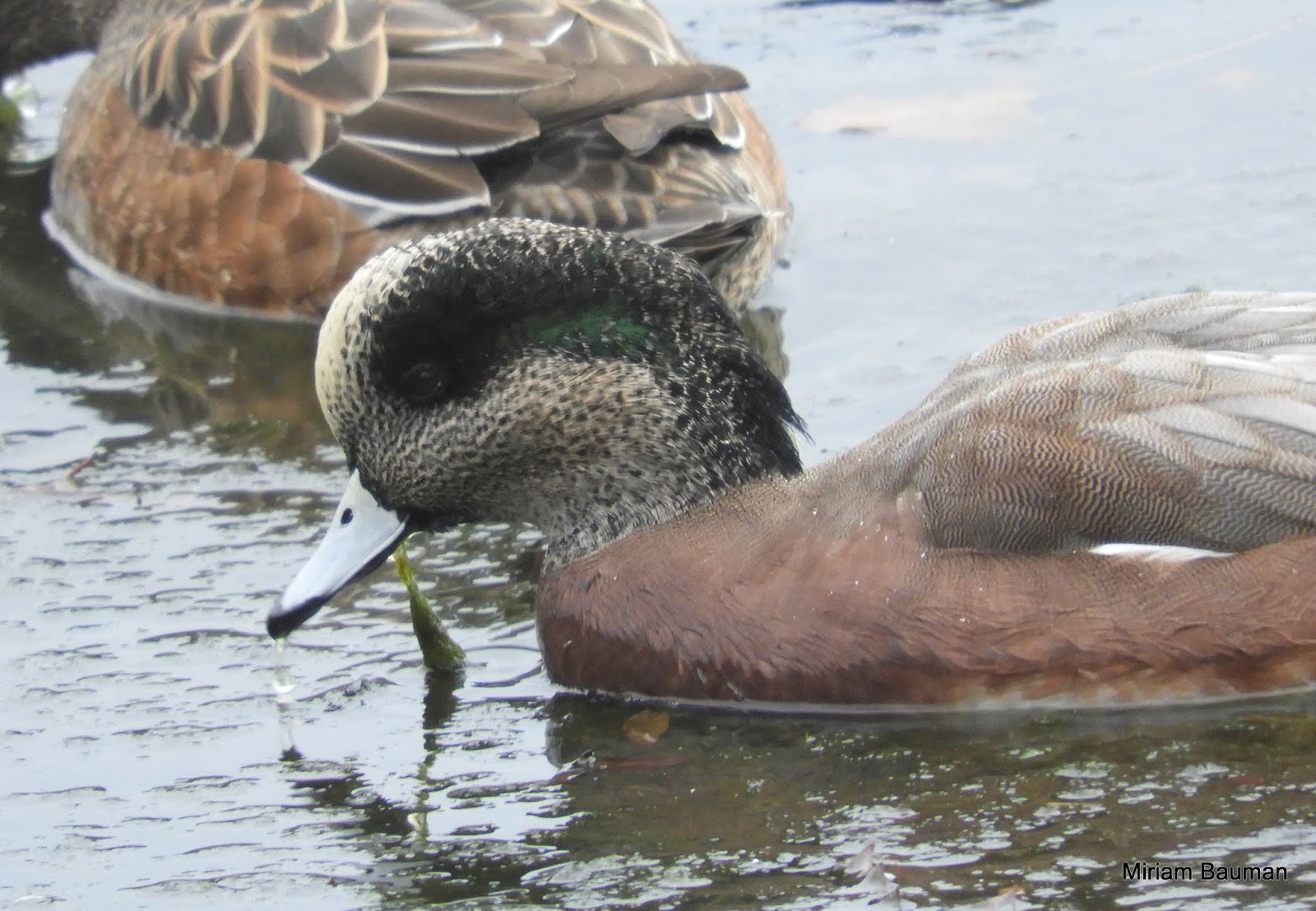

Mixed flocks were noisy and sometimes argumentative, but for the most part the ducks all coexisted without incident.


Within weeks, or even days, Bufflehead (Bucephala albeola) will become very common on Lake Ontario, but today we saw only three individuals, a male accompanied by two females.


It is a tiny duck and very attractive.
A solitary Pied-billed Grebe (Podiceps auritus) was seen practicing its flight capability in preparation for migration, after which it rested under some overhanging branches.

Our final stop was at Long Branch Park, but there was very little on the water, other than ubiquitous Mallards and Ring-billed Gulls, with an amazing total of 49 Mute Swans, mostly far off, however. Two were close by and posed nicely for a picture or two.


Since the birding was slow, what does a person of a certain age do? Why soar skywards on the children's swings, of course.

Miriam can still pump her legs with the best of them!
I would be remiss if I did not pay tribute to Mary at this location. We saw a woman feeding the gulls and Mallards, following which she tossed her plastic bag on the ground. Mary confronted her, pointing out oh so sweetly, "You dropped something, ma'am." The woman scowled, no doubt uttered a few curses under her breath, denied she had done so, and strode off. Mary picked up the trash. It is incredible to witness this kind of blatant disregard for even the most basic of environmental concerns, but perhaps Mary's action will cause this slob to think twice next time. Bravo, Mary!
We took a vote as to whether we wished to continue birding, but given the dire experience of the morning's drive, everyone elected to head for home to beat the afternoon rush hour.
Despite the weather, despite the dreadful journey, we had a very enjoyable day together and concluded one and all that we would not have missed it for the world.