Thursday, August 19, 2021

At Home and a Morning at SpruceHaven

09 August 2021
Our backyard, Waterloo, ON

     Northern Cardinals (Cardinalis cardinalis) are daily visitors to our backyard, and this handsome male makes a statement!


     You could be forgiven for thinking that he looks a little grumpy, but a couple of minutes later he was singing his head off!     
     A male House Finch (Haemorhous mexicanus) is a smart looking bird too.


     A female Cabbage White (Pieris rapae) would find it hard to compete with the cardinal or the finch in the good-looks department, but she is a welcome visitor nonetheless.


     I have tried as best I can to identify this arachnid, without success. If you know what it is, feel free to leave a comment.


13 August 2021
Our backyard, Waterloo, ON

     Chipping Sparrow (Spizella passerina) is a frequent victim of cowbird parasitism and in years past we have seen these tiny birds feeding gargantuan cowbirds. This year, however, we have on several occasions observed adults feeding their own young, so perhaps they are developing effective strategies to combat the cowbird cheats.
     These two are gazing skyward for some reason.


     They did not appear alarmed and we saw no predator in the sky above them, so what they were looking at will forever remain a mystery.
     A third individual was perched nearby.


    The following American Robin (Turdus migratorius) is probably a female, based on the muted colouration.


     Females are generally duller overall with browner black on the head, but I have never found this to be entirely reliable, and somewhat subjective. For all practical purposes males and females look the same.
     An Eastern Carpenter Bee (Xylocopa virginica) was industrious - as bees are supposed to be.


     You may recall from my last post that a Northern Cardinal was seen feeding a fledgling Brown-headed Cowbird (Molothrush ater). Here we see a male cardinal with his own young.


     As is the case with human children, food is usually top of mind.


     Give me more!


     There seems to be every indication that he will grow up to be as handsome as his father.


14 August 2021
Berlett's Road, Wilmot Township, ON

     On the way to SpruceHaven we generally travel along Berlett's Road, which at times can be pleasingly birdy. 
     We often see Wild Turkeys (Melegris gallopavo) and this flock seems to have become particularly tame around one of the houses that borders on a forested area.


     I have no doubt that they had consumed all the seed that had spilled from one of the bird feeders and were relaxing in the warm sunshine of an August morning.


     We parked at the side of the road quite close to them and they seemed not the slightest bit perturbed.


     Wild Turkeys buck the trend of species in decline; they have done spectacularly well in recent years and are now a common sight.


     A little farther along four juvenile Eastern Bluebirds (Sialia sialis) were perched on a wire; three left as soon as we spotted them, but one remained behind for a picture.


     In wet areas near the ditches Spotted Jewelweed (Imaptiens capensis), so important for hummingbirds fuelling up for migration, lined the verges.


     Usually it is difficult to get anywhere close to American Crow (Corvus brachyrynchos), but on this occasion, using the car as a blind, Miriam managed some quite decent shots.


14 August 2021
SpruceHaven, St. Agatha, ON

     Wild Bergamot (Monarda fistulosa) is a wonderful native plant that attracts bees, hummingbirds and other pollinators. 


     I am always happy to see it and it is established in several locations at SpruceHaven.
      Common Eastern Bumblebees (Bombus impaties) could be found all over it.


     To identify grasshoppers down to the species level is a bit daunting for any but an entomologist specializing in the taxon. The best I can do with the following species is to assign it to the large genus melanoplus.


     The grasshoppers were so numerous that many exploded in front of us as we walked, conjuring images of plague numbers that must defy belief.
     Many species of Echinacea populate prairie ecosystems, both moist and dry, and it is very exciting to see the number of species that have taken root in our emergent temperate grassland biome.
     Purple Coneflower (Echinacea purpurea) is exceptionally striking to my eyes.


     Sow Thistle (Sonchus oleraceus) is not quite so entrancing.


     As already mentioned identifying grasshoppers as to species is not easy, and I am certainly reaching the boundaries of my knowledge when I attempt it, but it is challenge to try, and the process of learning is always enjoyable.
     There is more than one genus of Smooth-horned Grasshoppers; I am pretty sure this is one of them, but I am not sure which!


     Goldenrod Soldier Beetle (Chauliognathus pensylvanica) is obviously not restricted to goldenrods.


     Ambush bugs, in the subfamily Phymatinae are superbly camouflaged as they lie in wait for their prey. We spotted Pennsylvania Ambush Bug (Phymata pennsylvanica) several times.


     You will note by looking carefully there are two bugs here, in copula.


     Camouflage seems not to be a major concern in the ecstasy of the moment!
     Grey-headed Coneflower (Ratibida pinnata) is one of the prairie species that has become established in the grassland; wonderful to behold.


     Appropriately enough, one of its alternate common names is Prairie Coneflower.
     Many areas are awash with gold, with False Sunflower (Heliopsis helianthoides) nodding in gentle breezes or bending to the power of stronger winds.


     It is impossible not to be moved by the beauty of it all.....


     ..... and to wonder what it will all look like a few short years from now.


     A Great Spangled Fritillary (Speraria cybele) found everything to its liking.


     Common Eastern Bumblebee (Bombus impatiens) foraged at will.


     Western Honey Bee (Apis melifera) was no less dedicated in its quest for nectar and pollen.


     A male Indigo Bunting Passerina cyanea) was perched on top of a conifer across the road from SpruceHaven.


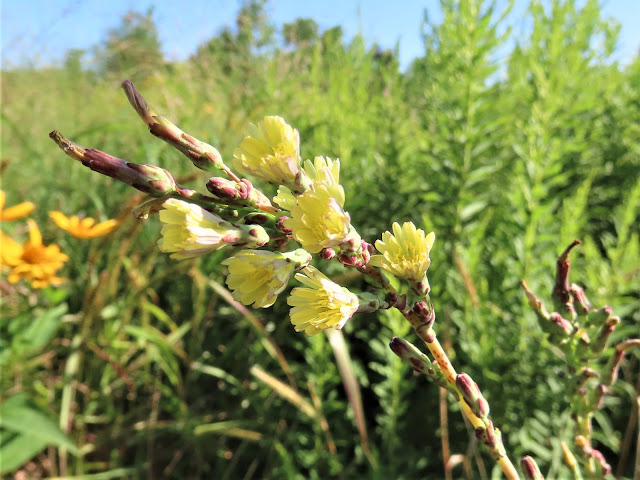
     Wild Lettuce (Lactuca canadensis) is sometimes referred to as Indian Lettuce, in reference to the fact that its leaves were boiled by First Nations people to make a kind of tea, albeit quite bitter.

     Stable Fly (Stomoxys calcitrans) is an impressive insect. Don't get bitten by one, however - it hurts!
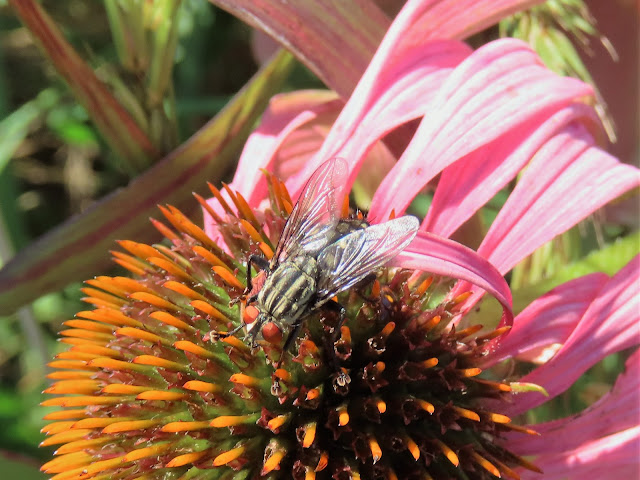

     Their preferred hosts are cattle and horses, but they display little hesitation in turning their unwelcome attention to dogs and humans.
     The following larva has eluded all my attempts to identify it.


     The fly below is found in the genus Poecilanthrax.


     Daisy-like Annual Fleabane (Erigeron annuus) was quite common throughout.


     This Western Honey Bee appears to have had a successful bout of foraging judging from the load in its pollen baskets.


     Canada Wild Rye (Elymus canadensis) is known to establish easily so it was no great surprise, yet no less of a pleasure to come across it, a recent component of the grassland.


     Various species of thistle (Genus Cirsium) are equally adept at propogating themselves, and though their seeds provide an important food source for birds such as American Goldfinch (Spinus tristis) they are aggressively invasive, and we may have to devise ways of removing them.


     A Black Blister Beetle (Epicauta pensylvanica) is known to favour yellow plants, as seen here.


     The web of Argiope spiders are wonders of architecture, and in the fall when early morning dew is a daily feature, meadows glisten with them.


     A Black Swallowtail (Papilio polyxenes) found foraging to its liking.....


     ..... as did a Northern Corn Rootworm (Diabrotica barberi).....


     ..... and a Clouded Sulphur (Colias philodice)


     Pinkweed (Persicaria pensylvanica) is an attractive plant and a target of pollinator insects.


     Unfortunately it has the potential to swamp entire areas, as has happened at the spot we refer to as Teen Hollow.


     We will have to put our heads together to see whether some form of remediation is possible.
     Common Eastern Bumblebees are nothing if not industrious.


     A hyper-abundance of Pinkweed is probably to their liking, if not to ours!
     It was difficult to slog through the Pinkweed down to the ponds which are reduced in size due to relentless summer heat, but a Twelve-spotted Skimmer (Libellula pulchella) justified the effort.


     A friendly Northern Leopard Frog (Lithobates pipiens) was unperturbed by our presence.


     Carolina Grasshopper (Dissosteira carolina) is numerous and the easiest  grasshopper to identify.


     We saw Common Ringlet (Coenonympha california) fluttering daintily above the grasses, alighting now and then.


     False Milkweed Bug (Lygaeus turcicus) is a very attractive little animal.


     Cabbage White was very common, and this male perched nicely for us.

 
     The sighting of a One-spotted Stink Bug (Euschistus variolarius) was a first - always exciting.


   Barn Swallows have had a successful year and many youngsters were waiting for long-suffering adults to come and feed them.


     Finally, I offer you a Tarnished Plant Bug (Lygus lineolaris), a serious pest of fruits such as strawberries, peaches and apricots. 


     We enjoyed discovering the bug, but we don't have to deal with its destructive consequences.
     It will be plain to all who read this account that our restored grassland, which just three summers ago hosted a soybean crop, has become a veritable centre of biodiversity.
     I am giddy just imagining what is still to come.  


Sunday, August 15, 2021

Mostly at home .....

     A combination of bad weather, other things to do, and perhaps a feeling of lethargy when it was really hot, has kept us at home more than usual, so this post is mainly from the back yard.

06 August 2021

     Our Rose of Sharon (Hibiscus syriacus) bushes have been prolific this year and the blooms have been quite incredible.


     The other day while sitting on the deck having a cup of tea, a hummingbird came to sip on the nectar, but we didn't have a camera at hand and it hovered only for a few seconds. It would have made a great shot.
     The Phlox (Phlox paniculata) is no less spectacular.


     We are very much enamoured of these flowers, and as we get older the fact that they are perennials requiring little care is a bonus.


     There are many species of Anemone (Ranunculaceae), all beautiful, but I am not sure of the exact species that lives in our garden.


    You will no doubt agree that it is gorgeous!
    A Leaf Beetle (Chrysomelidae) trundled around, and we found it very attractive.


     I have been unable to narrow it down as to species, but that is hardly surprising considering that there around 50,000 species of beetle in the world, many have not been identified, and even for those that have the taxonomy is far from resolved.

Lily comes for lunch

     Our little princess came for lunch for the first time.


     She was as good as gold and sat in a booster chair set on a regular kitchen chair, since we no longer have a high chair.


     She ate well, but only exactly what she wanted and nothing could convince her to try anything else. There was lots of healthy food, however, and she certainly did not go hungry.


     She even tried a little pasta salad but it was not her favourite.


     She chatted to us the whole time, clearly thrilled to be "visiting" and played that universal game of all children, i.e. throw something on the floor and watch those silly adults pick it up, like Pavlovian dogs on cue.
     It was wonderful to have Heather and Lily have lunch with us, and there will be more occasions like this to follow.
     She waves good bye now without any coaching at all!


     And by the way, she can take several steps unaided. Soon she will be faster than us!

07 August 2021

     We were quite delighted to have a visit from a Juniper Geometer Moth (Patalene olyzonaria), resting quietly after a busy night.


     This pollen-dusted Western Honey Bee (Apis mellifera) provides graphic evidence of the pollination services provided by bees.


     May their populations increase!
     Over the years we have been visited by a number of neotropical warblers, infrequently and unpredictably, so it was quite exciting to see a female American Yellow Warbler (Setophaga aestiva).


     Brown-headed Cowbird (Molothrus ater) is an obligate brood parasite that lays its eggs in the nests of other species, and takes no part in raising its own young. 
     We have seen host parents of several species feeding young cowbirds, but never a Northern Cardinal (Cardinalis cardinalis) so it was with a sense of discovery that we noted this male feeding a young cowbird.


     The picture is not great but it is the only one we have to memorialize this activity.
     As you may see from the picture below the cardinals have obviously been good surrogate parents and have raised a robust, healthy youngster.


     The Rose of Sharon buds, just before bursting out, are attractive in their own right.


     A Common Ringlet (Coenonympha california) is quite common as the name implies.


     European readers will notice the very close similarity to Large Heath (C. tullia), an illustration of speciation if ever I saw one.
     Our coffee cups empty, the apple cake crumbs swept away, we got up to go back inside, just as a flycatcher sailed in.


     At this time of the year, when the birds are no longer singing, the best ID that's possible is Empidonax sp. We did not know it's name, but we did know the family and its visit was well received.

08 August 2021

     A female Downy Woodpecker (Dryobates pubescens) spent quite a bit of time in the backyard, snatching sunflower hearts from the feeders to stash away in the bark of nearby trees.


     We were out and about in the afternoon and spotted beautiful Foxgloves (Digitalis purpurea) in a garden close to the road.


     A female Monarch (Danaus plexippus) was resting on milkweed (Asclepias sp.).


     Perhaps by the time I post again we will have ventured a little farther afield. See you then!

Friday, August 13, 2021

Book Review - What Insects Do and Why - Princeton University Press

 If all mankind were to disappear, the world would regenerate back to the rich state of equilibrium that existed ten thousand years ago. If insects were to vanish, the environment would collapse into chaos.
E. O. Wilson


     For the British Readers of my blog, Ross Piper will be a familiar name, as one of the star presenters of nature shows on BBC Television.
     He has written a fine book here, with the novice insect enthusiast in mind, and it serves as a marvelous introduction to exactly what the title implies - what insects do, and why.
      You will be astounded at the diversity of form, lifestyle, breeding strategies, food, and the extent of insect warfare you will find in these pages. From the familiar to the previously unknown, from the ordinary to the bizarre, the world of insects will open your eyes wide!
     As Piper points out, despite incremental increases in knowledge in recent years, the vast majority of species are still unknown, and anyone can help to fill in these blanks - "Watching and studying insects can take you to some amazing places, but equally, discoveries can be made in your own backyard. All you need to do is get out there and look." Based on personal experience I can vouch that this is absolutely true. 
     One of the insects that has fascinated me more than most others, is Leafcutter Ant, and many times I have watched these animals parading along the forest floor in Central and South America, marvelling at the loads these diminutive creatures can tote. Little did I know that a type of worker, known as a minor, often hitches a ride on the leaf to defend against parasitoid flies that pose a threat to the leaf carrier. I knew about the complex fungus gardens below ground, but I had no idea as to their extent, and that Leafcutter Ants dominate entire ecosystems. 
     I was astounded to read that Japanese Honey Bees have evolved a means of dealing with predatory giant Japanese Hornets. The worker ants form a tight ball, sometimes containing up to five hundred bees,  around the invader, and vibrate their wings to generate heat and literally cook the hornet to death.
     The caterpillar of blue butterflies (Phengaris spp.) behaves in strange ways. In addition to consuming flowers of its host plant, it ultimately drops to the ground and is able to fool a foraging red ant (Myrmica  spp.) into thinking it is one of its own grubs. The caterpillar is transported to the ant's nest where the deception continues, with some species receiving more care than the host's own larvae, and others actually consuming the ant brood. 
     All is not what it often seems to be in the insect world! 
    You will learn about parasitoids and parasites, the daily struggle to eat and avoid being eaten, the quid pro quos that exist in the insect world, and much, much more. Fabulous full colour photographs enliven every page. 
     On page 209, almost at the end of the book, the alarm call is raised about declining insect populations due to anthropogenic activity. This is a clarion call for all life on Earth in a time of global climate change, where tipping points are being reached. Piper states, "Human activity is simultaneously depriving insects of habitats, poisoning them, and creating a warmer world that puts beleaguered populations under even more strain."
     Failure to remedy this situation threatens our own survival. Sadly, it may be too late. Insects will thrive long after we have engineered our own demise.

What Insects Do, and Why - Princeton University Press
Author: Ross Piper
$27.95 - ISBN: 9780691217697
Published: 10 August 2021
224 pages - 150 coloured illustrations - 6.5 x 9 inches, (16.25 x 22.5 cm)

Tuesday, August 10, 2021

Tuesday Rambles with David Resume

02 August 2021
Hillside Park, Waterloo, ON

     After a COVID-imposed hiatus of almost a year, we finally were able to enjoy a Tuesday walk. Mary, Judy and Franc were unable to join us, for one reason or another, but Jim, Francine and Carol met Miriam and me for a pleasant stroll through Hillside Park in uptown Waterloo.
     The breeding season is complete for many species and it was encouraging to see this recently independent Red-bellied Woodpecker (Melanerpes carolinus) exploring its world.


     To the extent that we were able to judge, it was doing well.


     Berry-bearing shrubs and trees seem to have had a bountiful year, and Guelder-Rose (Viburnum opulus) was laden with fruit.


     These berries are mildly toxic to humans and are capable of inducing vomiting and diarrhea, but birds such as Cedar Waxwing (Bombycilla cedrorum) and American Robin (Turdus migratorius) eat them with impunity.
     A male Common Grackle (Quiscalus quiscula) was catching the sun, highlighting the iridescence in its plumage.


      A female House Finch (Haemorhous mexicanus) was drab by comparison. She seemed to be taking full advantage of the prolific berry crop of Eastern White Cedar (Thuja occidentalis).


     Song Sparrows (Melospiza melodia) are ubiquitous and very pleasing, akin to an old friend you never tire of seeing.


     A Hairy Woodpecker (Dryobates villosus) teased us a little, coming into view for a second or two, then disappearing behind the trunk of the tree on which it was foraging. 


     It was never in good light and seemed to have perfected its timing - disappear the moment the camera begins to focus!
     We had commented to each other that we had not seen a Belted Kingfisher (Megaceryle alcyon) all year at Hillside Park, a location generally reliable for an overwintering male, when we spotted this individual perched above the creek.


     It's not the greatest picture, unfortunately, but sometimes you have to take what you can get.
     Woodland Sunflower (Helianthus divaricatus) was in full bloom, glorious in the morning sun.


     A Leafcutter Bee (Megachilidae) wasted no opportunity to probe for nectar.


     A Western Honey Bee (Apis mellifera) had the same idea.


     Our only Tyrant Flycatcher of the morning was an Eastern Kingbird (Tyrannus tyrannus) who put in an appearance just before the end of our walk.


     It was good to get together again!

Sunday, August 08, 2021

Book Review - Rocks and Rock Formations - Princeton University Press


     Geology is not easy, and this book makes a valiant attempt to simplify the process of identifying rocks, even for the layman with little or no experience. As the author points out, "learning to identify rocks is a risky business".
     Even from the first cognitive stages of childhood we are at a disadvantage when it comes to rocks. Early in their development small children learn to identify familiar flowers and animals, and have a name for them. A rock or a pebble on the other hand remains just that - a rock or a pebble, with no clue as to its name, origin or composition, or anything else about it.
     It would be a rare parent indeed, who, having encouraged a child to look at a daisy, or a sparrow, followed up with "See that biotite schist, Jenny!" 
     Yet a better appreciation of rocks and rock formations is within the grasp of the amateur naturalist and citizen scientist. Jürg Meyer has devised a systematic method whereby rocks within the three groups, sedimentary, igneous, and metamorphic, can frequently be identified, with a good degree of accuracy. There will always be difficult samples that defy identification, but this is equally true for scientific geologists who need laboratory samples to confirm their discovery under powerful microscopes.
     Furthermore with no more than a keen ability to observe, and a pocket knife and a magnifying glass, component minerals can be identified. If you are really lucky, a fossil or two may make the discovery even more exciting.
     Go through this book carefully, learn its methods, apply yourself diligently, and you too can become a cut above the average rock hound. 
     You should expect no less of yourself!

Rocks and Rock Formations - Princeton University Press
Author: Jürg Meyer
US$19.95 £14.99 - ISBN: 9780691199528
Published: 21 June 2021
192 pages - 534 colour illustrations
5.5 x 8.5 inches (13.75 x 21.25 cm)

Land Acknowledgement

We acknowledge that the land on which we are situated are the lands traditionally used by the Haudenosaunee, Anishinaabe, and Neutral People. We also acknowledge the enduring presence and deep traditional knowledge, laws, and philosophies of the Indigenous Peoples with whom we share this land today. We are all treaty people with a responsibility to honour all our relations.

Followers