Showing posts with label Merlin. Show all posts

Tuesday, March 22, 2022

Let's Go and Find a Bald Eagle's Nest, Miriam.....

 20 March, 2022

World Sparrow Day

     I had no idea that a day had been set aside to honour House Sparrows (Passer domesticus) and in fact 20 March, 2022 was the tenth anniversary of this auspicious marker.
     In commemoration, I give you a handsome male from our backyard.


A Raptor-ous Day

     Our goal in setting out was to find a Bald Eagle (Haliaeetus leucocephalus) nest reported to Miriam by her niece, Julie. As it turned out the day turned into a raptor bonanza.
     It was not long before we detected a very cooperative Merlin(Falco columbarius) perched at the  top of a tree.
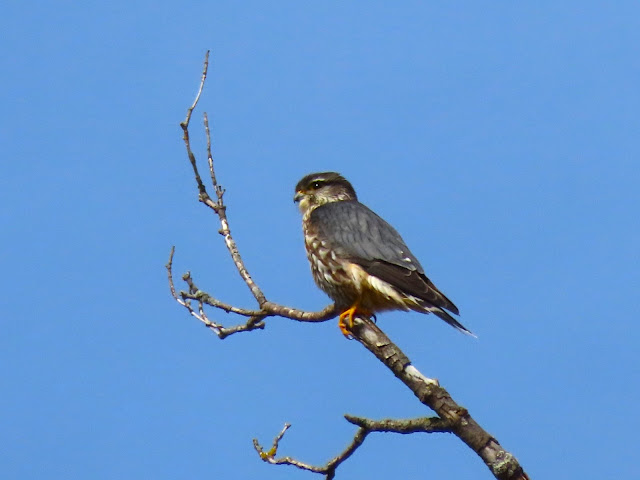

     Rarely does one have the opportunity to enjoy this spectacular little falcon for ten minutes, but this was one of those days.
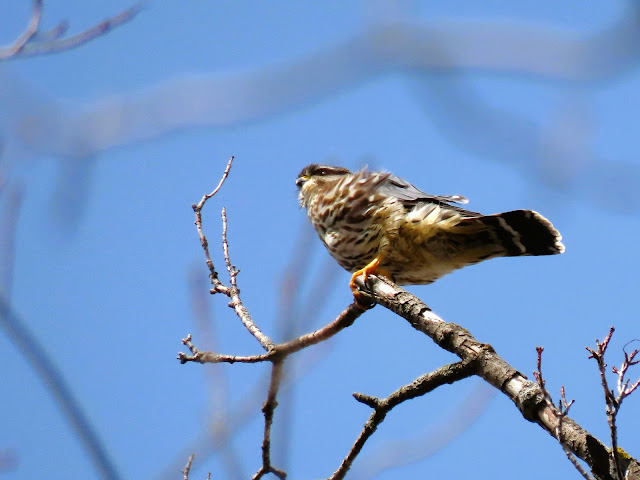

     Miriam moved stealthily towards it without causing it concern, and was at one point almost underneath the bird.
     We still had the Bald Eagle in mind, but we were already filled with elation.
     We are familiar with the general location of the eagle's nest as described by Julie, and had little trouble finding it. In fact a couple of old birding friends were already there when we arrived. 
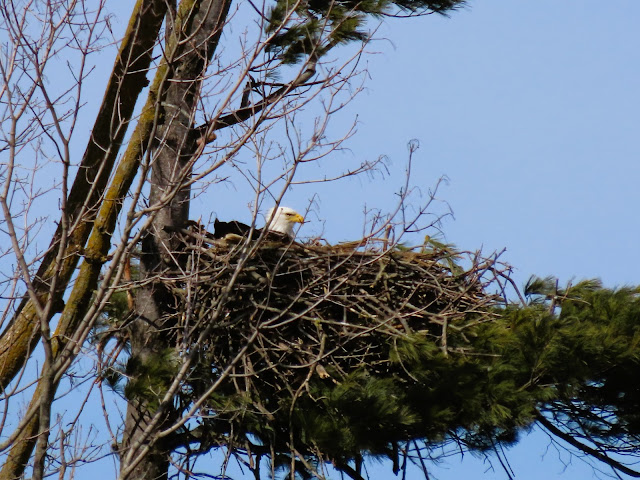

     We were advised that the eggs have now been incubated for twenty-one days. Normal incubation period for a Bald Eagle is 34 - 35 days so hatching is not too far off.
     The recovery of the Bald Eagle across the continent is a sign of hope for raptorial species that are no longer persecuted by humans. Left to their own devices they have the ability to thrive. In the process they provide incredible joy to gob-smacked humans. A Bald Eagle's nest may no longer be rare; it is no less special though.
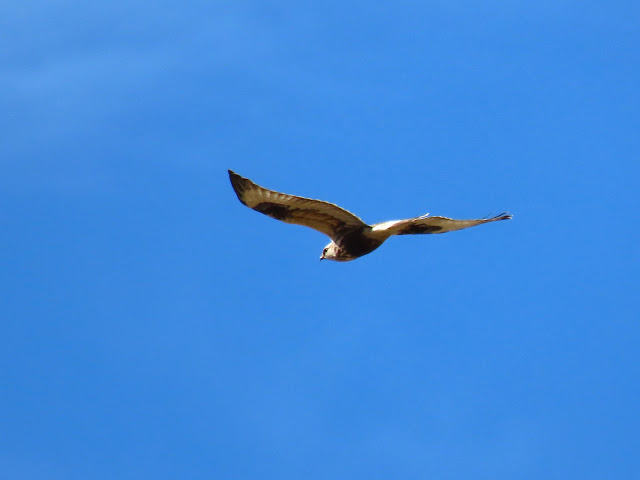
     Rough-legged Buzzards (Buteo lagopus) have for the most part left our area by now, but this individual patrolled the sky above us.

     
There were of course other birds to be enjoyed. American Robins (Turdus migratorius) seem to be everywhere, feeding together and starting to pair off in anticipation of breeding.


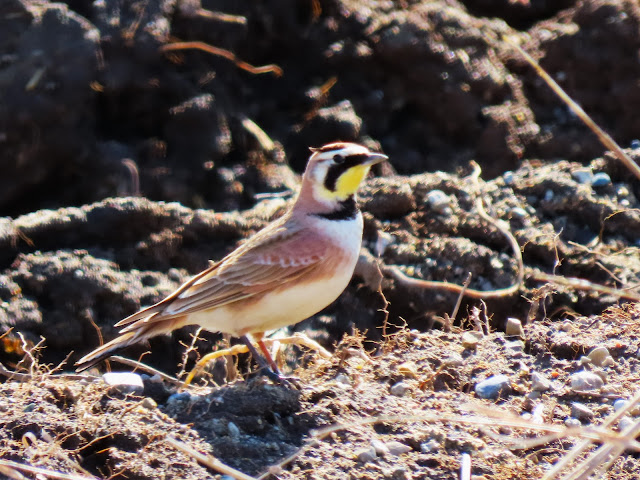
     Horned Larks (Eremophila alpestris) were not hard to find either.

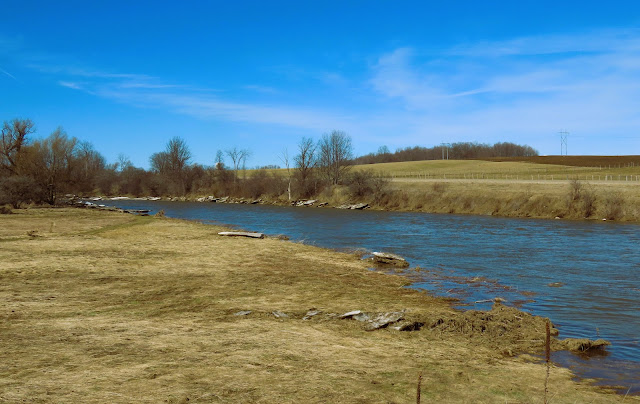
     Areas that mere days ago were still snow-covered are now bare, soon to green up as the magical transformation to spring occurs.

     Rapidly flowing streams and rivers, swollen by snow melt, carried Common Mergansers (Mergus mergansers) on the current.

Common Merganser ♂
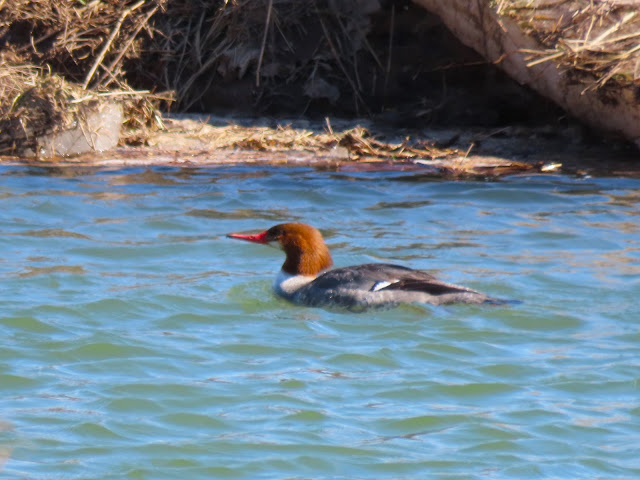
Common Merganser ♀

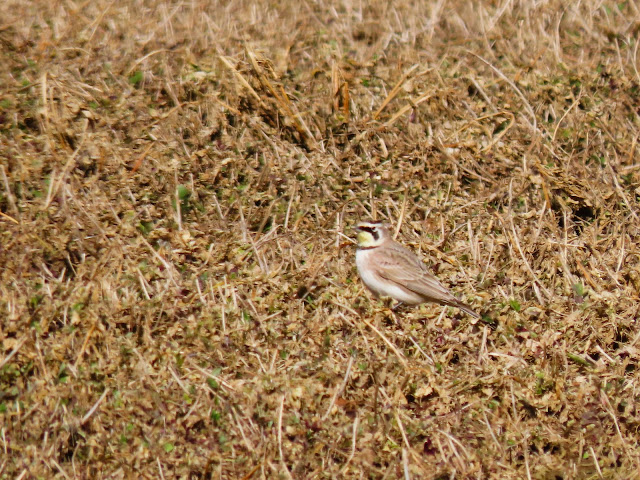
     And there were more Horned Larks.

     We circled back to take another look at the eagle's nest and this shot will give you an idea of how distant the nest is from the only convenient vantage point to see it.


     The bird on the nest had turned to face the other way. 


      Both sexes share incubation duties but the female does most of the daytime shift.
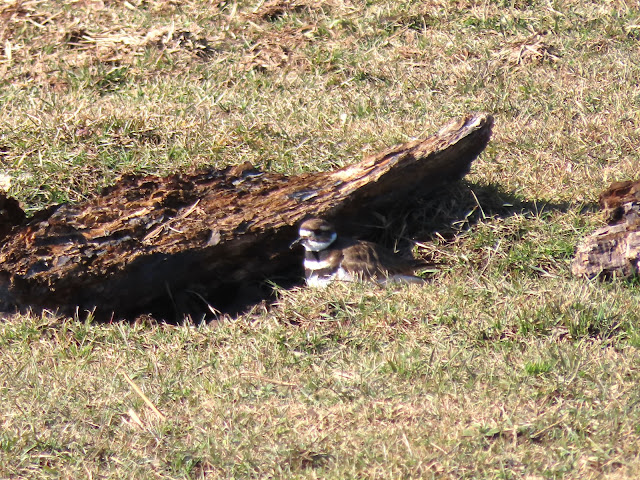
      Killdeer (Charadrius vociferus), that most delightful of plovers, scurried around sodden fields and ploughed land.

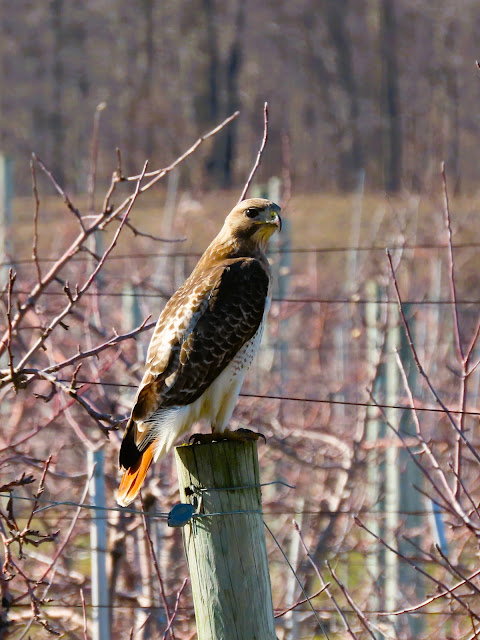
     In continuation of our good fortune with raptors we thought ourselves exalted when this handsome Red-tailed Hawk (Buteo jamaicensis) did not immediately fly off, not exhibiting the usual healthy caution hawks have for humans who throughout history have signalled death from the barrel of a gun.

     Our final raptor of the day was an American Kestrel (Falco sparverius) in an area where we have seen a pair in the past. I suspect they breed there, but I can't confirm it. This is one species that is very difficult to photograph. Almost as soon as you stop the car they fly off. 


Fairy Blogmother

     As you know, I recently had a makeover on my blog, and I am delighted with its new, clean look and greatly improved functionality. I was ably assisted in this endeavour by Linda Primmer, the Fairy Blogmother.
     Linda is kind, considerate, patient, competent, unflappable, charming, friendly and reasonable in every way. I have no hesitation in saying that if you too need a new look, don't hesitate to contact Linda with complete confidence.

www.myfairyblogmother.com
www.lifeandlinda.com

A Great Way to End the Day

     A little while after arriving home, right after dinner in fact, we watched a You Tube video of a Berlin Philharmonic performance of Beethoven's Violin Concerto with Daniel Barenboim conducting and  Yitzhak Perlman as the featured soloist. Surely this kind of music is one of the hallmarks of western civilization; a civilization one had reason to question  not so many years ago, and given what is happening in Ukraine, one cannot help but think that the veneer of civilization is precariously thin.
     There is clear irony that two unbelievably talented Jewish musicians were performing with Germany's finest orchestra, one of the greatest orchestras in the word in fact, when mere years ago they would have been dispatched to the gas chambers, or perhaps have fallen victim to the Einzatzgruppen. 
     And now, we have another Jew, desperate to save his country from the aggression of another psychopath, calling on the world for help, and watching as his cities are destroyed and people are being slaughtered or forced to flee. We have been here before. We never learn, do we?
     Better I focus on the birds and the music, on the joy they bring. It's hard not to despair for the future of humanity, however.

Friday, February 18, 2022

A Couple of Recent Walks through Snowy Woods

08 February 2022
Hillside Park, Waterloo, ON

     The first sight to greet us was a Great Blue Heron (Ardea herodias) perched stoically in a tree, weathering the storm like the rest of us.


     Most Great Blue Herons migrate at the approach of winter, but a few hardy individuals always remain, and over the past twenty years or so I have seen this species here in every month of the year. They are opportunistic feeders, and in addition to capturing prey in open water, will take waterfowl, rodents, rabbits and other mammals, anything they can capture really. As long as they are able locate food they appear to be capable of tolerating harsh weather.
     It was a snowy day in the park.

Sunday, November 21, 2021

Highlights From Here and There

      This post represents a few highlights from recent walks, and events at home, with no theme other than nature is on display!
     The Butterfly Milkweed (Asclepias tuberosa) which provided such a stunning burst of colour when in bloom, has gone to seed, but is no less spectacular.


     Mother Nature weaves her magic tapestry in many different ways.


Thursday, August 27, 2020

Another Grab Bag of the Meanderings of Miriam and David

      The realities imposed by the global pandemic are a daily feature of our lives, but by careful planning, common sense and respect for others we have been able to continue on with our lives without undue hindrance.

Forwell Park/Hillside Park, Waterloo, ON

     Often, after dinner, we go for a walk through Forwell Park to Hillside Park, and are bound to encounter other walkers and cyclists, but everyone seems to be well aware of the precautionary measures to be taken, and it is a pleasant experience all round. I don't think that we have ever encountered another birder there, but many have inquired as to what we are looking at, and a few have given us tips about birds they have seen farther along the trail. 


     Common Starlings (Sturnus vulgaris) appear to have had a successful breeding season and we frequently see large flocks with many hatch-year birds. Adults are underrated beauties in my opinion.


     A couple of Yellow-bellied Flycatchers (Empidonax flaviventris) were probably early migrants.


     This cat was handsome and very friendly but we hate to see felines wandering at large. They are fearsome predators of birds and other small wildlife, and seem to kill with abandon, their lethal pursuits bearing no relation to hunger.


     An American Robin has captured a tasty morsel or two.


     If there has been a constant component to our walks at Hillside Park this year it has been the presence of Northern Flicker (Colaptes auratus). There is ample high quality nesting habitat for them and they have had a successful breeding season based on our observations.


     I always think we pay less attention to the sky than we should, other than looking for birds above us, and Miriam rectified this shortcoming with a dramatic intersection of branch and cloud.


     The faint outline of a rising moon is no less charming.


     It is a little early for even incipient signs of fall and I suspect that this tree has been subject to stresses of one kind or another. Perhaps its root system is unduly shallow and has suffered from drought. Whatever the cause, I do not think it represents a genuine herald of autumn.


     Jerusalem Artichokes (Helianthus tuberosus) were dotted here and there, enlivening a backdrop of green.


       To the best of my recollection, and that of Miriam too, this is the first occasion when we have observed  a Grey Catbird (Dumetella carolinensis) bathing in the creek.


     On the way out of the park we noticed this handsome Swamp White Oak (Quercus bicolor), a pleasant discovery indeed. Perhaps there are others, seeded from tiny acorns, likely hidden and forgotten by squirrels; we will be sure to look.


Columbia Lake,  Waterloo, ON

     The level of the water at Columbia Lake is regulated, but for reasons not apparent to us, it seems to have fluctuated unreasonably this year. It has gone from depths where Ospreys (Pandion haliaeetus) were able to plunge dive in pursuit of fish, to conditions where we could walk across the lake  with ease. Such was the case this evening.


     These conditions are favourable to shorebirds and there were groups of Semipalmated (Calidris pusilla) and Least Sandpipers (C. minutilla) feeding on the mud and in shallow water.


     Ever skittish, they rapidly took to the air if we approached too close, only to land again 
on the mud a few metres away.


     There were several Lesser Yellowlegs (Tringa flavipes) present, often serenading us with their high, whistling call.


    A Solitary Sandpiper (Tringa solitaria) was mainly content to feed in a delicate manner, deliberately picking insects from the surface of the water. It appeared positively well mannered compared with the frenzy exhibited by the peeps all around it!


     Canada Goldenrod (Solidago canadensis) is at its peak in late August and presents a glorious sea of yellow.


     It is highly prized by pollinators of every description.


     There are many species of bumblebee seeking nectar, and I am not sure as to the exact species of the following individual.


     Mouse-ear Hawkweed (Hieracium pilosella) was ubiquitous.


     Clouded Sulphur (Colias philodice) is at its peak in southern Ontario from about mid June through mid September.


     Great Blue Heron (Ardea herodias) is among the most catholic of eaters, dining on just about anything it can swallow, and the low water level doubtless concentrated fish into shallow pools making for easy pickings.


Milverton Sewage Lagoons, Wellington County, ON

     Immediately upon arrival at the sewage lagoons we had the incredible good fortune to spot a Wilson's Phalarope (Phalaropus tricolor) among a large gathering of Lesser Yellowlegs. Actually, in all conscience we cannot lay claim to having spotted it; an old friend, Ken Dance, had arrived a little before us, and had already located the bird and pointed it out to us.


     It is a small bird - compare its size with a Lesser Yellowlegs.


     There were about a dozen or so Solitary Sandpipers present, all birds of the year making their first migration from the boreal forests to their winter quarters in South America. Their plumage is crisp and clean, not yet having endured the rigours of a year's life on the wing. The yellowish tinge to the legs is another clue that these are hatch year individuals.


     Lesser Yellowlegs was clearly the most common species and this bird was wrestling with some tasty food item hidden from view.


     Greater Yellowlegs (Tringa melanoleuca) was also in attendance, though in much lower numbers than Lesser Yellowlegs, as is usually the case.


Numerous Pectoral Sandpipers (Calidris melanotos) rounded out the contingent of shorebirds.


     It is hard to beat a Wilson's Phalarope for the "bird of the day" but a hunting Merlin (Falco columbarius) could perhaps lay claim to the honour.

     We first saw this young bird juking its way across the water in hot pursuit of a shorebird. The range of manoeuvers at mind-boggling speed was incredible, but the shorebird won the day and the falcon gave up. No doubt inexperience in the hunt played a role in the outcome; this youngster has much to learn in the honing of its survival skills.


     It perched on this snag, periodically leaving and making a circular flight, returning to the same branch.
There seemed to be no purpose to these forays that we could determine and they did not appear to reflect a bird in hunting mode.
     That all changed when it shot off the branch and returned mere seconds later with a bird in its talons.


 Success!
     It wasted no time in plucking and devouring its prey.


     It rested for a short period, perhaps to allow its food to digest, and then left the area completely.


     I would counsel those shorebirds, "Don't relax your guard. The Merlin will be back!"  
           

Land Acknowledgement

We acknowledge that the land on which we are situated are the lands traditionally used by the Haudenosaunee, Anishinaabe, and Neutral People. We also acknowledge the enduring presence and deep traditional knowledge, laws, and philosophies of the Indigenous Peoples with whom we share this land today. We are all treaty people with a responsibility to honour all our relations.

Followers