08 November, 2022
Bannister Lake Conservation Conservation Area, Ayr, ON
Bannister Lake is known as a feeding/staging area for Sandhill Cranes (Antigone canadensis), but there was neither the sound nor sight of a crane anywhere on the morning we visited.

Canada Geese (Branta canadensis) were present in good numbers, but other than that, there was not much at all. Several waves of geese came in, always a stirring spectacle.

There is still a distinct element of wildness about it when their honking penetrates the air and they make their descent to the water in an aerial ballet as old as time itself.
F. W. R. Dickson Wilderness Area, Ayr, ON

Species are moving north with a warming climate and Tufted Titmouse (Baeolophus bicolor) may be the next candidate to take up occupancy here. Three individuals greeted us as we parked the car. A single bird represents vagrancy, three might well signal territorial expansion.
The birds were quite high in the trees and on the move, and we were unable to get a picture. I am indebted to my friend, Karen von Knobloch, for permitting me to use her superb image of a titmouse from the previous day.

The Sandhill Cranes had eluded us at Bannister Lake, but we did have a couple of flocks fly over at Dickson Wilderness, their musical, resonating call permeating the crisp autumn air.

Almost from the moment we arrived we were treated to the loud "Teakettle, teakettle" chant of Carolina Wren (Thryothorus ludovicianus), but it never deigned to show itself, so here is a picture from our archives.

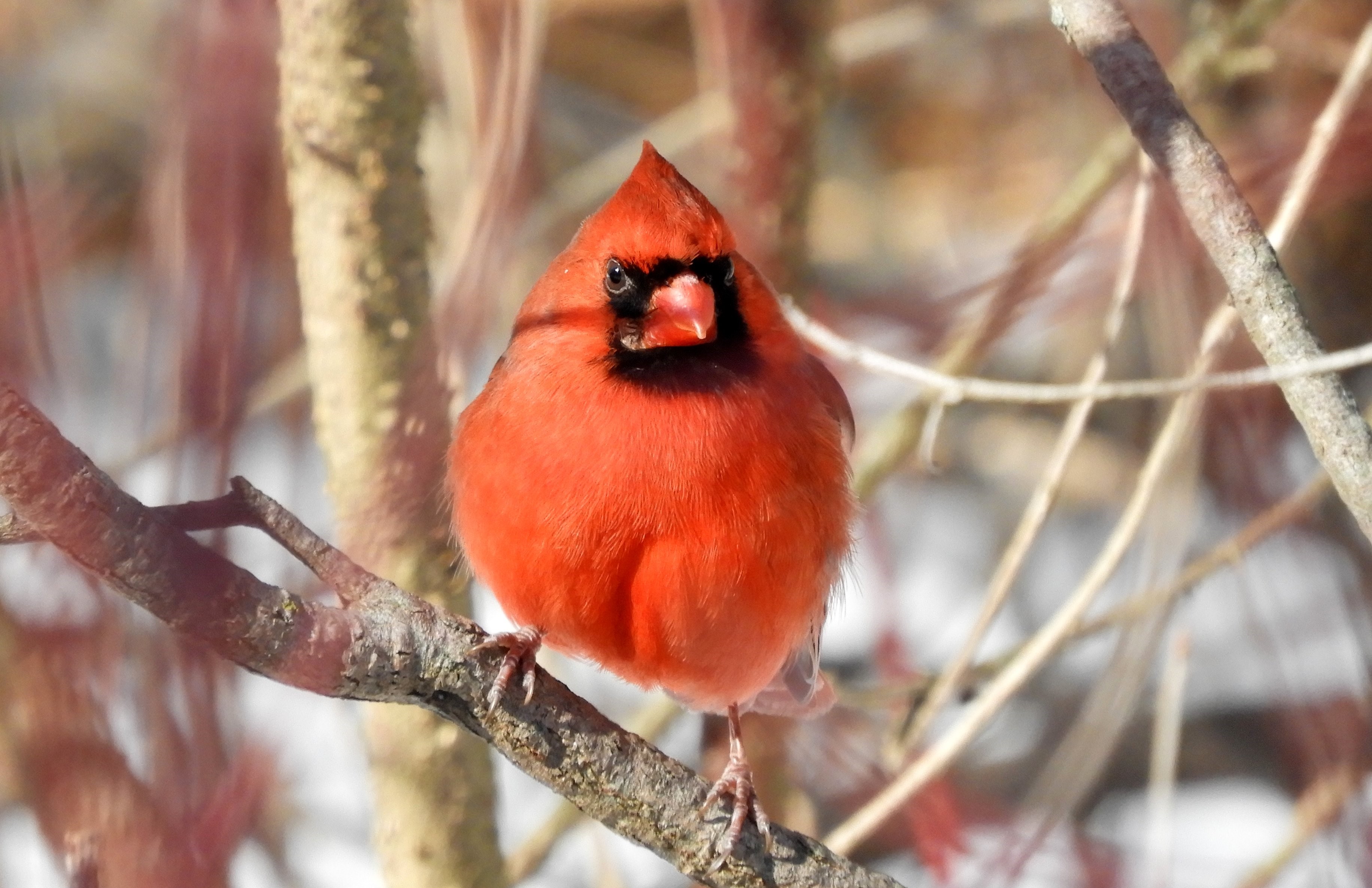
The leaves on the trees have become muted, or have fallen, and a Northern Cardinal (Cardinalis cardinalis) illuminates a branch like a torch in a catacomb.
White-breasted Nuthatch (Sitta carolinensis) was common, closeby, confiding and lovely.

The familiar strident call of Blue Jays (Cyanocitta cristata) was heard frequently.

At times their plumage positively glistened in the sun and they were not reticent about swooping down to the rail of the boardwalk where much food had been scattered by photographers.

A Bald Eagle (Haliaeetus leucocephalus) was indifferent to such blandishments and it did not pause as it cruised over to a fish-filled lake perhaps.

The wetland looks stark and dun-coloured in November, with splotches of Red Osier Dogwood (Cornus sericea) to relieve the drabness.

There is nothing drab about a Red-bellied Woodpecker (Melanerpes carolinus); of that you may be sure.

Here it is deploying its nictitating membrane to guard against damage to the eye from airborne wood chips.

A Red-breasted Nuthatch (Sitta canadensis) was determined to get a fair share of the food donated by photographers.

In reality, there was more than enough for all comers, including opportunistic squirrels.
Photographers, in their zeal for a natural look to their avian portraits, are wont to bring their own props. Here is just a sampling.

You'll have to agree that the results achieved are very agreeable.

There was no doubt in anyone's mind that the ubiquitous Black-capped Chickadees (Poecile atricapillus) were only too willing to cooperate.
We went for a pleasant stroll through the forested area beyond the boardwalk, although the birding action was left behind by doing so.

The walk was glorious, however, and it was ecouraging to see a tiny White Pine (Pinus strobus) seedling thrusting upwards to make its way in life.

Back at the boardwalk an American Tree Sparrow (Spizelloides arborea) teased us mercilessly by darting in and out of dense vegetation. Finally, however, it succumbed to the temptation of a mid-morning snack and joined the throng to dine at the rail.

I am not sure how many Red-bellied Woodpeckers were gathered around us, at least three I believe.

Had there been a hundred I would not have tired of even one of them.
There is something uniquely appealing about an Eastern Bluebird (Sialis sialia) that defies definition, but everyone feels it, and we were all transported to a plateau of delight when this male put in an appearance.

If you are not experiencing an endorphin surge just looking at the picture I think you have ice in your veins!
Cedar Waxwings (Bombycilla cedrorum) evoke the same feelings of intense joy too.

A Winterberry Holly (Ilex verticillata) provided a fine feast for a hungry frugivore.
Karen sent me this picture too of the bluebird taking advantage of the berries. As you may see, she is photographer of great skill and so kind to freely grant me permission to use her exceptional images.
.jpg)
Finally, she captured the waxwing at the moment of takeoff. Amazing work, Karen.

Downy Woodpecker (Dryobates pubescens) is our most common woodpecker, and perhaps our most endearing, and never fails to induce sentiments of sheer delight.

There were many Dark-eyed Juncos (Junco hyemalis), boldly showing off their white outer tail feathers like the miniature con trail of an aircraft - or sometimes fluffing and preening for comfort.

What a morning it had been! What joy birds bring!
Karen von Knobloch
.jpg)
If you gaze at the sky on a starry night, you will notice that there is always one star that shines brighter than the others.
Karen is that kind of star.
I met her several years ago when we were both monitoring urban Peregrine Falcons and I immediately experienced the pleasure of knowing someone for whom spite, vindictiveness, mean-spiritedness or even a casual unkind thought about another person is anathema. We lost contact during the restrictions imposed by COVID so it was with great joy that I ran into her at Dickson Wilderness Area.
Since I last saw Karen, she has been diagnosed with very serious cancer, affecting both her liver and her bones, and she is suffering greatly. Pain is a constant in her life, her mobility is impaired, and I have no doubt that dark thoughts enter her mind.
Despite all of this, she has drawn on her abiding love of nature, and her supreme ability to portray it in her pictures, to battle through it with fortitude and good spirits. No other balm would do it as well, no kind words or benevolent actions would exceed the joy of a chickadee's cheery song.
And she does not complain. She recounts the facts as they are, deals with the challenges as she must, yet all the while exudes friendship and good cheer to all who come into contact with her. One of Karen's hallmarks, at least in my experience, has been her hearty hugs. Not for her the brief bump of bodies, or an air kiss floating by a cheek, she hugs like she means it and as the recipient of many of her embraces I can vouch that it is wonderful. Her first reaction on seeing me yesterday was to bestow on me her world class hug.
The Karens of this world are all too few. I hope you have yours and that she is as precious to you as Karen is to me, and to all who know her.
I must make a point to see her soon so I get that next hug. She will never let me down.